Discovering the Enduring Legacy of Frank Lloyd Wright’s Coonley House
Stepping into a historic home is often a journey back in time, offering a glimpse into bygone eras and the lives of those who shaped them. While exploring the history of a century-old house is inherently fascinating, delving into the narrative of a 105-year-old Frank Lloyd Wright masterpiece elevates that experience from merely “interesting” to truly extraordinary. The Avery Coonley House, nestled in the picturesque suburb of Riverside, Illinois, stands as a pivotal testament to Wright’s revolutionary Prairie Style architecture and continues to captivate enthusiasts and historians alike.
The Visionaries: Avery and Queene Ferry-Coonley’s Grand Commission
The story of the Coonley House begins with its original patrons, Avery and Queene Ferry-Coonley, both prominent heirs to considerable fortunes. It was Queene Ferry-Coonley, a forward-thinking woman with a keen interest in progressive education and arts, who took the initiative to acquire the expansive 10-acre parcel in Riverside. Driven by a desire for a home that would reflect their modernist sensibilities and accommodate their progressive lifestyle, she made the groundbreaking decision to commission the then-emerging architectural genius, Frank Lloyd Wright. This choice was remarkable, especially considering that Avery Coonley was reportedly inclined towards the more conventional Georgian-Colonial style of the era. The decision to forge a path less traveled architecturally speaks volumes about Queene’s vision and her influence.
However, the naming of the estate, “The Avery Coonley House,” rather than “The Queene Coonley House,” subtly reflects the prevailing societal norms and the subordinate role often ascribed to women, even those of wealth and influence, at the turn of the 20th century. Despite her pivotal role in initiating the project and shaping its progressive vision, the public recognition often defaulted to the male head of the household. This historical detail offers a poignant reminder of the social landscape in which Wright’s architectural marvels were created.
Frank Lloyd Wright’s Prairie Style Masterpiece: An Architectural Symphony
The Coonley House is not merely a single dwelling but an expansive estate comprising several interconnected buildings, originally spanning over 9,000 square feet. Completed in 1908, it stands as one of Wright’s most significant examples of the Prairie Style, an architectural movement he pioneered. This style sought to create structures that harmonized with the expansive, flat landscapes of the American Midwest, emphasizing strong horizontal lines, low-pitched roofs, and deep overhangs that echo the prairie horizon.
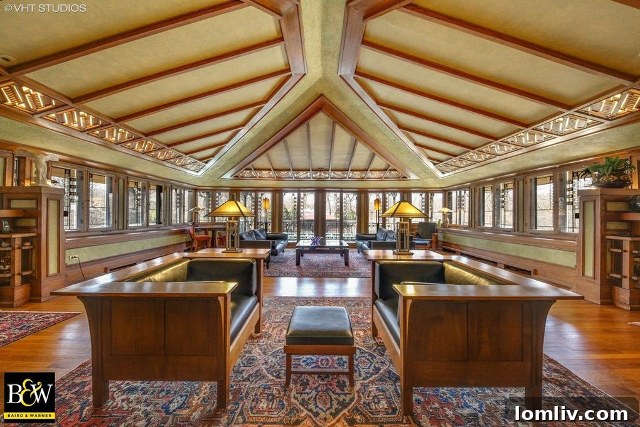
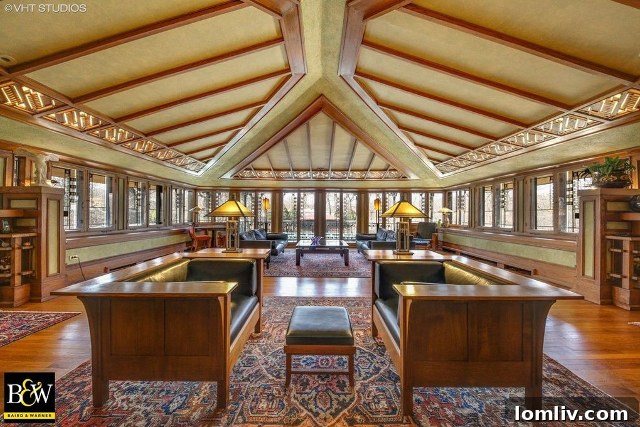
Wright’s design philosophy for the Coonley House was deeply rooted in creating an organic architecture, where the building felt intrinsically linked to its natural surroundings. The estate’s layout features a complex interplay of wings and courtyards, each meticulously designed to capture light, air, and views, fostering an unparalleled connection between interior and exterior spaces. Inside, the open floor plans flow seamlessly, promoting a sense of spaciousness and encouraging social interaction, a radical departure from the compartmentalized homes of the Victorian era. The interior finishes, including custom-designed furniture, art glass windows, and natural wood accents, all contribute to a cohesive and immersive aesthetic experience, typical of Wright’s holistic approach to design. The famous “Tapestry Window” in the Coonley House, with its abstract geometric patterns, is a prime example of Wright’s innovative use of light and color, transforming mere windows into works of art that define the internal atmosphere.
Beyond the main residence, the estate originally included a gardener’s cottage, a stable, and a playhouse, all designed with the same rigorous adherence to Prairie Style principles. This comprehensive approach ensured that every structure on the property contributed to a unified architectural vision, making the Coonley estate a miniature utopian community embodying Wright’s ideals of functional beauty and harmonious living.
A Century of Change: The Subdivision and its Impact
The mid-20th century brought significant challenges to the integrity of this architectural gem. By 1952, the entire property found itself directly in the crosshairs of developer Arnold Skow, who envisioned demolishing the grand estate to make way for a more lucrative development of 14 ranch homes. This scenario, unfortunately common for many historic properties, sparked a fervent debate over preservation versus progress.
Fortunately, a compromise was eventually reached that, while altering the original vision, prevented the complete destruction of the main residence. The primary structure was controversially split in half by a massive firewall, essentially creating two distinct homes from one unified design. The outlying structures—the gardener’s cottage, stable, and playhouse—were also sold off as separate residences. This drastic measure, though painful to architectural purists, served as a reluctant safeguard, preserving significant portions of Wright’s original work. The resulting ranch homes, built on the periphery of the once vast estate, stand in stark contrast to Wright’s brilliance. They possess all the architectural majesty of a contemporary fast-food restaurant compared to a grand palace, serving as a powerful visual testament to the irreplaceable value of original, visionary design.
The Enduring Appeal: A Piece of History on the Market
Despite the subdivision and the passage of time, the Avery Coonley House remains an object of intense architectural interest and historical significance. The separate portions of the estate have occasionally come onto the market, offering unique opportunities for individuals to own and cherish a tangible piece of American architectural history. Owning a part of the Coonley House is more than just acquiring property; it is embracing a legacy, becoming a steward of an iconic design that profoundly influenced modern architecture.
Currently, certain original components of Wright’s sprawling Coonley compound periodically become available for purchase. These rare opportunities allow prospective buyers to immerse themselves in the world of Frank Lloyd Wright, experiencing firsthand the innovative layouts, the meticulous craftsmanship, and the profound connection to nature that define his work. Each segment, whether a half of the main house or one of the ancillary buildings, retains elements of Wright’s genius, showcasing his revolutionary approach to domestic architecture.
For those passionate about architectural heritage and distinctive living spaces, exploring these listings presents a chance not just to buy a home, but to invest in a living piece of art. These properties offer an unparalleled glimpse into a pivotal moment in design history, providing a residence that is both profoundly beautiful and historically rich. To discover more about these extraordinary properties and perhaps even consider becoming the next custodian of Wright’s legacy, exploring current real estate listings for the Coonley House is a must.
The Frank Lloyd Wright Coonley House, in its fragmented but enduring state, continues to inspire and educate. It stands as a powerful reminder of architectural innovation, the complexities of historic preservation, and the timeless beauty of a design that dared to break convention and redefine what a home could be. Its story is a vibrant chapter in the annals of American architecture, inviting all to appreciate its grandeur and its indelible mark on the landscape of design.