By Lydia Blair
Special Contributor
Navigating Your Final Mortgage Payment When Selling Your Home: What to Do Before Closing
Selling a home is an exciting, yet often intricate process, filled with various financial considerations and important deadlines. One of the most frequently asked questions that arises during this transitional period, particularly for those closing mid-month, is: “Should I make my next mortgage payment before my house closes?” This common dilemma can cause unnecessary stress for sellers, who are eager to finalize their sale without incurring unexpected fees or impacting their credit.
The answer to this seemingly straightforward question is, in fact, nuanced and largely depends on a few critical factors, primarily your specific closing date and the exact timing of the transaction. Understanding the mortgage payoff process, the implications of your closing schedule, and the expert advice available can help you make an informed decision and ensure a smooth closing experience.
The Mortgage Payoff Process Explained: A Title Company’s Role
The cornerstone of a seamless real estate transaction when selling your home lies in the meticulous work of the title company or escrow agent. Their primary responsibility is to ensure that the property title is clear and transferable to the new buyer. A crucial step in this process is handling your existing mortgage obligation.
Before your closing date, the title company will proactively request a comprehensive “payoff statement” from your current mortgage lender. This vital document details the exact amount required to fully satisfy your existing loan, extinguishing all claims the lender has on your property. The payoff statement isn’t just your principal balance; it’s a dynamic figure that includes:
- The remaining principal balance on your loan.
- Accrued interest calculated up to a specific date (usually the day after closing to account for potential delays).
- Any outstanding late fees or penalties.
- Prepayment penalties, if applicable (though less common in conventional mortgages today).
- Release fees that the lender charges to formally remove the lien from your property records.
Once this precise payoff amount is confirmed and calculated, it is then deducted directly from your proceeds at closing. The title company is responsible for wiring this exact sum to your mortgage lender, ensuring that upon the successful conclusion of the sale, your property is free and clear of the previous mortgage lien. This entire mechanism is designed to protect both the seller and the buyer, guaranteeing a clean transfer of ownership.
Understanding Your Closing Date and Payment Deadlines
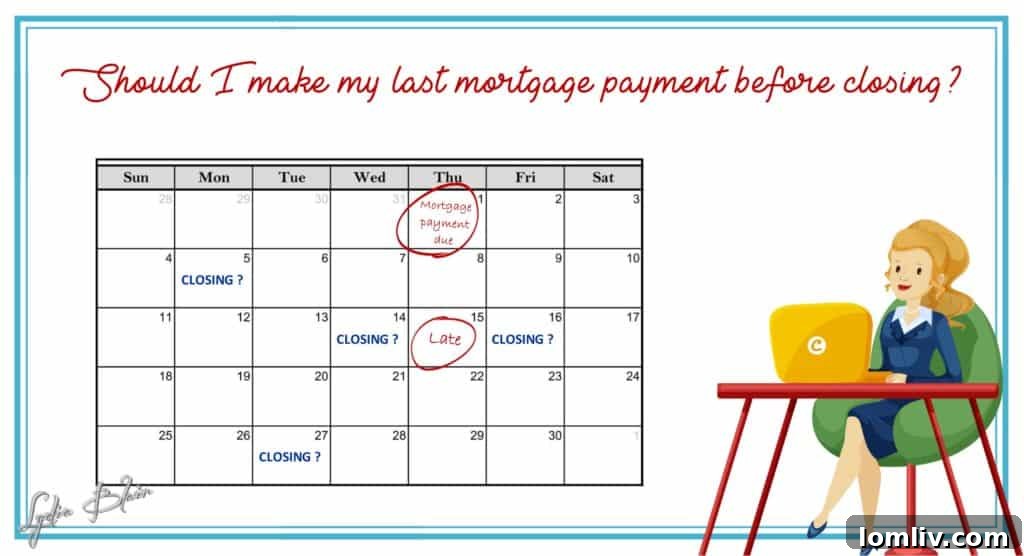
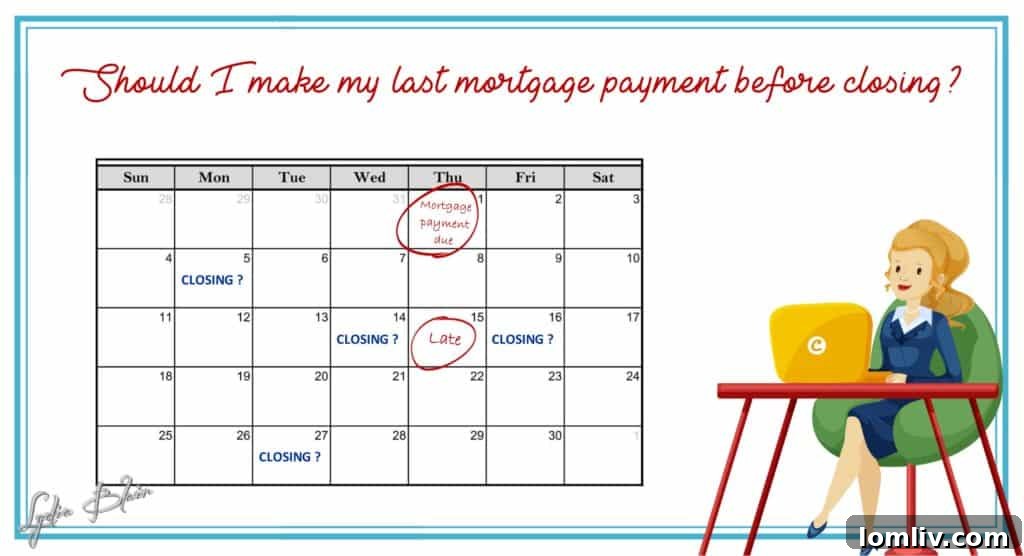
For most homeowners, mortgage payments are typically due on the first day of each month. Lenders usually provide a grace period, meaning the payment is not considered officially “late” until after a specific date, often the 15th of the month. This grace period is where the common question about making a payment before closing becomes particularly relevant and can create a complicated situation for sellers.
Let’s consider a scenario where your closing is scheduled for the 14th of the month. If your mortgage payment for that month is due on the 1st and considered late after the 15th, you’re in a tight window. While in a perfect world, the closing funds would be disbursed and your mortgage paid off immediately, real estate transactions, while meticulously planned, can sometimes encounter unforeseen delays. For instance:
- One or both parties might be signing documents in the afternoon, pushing back the funding timeline.
- The buyer’s lender may require additional review time for documents, delaying fund approval.
- Wiring deadlines at banks and mortgage companies mean that if funds aren’t received by a certain time (e.g., 3 PM EST), the payoff might not be processed until the next business day.
Because of these potential hurdles, many title companies strategically schedule the mortgage payoff amount to account for interest accrued up to the day *after* the scheduled closing date. This practice serves as a safety net, protecting sellers from incurring late fees if the closing is delayed by a day or if the final wiring of funds takes longer than anticipated. If the payoff is not received by your lender before your grace period expires (typically the 15th), even by a mere few hours, you could inadvertently incur a late fee. This highlights the importance of precise timing and clear communication throughout the closing process.
To Pay or Not to Pay? Expert Advice on Your Final Mortgage Payment
Given the complexities surrounding closing dates and payment deadlines, the central question of whether to make that final mortgage payment remains. Fortunately, insights from industry professionals can provide clarity and guidance.
According to Michael Fooshee, a Senior Loan Officer at Verity Mortgage, if you haven’t yet made your payment for the current month and your closing is scheduled for, say, the 14th, the payoff figure already calculated by the title company typically includes the interest due for the entire month. “My advice would be if you have not made your payment for the month and you are closing on the 14th then your payoff with title already includes the interest due for November. So it is ok to not make the payment even up till the end of the month as long as the loan funds in November and the payoff is wired to the lender,” Fooshee explains.
This means that in many scenarios, the funds transferred by the title company at closing will cover all outstanding interest and principal, negating the need for you to make that monthly payment yourself. Essentially, you are only responsible for the interest on the days you actually own the home, up to the day of closing.
However, Fooshee also issues a vital warning: while this approach often works seamlessly, there are risks. You could still be charged a late fee if the final payoff amount received by the lender is less than the total due, or if the payoff arrives after the official due date (usually the 15th of the month). It’s crucial to understand that while late fees can be an annoyance, the impact on your credit score is usually less immediate. “But your credit should not be affected unless the full payoff or payment wasn’t received by the lender by the last day of the month,” Fooshee adds. This provides a slightly larger window before serious credit implications arise, offering some relief but not an excuse for negligence.
For those who prefer absolute certainty and peace of mind, Fooshee offers practical advice: “If you are faint of heart, then I would recommend to go ahead and pay the monthly payment.” While this might mean temporarily parting with funds you could otherwise keep, it completely eliminates the anxiety of potential late fees or credit concerns. It’s a personal decision based on your comfort level with financial risk.
What Happens to Overpayments and Your Escrow Account?
One of the primary concerns for sellers who choose to make their final mortgage payment, even if their closing is imminent, is the fear of overpaying. The good news is that safeguards are in place to ensure you are only charged for the days you actually owned the property.
Should you opt to make the monthly payment and your closing concludes successfully before the due date, any overpaid principal or interest will be promptly refunded to you. “Any over payment made will be reimbursed to you,” confirms Fooshee. This refund process usually occurs automatically once the lender processes the final payoff from the title company and reconciles your account. It might take a few days or even a week, but the money will find its way back to you.
Another common question revolves around the escrow account. If you’ve been diligently paying into an escrow account for property taxes and homeowner’s insurance premiums as part of your monthly mortgage payment, you’re likely to have a positive balance when you sell your home. “Also, if you have a positive escrow balance, then you will receive a refund typically 2 to 3 weeks after the loan is paid off,” Fooshee explains.
The delay in receiving your escrow refund is normal. After your mortgage is paid off, the lender needs time to perform a final audit of your escrow account. They ensure all outstanding obligations, such as property taxes or insurance premiums for the period you owned the home, are settled. Once this reconciliation is complete and they confirm a surplus, they will issue a refund check directly to you. It’s important to remember that this escrow refund is separate from any overpayment of principal and interest and will be sent independently after the necessary administrative processes are finalized.
Mitigating Risks and Ensuring a Smooth Closing
To navigate your final mortgage payment and overall closing process with confidence, proactive communication and careful review are paramount. Here are some best practices to consider:
- Communicate with Your Title Company: This is your primary resource. Don’t hesitate to ask your title officer directly about their policy regarding the final mortgage payment. Confirm the exact payoff amount they received from your lender and the date it was calculated for. They can provide specific guidance tailored to your closing schedule.
- Consult Your Lender: While the title company handles the payoff, speaking with your current mortgage lender can offer additional reassurance. Ask them about their specific late payment policies and how they handle payoffs received mid-month.
- Review Your Closing Disclosure (CD): This critical document, provided a few days before closing, outlines all financial aspects of your transaction, including the exact mortgage payoff amount. Scrutinize it carefully to ensure all figures are correct and match your expectations. If you notice any discrepancies, raise them immediately.
- Have a Financial Buffer: Even with careful planning, unexpected delays can occur. Having a small financial buffer can alleviate stress if you need to make an emergency payment or cover a minor, unforeseen expense related to closing.
- Understand Prorations: Remember that property taxes, HOA dues, and other charges are often prorated at closing. This means you will pay for the days you owned the home in the current period, and the buyer will assume responsibility from the closing date onward.
Ultimately, the core principle is simple: you must pay for every day that you own your property, and you will not pay for the days that you no longer own it. Whether you make that last payment or allow the title company to handle it through the payoff, the financial outcome should be the same in the long run. If you overpay, you’ll get your money back. If you don’t make that last mortgage payment, you should generally be okay – as long as everything goes as planned and your title company executes the payoff promptly.
Key Takeaways for Your Home Sale
Deciding whether to make your final mortgage payment before closing can feel like a high-stakes gamble, but with the right information, it becomes a manageable decision. Here’s a summary of the key points to remember:
- It Depends on Timing: Your closing date and time are the most critical factors. If closing occurs early in the month, before your mortgage payment is officially late, you may not need to make it.
- Trust the Payoff: The title company will obtain an accurate payoff amount from your lender, which accounts for all accrued interest up to the date of closing (often a day beyond for safety).
- Risk of Late Fees: While rare if the process goes smoothly, a delay in the payoff reaching your lender past the 15th can incur a late fee.
- Credit Impact is Later: Your credit score is typically not affected unless the full payoff isn’t received by the last day of the month, offering a slightly larger buffer.
- Overpayments are Refunded: If you choose to make the payment and it turns out to be an overpayment, the excess funds will be reimbursed to you.
- Escrow Refunds Separately: Any positive balance in your escrow account will be refunded, usually within 2-3 weeks after your loan is paid off and the account is reconciled.
- Communicate Proactively: Always consult with your title officer and mortgage lender for specific advice related to your unique situation. They are your best resources for clarity.
- Peace of Mind Option: If uncertainty causes you stress, making the payment is a valid option, as any overpayment will be returned.
While the general guidance suggests you might not need to make that final payment if closing is early in the month, individual circumstances vary. Always prioritize clear communication with your real estate professionals and review all closing documents thoroughly to ensure a stress-free and financially sound home sale.
About Our Special Contributor, Lydia Blair
Lydia Blair (formerly Lydia Player) brings a wealth of experience and a unique perspective to the world of real estate. Prior to her distinguished tenure as an Escrow Officer for Carlisle Title since 2015, Lydia spent a decade as a highly successful Realtor. Her journey in real estate began even earlier, where she skillfully bought, remodeled, and sold homes – an endeavor she passionately pursued long before the term “house flipping” entered common parlance. With countless real estate closing processes under her belt, experienced as a buyer, a seller, and a Realtor, Lydia’s transition to the title side of the business was a natural progression. She excels at solving complex problems, adeptly navigating through bureaucracy, and finds immense satisfaction in the pivotal moments of her job: handing over keys to excited new homeowners or checks to satisfied sellers.
The opinions expressed are of the individual author for informational purposes only and not for the purpose of providing legal advice. Contact an attorney, accountant or mortgage officer to obtain advice for any particular issue or problem.