The contentious debate surrounding the reduction of Dallas’ minimum lot size requirements to foster greater residential density remains far from resolution. A recent special meeting of the Dallas City Council’s Housing and Homelessness Solutions Committee saw a significant turnout of residents and elected officials, many of whom voiced strong opposition to the proposed changes. This ongoing discussion highlights a deep divide within the city over how best to address Dallas’ evolving housing landscape and future growth.
District 7 Councilman Adam Bazaldua, a vocal proponent of reducing minimum lot sizes, characterized the gathering as a “dog and pony show,” largely orchestrated by the “Not in My Backyard” (NIMBY) contingent. His comments underscore the passionate, often confrontational, nature of the dialogue surrounding housing policy in Dallas.
For a comprehensive analysis of the arguments both for and against amending Dallas’ minimum lot size regulations, daltxrealestate.com provided an in-depth report on December 14, exploring whether such reforms represent a neighborhood nightmare or a crucial step towards achieving affordable housing dreams.
https://daltxrealestate.com/2023/12/14/reducing-minimum-lot-size-neighborhood-nightmare-or-affordable-housing-dream-come-true/
During the committee meeting, District 14 resident Melanie Vanlandingham, among others, passionately urged the committee to prioritize the protection of established neighborhoods. She emphasized the importance of a nuanced approach, advocating for careful consideration of specific areas where increased density could be beneficial, rather than implementing a city-wide development code alteration that would impact every neighborhood indiscriminately.
“Don’t gloss over the study results,” Vanlandingham urged the committee, referencing a key piece of research often cited in these discussions. “The Houston study showed that 80 percent of the new housing was already zoned for commercial or industrial. That’s why they didn’t impact existing neighborhoods. That’s why they didn’t displace residents. Look deeper. Try your experiment on those large swaths of extremely low-density commercial and industrial properties and large tracts of vacant land, like those along the Stemmons Corridor, for instance, close to hospitals and work centers.” Her argument suggests that strategically targeting underutilized commercial or industrial zones could provide housing solutions without disrupting existing residential communities or exacerbating displacement concerns.
More Than a Proposal: Framing the ‘Conversation’ on Dallas Housing
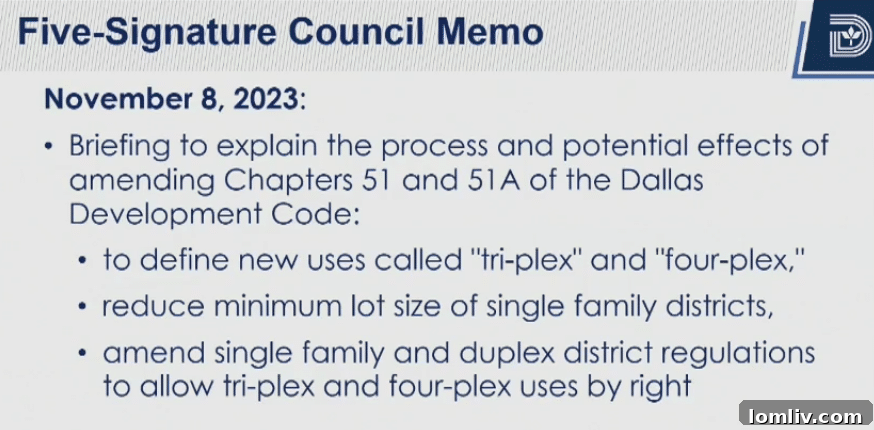
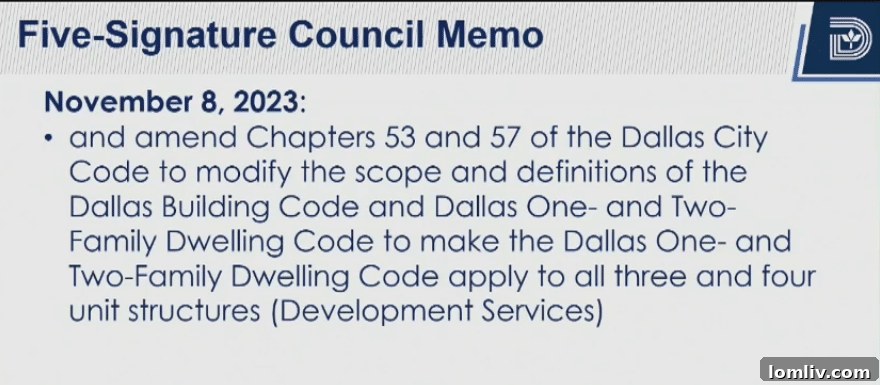
Interim Planning and Urban Design Director Andrea Gilles sought to temper the heated discussion, emphasizing that the briefing was merely “just a conversation.” This dialogue, she explained, was initiated by a memorandum spearheaded by District 1 Councilman Chad West and supported by four other Dallas City Council members, aimed at exploring potential solutions to the city’s housing challenges.

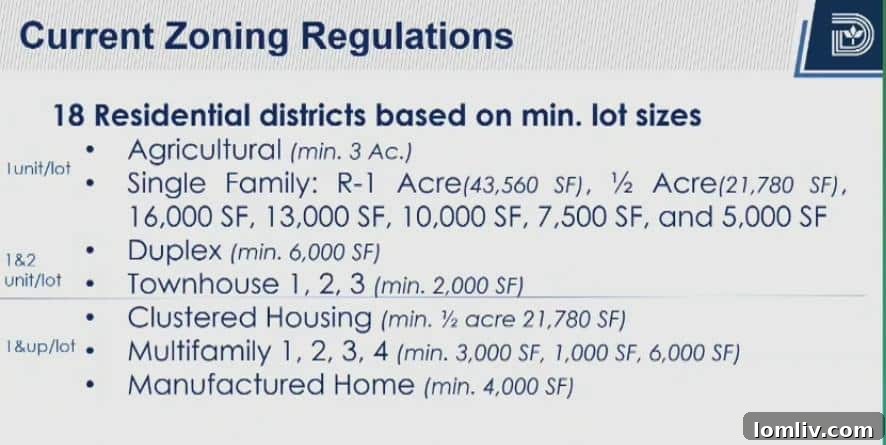
Gilles acknowledged the critical importance of being sensitive to the unique location, context, and design considerations for any new housing typologies introduced into Dallas neighborhoods. She clarified a common misconception, stating, “There is no proposal on the table. I know it’s come up a lot about affordable housing. Really in this conversation, we’re talking about different housing types at different price points, not affordable housing per se.” This distinction is crucial, as the discussion encompasses a broader spectrum of housing needs beyond strictly subsidized units, aiming to increase overall housing availability across various income levels.
Further elaborating on the city’s approach, Assistant Planning Director Andreea Udrea underscored that any proposed modifications to the development code concerning housing must inherently incorporate context-sensitive design standards. This commitment aims to ensure that new developments integrate harmoniously with existing neighborhood aesthetics and character, mitigating concerns about undesirable or incompatible construction.
Towards the conclusion of the lively meeting, six residents stepped forward to articulate their support for policies that would permit a greater number of homes on the same amount of land. Among them was Elizabeth Markowitz, who shared her personal experience of raising her son in an apartment, noting that Dallas’ historically large minimum lot sizes effectively price out many middle-income earners from homeownership. She highlighted a broader national sentiment, stating, “This is something that is supported by the majority of Americans.”
Markowitz further reinforced her arguments with empirical data, asserting, “From data out of Houston, we know that reforming our minimum lot size requirements works to lower the price of housing. It also works to reduce the displacement of Black and Latino residents.” Her testimony suggests that such reforms could not only expand access to homeownership for diverse populations but also serve as a tool for economic equity and community stabilization, challenging the notion that increased density inherently leads to displacement.
Dallas City Council: Diverse Stances on Minimum Lot Size Requirements
The Dallas City Council members weighed in on Wednesday, just days before Christmas, on the critical issue of potentially allowing multifamily units in areas traditionally zoned for single-family homes. Not all council members serve on the Housing and Homelessness Solutions (HHS) Committee, which meant some members were directly participating in the committee discussion while others were making their broader positions known. The comments below represent a distilled portion of the extensive three-hour meeting, which can be viewed in its entirety here. Their perspectives illustrate the complex political and social landscape surrounding this pivotal housing policy.
District 1: Chad West – Advocate for Housing Options
Councilman West’s stance on minimum lot size reductions is well-documented, as he has consistently advocated for policies that increase housing affordability and accessibility. He was unable to attend Wednesday’s meeting due to a pre-scheduled family vacation but expressed gratitude to the residents who participated, particularly those who supported the principle that “every Dallasite should have a realistic opportunity to become a homeowner in a community that works best for their family.” West firmly believes that current zoning regulations contribute to an exclusionary housing market. He articulated his motivation by stating, “Families like mine will be fine no matter what, but I can’t sit idly by as working families who have called Oak Cliff and Dallas home for generations feel priced out of their long-standing neighborhoods.” He concluded with a stark warning: “If we don’t increase supply, we all know who will be the ones to be priced out by a city that couldn’t do the right thing.” West sees the reduction of minimum lot sizes as a crucial mechanism to boost housing supply, stabilize communities, and prevent further economic displacement.
District 2: Jesse Moreno – Championing Neighborhood Self-Determination
As chair of the Housing and Homeless Solutions Committee, Jesse Moreno conveyed a cautious perspective, stating that allowing multifamily development “by right” in single-family neighborhoods constitutes “a big red flag for me and a non-starter.” Moreno is a strong advocate for “neighborhood self-determination,” emphasizing that while he supports increased density and more people living in Dallas, it must be implemented in “the appropriate place.” He firmly rejected a “blanket approach” that would uniformly apply changes across the city, arguing for tailored solutions that respect existing community character. Speculation arose that Moreno might have strategically timed and structured the meeting to allow opponents of lot size reduction to speak first, thereby setting a particular tone. Moreno defended his actions, explaining that the meeting’s timing was necessitated by strict deadlines established in the five-signature memorandum and a mayoral directive requiring the HHS Committee to address the matter within a fixed timeframe, ensuring that the process moved forward as mandated.
District 3: Zarin Gracey – Calling for Improved Communication
Councilman Zarin Gracey highlighted a critical issue often present in urban planning discussions: the need for better communication between city staff, council members, and residents. He acknowledged the undeniable reality that “Dallas has a housing problem,” and expressed an open mind toward “smart solutions.” However, Gracey voiced a consistent frustration, particularly prevalent in Southern Dallas: “Sometimes when these smart solutions come forward, though they make perfect sense logically, the things we’ve been asking for get overshadowed, and that is a consistent frustration.” His comments suggest that while broad policy changes may seem logical on paper, their implementation must also align with and address the specific, long-standing needs and requests of individual communities, particularly those historically underserved.
District 4: Carolyn King Arnold – Defending Single-Family Character
Councilwoman Carolyn King Arnold staunchly expressed her unwillingness to support any proposal that she believed would threaten the integrity of single-family zoning. She argued that while such a plan might be suitable for entirely new, undeveloped communities, it would be detrimental to established neighborhoods. Arnold asserted that residents in her district are not requesting “duplexes and triplexes in single-family zoning.” Instead, she conveyed their desire for traditional homeownership where “their children can grow up in the house, play in the backyard and live what we would call a normal life where you can engage with neighbors.” Her position underscores a deep commitment to preserving the existing suburban character and lifestyle that many residents associate with their neighborhoods.
District 5: Jaime Resendez – Supporting the Conversation’s Genesis
Although Councilman Jaime Resendez was not present at Wednesday’s HHS meeting, his participation was crucial in initiating the conversation. He was one of the signatories of the memorandum that formally requested the discussion on minimum lot sizes, indicating his support for exploring potential reforms and addressing the city’s housing challenges through policy examination.
District 6: Omar Narvaez – Silence on the Issue
Councilman Omar Narvaez was also absent from the Wednesday meeting and has not publicly issued a statement regarding his position on the minimum lot size debate. His silence leaves his stance on this complex and highly debated issue open to interpretation by his constituents and fellow council members.
District 7: Adam Bazaldua – Challenging the NIMBY Narrative
Councilman Adam Bazaldua, a fervent advocate for density, offered a personal anecdote to challenge prevailing notions about family living, sharing that he grew up in a duplex, played in a yard near a single-family neighborhood, and did not perceive his childhood as abnormal. He sharply criticized the tone of the meeting, stating, “The NIMBY tone of this meeting is just out of the roof. This is clearly an attempt to stifle the democratic process that we have in our city.” Bazaldua also refuted the portrayal of the discussion as a staff-driven proposal, clarifying, “This was five colleagues using a mechanism that was given to us as council members so that we could start a conversation.” He emphasized that city staff are diligently working to modernize Dallas’ “antiquated zoning” framework, suggesting that resistance to these conversations hinders essential progress.
District 8: Tennell Atkins – Process Over Policy Concerns
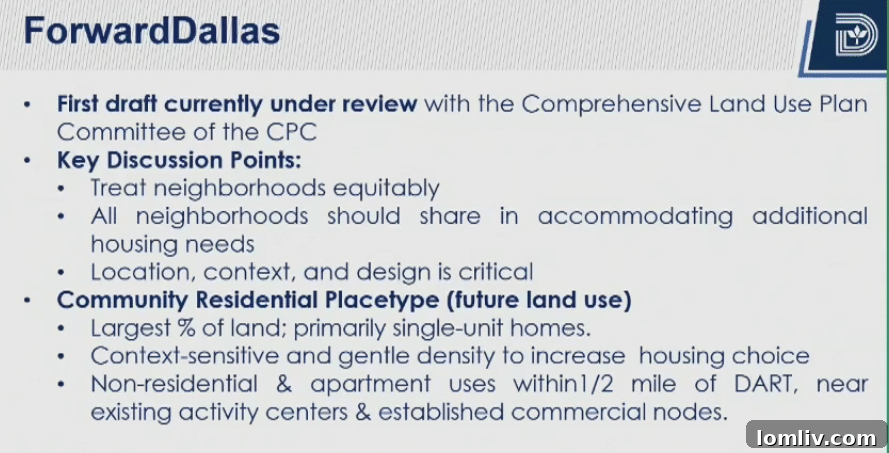
Councilman Tennell Atkins expressed significant reservations regarding the process and procedure surrounding the minimum lot size discussion. He indicated that residents in District 8 are largely against increased density in single-family neighborhoods. Atkins used the idiom, “I think right now we are getting the cart before the horse,” suggesting that this specific issue was being rushed ahead of broader, foundational planning efforts. He pointed out the long-standing “ForwardDallas” comprehensive land use plan, initiated in 2006, noting that the minimum lot size subject seemed to emerge abruptly, creating the impression that it was being “shove[d] this way in front of the cart right now.” He directly questioned Interim Planning Director Andrea Gilles about whether the minimum lot size issue was solely about affordable housing. Gilles reiterated her earlier clarification: “This is not about affordable housing. This is about housing options,” underscoring a broader goal of diversifying housing types and price points within the city.
District 9: Paula Blackmon – Key Memorandum Signatory
Councilwoman Paula Blackmon, similar to Councilman Resendez, was not present at Wednesday’s HHS meeting but was a crucial signatory of the memorandum that initiated the entire conversation. Her endorsement signifies her support for exploring potential reforms to Dallas’ minimum lot size requirements as part of a larger strategy to address the city’s housing challenges and promote urban development.
District 10: Kathy Stewart – Observing Natural Density Growth

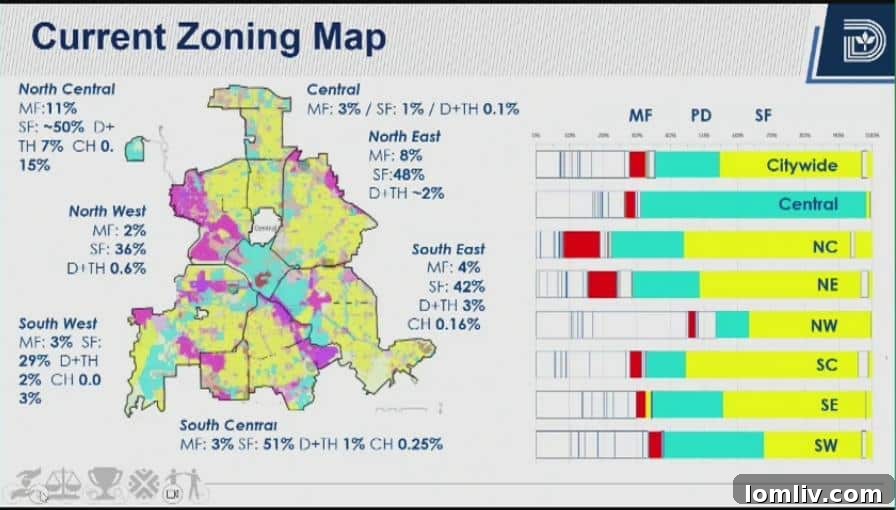
Councilwoman Kathy Stewart offered a unique perspective, observing that high-density development is already occurring “naturally” within District 10 due to existing market demand. She believed her constituents would offer a resounding “No thank you” to the idea of imposing duplexes and triplexes in their single-family neighborhoods. Stewart elaborated on her observations: “We are creating density just by the market demand. When a shopping center is torn down, townhomes are going in and when an old historical home on Greenville is finally torn down, David Weekley goes in and puts in zero-lot-line homes. Density is just happening naturally. When there is an opportunity, there is a market for these more dense developments, and those are happening.” Her argument suggests that market forces are already driving increased density in strategic locations, potentially reducing the need for city-wide zoning mandates and allowing for more organic, demand-driven growth.
District 11: Jaynie Schultz – Supporting the Dialogue
Councilwoman Jaynie Schultz, though absent from the HHS meeting on Wednesday, played a role in bringing the minimum lot size discussion to the forefront. As another signatory of the originating memorandum, her involvement underscores a commitment to examining diverse housing solutions for Dallas and engaging in critical policy conversations.
District 12: Cara Mendelsohn – Firm Opposition to Increased Density
Councilwoman Cara Mendelsohn has consistently voiced strong opposition to minimum lot size reductions, stating that her constituents overwhelmingly do not desire greater density in their single-family neighborhoods. She critically addressed the concept of “context-sensitive design,” noting, “The idea that you’re saying ‘context-sensitive means that it looks like a house’ is a very Dallas thing to say, that it’s about the appearance of it.” Mendelsohn argued that residents’ concerns run deeper than mere aesthetics: “I don’t think they care as much about the appearance of it as they don’t actually want to have multifamily — no matter what it looks like — in an established single-family neighborhood.” Her comments highlight a fundamental resistance among her constituents to any form of multifamily housing encroaching on traditionally single-family areas, regardless of architectural design.
District 13: Gay Donnell Willis – Advocating for Missing-Middle Housing

Councilwoman Gay Donnell Willis emphasized the urgent need for a variety of housing options, specifically highlighting duplexes, triplexes, and “missing-middle housing” types. She articulated a strong belief in the necessity of these options, stating, “We need all of that. It’s missing. We desperately need this, and I hear this from people who live in single-family neighborhoods. Of course, we need to have the conversation. We’re the ninth largest city in America.” Willis also raised concerns about the perceived imbalance in public feedback during the initial part of the meeting, noting that speakers who appeared early largely opposed higher density. “It seemed a little one-sided,” she commented, advocating for a more comprehensive and balanced public dialogue: “I think there are some who might be speaking on behalf of other housing options that should be heard if I am to feel that this is a transparent, legitimate, and open process.” She also pointed out that those supporting reduced minimum lot sizes often participated virtually, after staff presentations, which might have influenced the initial perception of public sentiment.
District 14: Paul Ridley – Conditional Support for Density
Councilman Paul Ridley acknowledged the undeniable need for more housing and a broader array of housing options in Dallas. However, he drew a crucial distinction: “My agreement ends with the proposition that all neighborhoods should share in accommodating additional housing needs. I don’t recognize an obligation on the part of existing single-family neighborhoods to accommodate increased density against their wishes as a matter of right.” Ridley’s position suggests that while new housing is vital, it should not come at the expense of overriding the desires of established communities. He further noted that he views higher density as a viable and good idea in areas currently lacking development, rather than within existing residential fabric. Melissa Kingston, Ridley’s appointed D14 Plan Commissioner, echoed this sentiment in a recent discussion, stating, “I don’t think infill development in stable single-family neighborhoods with multifamily projects is popular. It might have the effect of encouraging people to tear down single-family housing to put up multifamily buildings. I would probably look at locations where it makes sense.” Their perspectives collectively advocate for strategic, targeted development that minimizes disruption to existing residential areas while still addressing the city’s housing demand.
In a joint statement issued Wednesday, Council members Chad West, Adam Bazaldua, and Paula Blackmon further clarified their position and the overarching goals behind initiating this conversation:
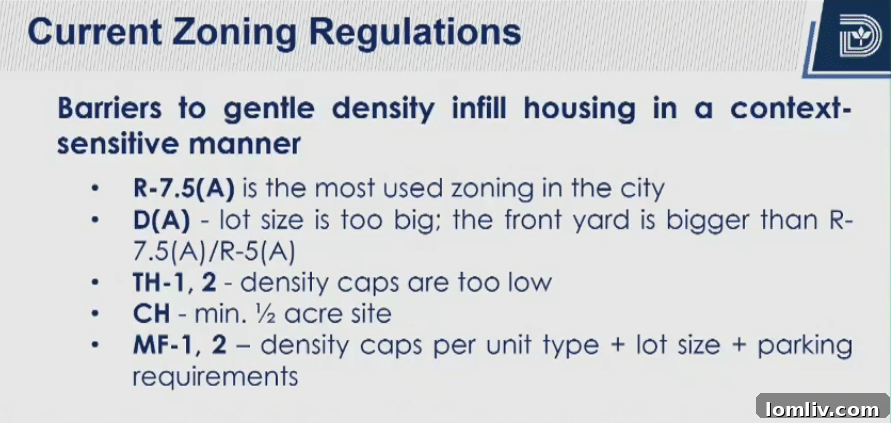
Protecting and preserving the diverse neighborhoods in Dallas has always been our main focus, along with starting this conversation around how our city moves forward. Many areas in our city are experiencing displacement due to higher taxes, and if lot sizes are modified beyond the 1950’s-era zoning standards, then families will have more options to stay in place.
We are committed to continuing this conversation through the ordinary process of community meetings, the Zoning Ordinance Advisory Committee (ZOAC), the city plan commission, council committee, and finally a council vote. It is important for all of our city residents to participate in this discussion as this will set a trajectory for how our city allows for both growth and preservation for future generations.
Dallas is now a mature city. Everyone should be able to have the economic freedom to choose a community that works for them, and we believe the policy proposals will do just that. With land values and appraisals at an all-time high, it is time to reassess how we allocate the size of our lots and the costs associated with them.
Councilman Chad West, Councilman Adam Bazaldua, Councilwoman Paula Blackmon