
Beware the Siren Song of “Too Good to Be True”: Navigating Real Estate Scams Online

In the bustling world of real estate, the promise of an incredible deal can be a powerful lure. However, as quickly as opportunities arise, so do deceptive schemes designed to trick unsuspecting buyers and renters. It’s a tale as old as the internet itself: a property listing appears, seemingly perfect, with a price tag that defies market logic. For many, such an offer sparks immediate excitement, but for seasoned observers, it triggers an alarm bell. These “too good to be true” listings are often elaborate real estate scams, preying on hope and urgency. This article dives deep into the anatomy of such a fraud, offering essential insights into how these schemes operate and, more importantly, how you can protect yourself and your investments in the volatile online property market.
The digital age has revolutionized how we search for homes, bringing countless listings to our fingertips. Yet, with this convenience comes an increased vulnerability to sophisticated fraud. Platforms like Zillow, Trulia, and even social media groups, while invaluable resources, can become breeding grounds for scammers. These fraudsters leverage public information and a veneer of legitimacy to create convincing, yet ultimately fake, property listings. Understanding their tactics is the first step in building an impenetrable defense against financial loss and emotional distress.
The Alluring Trap: When a Deal Seems Too Good to Be True
The alarm bells often start with a simple tip: a listing in a desirable area, like Dallas’s Knox-Henderson, priced at an unbelievably low figure. Take, for instance, a recent incident where a three-bedroom, two-bath home, typically valued at hundreds of thousands, was advertised for a mere $34,000. Such a drastic discrepancy between market value and asking price is the clearest indicator of a scam. In areas known for their robust real estate markets, a price this low isn’t a bargain; it’s a trap.
The psychology behind these scams is simple yet effective. Scammers understand that the dream of homeownership, especially for first-time buyers, can override common sense. They exploit the desire for an easy, affordable entry into the market, presenting an offer so enticing that potential victims might overlook critical red flags. Whether it’s a rental in an affluent neighborhood for a fraction of the going rate or a for-sale property at an impossible discount, the core strategy remains the same: create an irresistible illusion of opportunity.
Investigating Digital Deception: A Journalist’s Perspective
Our team at Daltxrealestate.com has a long-standing history of investigating such deceptive practices. We operate with zero reticence when it comes to engaging with individuals suspected of fraudulent activity, seeing it as our responsibility to expose these schemes and protect our community. A few years ago, we encountered a similar scenario when a legitimate property owner discovered her Highland Park rental listing duplicated, but offered at an absurdly low $1,000 a month. These experiences have honed our ability to quickly discern genuine opportunities from carefully constructed frauds.
In the recent $34,000 Dallas listing case, the fraudulent advertisement was swiftly removed by Zillow after the actual property owner was alerted. However, anticipating such a swift disappearance, we had already captured screenshots of the listing to document the scam. These digital footprints provide crucial evidence and allow us to analyze the scammer’s approach, detailing the tactics used to ensnare potential victims.
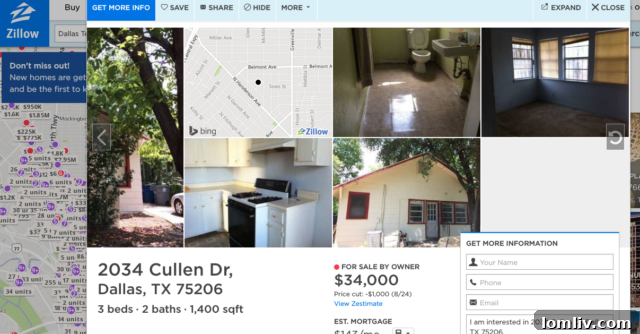
The following images showcase the fraudulent listing details, including the fabricated pricing and contact information, providing a visual example of the deceptive practices employed by these scammers.
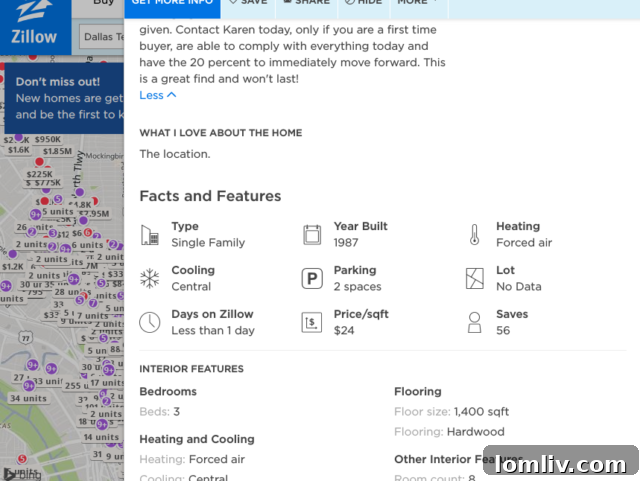
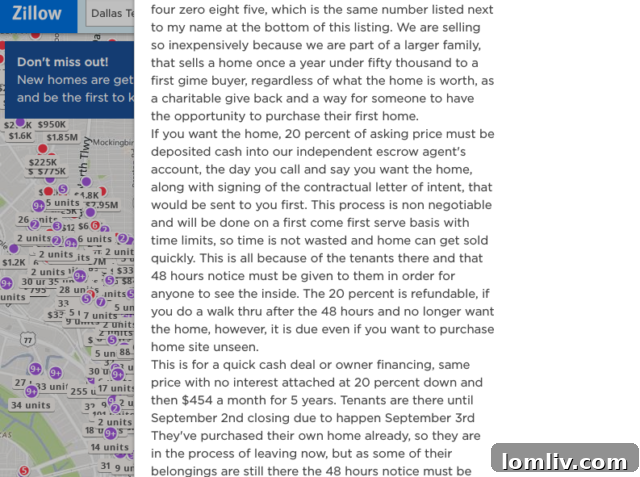
Dissecting the Fraudulent Listing’s Narrative
The text of the fraudulent listing was a masterpiece of manipulation, crafted to appeal directly to the emotions and aspirations of first-time homebuyers. It promised a “sweetheart deal” from an owner whose purported charitable intentions drove the absurdly low price. Let’s break down the key elements of this deceptive pitch:
“Amazing home is available today, for a REDUCED CASH SALE of $34,000 to a first time buyer only! No realtors, no brokers, no third party, no WHOLESALERS, no investors, no agents, no attorneys involvement, besides our independent property agent and my neice, Karen. All particulars will go thru her and her company and she can be reached on the number below next to my name, as owner of this property, seven seven zero three seven four four zero eight five, which is the same number listed next to my name at the bottom of this listing. We are selling so inexpensively because we are part of a larger family, that sells a home once a year under fifty thousand to a first time buyer, regardless of what the home is worth, as a charitable give back and a way for someone to have the opportunity to purchase their first home.
If you want the home, 20 percent of asking price must be deposited cash into our independent escrow agent’s account, the day you call and say you want the home, along with signing of the contractual letter of intent, that would be sent to you first. This process is non negotiable and will be done on a first come first serve basis with time limits, so time is not wasted and home can get sold quickly. This is all because of the tenants there and that 48 hours notice must be given to them in order for anyone to see the inside. The 20 percent is refundable, if you do a walk thru after the 48 hours and no longer want the home, however, it is due even if you want to purchase home site unseen.
This is for a quick cash deal or owner financing, same price with no interest attached at 20 percent down and then $454 a month for 5 years. Tenants are there until September 2nd closing due to happen September 3rd They’ve purchased their own home already, so they are in the process of leaving now, but as some of their belongings are still there the 48 hours notice must be given. Contact Karen today, only if you are a first time buyer, are able to comply with everything today and have the 20 percent to immediately move forward. This is a great find and won’t last!”
This elaborate narrative is packed with red flags. The explicit exclusion of realtors, brokers, and attorneys is a deliberate attempt to bypass the very professionals who would identify the fraud. The story of a “charitable give back” is designed to tug at heartstrings and rationalize the implausible price. The demand for an immediate 20% cash deposit into an “independent escrow agent’s account” before even viewing the property, coupled with an urgent “first come, first serve” and “time limits” clause, creates immense pressure and discourages due diligence. The offer of owner financing at an incredibly low monthly payment for five years further sweetens the pot, making the deal seem even more legitimate and accessible.
What’s truly remarkable about these scammers is their attention to detail in certain aspects. They took the time to look up the actual property owner on the Dallas Central Appraisal District website, then placed that legitimate name at the bottom of their fraudulent ad, lending a false sense of authenticity. This tactic, known as identity theft, adds a layer of complexity to their scheme, making it harder for casual observers to detect.
However, armed with reverse address search capabilities, we quickly discovered that the Patolia Revocable Living Trust was associated with the Patel family, the true residents of the home. Furthermore, the enticing photos used in the fraudulent Zillow listing were pilfered directly from the Patels’ legitimate rental listing on Trulia, where the property was advertised at a far more realistic $1,495 a month. This blatant intellectual property theft further underscores the deceptive nature of the scheme.
The Real Story: Contacting the Actual Owner
On a Saturday morning, I managed to connect with a understandably frazzled Mr. Patel, the legitimate homeowner. He was juggling calls, including one from Zillow, demonstrating the immediate impact such fraud has on real people. When questioned about the sale listing, his response was direct and unequivocal: “Yeah, that’s a fraud listing.” He explained how the scammers had meticulously copied everything from his legitimate rental listing and repurposed it for a fake sale. Mr. Patel’s diligence in constantly checking Zillow ultimately led to the listing’s removal, though the exact timing remained fluid.
This incident highlights the crucial role property owners play in combating online fraud. Their vigilance in monitoring their own properties across various platforms can be the first line of defense against these opportunistic criminals. The distress and inconvenience caused to Mr. Patel are a stark reminder of the real-world consequences of online real estate scams.
Zillow’s Role and Response to Fraud
While the immediate removal of the listing was likely prompted by Mr. Patel’s report, Zillow’s internal mechanisms are also designed to detect and address such fraud. A Zillow spokesperson confirmed their commitment: “Zillow goes to great lengths to police activity and fully inform our users of the existence of scams and how to protect themselves. Our customer support team monitors activity on the site in a number of different ways and if a listing is found to be fraudulent, it is immediately removed from Zillow.”
This statement underscores the shared responsibility in maintaining the integrity of online marketplaces. While platforms like Zillow invest heavily in fraud detection, user vigilance and prompt reporting remain indispensable tools in the fight against online property scams. It’s a continuous battle against evolving tactics, requiring collaborative effort from platform providers, property owners, and prospective buyers.
Confronting the Scammer: A Recorded Call
Curiosity, and a desire to fully understand the scammer’s modus operandi, led me to dial the number provided in the fraudulent listing. Armed with the knowledge that Texas is a one-party consent state for recordings, I set out to uncover the sales pitch. What I received was indeed a “doozy.”
During the call, the alleged scammer detailed an elaborate, yet ultimately deceptive, process for purchasing the home:
Alleged Scammer: “The owner is basically doing some maintenance online too it, along with some maintenance in the property itself, so at this point, she’s kind of posted it for sale.
If the person still wanted to purchase, that would person would have to sign the contractual letter of intent, which would state that they intend to make the purchase of the property, per a walkthrough, and that the property actual closing date has been moved up from Sept. 3 to Sept. 10 due to the maintenance that is happening.
More importantly, if you sign the contractual letter of intent, you have provided the 20 percent, it would have to be deposited into our independent escrow agent’s account, Mr. [name redacted], and he banks with Woodforest.”
That would have to be deposited today. It’s still available, but the closing date has been moved to a week later due to the maintenance crew doing the last bit of checks.
In the contractual letter of intent, it does state that it’s fully refundable.”
Me: “So if I changed my mind on the ninth, you would send my money back?”
Alleged Scammer: “Right. Basically, if you do the deposit today, right, you sign the contractual letter of intent today, then within 48 hours I would meet with you at the property, we would do a walk-through, say for whatever reason you no longer want to move forward, right, you let us know, you’ll receive your funds back within 24 hours.
If you do however still want to move forward, then you must understand that the closing date has been changed from the third to the tenth. The balance – 80 percent – will be paid at closing, or the balance the 80 percent will be paid over five years owner financing, that’s $464 per month.”
Me: “Ok. I should be honest with you right now. I am actually a journalist.”
Alleged Scammer: Hangs up.
The call illuminated several classic scam tactics: the invented maintenance delay to justify a postponed viewing, the emphasis on a “refundable” deposit to alleviate concerns, and the immediate pressure to secure funds. The quick hang-up upon my disclosure of being a journalist was the final, definitive confirmation of their illicit intentions.
Unmasking the Perpetrators: Tracing the Digital Footprint
Further investigation revealed that the phone number I dialed originated in Marietta, Georgia, and was not associated with anyone named Karen, the supposed “niece and independent property agent.” While Woodforest National Bank does have branches in Dallas and near Marietta, the entire setup pointed to a coordinated, remote operation designed to defraud. These details, though seemingly minor, paint a picture of organized deception rather than a simple misunderstanding.
Spotting the Red Flags: A Comprehensive Guide to Avoiding Real Estate Scams
For those navigating the real estate market, awareness is your strongest defense. Here’s an expanded list of critical red flags to look out for, drawing from our investigation and common scam tactics:
- Letters of Intent (LOI) are Not Binding for Significant Deposits: While an LOI expresses intent, it is generally not a legally binding contract that warrants a substantial cash deposit, especially before property inspection or formal agreement. Scammers often use “contractual letter of intent” to sound authoritative, but adding “contractual” does not imbue it with greater legal weight or make it suitable for collecting large, non-refundable deposits.
- Never Wire Money or Use Bank Drafts to Unknown Parties: Wire transfers and bank drafts are almost impossible to reverse. Scammers rely on this irreversibility. You should never send money to someone you haven’t met, for a property you haven’t seen, or without proper legal representation and a secure escrow process managed by a reputable, verifiable title company or attorney. Always conduct thorough due diligence before any financial transaction.
- Exclusion of Real Estate Professionals: If an owner explicitly states “no realtors, no brokers, no attorneys,” this is a massive red flag. Reputable transactions welcome professional oversight. Real estate agents, brokers, and attorneys are your advocates, providing expertise, conducting due diligence, handling complex paperwork, and protecting your interests. Bypassing them leaves you vulnerable.
- Unrealistic Pricing: This is arguably the biggest red flag. If a property in a desirable area is listed for a fraction of its market value (e.g., $34,000 for a home typically worth $300,000+), it’s almost certainly a scam. Always research comparable sales (comps) in the area using reliable sources like MLS data or property appraisal websites. If the price seems too good to be true, it is.
- Refusal to Show the Property or Delaying Viewings: Scammers often create excuses for why you can’t view the property immediately, like “tenants are still there” or “maintenance is ongoing.” While legitimate reasons exist, consistent delays, vague explanations, or demanding a deposit before a viewing are clear signs of fraud.
- Pressure Tactics and Urgency: Phrases like “first come, first serve,” “won’t last long,” or “act today” are designed to rush you into making decisions without proper consideration. Legitimate sellers understand that buying property is a significant decision requiring time and careful thought.
- Poor Communication or Generic Responses: While not always a definitive sign, a seller who communicates poorly, uses generic email addresses (e.g., Gmail instead of a professional domain), or avoids direct phone conversations might be a scammer. Look for professionalism and clarity.
- Requests for Personal Information Too Early: Be wary of requests for sensitive personal or financial information early in the process, especially before you’ve even seen the property or verified the seller’s identity.
- Non-Standard Contracts: Scammers may present vague or simplified “contractual letters of intent” instead of standard real estate purchase agreements. Always have any document reviewed by your attorney.
- Out-of-State or Foreign Owners (Often Fabricated): Scammers often claim to be out of the country or in remote locations, which conveniently explains why they cannot meet in person or show the property. This narrative is frequently used to justify wire transfer requests or to funnel money into untraceable accounts.
Protecting Your Property: Advice for Owners
For legitimate property owners listing their rentals or sales on platforms like Zillow, Trulia, Facebook, or Craigslist, proactive measures are essential to prevent your listings from being hijacked by scammers. The most effective, yet simple, step is to watermark your photos.
Watermarking is an inexpensive and highly effective way to deter fraudsters. A watermark, such as your contact phone number or your company’s logo, placed strategically across the middle of your photos, makes it virtually impossible for scammers to crop out or reuse your images without alteration. This significantly reduces the likelihood of your legitimate listing being duplicated for illicit purposes. You can easily apply watermarks using free tools like Microsoft PowerPoint, built-in features on your smartphone, or various free online apps. For a comprehensive guide on how to watermark your photos, you can refer to resources like this primer on Lifewire.
Beyond watermarking, regularly search for your property address on popular listing sites and search engines. Set up alerts for new listings with your address. This vigilance allows you to quickly detect and report any fraudulent duplicates, protecting your reputation and preventing potential victims from falling prey to scams using your property’s identity.
Conclusion: Vigilance is Your Best Defense Against Real Estate Fraud
The real estate market, especially online, demands constant vigilance. As the Zillow spokesperson aptly concluded, their platform features a “Beware of Scams and Other Internet Fraud” page, which advises users to watch out for red flags such as wire transfer requests and long-distance inquiries. However, the ultimate responsibility for due diligence rests with the buyer or renter.
Whether you’re a first-time homebuyer or an experienced investor, always remember that an unrealistically low price is the most telling sign of a scam. Educate yourself on local market comparables, understand the risks associated with online transactions, and never hesitate to seek professional advice from real estate agents, attorneys, or financial advisors. By staying informed, cautious, and proactive, you can navigate the complexities of the property market safely and confidently, avoiding the costly pitfalls of real estate fraud.