The Shifting Sands of Suburbia: Why Renting is Redefining the Dallas-Fort Worth Dream
The allure of homeownership has long been synonymous with the American Dream, particularly in the sprawling suburbs that fringe our major metropolitan areas. Yet, a significant and fascinating shift is underway, one that challenges this deeply ingrained perception. Recent analysis by RENTCafé highlights a striking trend: a growing number of suburbs, including several prominent ones in the dynamic Dallas-Fort Worth (DFW) metroplex, are now predominantly inhabited by renters rather than homeowners. This evolving landscape suggests a redefinition of residential aspirations and economic realities for a substantial portion of the population.
Dallas-Fort Worth Leads the Charge: Suburbs Turn Renter-Majority
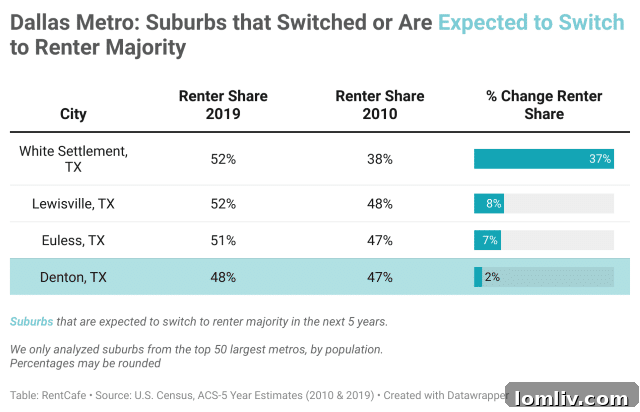
RENTCafé’s comprehensive analysis reveals that three key Dallas-Fort Worth suburbs have officially crossed the threshold into renter-majority territory. These communities now see more residents making monthly rental payments to landlords and property management firms than paying off mortgage loans to financial institutions. This is a profound demographic and economic indicator, reflecting a broader national pattern but with distinct local flavors.
White Settlement: A Western Transformation
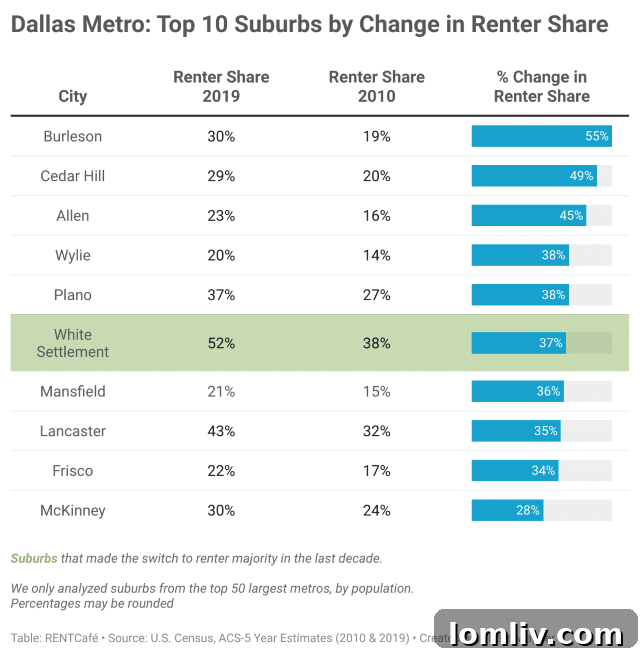
Located just west of Fort Worth, the city of White Settlement has experienced a notable transformation. Its overall renter share dramatically increased from 38 percent to an impressive 52 percent within the analyzed period. This substantial jump signifies a pivotal change in the community’s housing composition, moving away from its traditional homeowner-centric demographic. The growth of rental properties and the influx of residents preferring to rent have fundamentally reshaped White Settlement’s residential fabric.
Lewisville and Euless: Mid-Cities Embrace Rental Lifestyles
Further north, in Denton County, the vibrant suburb of Lewisville also reached the 52 percent renter share mark. Known for its strong job market and quality of life, Lewisville’s shift underscores that even desirable, growing communities are increasingly catering to a rental population. Similarly, Euless, nestled in the bustling Mid-Cities area of Tarrant County, saw its renter share climb to 51 percent. These figures are not mere statistics; they represent thousands of households opting for the flexibility and accessibility that renting provides over the long-term commitment of homeownership.
On the Cusp: Denton, Burleson, and Cedar Hill’s Trajectory
The trend isn’t limited to just these three suburbs. Other DFW communities are closely following suit, indicating that this phenomenon is far from over. Denton, a prominent city with a significant university population, registered a 48 percent renter share and is projected to reach renter-majority status within the next five years. This is particularly notable given its status as a growing educational and commercial hub. Furthermore, Burleson experienced a significant increase in its renter share, rising from 19 percent to 30 percent, while Cedar Hill saw its renter population grow from 20 percent to 29 percent. These suburbs, each with their unique characteristics, are clearly on a similar trajectory, suggesting a sustained evolution in the regional housing market.
A National Phenomenon: Suburbs Across America Embrace Renters
The Dallas-Fort Worth experience is not isolated; it mirrors a profound national trend. RENTCafé’s analysis, based on newly released Census data, paints a clear picture of this widespread shift. Between 2010 and the close of 2019, nearly 80 percent of incoming residents in suburban areas across the nation’s 50 largest metropolitan areas opted for renting. This period saw suburban communities gain an astonishing 4.7 million people, largely propelled by this influx of renters.
Today, the landscape of suburban living has been significantly redefined. Nearly 21 million individuals now rent a home within the suburbs of the 50 largest metros, marking an increase of 3.7 million people compared to a decade ago. This decade of transformation witnessed 103 new suburbs officially flipping to renter-majority status, and an additional 57 suburbs are anticipated to make this transition within the next five years. This data unequivocally demonstrates that the traditional image of suburban homeownership is undergoing a radical transformation nationwide, with renting becoming an increasingly prevalent and accepted mode of living.
Among these national shifts, Merrifield, Virginia, stands out, experiencing the largest percentage increase. Its renter share surged by 64.2 percent, climbing from 44 percent to an astounding 72.2 percent. This dramatic change in Merrifield serves as a powerful testament to the accelerating pace of suburban rental growth and the changing preferences of residents across various regions.
Unpacking the “Why”: Drivers Behind the Suburban Rental Boom
Understanding the root causes of this substantial shift is crucial. On the surface, one might assume high mortgage rates play a role, but the data preceding 2019 indicates otherwise. During this period, mortgage rates were at historic lows, making borrowing relatively inexpensive. This suggests that the drivers behind the growing preference for renting are more complex and multifaceted.
The Triple Threat: Inventory, Values, and Supply Chains
Instead, several interconnected factors are largely responsible for deterring potential homeowners. A critical issue has been the persistent lack of available housing inventory. Simply put, there aren’t enough homes on the market to meet demand, especially in desirable suburban locations. This scarcity, in turn, has fueled an exponential rise in home values, pushing prices beyond the reach of many aspiring homeowners. Even with low mortgage rates, the sheer cost of a down payment, coupled with escalating property taxes and closing costs, presents an insurmountable barrier for a significant portion of the population.
Adding to these challenges are supply-chain issues, which further exacerbate the housing shortage. Disruptions in the availability of materials and labor bottlenecks can slow down new construction, keeping inventory low and prices high. These combined factors create a challenging environment where even those with stable incomes find it difficult to enter the homeownership market, making renting a more practical and immediate solution.
Beyond Economics: Lifestyle and Flexibility
While economic factors are paramount, the shift also reflects evolving lifestyle preferences. The traditional ideal of settling down in one location for decades is becoming less universal. Younger generations, in particular, often prioritize flexibility, mobility, and the ability to adapt to changing career opportunities or personal circumstances without the encumbrances of property ownership. The simplified process of moving, fewer maintenance responsibilities, and access to amenities that rental communities often provide are increasingly attractive.

The Demographics of Renting: Millennials, Gen Z, and the Modern Workforce
The demographic profile of these new suburban renters offers further insight into the trend. According to RENTCafé, Millennials and Gen Z account for a substantial portion of this population, with 55 percent of suburban renters being younger than 45. Their median household earnings hover around $50,000, a figure that, while respectable, often falls short of the financial requirements for homeownership in today’s inflated market, especially when considering student loan debt and other financial obligations common to these generations.
The Era of Flexibility and Mobility
The younger demographic’s preference for renting is intrinsically linked to a modern work culture defined by flexibility and mobility. Dr. Kenneth Laundra, associate professor of sociology at Millikin University, articulated this sentiment in RENTCafé’s report: “With the increase in remote work, short-term projects, and ‘side hustles,’ there’s every reason to believe that the future will be a more transitory, migratory existence.” This observation is particularly pertinent to Millennials and Gen Z, who have grown up in an era of rapid technological advancement and economic dynamism.
The ability to work remotely has untethered many from the necessity of living in expensive urban cores, allowing them to explore more affordable, yet still amenity-rich, suburban areas. However, even within these suburbs, the demand for adaptable living solutions remains high. Short-term contracts and the prevalence of diverse income streams often necessitate a living situation that doesn’t demand a decades-long commitment. Renting perfectly aligns with this “transitory, migratory existence,” offering the freedom to relocate without the complex processes of buying and selling property.
Suburbs Redefined: Clustering Near Urban Hubs
Dr. Laundra also posited that “Most of this migration will be toward cities and urban landscapes, where even the suburbs will cluster most closely to urban areas.” This speaks to a fascinating evolution of the suburban model. The desire for suburban space and community remains, but often with the added expectation of convenient access to urban amenities, job opportunities, and cultural experiences. This leads to a concentration of growth in suburbs that are well-connected to major cities, blurring the traditional lines between urban, suburban, and even exurban environments. These “urban-adjacent” suburbs become prime locations for rental development, appealing to those who seek a balance between suburban tranquility and urban accessibility without the financial strain of city homeownership.
The Evolving Suburban Dream: Renting as the New Normal
The question “Has homeowning lost its appeal?” is more nuanced than a simple yes or no. For many, the aspiration to own a home remains strong. However, for a significant and growing segment of the population, particularly younger generations, the practicalities and economic realities make renting a far more attainable and often preferable option. The findings from RENTCafé’s analysis confirm that the American suburban dream is indeed evolving.
This shift has profound implications for urban planning, infrastructure development, and the very fabric of community life in these transforming suburbs. Developers are responding by constructing more rental-oriented housing, from luxury apartment complexes to single-family rental communities. Local governments may need to adapt services and infrastructure to cater to a more transient, younger, and potentially less invested resident base. The traditional image of the homeowner-centric suburb, with its picket fences and long-term residents, is giving way to a more dynamic, diverse, and rental-friendly environment.
As we look to the future, it’s clear that renting is not just a temporary stopgap for many suburban residents but a viable, long-term lifestyle choice. The Dallas-Fort Worth metroplex, with its rapid growth and changing demographics, serves as a compelling microcosm of this national trend. The suburbs are no longer solely the domain of homeowners; they are increasingly vibrant, mixed-tenure communities where the “dream” can be realized through a monthly rental check, offering flexibility and accessibility in an ever-changing world.