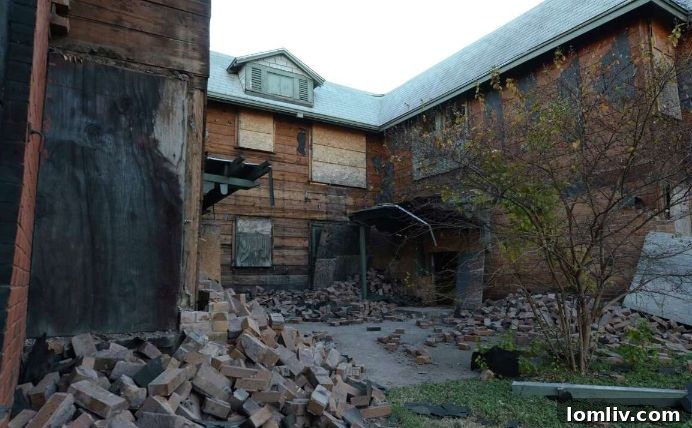
In the vibrant heart of Dallas, just a stone’s throw from the bustling Bishop Arts District, a seemingly straightforward property purchase spiraled into a decade-long saga of bureaucratic battles, historical revelations, and personal hardship. This is the compelling story of Jane Bryant and the property at 600 Elsbeth, a modest 1925 home that held far more secrets than its charming facade suggested, including a contentious link to American history.
Jane Bryant, a former professor at the University of North Texas at Dallas, envisioned a new chapter in 2007 when she acquired the property situated at the corner of West Davis and North Elsbeth. Her aspirations for the early 20th-century home were dual-faceted: a personal residence upstairs and a strategic operational hub for her apparel business on the ground floor. The location, mere yards from one of Dallas’s most dynamic cultural hubs, seemed perfectly poised for her entrepreneurial and residential dreams.

However, Bryant’s vision for the 600 Elsbeth property quickly encountered unforeseen obstacles. What began as an exciting renovation project soon transformed into a protracted legal and administrative struggle with the City of Dallas. Her attempts to revitalize the residence and secure appropriate zoning for her business were repeatedly thwarted. The former UNT professor found herself embroiled in a seemingly endless cycle of denials, court appearances, and mounting frustration, preventing her from ever truly inhabiting the home she had so carefully chosen.
The situation escalated dramatically in 2012 when, despite Bryant’s fervent wishes and ongoing legal challenges, the historic structure was summarily demolished. This act of demolition, carried out against her express desires, marked a profound turning point, transforming a promising property into a vacant lot and deepening her resolve to challenge what she perceived as unjust city practices. The land, once holding a dream and a piece of history, now represented a complex entanglement of unresolved grievances and significant financial burdens.
Adding insult to injury, Bryant now faces an uphill battle to sell the cleared land. The City of Dallas has filed a substantial lien against the property, which Bryant vehemently asserts is “bogus.” This lien levies charges against her for asbestos removal and other associated costs stemming from the demolition – an event she opposed from the outset. “The title changed over to my name was barely dry and the city said, ‘Fix it or the building comes down. Renovate it within 30 days or the building comes down,’ and they sued me,” Bryant recounted, painting a vivid picture of the immediate and aggressive posture taken by the city. She described constant harassment and an impossible demand to renovate without proper zoning, calling the entire situation “crooked” and a “dead-end deal.”
Beyond the labyrinthine legal and administrative hurdles, Jane Bryant has been courageously fighting a personal war against leukemia for the past several years. This significant health challenge inevitably impacted her energy and momentum, further complicating her efforts to resolve the property dispute and finally sell the now-vacant lot. Her fight is not just for her property rights, but against a system she believes has unfairly targeted and financially burdened her during one of the most challenging periods of her life.
The Elsbeth Home: A Dream Interrupted and a Historical Revelation
When Jane Bryant initially purchased the 600 Elsbeth home, she was residing in a duplex within the more affluent University Park area of Dallas. Her professional life was multifaceted, encompassing her role as a university professor, a consultant, and the owner of an apparel business. The University Park location, while suitable for her academic and consulting endeavors, was restrictive for the manufacturing arm of her business.

The 600 Elsbeth property, with its proximity to the Bishop Arts District and its mixed-use potential, offered a compelling solution. “I had an apparel business in addition to being a professor and doing consulting work,” she explained. “I can’t do manufacturing in University Park. [The Elsbeth home] was ideal. I would have my manufacturing downstairs and I would live upstairs. You could do that over there; I think you still can with commercial zoning. I bought this property for a purpose, not just for my business, but I think there’s some historical value to it.” This foresight into the property’s historical significance would prove chillingly accurate, though not in a way she could have ever anticipated.
Shortly after Bryant acquired the home from the Jurek family, her initial excitement gave way to exasperation as the City of Dallas initiated legal proceedings against her. The matter became entangled in Dallas Municipal Court, leading to an astonishing nearly 60 hearings. The city alleged that Bryant was negligent and had failed to bring the building up to code, despite her persistent efforts and the inherent difficulties posed by the lack of appropriate zoning. “They wanted me to redo it and I couldn’t do it without the zoning,” Bryant stated, highlighting the bureaucratic Catch-22 she found herself in. “We just got into a constant battle where every week they were hauling me into court for something. They sued me to have it renovated then I’d have to get an attorney, which cost more money. I could never do anything with it.” This cycle of legal demands and administrative roadblocks effectively paralyzed her plans and drained her resources, preventing any progress on her intended renovations.
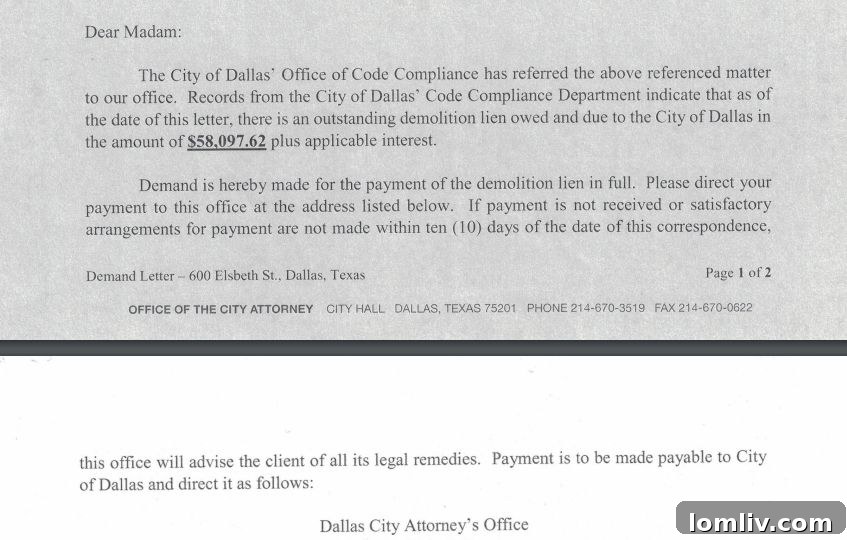
The culmination of this protracted dispute was a lien filed on the property, years after the house was demolished. Bryant described this lien as being based on an “inaccurate bill” sent in 2020, claiming she owed approximately $58,000. This staggering sum was attributed to the teardown, asbestos removal, and accrued interest, costs Bryant firmly believes she should not bear, given the city’s role in the demolition and the alleged lack of due process. In a letter dated August 9, 2021, Bryant directly appealed to municipal leaders, writing, “I ask that the mayor and City Council recognize that the lien on the property is bogus and remove the lien.” This plea underscores her conviction that the city’s actions were unfounded and punitive. Despite repeated attempts to gain clarification or comment, Interim City Attorney Tammy Palomino and Assistant City Attorney Kyle Paur, whose name appears on relevant legal documents, have remained unresponsive. A spokeswoman for the City of Dallas offered a terse “no comment at this time,” further illustrating the official silence surrounding this contentious issue.
History of 600 Elsbeth: A Notorious Past
The property’s historical significance, a factor Bryant initially acknowledged, became far more profound and unsettling than she could have imagined. Through her own research and that of diligent local reporters, it was uncovered that 600 Elsbeth was once a residence of Lee Harvey Oswald. More specifically, it was at this address that Oswald was believed to be living when he acquired the firearm used to fatally shoot Dallas Police Officer J.D. Tippit on November 22, 1963 – approximately 45 minutes after the assassination of President John F. Kennedy. This connection irrevocably linked the humble Dallas home to one of the most pivotal and tragic days in American history.

“All of a sudden we found out this place had historical significance,” Bryant recalled, a realization that deepened her commitment to preserving the structure. “I really wanted to save it, not just for my business, but it was a charming little building.” The discovery of its notorious past transformed her fight from a purely personal business endeavor into a mission of historical preservation. She recognized that the building, irrespective of its former occupant’s actions, held a tangible link to a momentous event that continues to fascinate and shape national narratives.
Following the city’s decision to demolish, Bryant found herself trying to sell a vacant lot that had once been a historic residence. She rejected offers from several developers, including an agent representing a national drugstore chain, steadfast in her belief that the site’s unique history deserved more respectful consideration. She vividly recounted a “gentleman’s agreement” with the city, where she was promised sufficient time to dismantle the building herself, with the intention of salvaging architectural elements that could be preserved. However, this agreement was allegedly breached. “They just kept stalling the teardown and then they said we violated our contract of bringing the building down in a timely fashion. They came in with bulldozers. They destroyed all the things I was trying to save.” This account paints a picture of betrayal and arbitrary power, where a historical structure was not only razed but its recoverable components were callously discarded.
Lien Reform: Advocating for Fairer Property Practices
Now residing in another historic home on Swiss Avenue, Jane Bryant reflects on her strenuous and costly battle with the city. “I think people know I tried,” she states, acknowledging the immense effort and personal resources she poured into her fight. Despite the toll, her spirit remains undeterred, fueled by a desire not only for personal justice but also for systemic change within the City of Dallas’s property handling procedures.
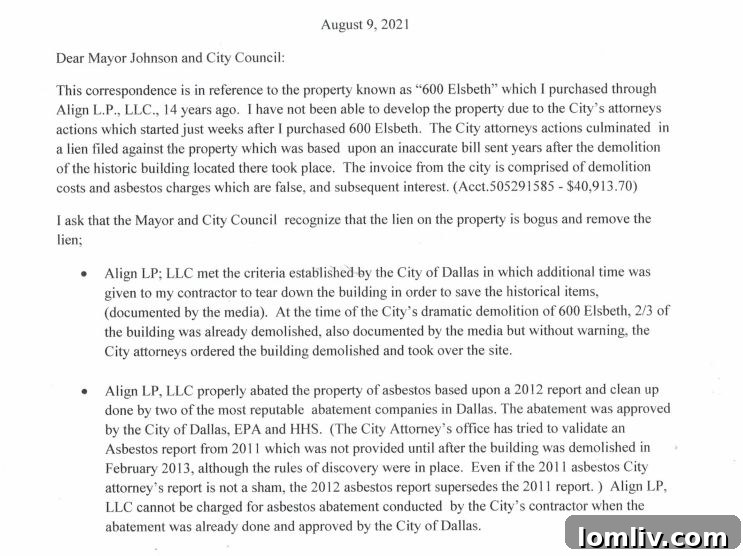
Recently, Bryant engaged the services of Wichita Falls attorney Gant Grimes, signaling her renewed commitment to challenging the city’s lien. Her immediate goal is the removal of this disputed financial encumbrance, which prevents her from liquidating the property. Beyond her personal case, however, Bryant is driven by a broader advocacy for reform. She envisions a future where the City of Dallas adopts more transparent, equitable, and accountable practices when dealing with its property owners.
The financial ramifications for Bryant extend beyond the initial demolition costs and the lien. She notes that her property appraisal has soared by as much as 500 percent, a startling increase that she believes further compounds her predicament. “I’m trapped,” she lamented, outlining the multifaceted pressures she faces. “That just increases their income. There’s the appraisal, the secret lien, the zoning, and all the different prices they’ve quoted me for teardown. What else can they do?” This array of charges and administrative hurdles creates a sense of entrapment, leaving her with a valuable piece of land that is simultaneously a financial burden and an administrative quagmire.
To shed light on what she characterizes as an unfair and opaque process, Bryant is seeking a jury trial concerning the lien. Her hope is that a public trial will not only vindicate her claims but also draw much-needed attention to the flaws she perceives in the city’s property lien system. “The city should have an honest and fair lien approval or dismissal system,” she asserted, advocating for fundamental changes. “The lien process is completely flawed and it is so important. That is the muscle. That is what they do to get people out of their homes. We’ve got to improve things for the next generation.” Her impassioned plea underscores a critical concern for property rights and the integrity of local governance, aiming to ensure that no future property owner in Dallas endures a similar ordeal.