Recent developments in downtown Dallas’s Farmer’s Market area have sparked considerable debate among urban planning enthusiasts and residents alike. A specific project, proposed by Spectrum Properties for the former North Texas Food Bank headquarters, situated between Pearl Expressway, Cesar Chavez Blvd., and Farmers Road, has particularly drawn scrutiny.
The concern isn’t about the Food Bank’s relocation, as it will remain a tenant within the new structure. Rather, it centers on the nature of the proposed development. Spectrum Properties, having acquired the land from the Food Bank in October 2020, plans a six-story building. This structure will feature four stories of apartments built atop a newly constructed Food Bank HQ, complemented by 125 above-ground parking spaces. Additionally, the third floor is slated to house a community center and a pool. While these amenities sound appealing, the scale and design philosophy of this particular project raise critical questions about its suitability for the heart of a major metropolitan city like Dallas. This type of suburban-oriented development seems profoundly out of place in an urban core largely zoned for high-density, “high as you want” construction. It challenges the vision for a vibrant, walkable, and densely populated downtown.
To put it simply, an easy litmus test for appropriate urban development can be applied: if a building design appears more suited for an Interstate 20 frontage road in a suburban community such as Duncanville, it likely does not belong in the dynamic and evolving landscape of downtown Dallas. The distinctive character of an urban center demands architectural and planning choices that maximize density, promote pedestrian activity, and integrate seamlessly with existing infrastructure, fostering a truly metropolitan environment.
A Pattern of Questionable Urban Planning in Dallas
The Spectrum Properties deal is not an isolated incident; it reflects a broader trend in Dallas’s development strategy. In March, Serra Real Estate Capital unveiled plans for a sprawling 1,200-space, above-ground parking garage in downtown Dallas. This “by-right” project, on an acre near the Omni Hotel and the County Courthouse, is valued at $61.7 million and will include ground-level retail to mitigate its impact on the streetscape. The economic viability of such a large parking structure on prime downtown land begs the question: how is real estate in Dallas’s urban core so undervalued that a surface-level parking garage becomes a financially attractive investment? This situation points to fundamental flaws in the city’s approach to land use and highlights the challenges faced by progressive Dallas urban planning initiatives.
Another poignant example involves a parcel of land off Mockingbird Lane, nestled between The Highland Hotel, various condominiums, and Glencoe Park. For many years, a developer sought City Hall’s approval for a high-rise project on this site. Despite its seemingly undesirable location adjacent to Central Expressway, the property was exceptionally close to Mockingbird Station, presenting an ideal opportunity for Transit-Oriented Development (TOD). TOD is a critical strategy for enhancing public transit usage and reducing vehicular dependency, a stated goal of Dallas City Hall. However, residents of the neighboring Highland House successfully opposed the development, citing concerns over view infringement. This outcome is particularly perplexing given that the city often asserts that views are not a consideration in its planning decisions, yet this high-rise was effectively blocked, undermining the very principles of TOD it claims to champion. Such inconsistencies undermine confidence in Dallas City Hall’s commitment to strategic urban growth.
Hillwood’s Diminished Ambitions in Dallas Downtown Development
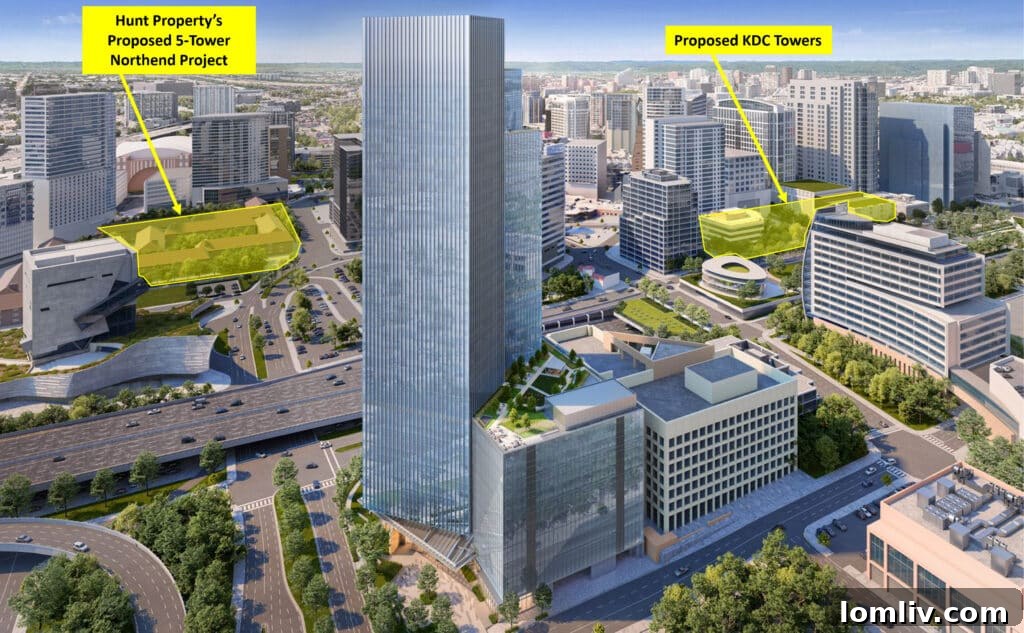
In contrast to the suburbanization trend, the announcement of Hillwood Urban’s Field Street Tower offered a glimmer of traditional urban ambition. This new office building, positioned at Woodall Rodgers and Field Street, near two other major announced projects, was initially touted by the Dallas Morning News as the “tallest Dallas skyscraper in three decades.” While the renderings depict an attractive complex of buildings, (with hopes that the shorter adjacent structure isn’t merely another parking garage), a closer look reveals a sobering reality about Dallas real estate ambitions.
At 600 feet, the Field Street Tower would indeed become the 12th tallest building in Dallas, surpassing Republic Center Tower II by a mere two feet. It would also stand 40 feet taller than the nearby Museum Tower, yet paradoxically feature fewer overall floors (38 compared to Museum Tower’s 42). More significantly, it would remain 321 feet shorter than Bank of America Plaza, which has held the title of Dallas’s tallest building since 1985. This stagnation, with no new “tallest building” for over three decades, is not only embarrassing but also indicative of a lack of robust growth and bold vision in the city’s central business district. It suggests that while the Dallas-Fort Worth metroplex continues to expand at an exponential rate, downtown Dallas development struggles to attract the monumental projects that define other thriving urban centers.
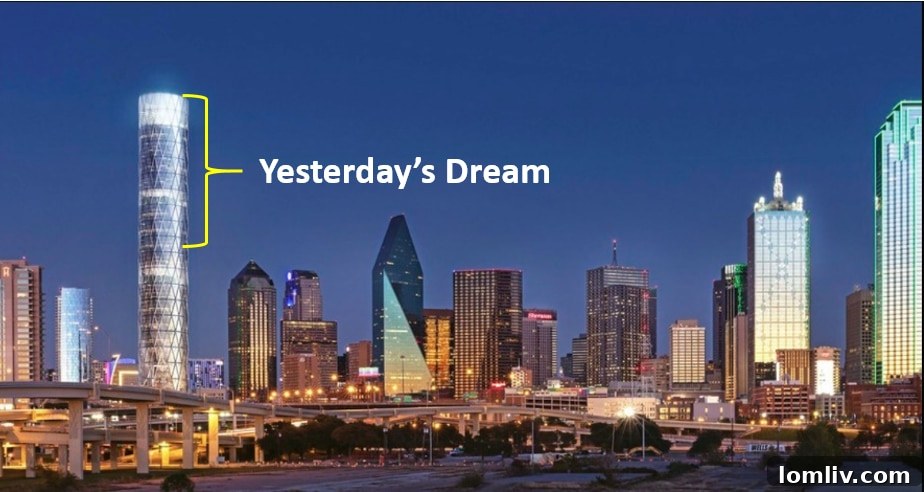
To fully grasp the scale of this diminished ambition, we must recall Hillwood’s original vision for this very site in 2017. At that time, the developer proudly showcased zoning approvals for unlimited height and 1.5 million square feet of development. Their ambitious Renzo Piano-designed skyscraper, dubbed the Perot Tower, was envisioned as a grand gateway to downtown Dallas. Fast forward four years, and that “gateway” has shrunk considerably in scope, becoming a mere shadow of its initial promise. While the current complex is aesthetically pleasing, it falls short of the transformative, skyline-defining structure originally dreamed of by both the developer and urban observers.
It’s tempting to imagine the impact if this project were comprised entirely of reasonably-priced residential units, or if Hillwood decided to add another 322 feet of residential space to reclaim the coveted “tallest” crown. Such a move would undoubtedly inject much-needed vitality and a renewed sense of ambition into downtown Dallas. While this “by-right” project technically operates outside direct City Hall intervention, its scaled-back nature from one of Dallas’s premier developers is telling. It reinforces the argument that despite the broader metro area’s robust growth, downtown Dallas struggles to attract genuinely transformative “tallest” buildings. This challenge is, in no small part, attributable to Dallas City Hall’s perceived inability to consistently drive and facilitate high-impact Dallas high-rise development in its urban core.
Unraveling the Paradox: Why Downtown Dallas Lags
A fundamental question emerges from these observations: why the stagnation in downtown Dallas? Why have we not seen a proliferation of 20-story apartment buildings in the Farmer’s Market area, akin to the dozen-plus projects flourishing in Uptown and Oak Lawn? Why has Dallas not celebrated a new “tallest building” in 36 years? Furthermore, why are the city’s highest-density residential zones, often underserved by DART public transit, simultaneously falling victim to oversized, yet under-dense, developments? From a residential perspective, downtown Dallas seems to offer only two extremes: ultra-luxury high-rises bordering the Arts District or low-density, suburban-style sprawl exemplified by projects in the Farmer’s Market. This dichotomy is unsustainable for a truly vibrant urban core.
The core issue appears to be the low cost of land, which makes economically viable projects like a massive parking garage or a mere six-story apartment building justifiable in an area that should command premium, high-density development. Could this market distortion be a direct consequence of the Dallas City Plan Commission and Dallas City Council’s propensity to approve high-rises in locations where they fundamentally don’t belong? By doing so, they inadvertently diminish interest and depress property values in downtown, where such density is most needed. Is City Hall’s decision-making process more swayed by localized peer pressure and vocal opposition than by sound, long-term Dallas zoning and urban planning principles?
High-density housing is, in many respects, a zero-sum game. There is a finite amount that will be built in any given period. Therefore, when City Hall readily approves such projects in inappropriate, low-impact locations, it inevitably diverts development away from areas where professional urban planners would deem it most beneficial and impactful. This decentralized approach fragments urban growth, preventing the concentrated density necessary to foster true urban vibrancy.
Numerous examples illustrate this point. Consider Streetlights Residential’s planned high-rise at Lemmon and Oak Lawn, or Pegasus-Ablon’s two 20-story high-rises on Dickason off Cedar Springs. Nazerian’s Exxir Capital has also been marketing its Carlisle on the Katy Trail apartment building for high-rise redevelopment (especially now that Lincoln Katy Trail has been approved), and four low-rises across from Cole Park are being marketed for 20-story high-rise projects. Each of these examples represents a decision by City Hall, either through direct approval or through market conditions influenced by current policies. However, one specific instance stands out as a loophole that continues to plague sound urban development planning.
The Persistent Flaw: Dallas’s Unclosed Replat Loophole
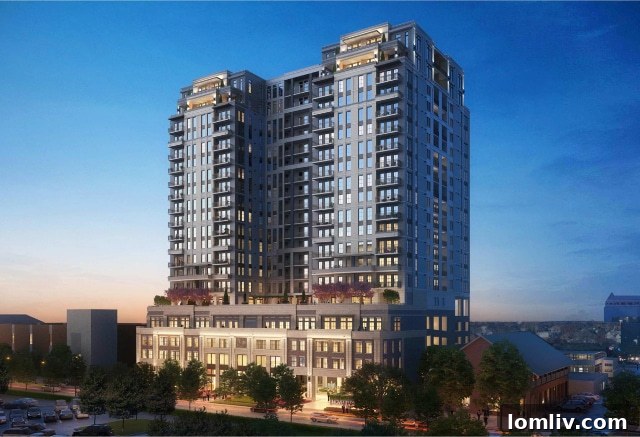
In early 2020, the discussion around a legally sanctioned yet mind-boggling high-rise under construction on Irving Avenue, behind the Kinko’s/FedEx Office on Oak Lawn Avenue, brought to light a significant and ongoing flaw in Dallas’s planning process. This development materialized largely because replats, or changes to property boundary lines, are effectively immune to significant scrutiny from the Plan Commission. Under current regulations, the Commission is severely restricted: they cannot inquire about the reasons for a replat, demand to review detailed development plans, or even conduct site visits – a level of restriction virtually unheard of in surrounding municipalities. Consequently, by the time this particular project came to public attention, its underlying replat had already been approved, cementing its legality despite questionable urbanistic merit.
Considering this egregious exploitation of a procedural loophole, one would reasonably expect the city to promptly address and close this gap to prevent similar occurrences. Yet, to this day, replat proposals are largely voted upon blindly, with commissioners often relying solely on the limited information the applicant chooses to provide. My repeated suggestions to multiple Plan Commissioners have focused on a simple but impactful approach: refuse to vote on replat cases until the rules are revised, making a public declaration, “I will not cast a vote where I am prevented from fully understanding the applicant’s objectives and the project’s implications.” If a sufficient number of Plan Commissioners consistently adopted this stance, effectively blocking replat approvals, it is highly probable that the necessary procedural changes would be implemented with remarkable speed.
The current state of affairs suggests a lack of courage and resolve among decision-makers. Dallas City Hall’s elected and appointed officials, unfortunately, often lack a foundational understanding of urban planning principles, and many do not even feign interest in acquiring such expertise. Their approach sometimes resembles a scene from “I Dream of Jeannie,” where complex issues are expected to resolve with an instant, magical solution, rather than through diligent, thoughtful, and proactive urban strategy. This passive oversight continues to undermine the potential for Dallas to achieve its full potential as a truly world-class urban center, characterized by smart growth and sustainable development.