Dallas STRs: Wednesday Decision Looms on Ban Regulation or Restriction
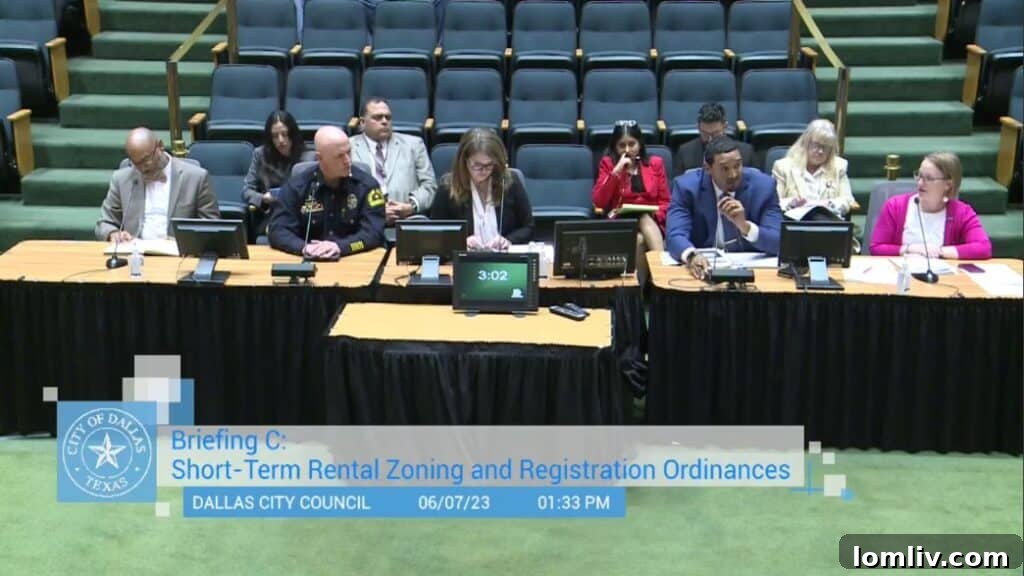
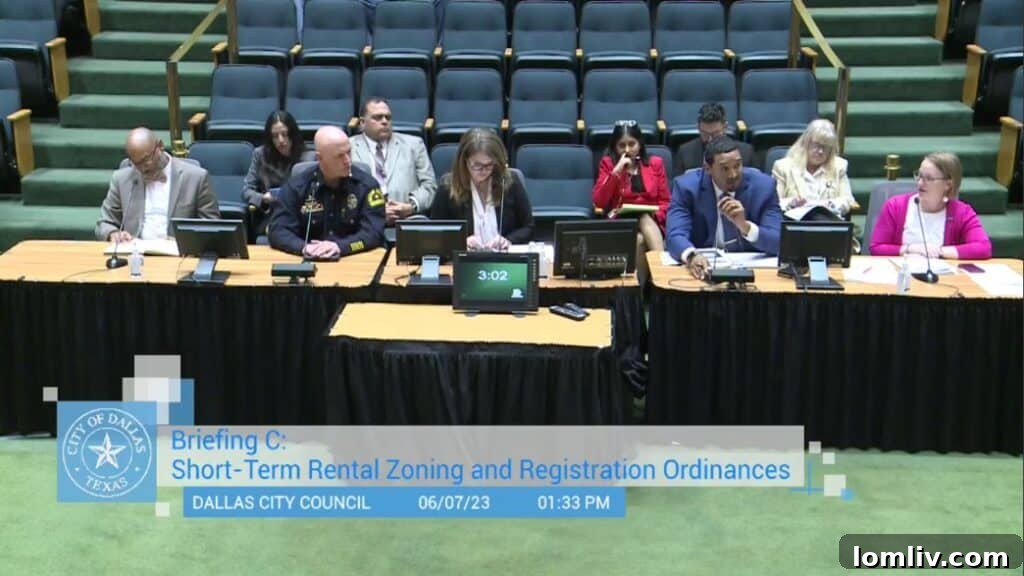
A panel of Dallas staff representatives answers questions at a June 7 briefing on short-term rentals.
The city of Dallas stands at a critical juncture, facing mounting pressure to address the contentious issue of short-term rentals (STRs). Following an intensive three-hour briefing last week, City Manager T.C. Broadnax assured the public that staff would present a professional recommendation. This assurance came despite several council members expressing that such a measure might not be strictly necessary ahead of the pivotal June 14 vote. The forthcoming decision has significant implications for Dallas neighborhoods, residents, and the burgeoning STR market, which includes platforms like Airbnb and Vrbo.
The highly anticipated official memo outlining staff recommendations has now been released, providing crucial insights into the city’s proposed path forward. This document, presented in its entirety below, will undoubtedly serve as a cornerstone for the discussions and decisions set to unfold at City Hall this Wednesday. The debate surrounding STRs has been fraught with challenges, balancing property rights with community welfare, and the city is now poised to make a definitive move.
Before delving into the detailed staff recommendations, it’s essential to understand the various options currently on the table for the Dallas City Council. These proposals aim to curb issues such as noise complaints, parking congestion, safety concerns, and potential criminal activities associated with “party houses” operating as STRs within residential zones.
Navigating the Future: Three Key Options for Dallas Short-Term Rentals
The Dallas City Council is tasked with choosing from three primary approaches to regulate or restrict short-term rentals, particularly those contributing to disturbances in residential neighborhoods. Each option presents a distinct philosophy and set of challenges, reflecting the complex nature of the STR debate.
The “Keep It Simple Solution” (KISS): Banning STRs from Residential Neighborhoods
This proposal, which garnered approval from the City Plan Commission and enjoys the support of at least three council members, represents a straightforward approach. The “Keep It Simple Solution” advocates for the outright ban of short-term rentals in single-family residential zoning districts. Under this plan, STRs would only be permitted in commercial or mixed-use zones. Proponents argue that this solution directly addresses the root cause of neighborhood disruptions by separating commercial lodging activities from traditional residential living. It is perceived as the most direct way to restore peace and quiet to residential areas and is currently on Wednesday’s agenda for a vote. Any modifications or alternative suggestions would need to be introduced as formal amendments, as confirmed by the Dallas City Attorney’s Office. This approach offers clarity but could face legal challenges from STR owners who view it as an infringement on their property rights.
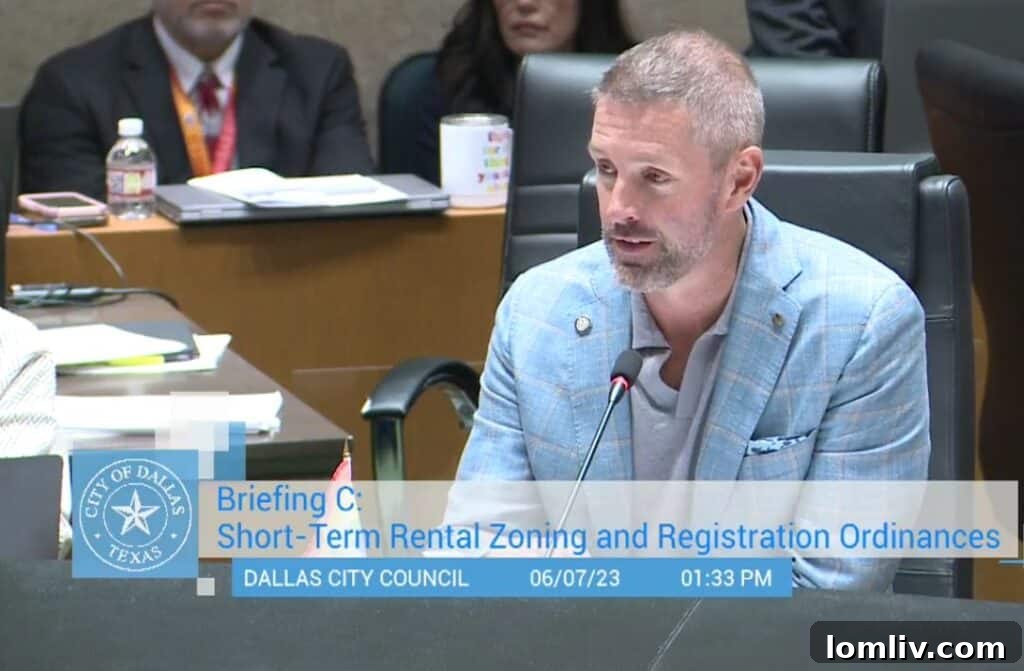
District 1 Councilmember Chad West advocates for a robust regulatory framework for STRs.
Councilmember Chad West’s Comprehensive Regulatory Framework
District 1 Councilmember Chad West has put forth a detailed and aggressive regulatory proposal that seeks to manage STRs through stringent oversight rather than an outright ban. His plan includes several key components:
24-hour Enforcement: Establishing a dedicated enforcement team funded through hotel occupancy taxes to respond to complaints around the clock.
Parking Requirements: Implementing specific parking mandates to alleviate street congestion in residential areas.
Limitations on Occupancy: Setting clear limits on the number of guests allowed per STR to prevent overcrowding and reduce disturbance.
Party House Ban: Explicitly prohibiting properties from being used primarily as “party houses.”
On-site Caretaker for Residential STRs: Requiring a designated caretaker to be available on-site or nearby to manage issues promptly.
2,000-foot Separation Requirement: Mandating that new STRs must be located at least 2,000 feet from an existing short-term rental to prevent an overconcentration in specific areas.
Significantly, Councilmember West’s proposal does not extend to apartment STRs. He contends that these units often have existing building management and homeowners’ associations that provide a level of self-regulation, making additional city-level intervention less critical. This nuanced approach aims to create a sustainable coexistence between residents and STRs, providing a middle ground between outright prohibition and unregulated operation.
An Alternative: Staff Recommendations Focused on Registration and Operational Control
A third major option emerges from the recommendations of Planning and Urban Design Director Julia Ryan and Code Compliance Director Chris Christian, as detailed in the memorandum from Assistant City Manager Carl Simpson. This alternative approach pivots away from traditional zoning amendments for STRs, instead advocating for a robust registration system and comprehensive operational standards. This model suggests that many of the core issues associated with STRs are operational in nature—such as noise, trash, and parking—and are therefore best managed through a dedicated registration ordinance enforced by Code Compliance Services. This approach emphasizes regulation and enforcement over restrictive zoning, aiming to control behavior rather than restrict location in all instances. The specifics of this recommendation are elaborated further in the official memo below.
Dallas City Staff’s Official Recommendation on Short-Term Rentals
The following memorandum, issued on Friday, June 9, by Assistant City Manager Carl Simpson, provides a comprehensive overview of the staff’s professional recommendations regarding the Proposed Short-Term Rental (STR) Registration and Zoning Ordinances. This document reflects the city’s administrative perspective, carefully considering existing codes, operational capacities, and desired outcomes.
This serves as a follow-up memorandum from the City Council briefing on June 7, 2023, on the Proposed Short-Term Rental (STR) Registration and Zoning Ordinances. The intent of the memorandum is to provide an overview of staff’s recommendations discussed during the City Council briefing.
Planning and Urban Design (PUD) Staff Recommendation: Focus on Registration, Not Zoning
Prior to the June 7, 2023, Council briefing, Planning and Urban Design (PUD) staff did not prepare a professional recommendation on the code amendment City Plan Commission (CPC) authorized December 2, 2021. The CPC’s earlier direction had specifically included creating a new “lodging” use category for STRs within the zoning code. However, the staff’s formal recommendation, now incorporated into the zoning staff report and presented via this memorandum as requested by members of the City Council, presents a different approach. It is crucial to note that staff’s recommendation diverges significantly from the previous recommendation of the City Plan Commission.
Planning and Urban Design Director Julia Ryan
The PUD staff’s core recommendation is to address short-term rentals entirely through a comprehensive registration process and to refrain from amending the existing zoning code for this purpose. This recommendation is firmly based on the assertion that the primary concerns related to STRs are operational in nature—such as noise, waste management, parking, and public safety disturbances—rather than inherent land use conflicts. Therefore, these operational issues would be most effectively managed and enforced through a well-structured registration ordinance, administered by Code Compliance Services. This approach aligns with the existing framework of the Dallas Development Code, which typically governs the operational considerations of residential properties within the zoning ordinance without dictating tenancy types.
The Dallas Development Code, in its current form, is silent on the specific tenancy or ownership status of occupants in a residential property. It makes no distinction in land use standards based on whether a property is owned outright, leased, rented, mortgaged, or part of a shared ownership condominium regime. This philosophy underpins the PUD staff’s argument. Instead, Chapter 27 of the Dallas City Code already contains standards for various rental properties, and the proposed Chapter 42B specifically outlines new standards for STRs. This proposed chapter is deemed better suited to address and enforce the operational standards and concerns voiced by the community regarding STRs.
Should the City Council nonetheless prefer to utilize the land use category within the zoning code, the PUD staff suggests an alternative. A new main use, “short-term rental lodging,” could be created within the existing Lodging Use category, as previously defined by the City Plan Commission. However, staff recommends permitting this use “by right” in all zoning districts. Under this scenario, all operational concerns—which staff believes are the true issues—would still be deferred to the dedicated registration ordinance, to be managed and enforced by Code Compliance Services. A draft comparing staff’s recommended zoning ordinance with the City Plan Commission’s earlier recommendations is attached to this memorandum, highlighting these distinct approaches.
Implications for Planned Development Districts and Conservation Districts
It is vitally important for the City Council to consider the unique characteristics of Dallas’s Planned Development Districts (PDs) and Conservation Districts (CDs). Approximately 40 percent of existing STRs within the city limits are located within these special districts. PDs and CDs are areas with specific zoning regulations tailored to unique community needs or development goals, and they often include a direct reference to a base zoning district for permitted uses.
Dallas officials estimate there are about 1,800 registered short-term rentals in the city limits, highlighting the scale of the regulatory challenge.
If the City Council opts to approve a zoning code amendment that establishes “short-term rental lodging” as a new main use in the Development Code—regardless of the specific permitted districts or the use category—each individual PD and CD would need to be meticulously examined. This review would be necessary to determine whether STRs are explicitly permitted or implicitly excluded within that particular district’s unique regulations. This process could be administratively intensive and potentially lead to inconsistencies or legal challenges.
In PDs and CDs that refer to a base zoning district (e.g., R-7.5), and which do not contain further exclusions of uses or provisions that otherwise prohibit lodging activities, STRs would generally be permitted. In such cases, these STRs would be regulated primarily by the proposed registration ordinance, consistent with how they would be managed in standard base zoning districts. The majority of PDs and CDs in Dallas operate in this manner, streamlining the application of new regulations.
However, a critical distinction must be made for several large and historically significant PDs that include an exhaustive, itemized list of permitted uses. In these specific districts, if “short-term rental lodging” is not explicitly listed as a permitted use, STRs would effectively not be allowed. This is because these PDs do not simply refer back to a general Chapter 51A zoning district for their permitted uses; their lists are definitive. Below is a non-exhaustive list of such PDs where this pattern applies and where STRs would likely be prohibited without specific amendments to each PD:
PD 193 Oak Lawn Special Purpose District
PD 269 Deep Ellum / Near Eastside
PD 317 Cedars Area Special Purpose District
PD 621 Old Trinity and Design District Special Purpose District
PD 830 Bishop Arts
The implications for these districts are significant, potentially leading to a de facto ban on STRs in some of Dallas’s most vibrant and sought-after neighborhoods if a zoning-based approach is adopted without careful consideration of these specific PDs.
Code Compliance Staff Recommendation: Universal Registration and Regulation
The definitive recommendation from Code Compliance Services is to permit Short-Term Rentals “by right” in all zoning districts across the city, provided they are properly registered and regulated under the proposed Chapter 42B of the Dallas City Code, which specifically governs Short-Term Rentals. This recommendation underscores a belief that the core issues are not about where STRs are located, but how they are operated. Moreover, Code Compliance Services strongly encourages the approval of necessary resource allocations—including additional staffing and funding—that align with the rejection of the City Plan Commission’s initial recommendation (which presumed approximately 3,000 STRs operating under a different framework). This commitment to resource enhancement is vital for effective enforcement of the proposed registration and operational standards, ensuring that the city can adequately manage the estimated 1,800-3,000 existing STRs and respond to community concerns promptly and efficiently.
Carl Simpson Assistant City Manager
The Dallas City Council’s decision on June 14 will undoubtedly shape the future landscape of short-term rentals in one of Texas’s largest metropolitan areas. Whether the city moves towards outright bans in residential zones, adopts a comprehensive regulatory framework, or implements a registration-focused operational control system, the outcome will have lasting effects on neighborhood character, property values, and the city’s economic vitality. The detailed staff recommendations highlight the complexities involved, urging a pragmatic approach that addresses operational concerns without necessarily resorting to broad zoning restrictions, especially given the intricacies of Planned Development and Conservation Districts. As the vote approaches, all eyes will be on City Hall to see which direction Dallas chooses for its evolving STR market.