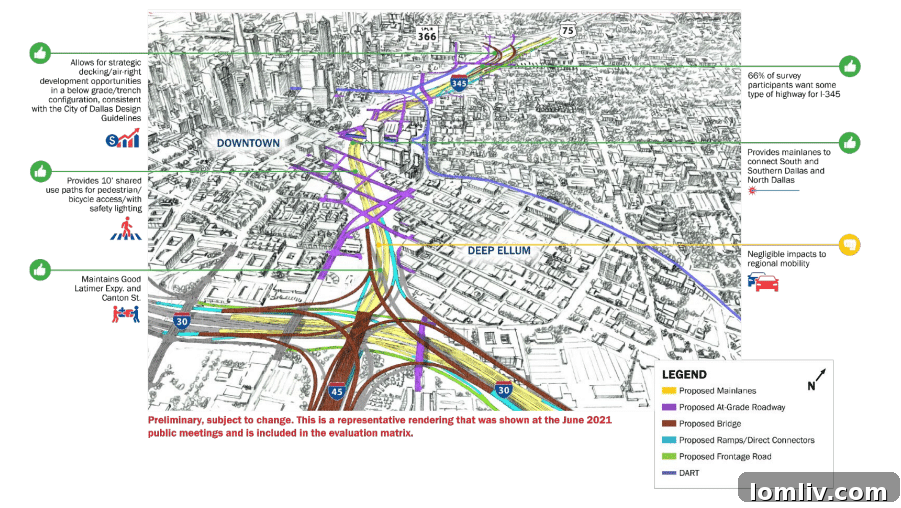
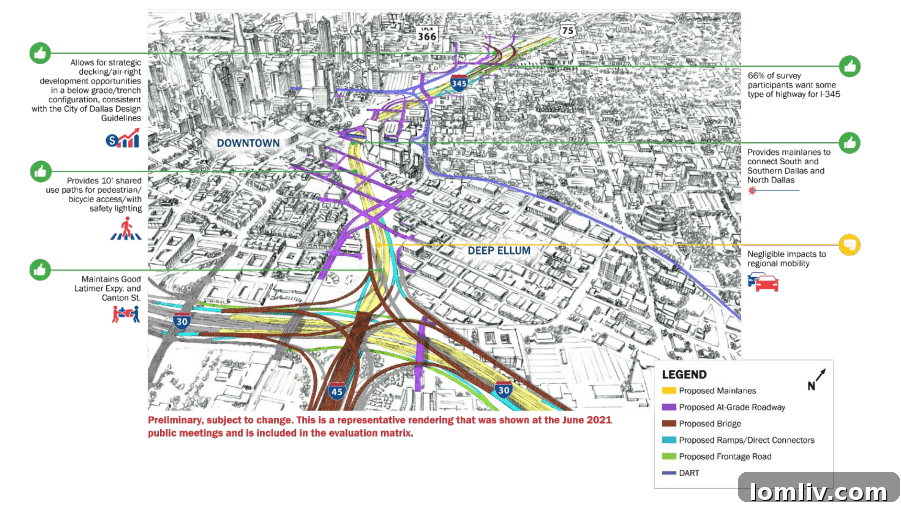
The future of Interstate 345, a critical elevated freeway dissecting the vibrant neighborhoods of Deep Ellum and Downtown Dallas, continues to be a central point of discussion among Dallas city leaders, Texas Department of Transportation (TxDOT) officials, and concerned residents. This monumental infrastructure decision is widely regarded as one of the most impactful transportation and urban development choices Dallas has faced in recent memory. For years, the elevated structure has served as both a vital artery and a divisive barrier, prompting extensive debate over its redesign. While TxDOT has put forward a “hybrid trench” recommendation, a segment of the Dallas City Council has expressed strong reservations, advocating for an independent, third-party study to thoroughly evaluate all potential alternatives before committing to such a significant, long-term project.
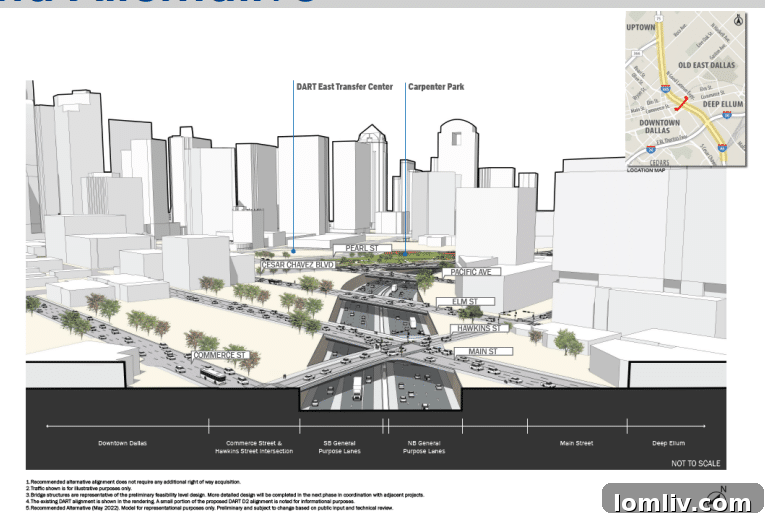
A pivotal moment occurred recently as the city council’s transportation committee voted 5-2 to endorse TxDOT’s proposed plan. This plan envisions lowering Interstate 345 approximately 65 feet below ground level on the eastern side of Downtown Dallas, effectively creating a trench. This trench would allow for continuous traffic flow, while covering decks above the roadway would reconnect the urban fabric. A key benefit touted by proponents of this “hybrid option” is the liberation of an estimated 5.4 acres of surplus right-of-way. This newly available land is slated for crucial housing and economic development initiatives, promising to transform previously underutilized spaces into thriving community assets and address Dallas’s growing housing needs.
Although the committee’s vote was not strictly mandatory – as recommendations are not typically required for briefing items – it nonetheless placed a significant endorsement on the table for the upcoming City Council briefing. Committee members indicated that an independent study could still be commissioned at a later stage, but the current vote signals a strong lean towards TxDOT’s preferred solution. This decision has not, however, quieted the dissenting voices, particularly those who represent the communities most directly impacted by the freeway’s presence.
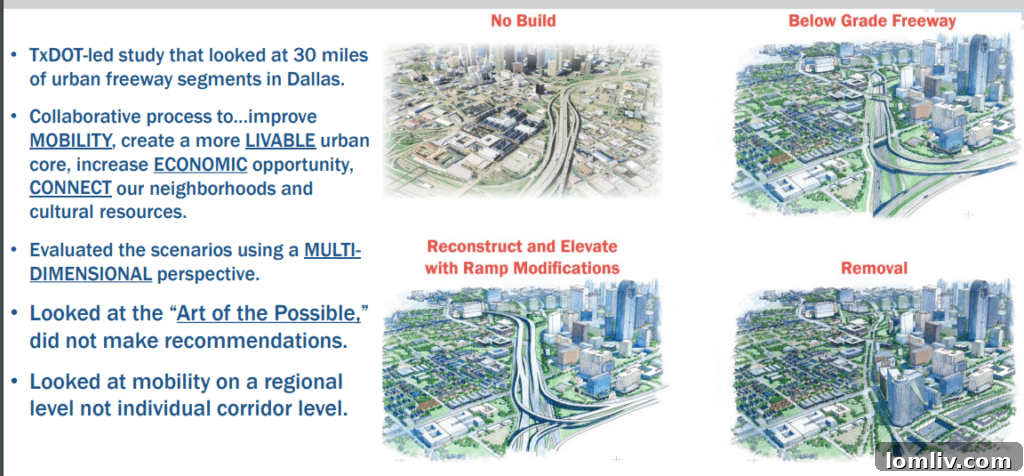
Among those expressing serious concerns about what they perceive as a premature endorsement were Council Members Chad West and Jesse Moreno. Moreno, whose district encompasses Deep Ellum—an area intensely affected by the I-345 corridor—appeared particularly invested in exploring an alternative “boulevard option.” This alternative concept, favored by many urbanists and community advocates, would convert the freeway into a more integrated urban boulevard, potentially yielding a much larger surplus of approximately 25 acres of right-of-way. This substantial increase in available land could dramatically expand opportunities for housing, green spaces, and diverse economic development, fostering a more pedestrian-friendly and community-oriented environment.
Moreno articulated his frustration, stating, “I hear loud and clear that TxDOT will not support any other option but the hybrid option. It doesn’t matter what questions we ask and what the outcome is. The direction from TxDOT is that they’re moving forward with the recommendation of a hybrid, regardless.” This sentiment underscores a core tension in the ongoing debate: the perception that TxDOT’s recommendation is a fixed position, potentially sidelining other viable and potentially more beneficial alternatives for Dallas’s long-term urban landscape.
The Critical Need for an Independent Analysis of I-345
Council Member West echoed Moreno’s disappointment, particularly regarding the transportation committee’s decision to back TxDOT’s recommendation, which he argued undermined a five-signature memo filed just a month prior. This memo explicitly called for an independent analysis of the I-345 project, aiming to provide an unbiased assessment of all proposed options and their far-reaching implications. Compounding the issue, the transportation panel also voted 5-2 against recommending this memo, a decision justified by some as a conflict with the panel’s direct support for the hybrid option. This rejection of an independent review raises significant questions about the decision-making process for such a monumental project.
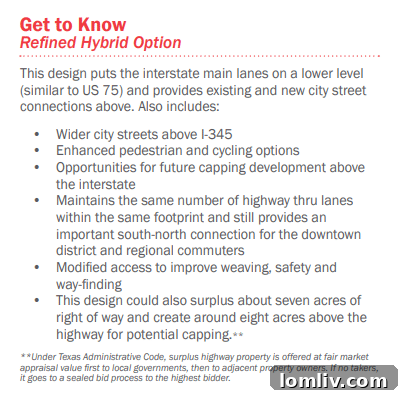
West did not mince words in his critique of the “hybrid” terminology. He asserted, “The ‘hybrid’ terminology is a brilliant marketing term. It suggests a compromise. It’s not a compromise; it’s a trench. Let’s just be honest with ourselves.” He passionately argued that the committee’s decision to move forward without an independent study for what he termed a “generational decision” – one that will shape Dallas for the next 70 to 100 years – was deeply flawed. West emphasized the unprecedented nature of this infrastructure undertaking and the irreversible consequences of making a decision without a comprehensive, unbiased examination of all alternatives.
He expressed concern that future generations, looking back in 2099, would see that the transportation committee chose to “jump in the car with TxDOT” and endorse an option that prioritizes vehicular traffic over other critical considerations. These considerations include environmental sustainability, the crucial task of reconnecting historically divided communities, maximizing housing opportunities, and fostering robust economic development. West’s powerful statement underscores the potential for the chosen path to define Dallas’s urban character for decades, making the call for a thorough and independent study not just a preference, but a perceived necessity. “I’m disappointed, and staff has said once we do this, there is no turning back,” he warned, highlighting the finality of the decision once implementation begins.
How the I-345 Hybrid Option Could Impact Dallas’s Housing Future
The implications of the I-345 redesign extend significantly to Dallas’s pressing housing challenges. Michael Morris, Director of Transportation for the North Central Texas Council of Governments, made an impassioned plea to community leaders and housing advocates during a recent community meeting. He urged them to coalesce in support of TxDOT’s hybrid option, framing it as a unique and timely opportunity. “When we have this amount of money sitting in Washington, you make hay when the sun shines, and this is a great opportunity, in my opinion, to do that,” Morris stated, underscoring the potential to secure substantial federal funding that could be leveraged for comprehensive urban improvements, including housing.
David Noguera, Dallas Director of Housing and Neighborhood Revitalization, offered a critical historical perspective, noting that freeways have historically served as instruments of disconnection, fragmenting communities across North Texas. He emphasized the profound opportunity I-345 presents: “Here we have an opportunity to reconnect them. How we do that is up for debate. I believe that the hybrid option does offer a way to integrate that.” Noguera also highlighted the crucial importance of leveraging additional funds for housing development. He explained that while affordable housing projects share many similarities with market-rate housing, they invariably face a funding gap that requires external sources. This often necessitates tapping into state and federal funding streams, making TxDOT’s project a potential conduit for much-needed resources.
Noguera articulated the city’s strategic approach: “The question is, how do we put ourselves in the position to do that? So when we’re coming before the city manager and the city council looking for funding to carry out our project, we’re not taking a go-it-alone approach. That approach typically doesn’t get us very far, particularly when the needs that we have for housing far exceed the resources.” He humorously but pointedly described his strategy as the “barnacle approach,” explaining, “I want to latch on to an effort that’s already underway and ride it as far as it’ll take us, particularly when it comes to developing more housing.” This perspective highlights the pragmatic need to align with large-scale projects like I-345 to secure funding for critical housing initiatives, even if the primary focus of such projects is transportation.
Key Debates from the Transportation Committee Briefing on I-345
The Monday transportation committee meeting, presided over by Deputy Mayor Pro Tem Omar Narvaez, vividly showcased the deep divisions among council members. A central point of contention revolved around the potential for an independent study to cause further delays to a project already anticipated to span at least a decade. Narvaez voiced strong opposition to the five-signature memo calling for such a study, citing several critical concerns. “I do not agree with the five-signature memo, and the main reason is it delays the entire process that would cause us to lose funding and … it wasn’t clear which option we were studying,” Narvaez stated. He underscored that the potential loss of crucial state and federal funding due to project delays was his paramount concern, alongside the practical challenge of securing funds for an additional study.
Council Member West pressed TxDOT representatives on whether their engineering and planning processes were being aligned with recently approved city policies concerning housing, economic development, and environmental sustainability. While TxDOT has indeed dedicated 15 years to studying the I-345 project, their representatives made it clear that continued council support is essential for them to secure the necessary funding and to advance into the detailed design and planning phases. Assistant City Manager Robert Perez further explained that once a definitive recommendation is chosen, a comprehensive market study would be required to determine the optimal land use for the surrounding redeveloped properties, ensuring that the surplus land contributes maximally to Dallas’s urban goals.
However, the lack of comparative data remained a sticking point for West. He specifically asked, “Do we know how many more people could live around I-345 with the boulevard option as opposed to the trench option?” The response indicated that such detailed comparative analysis would necessitate additional studies—precisely the kind of independent assessment West and other council members had been advocating for. West concluded, “That’s the core of my issue with this,” highlighting the fundamental disagreement over proceeding with a “generational decision” without a full, transparent understanding of the comparative benefits and drawbacks of each potential pathway for Interstate 345’s future. The eventual decision on I-345 will not merely reconfigure a highway; it will redefine significant portions of Dallas’s urban landscape, impacting everything from traffic flow and community connections to housing availability and economic vitality for generations to come.