The I-345 Debate: Rethinking Dallas’s Urban Future and Traffic Realities
The urban landscape of Dallas is currently at the heart of a significant and passionate debate: the proposed demolition of the I-345 elevated highway in downtown. This contentious idea, spearheaded by proponents like Patrick Kennedy and his allies, suggests that the freeway acts as a barrier, stifling urban development, creating a divide between neighborhoods, and occupying valuable land that could otherwise be repurposed for housing and commercial ventures. However, a compelling counter-argument, meticulously researched and articulated by Dallas attorney Ed Woodson and computer scientist Aren Cambre, offers a different perspective, urging caution and a deeper consideration of the potential repercussions. This article delves into their insights, exploring what truly defines a “world-class city” and, crucially, where the displaced traffic would go if I-345 were to be removed.
The implications of such a monumental change are far-reaching. As evidenced by current traffic patterns, our city’s infrastructure is already under immense pressure. Consider Northwest Highway, a vital cross-town artery. A 2011 NCTCOG traffic study reported it carried 56,659 cars daily. With ongoing re-routing due to LBJ/I-635 construction, that number is now likely closer to 67,000 cars per day. This illustrates a fundamental principle of traffic flow: much like water, it rarely disappears entirely; instead, it finds the path of least resistance. This underscores the critical need to understand the true impact of removing a major highway like I-345 rather than assuming traffic will simply vanish.
Defining “World-Class”: Dallas’s Unique Appeal
The notion of a “world-class city” often evokes images of densely packed metropolises like New York, Boston, or prominent European capitals. Mr. Kennedy’s vision aligns with this high-density model. Yet, we propose a more inclusive definition: a world-class city is characterized by a thriving economy, a substantial and growing population, and a comprehensive array of “big city” amenities. This includes a vibrant culinary scene, rich cultural institutions, professional sports teams, state-of-the-art airports, and leading universities. By these metrics, Dallas unequivocally stands as a world-class city today. The ability for its residents to navigate the city by car, enjoying unparalleled mobility, does not diminish this status; rather, it contributes to its distinct identity and appeal.
Furthermore, Dallas offers a significant advantage that many of its more densely urbanized counterparts cannot: accessible and affordable single-family housing. Homeownership remains a cornerstone of the American Dream, a goal actively supported by various levels of government through incentives and, notably, through the development of robust highway networks that connect residential areas to major employment centers. This approach has shaped the rapid growth seen over the last five decades in major U.S. regions like Dallas, Houston, Phoenix, and Atlanta, resulting in expansive suburbs alongside dynamic urban cores. While critics might label this as “sprawl,” for countless citizens, it represents a preferred lifestyle, offering space, community, and the promise of homeownership.
Without this fifty-year trajectory of suburban expansion, the greater Dallas area would be a mere shadow of its current prosperous self. While it might exhibit greater density and walkability in its core, it would undoubtedly be a much smaller city, lacking the scale and economic power that define its “world-class” standing today. Moreover, such a restricted growth model would likely run counter to the expressed desires and preferences of the vast majority of Dallas’s citizens, who have actively chosen the quality of life and opportunities afforded by its current structure.
Mr. Kennedy also employs a contrasting argument, suggesting that without embracing his specific vision for a “new urban Dallas,” the city risks a slow decline akin to Detroit’s past struggles. We commend his ingenuity in invoking a modern “boogeyman” to galvanize support for his proposals. However, this argument, while dramatic, borders on scare-mongering and overlooks the fundamental historical and socio-economic disparities between Detroit and Dallas. Dallas boasts a remarkably stable population, a consistently effective city government, and a history free from the widespread race riots and rampant crime that plagued Detroit. Crucially, Dallas has never experienced the near-wholesale departure of entire industrial sectors that devastated Detroit’s economy. Equating Dallas’s future with Detroit’s past ignores these critical distinctions.
His “world-class” city argument also raises an interesting question when considering Dallas’s own successes. What about Uptown, which has been the fastest-growing area adjacent to downtown over the past decade? Does the presence of one highly successful, growing urban district merely qualify Dallas as a “provincial city,” while the addition of another—achieved by removing I-345—would suddenly elevate it to “world-class” status? This line of reasoning appears inconsistent with the vibrant growth already happening within Dallas’s existing framework.
Deconstructing the “Noose”: I-345 as a Functional Connector
The characterization of I-345 as a “noose” or “wall” around downtown Dallas is a point that generates varied opinions. From our perspective, the concept of a rigid barrier seems questionable, given the numerous surface roads that flow underneath I-345, making it quite porous. Furthermore, downtown Dallas has experienced significant eastward renewal and development over the last two decades, suggesting that I-345 has not entirely stifled growth in that direction. While we acknowledge that prominent voices like Peter Simek at D Magazine strongly contest this view, we approach this specific facet of the argument with caution, recognizing the complex nature of real estate development and focusing our efforts on other, more readily apparent concerns.
However, we do have a crucial observation regarding I-345’s functionality: for pedestrians, cyclists, and motorists alike, traversing from one side of I-345 to the other is remarkably straightforward compared to what its absence might entail. Consider the closest analogy we can imagine: the often-gridlocked Northwest Highway near Preston Road. If I-345 were to be replaced by a series of congested surface streets, this is precisely the kind of traffic nightmare we would create downtown. The elevated design of I-345 effectively removes significant volumes of through-traffic from ground level, channeling it efficiently above the urban fabric. This separation is vital, leaving the areas below safer, more walkable, and more tranquil for residents and visitors. Removing this critical piece of infrastructure risks transforming local streets into choked arteries, detrimental to both commuters and urban life.
New Urbanism: Ideals vs. Dallas Realities
Mr. Kennedy identifies as a proponent of “New Urbanism,” an urban design philosophy that champions walkable neighborhoods, mixed-use development, and a balanced integration of jobs and housing within dense urban environments. A core tenet of New Urbanism asserts that “high-density” cities—those with more people per square mile—are inherently beneficial, while “low-density” cities are considered less desirable. This philosophy extends to its corollaries: multi-family dwellings, such as apartments and condominiums, are favored, while a reduced reliance on personal automobiles is strongly encouraged. Conversely, traditional single-family homes are often viewed as undesirable, if not problematic, and cars are seen as detrimental to urban vitality. One can only imagine the disdain for SUVs within this framework. For a staunch New Urbanist, living in a sprawling city like Dallas might feel like a constant source of frustration.
The underlying aspiration of New Urbanism, as applied to Dallas, appears to be a transformative shift in lifestyle: encouraging citizens to abandon their single-family residences, forgo their personal vehicles, relocate to the urban core, and rely heavily on public transportation. From this perspective, any disruption to existing traffic patterns, particularly one caused by the demolition of I-345, might be viewed as a positive catalyst. Even if it results in more intense traffic than proponents admit, and necessitates a substantial reshuffling of Dallas living habits, it could be seen as a desirable outcome once Dallasites adapt. After all, according to Mr. Kennedy, the removal of I-345 is merely the initial stride in a broader vision for “reimagining Dallas.” This process would extend beyond immediate new developments adjacent to the current freeway, fundamentally altering the driving habits and residential preferences of the city’s inhabitants.
The Fallacy of “Disappearing Traffic”: Induced Demand Reconsidered
Many advocates for highway teardowns often invoke the theories of “induced demand” and “disappearing traffic.” These theories posit that constructing more roads inevitably generates more overall traffic, and conversely, removing roads will eventually lead to a reduction in total traffic volume. In a general sense, there is some truth to this. Historically, highways were built in Dallas to facilitate suburban development; as suburbs grew, more people naturally used the highways. Similarly, if highway capacity is significantly diminished through demolition, total traffic might decrease over time as people actively avoid congestion by driving less, opting for alternative modes of transport, or altering their routes and destinations.
However, the crucial question remains: where would this traffic actually go? How do people truly adjust to significantly worse traffic conditions? The most common responses include reducing commute length, utilizing alternative freeways or surface streets, or, less commonly, transitioning to public transportation. A new urbanist might view reduced commute lengths as a clear positive, leading to greater density in central Dallas as some move closer to their jobs, or less driving in the suburbs as others find employment closer to home. Mr. Kennedy specifically suggests that some of the traffic “disappearing” after I-345’s destruction would be attributed to people relocating to his envisioned “new urban oasis” east of downtown.
Theoretically, the more severe the post-demolition traffic, the greater the motivation for central Dallas’s density to increase. Yet, an opposing scenario is equally plausible, if not more likely. Jobs are already decentralizing from downtown, gravitating towards booming areas like Uptown, Plano, and other northern suburbs. Worsening downtown traffic would only accelerate this existing trend of reverse-commuting, pushing more jobs and residents away from the urban core rather than attracting them. Moreover, a critical factor often overlooked is that most people are unwilling to drastically alter their living arrangements or job locations overnight.
Mr. Kennedy’s proposed disruption, while framed as a benefit for the entire city, disproportionately serves well-positioned property owners and a hypothetical segment of the population willing to relocate to the urban core, often at the expense of everyone else’s convenience and quality of life. There may also be very real limitations to Mr. Kennedy’s perceived “pent-up demand” for urban housing. While downtown and Uptown apartments might appeal greatly to single individuals or childless couples, it is highly improbable that a significant number of suburban parents would readily abandon their homes and established school districts for apartments adjacent to downtown, particularly if it means navigating increased traffic congestion to reach other parts of the city.
The Dire Consequences of Displacement: Where Will the Traffic Go?
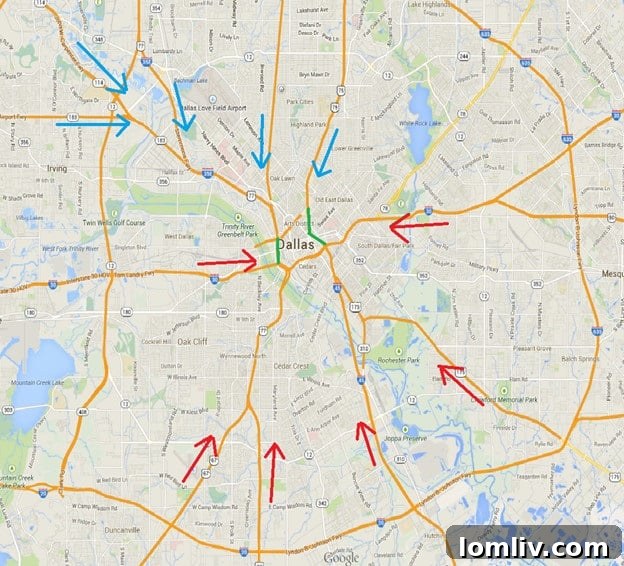
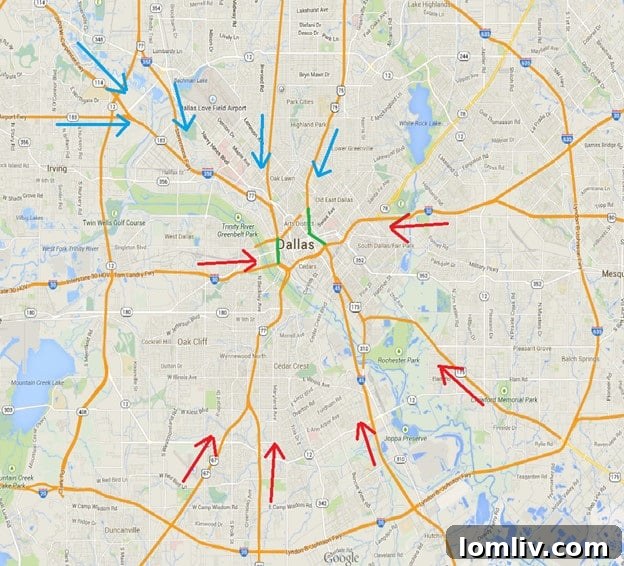
Regarding through traffic, the hypothetical solution is that it would simply find different freeway routes through Dallas to bypass the absence of I-345. Mr. Kennedy estimates that 75% of the traffic currently using I-345 does not exit into or out of downtown. He argues that post-demolition, this traffic would divert to other major freeways like I-635 or onto already strained surface roads such as Northwest Highway. Unfortunately, the devil is in the details; comprehensive data regarding traffic origins and destinations is paramount. This is precisely why we, and others, contend that any demolition plans should be indefinitely deferred until a definitive, independent traffic study thoroughly identifies these critical origins and destinations.
If the traffic in question genuinely represents “through traffic” – originating and terminating entirely outside the I-635 loop – then alternative freeway routes might seem less problematic, assuming we are content with subjecting current users of I-635 to significantly longer commute times and increased congestion. However, any portion of the traffic that either originates or terminates within the I-635 loop will likely have no viable alternative freeway options. Instead, these vehicles would be forced onto already overburdened surface streets or, more realistically, funneled into the intricate and frequently congested “Mixmaster” interchange. The true breakdown of traffic types on I-345 is currently poorly understood, and any rational decision-maker would demand a clear answer to this before contemplating the irreversible destruction of the only direct connector between two vital freeways.
Let’s assume, for a moment, that Mr. Kennedy’s estimates are accurate, and the approximately 150,000 daily vehicles (representing 75% of I-345’s through traffic) are indeed forced to divert. Where, precisely, would this enormous volume of traffic go? It would inevitably be distributed across Loop 12, I-635, the Bush Turnpike, and numerous other arterial roads. In essence, this scenario paints the rest of the Dallas area – its suburbs and many neighborhoods within the city limits – as unwilling victims, forced to endure significantly worse traffic misery. This sacrifice would be made so that Mr. Kennedy and his allies can pursue utopian urban planning experiments, potentially enriching a select few property owners in the process.
Some of Mr. Kennedy’s supporters have explicitly framed this issue as an adversarial conflict between the city of Dallas and its suburbs. To them, the prospect of additional traffic on suburban routes might appear immaterial. However, even if Dallas were inclined to disregard its suburban neighbors, it is crucial to recognize that the city of Dallas encompasses far more than just its urban core. Many of the negatively affected suburban areas, as well as the alternative routes that would be forced to absorb displaced through traffic, are either entirely or partially situated within the official city limits of Dallas itself. This isn’t just a city vs. suburb issue; it’s a city-wide problem.
Regarding public transportation, we are unequivocally in favor of it for anyone who chooses to use it and contribute to its sustainability. However, it strikes us as deeply authoritarian and cynical to intentionally degrade existing driving conditions solely to coerce people into using public transportation. As a Twitter follower of Wick Allison aptly noted, while lamenting the width of I-35E, “we wonder why mass transit doesn’t get utilized by the masses. They don’t have to.” Indeed. The implication is clear: Mr. Kennedy’s approach seems to suggest that he would make them.
A Call for Prudence: Data-Driven Decisions Over Ideology
We believe in and appreciate urban living. Both of us reside within the I-635 loop and regularly enjoy the city’s extensive amenities. One of us even lived downtown for several years and thoroughly embraced the experience. We are not opposed to high-density development in the DFW area, provided it is supported by adequate demand and thoughtful planning. However, there is a categorical difference between urban planning on a blank slate – an undeveloped parcel of land – and the complex task of re-planning an established metropolitan area of five million people, where billions of dollars have already been invested in the intricate infrastructure that supports the city as it functions today.
This is why we have a fundamental disagreement with the proposal to demolish I-345. A preliminary review of Dallas traffic patterns strongly suggests that such a teardown could have catastrophic consequences for the city’s transportation network. While our concerns might be alleviated by a comprehensive and impartial traffic study, the critical issue is that proponents are pushing for demolition before such a study is completed and its findings are understood. We have a major objection to arguments suggesting we should proceed with the I-345 teardown based on what Mr. Simek calls “the example set by cities around the country,” particularly when these examples rely on Mr. Kennedy’s wildly optimistic and, at times, deceptive case studies. The proposed removal of I-345 is unprecedented, both in terms of the raw volume of traffic flow it handles and its critical function as a direct connector between two essential freeways in the Dallas metropolitan area.
Therefore, before we commit to an irreversible decision that could lead to profound and lasting regret, let us all take a deep breath. Let us first ascertain the precise composition of the traffic flow on I-345, understanding its origins, destinations, and functional purpose. Let us thoroughly explore all viable alternatives to demolition, evaluating their costs, benefits, and feasibility. And, perhaps most importantly, let us endeavor to understand what the citizens of Dallas truly desire for their city’s future – which, in all likelihood, does not include greater traffic misery.