

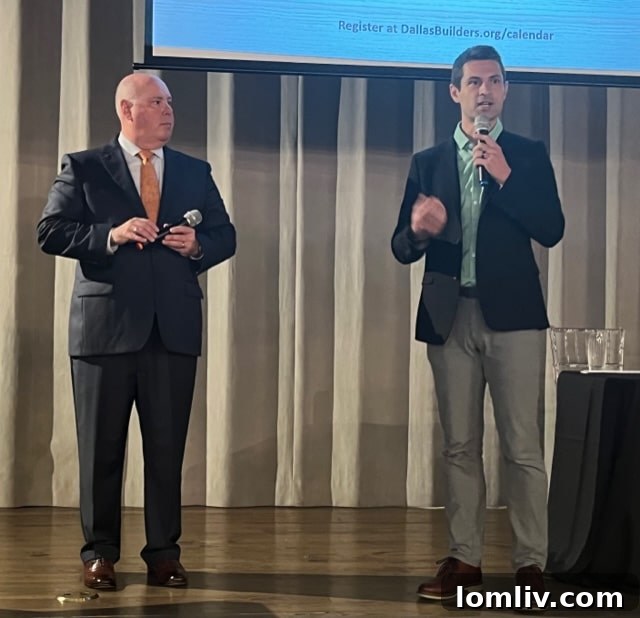
The Texas housing market continues to stand out as a beacon of resilience and opportunity in the national landscape, even as homebuilders across the country grapple with significant headwinds. This sentiment was a central theme at the recent Dallas Builders Association’s State of the Industry event, where industry leaders convened to dissect the multifaceted challenges and unique advantages faced by the building sector. Phil Crone, Vice President of the Leading Builders of America and former Executive Officer of the Dallas BA, conveyed a clear message: while no market is without its imperfections, Texas builders are navigating a comparatively favorable environment. This perspective was reinforced by James Tobin, President and CEO of the National Association of Home Builders (NAHB), who joined Crone for an in-depth discussion on how federal regulations are profoundly shaping home building and development nationwide.
The dialogue at the summit underscored the complex interplay between economic policy, federal mandates, and local market dynamics. Crone and Tobin, both seasoned advocates for the home building industry, provided critical insights into the forces impacting housing supply and affordability. Their discussion illuminated the pressing need for policy adjustments that foster, rather than hinder, the creation of much-needed homes. Attendees, comprising a mix of builders, developers, and real estate professionals, gained a comprehensive understanding of the current market climate and the advocacy efforts underway to ensure a healthier future for housing.
One of the primary economic forces discussed was the Federal Reserve’s aggressive campaign to reduce inflation to its target of 2 percent. Crone recalled the Fed’s warnings to home builders about the impending pain, acknowledging that their efforts have indeed had a profound impact. “They thought that with the inflationary attack, they were going to break the consumer,” Crone explained. However, the outcome was different: “What happened was they broke the transaction.” This critical distinction highlights that while consumer demand for housing remains robust, the ability to execute a home purchase has been severely hampered by soaring interest rates and persistent high prices. The market is characterized by a paradox: strong underlying demand meets an increasingly unaffordable reality. Supply remains at historically low levels, making the landscape exceptionally challenging for both prospective homebuyers and the builders striving to meet their needs. This environment of high prices, restricted supply, and elevated borrowing costs creates a difficult balancing act, underscoring the urgency for innovative solutions and sensible policy adjustments.
Why Texas Leads the Nation in Housing Growth
Despite the national headwinds, there’s an undeniable truth: demand for housing is robust, particularly in growth states like Texas. Crone emphasized that the most straightforward and effective solution to the housing crisis is to increase supply. “We can fix it by building more homes,” he asserted. “That’s what we do. That’s what needs to happen. It’s easier said than done.” This statement encapsulates the core mission of home builders while acknowledging the significant barriers they face. The U.S. is currently grappling with a severe housing deficit, estimated at approximately 4 million homes. This shortage is exacerbated by historical lows in available inventory. According to the National Association of Realtors (NAR), the country is experiencing the lowest supply of single-family homes since 1982, the year the NAR first began systematically tracking such comprehensive data. This prolonged scarcity has profound implications for housing affordability and economic mobility across the nation.

Addressing this deficit requires a concerted effort to remove obstacles to construction. Crone noted, “You should be able to build your way out of it, but it’s not easy.” The affordability gap has widened dramatically; to afford a median-priced home in today’s market, an American household typically needs an annual income of about $115,000. This figure starkly contrasts with the median household income, which falls short by approximately $40,000, illustrating the growing challenge of homeownership for a significant portion of the population. Texas, however, benefits from a combination of factors that position it favorably, including a strong job market, continuous population growth, and a comparatively more flexible regulatory environment than many other states. While even Texas builders face rising land, labor, and material costs, the state’s proactive approach to development and its abundant land resources allow for greater potential to scale up housing production.
Crone elaborated on the diverse and complex challenges faced by home builders in other regions, further highlighting Texas’s relative advantages. In California, for instance, rampant wildfires, coupled with stringent environmental regulations and high development costs, create an exceptionally difficult environment for new construction. Developers contend with extensive permitting processes, significant land constraints, and costly mitigation measures. Nevada has historically faced issues with illegal practices, which have left a legacy of distrust and complicated current efforts to streamline development, despite the state’s rapid growth. Arizona struggles with acute water scarcity, a critical resource issue that directly impacts the feasibility and scale of new housing developments, often leading to moratoriums or severe restrictions on building permits. These regional examples underscore how varied environmental and historical regulatory landscapes can profoundly impact housing supply and affordability. In contrast, while Texas is not immune to environmental concerns or regulatory hurdles, its challenges, when viewed comparatively, are often less severe or more manageable, contributing to its standing as a leading housing market.

Furthermore, Crone pointed out that aggressive climate-related legislation originating from Washington, D.C., often neglects to adequately consider its downstream impact on housing affordability. While environmental protection is crucial, the implementation of new mandates without careful assessment of construction costs and development timelines can inadvertently inflate home prices and reduce housing options. These federal policies, when layered onto existing state and local regulations, can create a cumulative burden that makes building more expensive and time-consuming. This makes it difficult for builders to deliver homes at price points accessible to the average American family. Reflecting on this broader context, Crone offered a crucial perspective to the Dallas builders: “The takeaway here is you’re still, for a lot of reasons, in the best market in the country and in as good of a situation as you could possibly have.” He acknowledged the legitimate concerns and frustrations within the industry but stressed the importance of context. “There’s plenty of things to be worried about and plenty of things to complain about … It’s all relative. You’ve got to realize, that like a lot of things in life, other people have it worse and in the housing industry, just about everybody else does in terms of the challenges we’re dealing with.” This balanced view serves as both a comfort and a call to action, reminding Texas builders of their pivotal role in a critical national industry.
National Association of Home Builders: Advocating for Supply-Side Solutions
James Tobin, President and CEO of the National Association of Home Builders (NAHB), brought a national perspective to the discussion, drawing on his extensive experience as a “recovering lobbyist” whose office is strategically located in the nation’s capital. Tobin confirmed that a tough, yet essential, conversation is taking place at the national level about how to genuinely solve the escalating housing crisis. He articulated the core mission of NAHB members: “We’re all trying to build the American dream as affordably and attainably as possible.” This aspiration, however, is frequently hindered by a pervasive and often underestimated factor: the regulatory burden. According to NAHB research, regulatory costs account for over 25 percent of the final price of a newly constructed single-family home. For multifamily developments, this burden is even more substantial, exceeding 42 percent. These figures encompass a wide array of regulations, including zoning requirements, lengthy permitting processes, impact fees, environmental reviews, and various building code mandates, all of which add significant cost and complexity to construction projects. Such regulatory accumulation makes it extraordinarily difficult for builders to deliver homes at price points that are accessible to the average American family, directly fueling the affordability crisis.

Tobin highlighted a curious paradox in housing policy: “I’ve never met a legislator who is anti-housing, but they really put some barriers up toward achieving that goal.” He explained that policymakers genuinely care about housing and are actively trying to make it more affordable. However, their efforts often misfire because they primarily approach the problem from the demand side. Legislators tend to focus on programs and subsidies designed to help people afford an already expensive product, rather than tackling the root cause of high prices by increasing supply. “They want to help people afford an already-expensive product because they don’t want to lower the price,” Tobin stated. This demand-side focus includes initiatives like first-time homebuyer credits, down payment assistance, or rent subsidies. While these programs provide immediate relief to some individuals, they often fail to address the fundamental imbalance between housing supply and demand. In some cases, by increasing purchasing power without adding to the housing stock, demand-side solutions can inadvertently push prices even higher, exacerbating the very problem they aim to solve. The NAHB argues that a sustainable solution requires a fundamental shift towards supply-side policies.
Tobin passionately argued that if more supply is added to the market, prices will naturally and organically begin to decline. This basic principle of economics is often overlooked in policy debates. “We’re looking for the government to step back and let us do our jobs, which means if you turn the power in this room loose, we will meet the demand in this country for housing in America, plain and simple,” he asserted. This call to action emphasizes that builders possess the expertise, capacity, and drive to construct the homes America needs, provided they are not unduly burdened by excessive regulations and bureaucratic hurdles. He warned against the current trajectory: “We are creating a society where only the wealthy can afford to be landowners in America. We can no longer do that.” The societal implications of declining homeownership are profound, leading to increased wealth inequality, reduced economic mobility, and a diminished sense of community. Tobin concluded with a powerful and stark choice: “We’ve got to decide if we want to house everybody or if we just want to house the wealthy. The way we do that is with more supply.” His message resonated deeply with the builders present, underscoring the urgent need for a national policy pivot that prioritizes robust housing production as the cornerstone of a healthy and equitable society.