The Untethered Workforce: How Remote Work is Reshaping Our Cities and Lives
The daily grind of the commute has long been a defining, and often dreaded, aspect of modern working life. Endless hours spent stuck in traffic, battling crowded public transport, or simply rushing from one point to another, often left employees feeling drained before their workday even began. Then, a global health crisis forced an unprecedented experiment: remote work on a massive scale. What started as a temporary measure quickly revealed a dramatic and potentially permanent shift in how and where we work, fundamentally altering the landscape of urban living, transportation, and the housing market.
For millions across the globe, the opportunity to work from home became one of the unexpected upsides of the pandemic. The once-inescapable rush hour became a distant memory for many, replaced by newfound flexibility and a re-evaluation of work-life balance. This transformative period has unveiled a profound evolution in professional dynamics, moving beyond mere convenience to become a core component of the modern employment ecosystem.
The Rise of the Remote-First Economy
The transition to remote work wasn’t merely a change in scenery; it represented a paradigm shift in economic and social structures. Before the pandemic accelerated its adoption, remote work was a niche concept, embraced by a mere 17 percent of the workforce, according to Statista research. Today, the landscape is vastly different. A comprehensive analysis by Apartment List estimates that a staggering one in three American jobs possesses the potential to be performed remotely on a long-term basis. This projection signals a future where geographic constraints diminish, opening up a world of possibilities for both employees and employers.
The Apartment List’s latest report is an impressively exhaustive analysis, delving deep into the nuances of remote working and its far-reaching impact on housing markets across the nation. It highlights how this seismic shift is not just about individuals working from their living rooms, but about the emergence of entirely new demographics and economic forces that are reshaping urban development and regional economies. This groundbreaking research deserves a close look for anyone seeking to understand the evolving dynamics of the post-pandemic world.
Understanding the “Untethered Class”
One of the most compelling insights from the Apartment List report is the identification of a new category of workers: the “untethered class.” These individuals are uniquely positioned within the modern economy. They are employed in occupations that are inherently remote-friendly, meaning their physical presence in an office is not a prerequisite for productivity. What further defines them is their freedom from traditional commitments that often dictate where people live, such as home ownership or significant family obligations that anchor them to a specific location. Consequently, members of the untethered class are typically younger, highly mobile, and possess a greater degree of flexibility in choosing their residential locations.
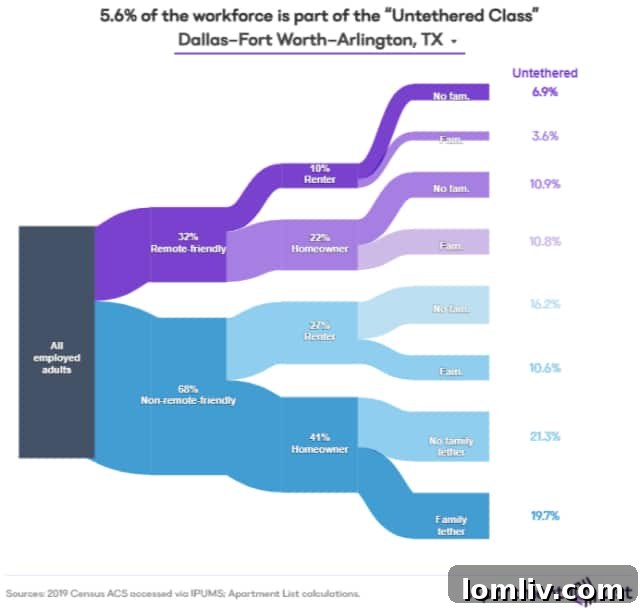
The report reveals that approximately 8.7 million Americans, constituting 5.6 percent of the total workforce, currently fall into this untethered category. Unsurprisingly, major metropolitan hubs like San Francisco, New York, and Seattle, which are renowned for their tech industries and high concentration of knowledge workers, exhibit higher shares of these mobile professionals. These cities, long considered epicenters of innovation and opportunity, are now experiencing a fascinating push and pull as their workforces gain the freedom to explore living options beyond historically expensive urban cores.
Regional Spotlight: Dallas-Fort Worth and the Remote Revolution
While tech hubs might lead in sheer numbers, the phenomenon of the untethered worker is having a significant impact across diverse regions, including the dynamic Dallas metro area. Within Dallas-Fort Worth, an impressive 6.9 percent of the workforce is classified as fully untethered, positioning the region at a respectable 14th nationally. This demographic in Dallas showcases distinct characteristics: untethered workers here have a median income of $50,000 and a median age of 32, which is a full decade younger than the median age of the area’s overall workforce. This younger, more flexible demographic suggests a vibrant, evolving professional landscape.
Furthermore, the Dallas-Fort Worth metroplex boasts a substantial portion of its employment opportunities as remote-friendly, with 32.2 percent of jobs falling into this category. This ranking places the region 31st among the nation’s 100 largest metro areas, indicating a strong foundation for continued growth in flexible work arrangements. The economic benefits for these workers are palpable: remote-friendly professionals in Dallas earn a median income of $63,000, significantly higher than the $35,400 median for the metro’s non-remote-friendly workforce. These statistics underscore the dual impact of remote work: it’s not only changing where people live but also highlighting a growing economic disparity between those with remote options and those without.
These figures are far from mere academic curiosities. They provide invaluable insights for individuals contemplating career moves, employers seeking to attract top talent, and urban planners strategizing for future growth. As the pandemic’s immediate pressures subside, the underlying shift towards more WFH opportunities remains, offering a compelling case for workers to explore how this new reality can enhance their careers and lifestyles.
Beyond the Commute: Traffic, Environment, and Urban Design
The most immediate and tangible benefit of widespread remote work has been the dramatic reduction in urban traffic congestion. INRIX, a leading transportation analytics company, highlighted this in its 2020 Global Traffic Scorecard. Their findings revealed that traffic delays plummeted by nearly 50 percent in major U.S. cities, collectively saving drivers an astonishing 75 hours on the road annually. This reduction isn’t just about saving time; it translates to significant environmental benefits, with fewer emissions contributing to cleaner air, and a noticeable decrease in fuel consumption.
The implications of sustained lower traffic levels extend far beyond convenience. Urban planners are beginning to envision cities with less car dependence, opening up possibilities for transforming roadways into green spaces, expanding pedestrian and cycling infrastructure, and rethinking public transportation models. Reduced traffic also mitigates noise pollution, contributing to a higher quality of life in once-congested areas. This shift could fundamentally alter how we design and experience our cities, moving towards more livable, sustainable, and community-centric environments.
The Broader Impact on Housing Markets and Migration Patterns
The bottom line is clear: the pandemic acted as a powerful accelerant for the work-from-home experience, pushing a gradual trend into overdrive. This rapid transition has, in turn, unleashed potentially drastic implications for migration patterns and housing markets across the country. With geographical ties loosened, individuals are increasingly prioritizing affordability, space, and lifestyle choices over proximity to a physical office. This dynamic is creating ripple effects, driving demand in previously overlooked suburban and exurban areas, and reshaping the competitive landscape of real estate.
Dallas-Fort Worth Home Sales: A Booming Market
The Dallas-Fort Worth area exemplifies this broader trend. According to the RE/MAX National Housing Report, the median home-sale price in DFW surged by an impressive 14.9 percent over the previous year, reaching $314,000. This significant appreciation reflects robust demand, fueled partly by an influx of remote workers and families seeking more space at a relatively lower cost compared to coastal mega-cities. Concurrently, housing inventory has tightened dramatically, standing at a mere 1.1 months’ supply – a staggering 57.7 percent decrease from last year. This severe lack of available homes has intensified competition, leading to properties selling at an accelerated pace, approximately 38 percent faster than a year ago. Such conditions create a challenging environment for buyers but signal a strong, seller-friendly market. For further details on the national trends, you can learn more here.
Trends in the Dallas-Fort Worth Rental Market
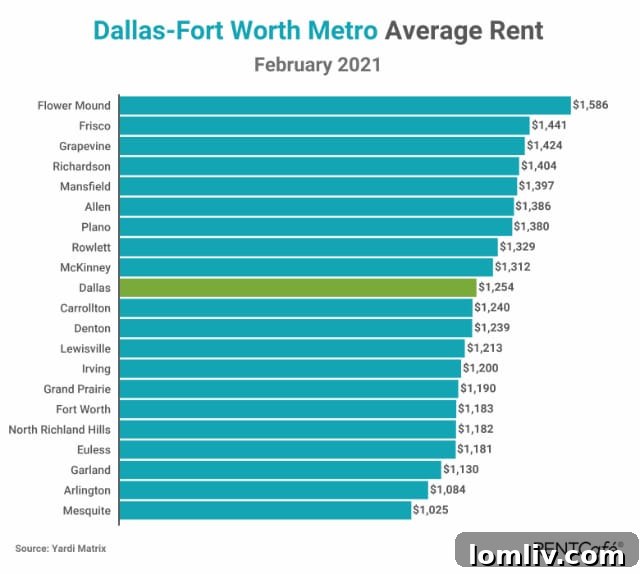
The rental market in Dallas-Fort Worth also mirrors the evolving dynamics of population shifts. RENTCafé’s February report for the DFW area highlighted varied rent increases across the region. Fort Worth led the pack with the largest year-over-year rent increase for a 1-bedroom apartment, rising 4.6 percent to $1,183. Arlington also experienced a healthy increase of 3.5 percent, pushing average rents to $1,084. Dallas proper saw a more modest increase of 0.2 percent, with rents averaging $1,254. Interestingly, Flower Mound continues to hold the title for the most expensive rent in D-FW at $1,586, despite experiencing a slight dip of 0.9 percent from the previous year. These varied changes suggest that while demand remains high, different sub-markets within the metroplex are responding distinctly to new migration patterns and local economic factors. Learn more about regional rent trends here.
Home Flipping Activity: A Changing Investment Landscape
The investment side of the housing market is also seeing significant shifts. Attom Data Solutions reported a 13.7 percent decrease in home flips within the Dallas-Fort Worth area. This local trend aligns with a broader national decline, where home flips fell by 13 percent nationwide, reaching their lowest level since 2016. In 2020, despite the downturn in flipping activity, the D-FW area still saw approximately 4,398 home flips, generating an average profit of $50,374. This placed D-FW as the eighth-best nationally for flipping profits. In North Texas, home flips constituted about 5 percent of total property sales, indicating that while the market is still attractive for investors, the frenetic pace seen in previous years may be moderating. This could point to a market that is less driven by speculative ventures and more by long-term investment or owner-occupancy. For more in-depth data, you can learn more here (subscription required) or explore their Q3 Report for the Dallas Metro Area.
The Future of Work and Living
The enduring legacy of the work-from-home experiment will be its transformative impact on nearly every facet of our lives. From the daily rhythms of commuting to the long-term strategic decisions in housing and urban development, the untethered workforce is an undeniable force. As companies continue to embrace hybrid models and employees demand greater flexibility, cities like Dallas-Fort Worth are uniquely positioned to attract new talent and redefine their economic identities. The evolution of remote work is not just a passing trend but a fundamental shift that will continue to shape our communities, economies, and personal choices for years to come.
Navigating this new era requires understanding these profound changes. For individuals, it means evaluating career paths with a broader perspective on location and lifestyle. For businesses, it necessitates rethinking office spaces, talent acquisition strategies, and employee engagement. For policymakers and urban planners, it demands innovative approaches to infrastructure, housing, and community services. The untethered class is not just a demographic; it’s a harbinger of a more flexible, decentralized, and dynamic future.