

Navigating Tarrant County Real Estate: The Critical Role of School District Ratings
When embarking on the journey to find a new home, the adage “location, location, location” invariably takes center stage. However, a close second, and often equally decisive factor for many families, is the quality of the local school district. The desire to provide children with access to excellent education is a powerful motivator, significantly shaping housing choices and property values across North Texas, particularly within the dynamic Tarrant County market.
For licensed real estate professionals, navigating this aspect of home buying comes with a specific set of guidelines. Due to fair housing regulations and strict governmental oversight, agents are ethically and legally prohibited from offering subjective opinions or specific factual comparisons about local schools and their districts. This restriction is designed to prevent “steering” or any form of discrimination based on school perceived quality. Fortunately, the vast resources of the internet empower homebuyers to conduct their own thorough research, providing an accessible pathway to critical information about educational institutions.
Understanding the impact of school performance on real estate decisions begins with reliable data. The Texas Education Agency (TEA) provides invaluable insights through its annual accountability ratings for school districts across the Lone Star State. These ratings offer a transparent snapshot of school performance, influencing everything from neighborhood desirability to property appreciation. The 2018 D/FW School District Accountability Ratings, for instance, offered particularly telling information that continues to resonate within the Tarrant County real estate landscape.
Decoding School District Accountability Ratings in Texas
The TEA’s accountability system assigns school districts a letter grade from A to F, based on a comprehensive set of criteria reflecting student achievement, school progress, and efforts to close achievement gaps among various student groups. These grades serve as a straightforward indicator for parents and potential homebuyers:
A = Exemplary Performance
B = Recognized Performance
C = Acceptable Performance
D = Needs Improvement
F = Unacceptable Performance
The implications of these grades extend far beyond academic benchmarks. A district’s rating can significantly impact its appeal to families, subsequently affecting local housing markets. It’s often observed that a “C” rating, while officially deemed “acceptable,” might not meet the aspirations of many families seeking top-tier educational environments, leading to a nuanced perception of district quality.
Tarrant County’s Educational Landscape: A Deeper Look
Focusing on Tarrant County, the TEA ratings reveal distinct patterns that directly correlate with real estate trends. A closer examination of the larger school districts provides compelling insights into current market dynamics.
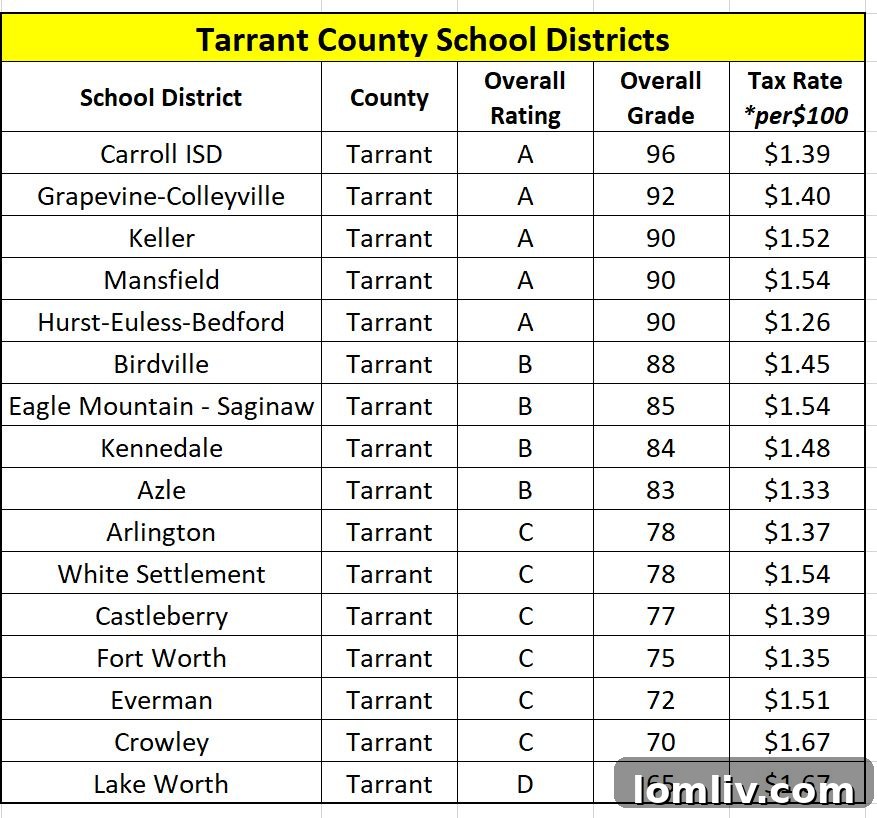
For those familiar with the geography and demographics of Tarrant County, a clear pattern emerges. School districts consistently achieving “A” or “B” overall ratings are typically found in the more suburban, rapidly developing areas. These “burbs” often feature newer infrastructure, master-planned communities, and a high concentration of family-oriented amenities. Districts like Keller, Carroll (Southlake), Mansfield, Grapevine-Colleyville, and Northwest ISD frequently fall into this category, characterized by strong community engagement and a shared focus on educational excellence. Their proximity to burgeoning economic centers and availability of modern housing stock further amplifies their attractiveness.
Conversely, districts receiving “C” ratings, considered “acceptable,” are often the larger, more established urban districts such as Fort Worth ISD and Arlington ISD. These districts serve vast and diverse populations, frequently managing older facilities and a broader range of socioeconomic challenges. While they offer unique programs, diverse student bodies, and often a rich historical context, their sheer size and complexity can make it challenging to achieve the highest overall ratings compared to their smaller, more homogenous suburban counterparts.
The Surprising Link Between Tax Rates and School Ratings
One of the most intriguing observations in Tarrant County is the unexpected relationship between school district ratings and property tax rates. It might seem logical to assume that higher-rated districts would necessitate higher tax rates to fund their superior performance. However, analysis often reveals the opposite: many of the top-performing districts exhibit relatively lower school tax rates on property values. In contrast, the largest and often lower-rated districts, like Fort Worth ISD and Arlington ISD, sometimes carry the highest tax rates per $100 of valuation.
This paradox can be attributed to several factors. High-rated suburban districts often benefit from a robust commercial tax base, significant new development that expands the tax rolls, and higher property values that distribute the tax burden more broadly among homeowners. As homes in these desirable areas command premium prices, even a lower tax rate can generate substantial revenue. Conversely, larger urban districts might grapple with a less expansive commercial tax base, older residential areas with lower property values, and a greater need for specialized programs to support diverse student populations, necessitating a higher rate to meet their budgetary requirements.
The combined effect of excellent schools and potentially lower effective tax rates makes these areas exceptionally sought after. Locations such as Keller, Southlake, Mansfield, Grapevine, and Colleyville exemplify this trend, consistently drawing homebuyers and fostering intense competition in their real estate markets. This increased demand, fueled by the promise of quality education, inevitably drives up property values and housing costs. It’s a classic supply-and-demand scenario where educational excellence translates directly into significant real estate premiums.
Beyond Tarrant County: The North Texas Real Estate Boom
The patterns observed in Tarrant County are not isolated incidents but rather reflective of broader trends across the entire North Texas region. The D/FW Metroplex, renowned for its robust economy and rapid growth, exhibits similar correlations between school district quality and real estate vitality.
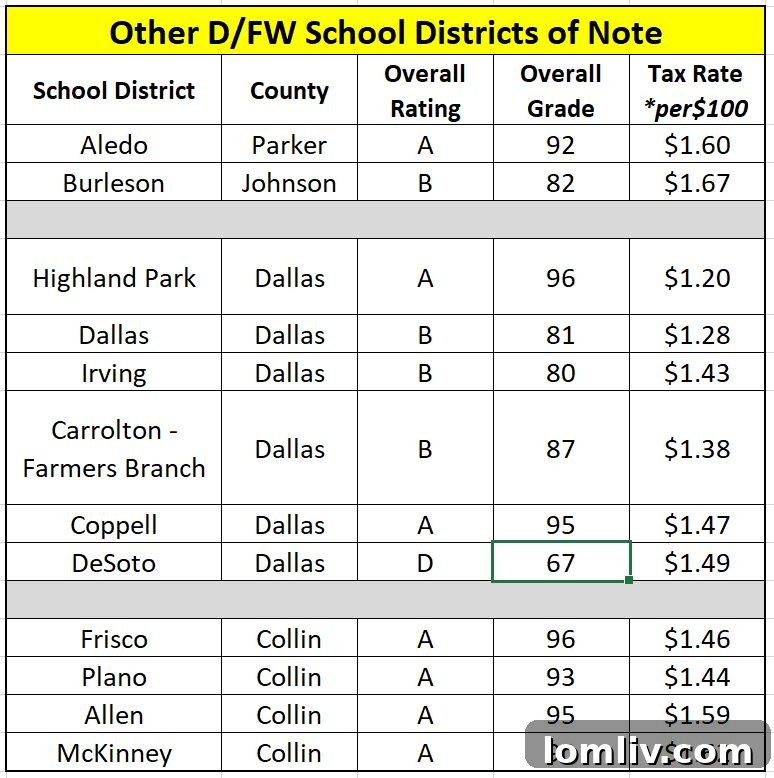
The corridor along Interstate 75, encompassing cities like Plano, Frisco, Allen, and McKinney, stands as a prime example. This region has experienced an unprecedented real estate boom, with skyrocketing home prices and continuous development. Coincidentally, these areas are home to some of the most highly rated school districts in the state. The synergy between economic opportunity, community development, and educational excellence makes these communities magnets for families seeking a high quality of life.
Interestingly, the long-standing debate about whether school districts prioritize athletics over academics often finds a nuanced answer in North Texas. Districts like Aledo, Allen, and Highland Park are not only frequent contenders for state football championships but also consistently achieve “A” ratings for their academic performance. This demonstrates that excellence in extracurricular activities and rigorous academic programs are not mutually exclusive; rather, they can coexist and even thrive within well-funded, well-managed, and community-supported school systems. While a district like DeSoto ISD has also seen athletic success, their overall academic ratings present a different picture, highlighting the complexity of balancing multiple priorities within a large district.
The Widening Gap and Its Implications for Housing and Education
The insights from the TEA ratings and the subsequent real estate trends paint a clear picture: school district quality is a dominant force shaping North Texas property markets. However, this trend also highlights a growing disparity.

If homebuyers continue to overwhelmingly favor highly rated districts, the existing gap between districts will inevitably widen. This creates a challenging cycle: top districts become more exclusive and expensive, while districts with lower ratings face increasing hurdles in attracting new families and retaining residents. Such a chasm negatively impacts not only the equitable distribution of educational opportunities but also the overall stability and diversity of housing markets across Tarrant County and beyond.
Addressing this requires a multi-faceted approach involving community leaders, educators, parents, and policymakers. Initiatives aimed at improving educational outcomes in all districts, fostering community engagement, and exploring innovative funding models are crucial for ensuring that every child has access to quality education, regardless of their zip code. The goal should be to elevate all districts, thereby creating a more balanced and accessible housing market for everyone.
Making Informed Decisions in the DFW Real Estate Market
The journey of homeownership is complex, with myriad factors influencing the final decision. For families, the quality of local schools is undeniably one of the most significant. Understanding the Texas Education Agency’s accountability ratings, recognizing the patterns within Tarrant County and the broader North Texas region, and appreciating the intricate relationship between educational performance and property values are essential steps for any prospective homebuyer.
As you navigate the dynamic real estate market of Tarrant County, remember that thorough research and informed decision-making are your most powerful tools. Explore district websites, review TEA reports, and engage with local community resources to gather comprehensive information that aligns with your family’s priorities and aspirations. The market is constantly evolving, but the fundamental desire for a great location, complemented by an excellent school district, remains a constant driver.
We hope this deeper dive into Tarrant County’s school districts and their impact on real estate has been insightful. Your questions, comments, and ideas for future discussions are always welcome!
Seth Fowler is a licensed Real Estate Sales Professional for Williams Trew Real Estate in Fort Worth, TX. Statements and opinions are his and his alone. Seth has been involved with the home sales and real estate industry in the Fort Worth area since 2004. He and his family have lived in the area for over 15 years. Seth also loves bowties! You can reach Seth at: 817.980.6636 or [email protected]
Information collected from: txschools.org, tea.texas.gov, davedowns.com/best-school-districts-dfw, www.nbcdfw.com