

The saga surrounding the proposed redevelopment of the Preston Center Garage continues to unfold, revealing a pattern of escalating ambition that raises significant questions about public interest versus private gain in Dallas urban planning. What began as a critical need to address aging infrastructure and improve parking in a bustling commercial hub has seemingly transformed into a highly contentious battle over land use, density, and community impact. The increasing scope of proposed developments, particularly by Ramrock Real Estate LLC, highlights a growing concern among residents and city planners alike regarding the long-term vision for this vital part of Dallas.
For years, the Preston Center Garage has served as a cornerstone of the vibrant Preston Center district, facilitating access for shoppers, diners, and office workers. However, the structure’s age and capacity issues have long necessitated a comprehensive solution. To address this, the city commissioned Walker Consultants to explore viable options for its future. Their final report presented two primary scenarios designed to balance parking needs with community benefits and potential urban enhancements. These studies aimed to provide a foundation for sustainable development, considering both the immediate requirements and the future growth of Preston Center.
The first option proposed by Walker Consultants envisioned a fully underground parking facility, topped by a sprawling, verdant public park. This approach would maximize green space, enhance the aesthetic appeal of the area, and provide a much-needed recreational amenity for residents. The second, a compromise option, suggested a partially underground parking structure. Under this scenario, half of the city block would be dedicated to an at-grade public park, while the remaining half would be developed into a high-rise building, most likely residential. Both options sought to retain or improve public parking capacity while simultaneously adding value to the community through green spaces or thoughtful vertical development.
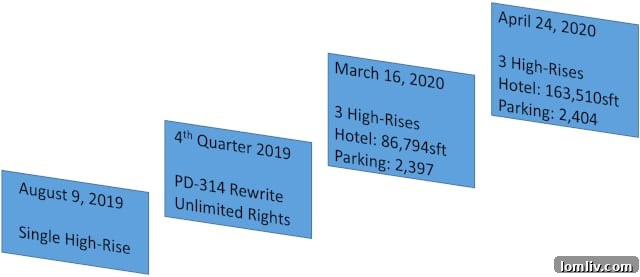
However, parallel to the consultants’ objective studies, Robert Dozier’s Ramrock Real Estate LLC introduced its own series of proposals, which have progressively broadened in scope. Initially, in August 2019, Dozier presented a plan for a single high-rise. This seemed to be a starting point for discussions. Yet, subsequent filings with the city have shown a dramatic escalation of this initial concept. The proposed rewrite of PD-314, a crucial planned development district ordinance, alongside an accompanying development plan, now calls for not one, but three high-rise structures. These buildings would collectively encompass an staggering 697,245 square feet of development, demanding zoning for an unprecedented 100 percent lot coverage. This aggressive expansion raises alarms about over-densification and its potential strain on existing infrastructure and the character of Preston Center.
The Alarming Timeline of Development Expansion
The timeline of these proposals is particularly revealing, painting a clear picture of rapidly increasing development ambitions. In August 2019, during a public meeting hosted by City Council member Jennifer Gates to discuss the garage’s future, Robert Dozier unveiled his initial plan for a single high-rise. This proposal, even in its simpler form, did not garner widespread community support, especially from those without direct financial interest in the project. The public sentiment leaned heavily towards solutions that prioritized community benefits and maintained the area’s existing charm rather than introducing massive new structures.
Despite the lukewarm reception, Dozier’s team proceeded with a rewrite of PD-314, astonishingly assuming city approval by the end of 2019, just four months after his initial presentation. This revised ordinance pushed the boundaries significantly, proposing unlimited height, unlimited stories, and an unlimited Floor Area Ratio (FAR), coupled with 100 percent lot coverage. Such a dramatic upsizing from a single high-rise to virtually unrestricted development within a matter of months underscores a clear intent to maximize development potential at an unprecedented scale, raising serious questions about the consultation process and the protection of public spaces. This rapid shift from a moderate proposal to one of immense scale suggests a strategy to push for maximum allowable density, potentially overlooking the community’s initial concerns.
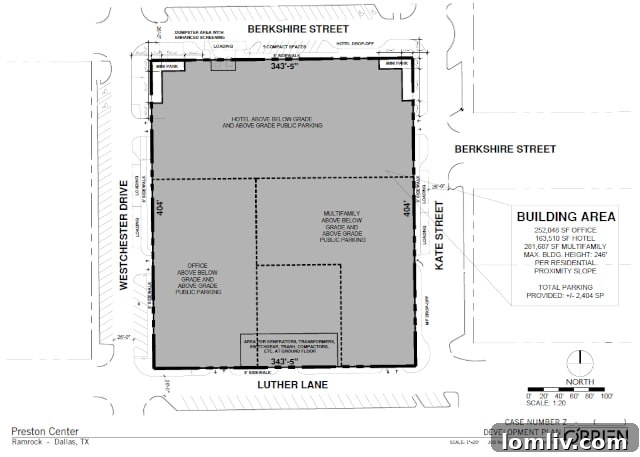
Further solidifying this trajectory of expansion, a development plan dated April 24, 2020, specifically outlined the construction of three distinct buildings. This plan also detailed the inclusion of two remarkably small “mini-parks,” alongside the aforementioned 697,245 square feet of built space. The continuous evolution and expansion of these plans, often with little public input or adjustment based on community feedback, reinforce the perception that the development is being pushed forward with an agenda to maximize commercial returns, potentially at the expense of urban planning principles and community well-being. The lack of substantial green space in such a large development footprint is particularly concerning for a dense urban area like Preston Center.
Landscape Plan Exposes Project Swell and Parking Deficiencies
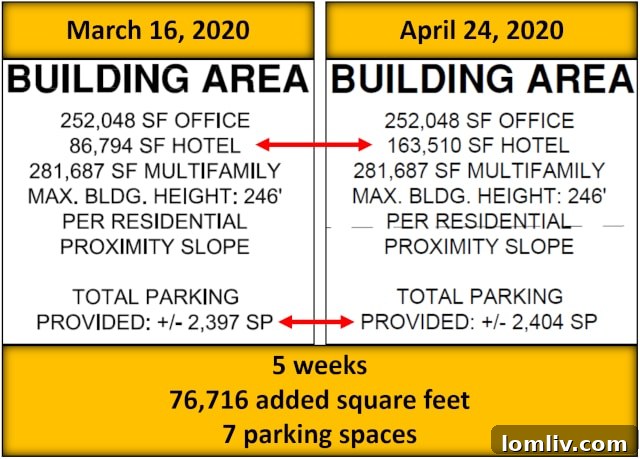
A more detailed review of the landscape plan, dated March 16, 2020, provides further insight into the project’s evolving scale and its concerning implications. While this plan does not precisely delineate the placement of the proposed high-rises on the lot, it reveals a significant discrepancy regarding the proposed hotel component. The landscape plan indicates a hotel of 86,794 square feet. However, a development plan submitted just a month later proposes a hotel nearly twice that size, specifically 163,510 square feet – an increase of approximately 76,716 square feet. This represents a near-doubling of the hotel’s footprint in an incredibly short period, showcasing a rapid and substantial project swell.
Compounding this issue is the alarming lack of proportional parking provision for this expanded hotel. Despite the addition of over 76,000 square feet to the hotel, the plan accounts for only seven additional parking spaces. This utterly disproportionate ratio highlights a fundamental flaw in the project’s planning, threatening to exacerbate the already challenging parking situation in Preston Center. More critically, as detailed in the rewritten PD-314 ordinance, neither version of the plan increases the existing 800 public parking spaces. This contradicts a core principle of the Preston Road Area plan, which was unanimously supported by its authors, including representatives from Preston Center, emphasizing the critical need for maintaining or increasing public parking. The failure to address public parking adequately suggests a prioritizing of private development needs over the broader community’s access and convenience.
The City’s Landscape Plan: Encroachment on Public Roads
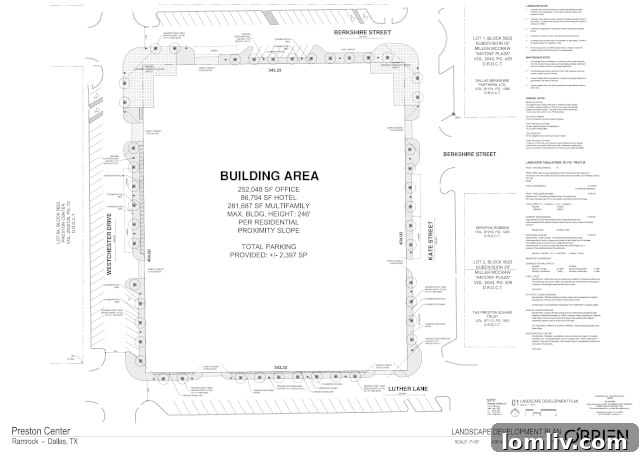
The March 16 landscape plan provides a visual representation of the proposed “building area,” outlined by a grey frame of landscaping with black dots signifying trees and various planting beds. A crucial detail revealed here is that, apart from two small “mini-parks” intruding at the top of the rectangular building area, the majority of the proposed landscaping would actually occupy existing city land. This implies that the developer’s plan relies heavily on utilizing public property for its green elements, rather than dedicating significant private land to these features.
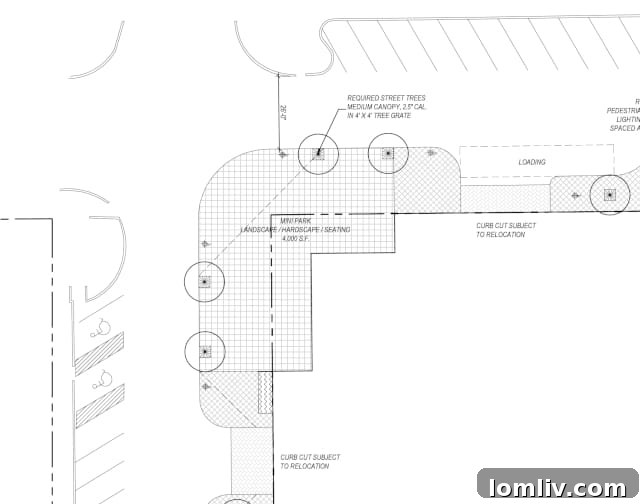
A closer examination of the Berkshire Lane and Westchester Drive corner within the plan further exposes the extent of this encroachment. The inner “L” shape of one of the mini-parks subtly intrudes upon the existing full-block parking garage footprint. More significantly, the grey patterns delineating hardscape and landscape elements are a combination of today’s sidewalks and an approximately 13-foot intrusion into the existing roadway. This expansion into public right-of-way is not merely an aesthetic choice; it has tangible consequences for traffic flow and public access. For instance, a vertical line from the northern neighbor’s existing planting area runs south, marked as 26 feet. Yet, a physical measurement reveals an additional 13 feet from that endpoint to the existing sidewalk, meaning even more public space is being absorbed.
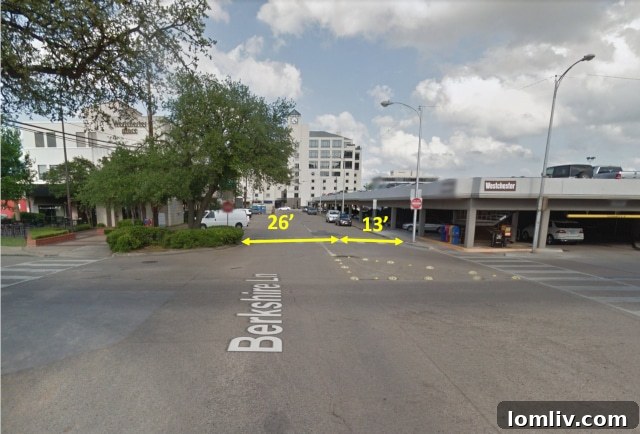
This aggressive land use strategy, which seeks to maintain a staggering 97.6 percent lot coverage, is deeply concerning. It suggests that Dozier’s plan not only anticipates being gifted the valuable garage land from the city but also relies on encroaching upon existing public roads. This effectively narrows Berkshire, Westchester, and Luther Lanes, potentially reducing them to a single lane of traffic. The irony is stark: a proposal aiming to add nearly 700,000 square feet of hotel, office, and apartment space – thereby significantly increasing traffic – simultaneously proposes to constrict the very roadways designed to handle that traffic. Such a contradictory approach threatens to create severe congestion, diminish walkability, and fundamentally alter the character and functionality of Preston Center.

The Illusion of Greenery: The 2.5-Inch Caliper Trees
The proposed landscape plan also raises questions about the genuine commitment to green space and environmental quality. A small note near the top of the page specifies “Medium canopy, 2.5” CAL,” referring to the caliper or diameter of the tree trunks. A 2.5-inch caliper tree is, in practical terms, quite small – roughly the diameter of a fun-size Halloween candy bar. Such trees offer minimal shade canopy, and it would take decades for them to mature into anything resembling substantial urban greenery. This choice of small, nascent trees significantly undermines any claim of creating a vibrant, shaded, or environmentally robust public space, especially when considering the scale of the proposed development.
To put this in perspective, one can compare it to other nearby developments. For instance, the pair of high-rises proposed for the Hopdoddy corner will feature significantly larger trees: 20 trees of 5-inch caliper and 19 trees of 4-inch caliper. These larger specimens promise more immediate and substantial environmental benefits, including shade and aesthetic appeal. In stark contrast, Dozier’s plan for an entire city block proposes only 45 considerably smaller trees, distributed across all four sides. Luther Lane, for example, is slated to receive just nine of these small trees, a number comparable to what an adjacent apartment building at the Hopdoddy site would place in its alley. This disparity highlights a worrying trend of prioritizing minimal compliance over meaningful green infrastructure, sacrificing genuine urban ecology for sheer development volume.
Furthermore, the plan includes seven curb cuts for driveways, which, while an improvement over the existing garage’s fourteen, are distributed across all four sides of the block, potentially creating multiple points of friction with pedestrian and vehicular traffic. Unlike more modern urban developments that integrate loading areas internally within building footprints, this plan designates five on-street loading areas on three of its four border roads. Between the inevitable increase in traffic volume, surrounding head-in and angle parking, these five on-street loading zones, and numerous driveways, drivers navigating the area will face a complex and potentially hazardous environment, demanding constant vigilance. Such design choices contribute to congestion and diminish safety, further burdening the existing infrastructure.
Prioritizing Public Interest in Preston Center
The unfolding narrative around the Preston Center Garage redevelopment serves as a potent reminder of the words of Lau Tzu: “There is no greater disaster than greed.” The accelerating scale and perceived self-interest embedded within these development proposals make it increasingly evident that the developer believes the city has few alternatives but to consent to his demands. This posture, if unchallenged, could set a dangerous precedent for future urban planning in Dallas, where private financial objectives might consistently outweigh community welfare, sustainable growth, and the preservation of public spaces.
The community’s initial reservations, voiced during public meetings, were clearly not arbitrary but stemmed from a genuine desire to protect and enhance Preston Center as a valuable urban asset. The relentless pursuit of maximum lot coverage, the minimal provision of meaningful green space, the encroachment upon public roadways, and the inadequate consideration for increased traffic and parking are all symptoms of a plan that appears to prioritize profits over people. For the city of Dallas, this presents a critical juncture. If this project is indeed perceived as a zero-sum game, where one party gains at the expense of another, then the city must be prepared to play that game with resolve. This could mean refusing to approve any action concerning the garage for as many years, or even decades, as it takes to secure a proposal that truly serves the long-term interests of its residents and aligns with sound urban planning principles.
Ultimately, the future of Preston Center Garage is more than just a real estate transaction; it is a testament to Dallas’s commitment to balanced, community-centric urban development. Ensuring a solution that respects public space, provides adequate infrastructure, fosters genuine green initiatives, and genuinely addresses the needs of its diverse stakeholders is paramount. This requires transparent decision-making, rigorous evaluation, and, crucially, an unwavering commitment to the public good.