
Texas State House District 108: A Battleground Race with Far-Reaching Implications

The political landscape of Texas, long considered a Republican stronghold, is experiencing significant shifts, evidenced by the nail-biting contest for State House District 108. This closely watched race between Democratic challenger Joanna Cattanach and Republican incumbent Morgan Meyer remains too close to call, with an incredibly slim margin separating the two candidates. The outcome of this particular election, encompassing the affluent Park Cities and strategic areas of Dallas, is more than just a local affair; it is a microcosm of the broader political evolution underway in the Lone Star State and holds crucial implications for both parties.
As election night transitioned into the following days, the focus intensely shifted to the meticulous counting of every last ballot. Despite all precincts having reported their initial results, the final tally hinges on provisional and mail-in ballots, which often take longer to process. Currently, Meyer maintains a lead of a mere 440 votes over Cattanach, a margin so thin that it practically guarantees a period of intense scrutiny and potential recounts. This razor-thin difference underscores the competitive nature of Texas politics in the modern era, where even traditionally red districts are becoming fiercely contested battlegrounds.
The Contenders: Morgan Meyer vs. Joanna Cattanach
Both candidates bring distinct backgrounds and political philosophies to the forefront of this critical race, appealing to different segments of the HD 108 electorate. Morgan Meyer, an experienced attorney, has carved out a reputation as a moderate Republican, often aligning with the pragmatic wing of the party, reminiscent of figures like former House Speaker Joe Straus. His platform typically emphasizes fiscal responsibility, local control, and a business-friendly environment, aiming to appeal to the district’s conservative-leaning professionals and families.
On the other side, Joanna Cattanach, a dedicated college professor, has offered a compelling and deeply personal narrative throughout her campaign. She openly shared her experiences as a foster child, a powerful testament to her commitment to advocating for vulnerable populations. Cattanach’s platform prioritizes women’s rights, children’s welfare, and access to quality education and healthcare. Her campaign resonated with progressive voters and those seeking a more compassionate and inclusive approach to state governance, particularly in an urbanized and diversifying district like HD 108.
The Lingering Uncertainty: Ballot Counting and Campaign Stance
The days following election night are often characterized by a nervous anticipation, and the HD 108 race is no exception. With such a tight race, every uncounted ballot carries immense weight. Jacob Limon, a spokesperson for the Cattanach campaign, articulated their unwavering commitment to transparency and accuracy, stating, “Every vote matters and we are determined to make sure the correct outcome of this race includes all ballots including provisional and mail-in ballots.” He further emphasized, “As such, our campaign will work with the County elections department until ALL ballots are counted.” This resolute stance highlights the importance placed on ensuring democratic integrity and leaves no room for doubt about the thoroughness of the process.
Limon further added, “Our campaign staff and volunteers, our supporters and allies, and most especially the voters in House District 108 deserve a factual and thorough count, and we have the time in which to pursue such action.” This sentiment reflects a broader call for due diligence in electoral processes, particularly when the margins are so close that every ballot could potentially sway the final result. For a district with such high stakes, the commitment to a complete and accurate count is paramount.
In contrast, an hour prior to Cattanach’s campaign statement, Meyer and his wife, Keana, expressed a sense of victory, reflecting the confidence from their side based on the preliminary numbers. Their statement, released on Facebook, conveyed gratitude and an expectation of returning to the Texas House. “We are honored and grateful for the support and to be returning to the Texas House to work on behalf of families, and Texas,” they stated. This stark difference in public posture underscores the high tension and uncertainty surrounding the final outcome, illustrating how both campaigns are navigating the post-election period.
Beyond HD 108: Implications for the Texas Democratic Party
Should the final count indeed swing in favor of Joanna Cattanach, her victory would be historic for the Texas Democratic Party. It would mark the 13th state House seat picked up by Democrats in this election cycle, a record achievement for the party in recent history. Such a gain would significantly alter the balance of power within the Texas Legislature, chipping away at the Republican supermajority and potentially influencing policy debates and legislative priorities in upcoming sessions.
Furthermore, a Cattanach win would mean that only one Republican incumbent in the entire Dallas area — Angie Chen Button — would retain her seat. This outcome would signify a substantial realignment in a historically conservative metropolitan region, reflecting changing demographics and evolving voter preferences in major Texas cities. The implications extend beyond legislative numbers, signaling a potential shift in the narrative of Texas as a purely red state and invigorating Democratic efforts across the state.
Texas Election 2018: Key Statistics and Shifting Tides
The 2018 election cycle in Texas was characterized by several noteworthy trends and outcomes that speak to the state’s evolving political identity. These statistics provide crucial context for understanding the HD 108 race and the future trajectory of Texas politics:
- US House District Shifts: Nationwide, U.S. House districts that flipped to Democrats did so by an average shift of 21 points, as reported by the New York Times. Remarkably, in Texas, this shift was even more pronounced, averaging a significant 32 points. This indicates a stronger anti-incumbent or pro-Democrat sentiment in Texas congressional races compared to the national average, suggesting a deeper undercurrent of change.
- Tight Statewide Races: Even in statewide contests, where Republicans historically enjoy wider margins, the 2018 election saw much closer finishes. Lt. Gov. Dan Patrick and Attorney General Ken Paxton, both prominent Republican figures, were re-elected with margins of 5 points or less. This narrow victory margin in top-ballot races signals that even established Republican leaders are facing tougher competition, and that Texas is indeed becoming more competitive on a statewide level.
- Historic Representation: The election marked a significant milestone for diversity and representation in Texas politics. Veronica Escobar (El Paso) and Sylvia Garcia (Houston) made history by becoming the state’s first Latinas elected to Congress. Their victories underscore the growing political influence of the Hispanic community in Texas and reflect the state’s diverse demographic reality, ushering in a new era of representation.
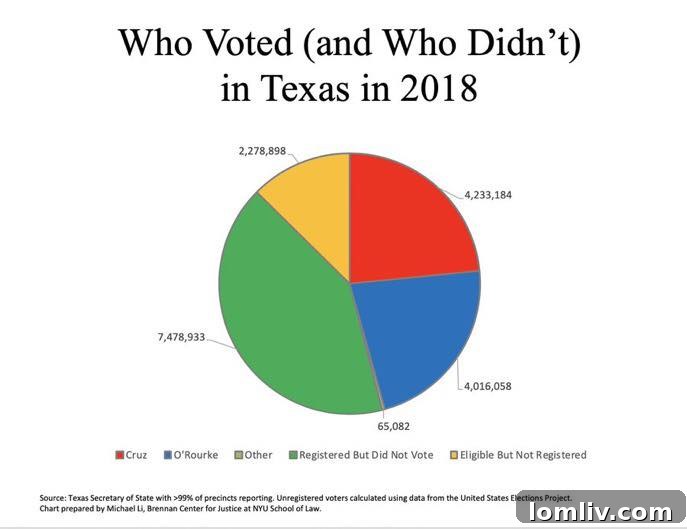
- Record Voter Turnout: The 2018 election witnessed an unprecedented level of voter engagement. Turnout statewide topped an impressive 8.3 million voters, demonstrating a surge in civic participation. In Dallas County specifically, 727,371 individuals cast their ballots, representing 54.33 percent of all registered voters. This high turnout, especially in urban and suburban areas, often benefits Democratic candidates and reflects an energized electorate on both sides.
- Untapped Voter Potential: Despite the record turnout, the numbers also highlight the vast potential for further engagement. Approximately 7.5 million registered voters did not cast ballots in this election, indicating a substantial pool of citizens who could yet be mobilized. Moreover, nearly 2.3 million individuals were eligible to vote but not registered, presenting a significant opportunity for future voter registration efforts by both parties.
Reflections on a Pivotal Election Night
The 2018 election provided numerous insights into the dynamic nature of Texas politics. The results illuminated a state in transition, moving from a reliably red bastion to a more competitive “purple” state. The razor-thin margins in key races, coupled with historic demographic shifts, suggest that future elections in Texas will continue to be intensely fought and closely watched.
Many observers noted that races that were not expected to be close ended up being very much so, indicating a broader electoral volatility. This sentiment highlights a growing unpredictability in Texas politics, challenging long-held assumptions about district leanings and voter loyalties. The increasing competitiveness means both parties will need to invest more resources and develop more nuanced strategies to win over Texas voters.
The discussion also extended to campaign finance and voter engagement. There was scrutiny regarding the effectiveness of certain political investments, with some commentators suggesting that some traditional funding avenues yielded diminishing returns. This points to a need for campaigns to adapt their financial strategies and voter outreach methods to better connect with an evolving electorate.
Concerns were also raised about the infrastructure of elections, including the age and reliability of voting machines. As civic engagement increases, ensuring that electoral processes are robust, accessible, and transparent becomes even more critical. Modernizing election equipment and procedures is a key area for improvement to maintain voter confidence and operational efficiency.
Furthermore, bond sales and local propositions saw significant voter approval, with at least $12.3 billion in bond sales approved statewide. In Collin County, for example, voters approved $750 million in improvements aimed at keeping pace with the county’s rapid expansion. These local outcomes demonstrate voters’ willingness to invest in community development and infrastructure, even amidst broader political polarization.
The collective takeaway from the 2018 election is clear: Democrats broke through an electoral ceiling that had constrained them for over two decades. Losing candidates across the ballot achieved percentages in the high 40s (46-47%), and statewide races saw margins of just 5 or 6 points. While not definitively “blue,” Texas is undeniably becoming “less red,” signaling a significant transformation in its political identity. The close race in HD 108 is a prime example of this statewide shift, reflecting a new era of political competition and engagement in Texas.