Serving as an (unpaid) member of the Dallas City Plan Commission (CPC) demands considerable dedication, often stretching into late-night sessions. Imagine the scene: it’s 9 p.m., commissioners have just returned from a brief 10-minute break, grabbing a quick bite before diving into yet another complex case. Following a series of lot replatting cases and a contentious mobile home park discussion in West Dallas, two distinct development proposals from the vibrant Oak Lawn area finally made their way to the horseshoe. By this time, many Dallas residents were likely well into their evening happy hour, unaware of the rigorous civic discourse unfolding.
The inherent challenge of this role lies not just in the demanding hours, but in the sheer variety of cases presented in a single session. Commissioners might find themselves evaluating anything from a meticulously designed luxury development to a pragmatic “solid waste disposal” facility. It’s a true roller coaster ride, transitioning from the architecturally inspiring to the mundanely essential aspects of city planning. On this particular evening, the journey included both the highly anticipated and generally well-received 2727 Turtle Creek mixed-use development and the frequently debated Lincoln Katy Trail project.
Another common frustration for those involved in urban planning debates is the recurring sentiment from community objectors, often prefaced with the seemingly conciliatory phrase: “I’m not opposed to development, but…” This ubiquitous statement frequently signals a deeper, often localized, opposition despite the disclaimer, highlighting the perpetual tension between urban growth and existing community concerns.
The City Plan Commission plays a critical role in shaping Dallas’s future, balancing the city’s growth ambitions with the preservation of neighborhood character and quality of life. Each decision has far-reaching implications, impacting everything from property values and traffic flow to green spaces and local commerce. Navigating these complexities requires a deep understanding of zoning laws, urban design principles, and, crucially, the diverse perspectives of developers, residents, and other stakeholders. This particular CPC meeting offered a microcosm of these challenges, presenting two Oak Lawn projects that couldn’t have been more different in their reception and eventual outcome.
2727 Turtle Creek – A Vision Approved for Dallas’s Luxury Landscape
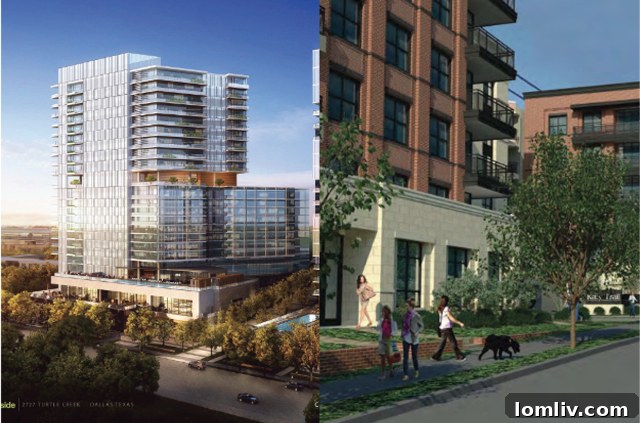
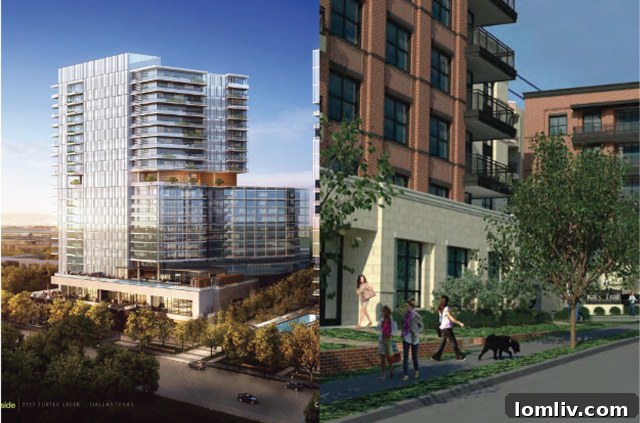
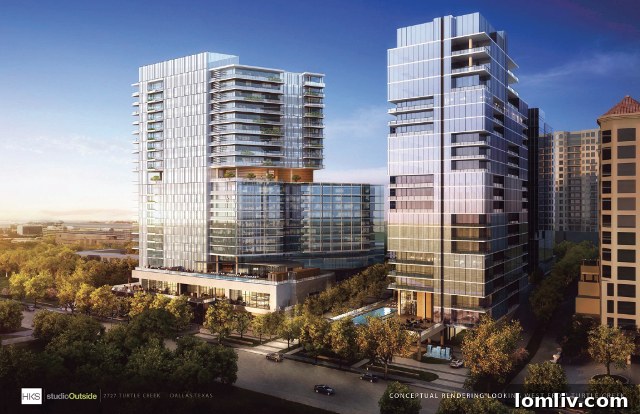
In a rare instance where the best wasn’t saved for last, the 2727 Turtle Creek mixed-use development quickly garnered positive attention and eventual approval. We first highlighted this impressive project, strategically situated adjacent to the iconic Mansion on Turtle Creek, back in March. For those unfamiliar with the details, it’s a meticulously planned three-building complex spanning 5.5 acres. The design envisions a vibrant blend of luxury, featuring a five-star hotel integrated with high-end condominiums, a premium apartment building poised to command rents exceeding $4.00 per square foot, and a discreetly placed office building located towards the rear of the property (not visible in initial renderings).
The developers, Prescott, demonstrated a shrewd understanding of community relations, successfully securing crucial support from prominent neighboring entities. The Mansion Hotel and Residences, The Plaza condos, and the Cantabria apartments, all immediately surrounding the proposed site, expressed their endorsement. This broad base of local support was a significant factor in the project’s smooth progression. However, not all neighbors were as enthusiastic. Opposition primarily stemmed from the Turtle Creek Gardens’ condos, situated to the left of the project, and the Park Bridge community, located to the south and directly in front of the proposed development.
In my initial assessment of this project, I anticipated strong objections from Park Bridge – and indeed, they were vocal in their concerns. Interestingly, I had predicted that Turtle Creek Gardens would be supportive, reasoning that an upscale project of this caliber might enhance their own appeal to future developers, especially after two recent sales attempts for their property had fallen through. My hypothesis was that they would welcome a new, high-class neighbor, believing it would elevate the overall prestige and market value of the area. However, this assumption proved incorrect, as Turtle Creek Gardens emerged as a formidable opponent.
Fried Elliott, the president of the Turtle Creek Gardens Homeowners Association, spearheaded the opposition from his community. His arguments primarily focused on the hotel portion of the development, specifically the planned driveway’s proximity to their property line. Elliott presented a linear progression of objections: his complex fundamentally opposed the hotel, but if a hotel was unavoidable, then the driveway’s location was unacceptable, and so forth. This nuanced but firm stance underscored their core discomfort with certain aspects of the design.
Both Elliott and residents from Park Bridge strategically attempted to leverage Dallas’s antiquated “liquor dry overlay” restrictions to stall the project. They understood a fundamental truth: no five-star hotel could viably operate on “dry” land, where alcohol sales are prohibited. Eliminating the liquor overlay removal would effectively kill the entire deal. One protester further exemplified the specific nature of these objections, stating they wouldn’t mind a restaurant but wanted absolutely “nothing to do with a café with outdoor seating,” highlighting precise fears about public interaction and potential noise.
The specter of “millennials” and their supposed “raucous booze-fueled parties” was also somewhat comically invoked as a point of contention. Such fears, while perhaps reflecting generational anxieties, seem misplaced when considering multi-million dollar condos or 1,000-square-foot apartments commanding $4,000 a month in rent. Furthermore, a high-caliber hotel of the Mandarin Oriental or Four Seasons ilk would never tolerate such disturbances, ensuring a level of decorum commensurate with its luxury branding. These objections, though presented earnestly, often masked deeper concerns about density, traffic, and change.
Plan Commissioner Margot Murphy shrewdly noted that Elliott appeared far more astute and informed than he initially claimed. Indeed, while Elliott repeatedly professed ignorance of procedural matters, he simultaneously demonstrated intimate knowledge of land values and admitted to having worked on both failed development deals for Turtle Creek Gardens. This apparent contradiction, coupled with his claim of being unaware of the influential Oak Lawn Committee – a group that, after last year’s contentious Toll Brothers brouhaha, was known to “everyone in a five-mile radius” – raised questions about the sincerity of his procedural naiveté.
Elliott also indicated that Turtle Creek Gardens was no longer for sale and would instead embark on a multi-million dollar revitalization plan to address long-standing maintenance issues and generally “gussy up” the property. From an objective standpoint, being in their shoes, I would personally be thrilled about a new, high-class neighbor bringing significant value to the area, particularly when substantial (and often invisible) money is being spent on internal renovations. A rising tide, after all, lifts all boats.
Ultimately, Prescott, the developer, offered meaningful concessions to mitigate the concerns of Turtle Creek Gardens, including extensive screening and landscaping along their shared border. The possibility of a dedicated bike-pedestrian path was also put forth, enhancing public amenities. These gestures demonstrated a willingness to compromise and adapt, a crucial factor in successful urban development.
The City Plan Commission eventually approved the 2727 Turtle Creek project with only two “nay” votes, reflecting strong overall support for its vision and design. This approval paves the way for the project to advance to the Dallas City Council for final consideration.
Why did this project garner approval so readily? Several factors contributed to its success. Firstly, the submitted plans were exceptionally complete and detailed for this stage of the approval process, demonstrating the developer’s thorough preparation. Secondly, their “asks” – specifically, relief from antiquated liquor restrictions and a minor height increase from 240 feet to 299 feet (a mere 59 feet) – were perceived as reasonable, especially when balanced against the significant community givebacks. Beyond the technical merits, the inherent attractiveness and prestige of the project undoubtedly played a subliminal, yet powerful, role. It’s also vital to remember that the parcel was already zoned O-2 (Office), which permitted a height of 240 feet, and already allowed for hotels, multi-family residential, and office uses. Thus, the proposed changes were largely incremental adjustments within an already established framework, making the case for approval considerably stronger.
Lincoln Katy Trail – Back to the Drawing Board for a Contentious Proposal
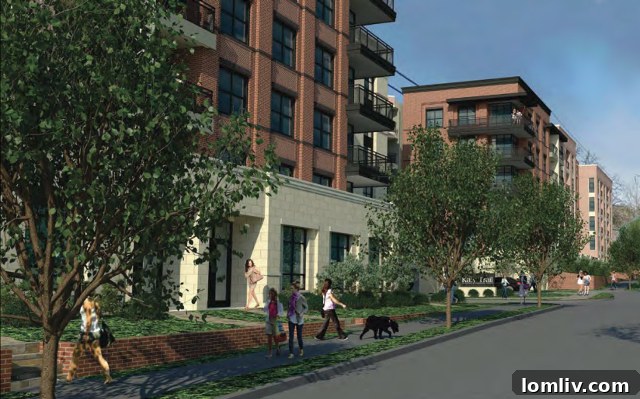
On the other end of the spectrum, though perhaps not entirely devoid of architectural merit, the Lincoln Katy Trail project continued its rather clumsy journey towards a final resolution. Unlike its Turtle Creek counterpart, this development has been plagued by a consistent lack of comprehensive documentation since its inception. The project barely scraped through the Oak Lawn Committee by a single vote, and that was only after multiple appearances and significant debate. Following its contentious passage through the OLC, it faced scrutiny from various city departments and concerned neighbors, all of whom voiced significant apprehension regarding the insufficient and often unclear documentation. By the time it reached the City Plan Commission last night, none of these critical “looseness” issues had been adequately addressed or tightened, leading to predictable confusion and frustration.
And it showed. The presentation was notably disjointed. Even former City Council Member Angela Hunt, an experienced lobbyist who has worked for Lincoln for over a year, found herself repeatedly compelled to deflect a large number of detailed questions to other team members for clarification. This inability to directly answer commissioner inquiries from a primary presenter is typically a red flag, signaling a lack of preparedness or an underlying issue with the project’s specifics.
Questions from the commissioners rained down, acutely noting the glaring disparity between what was explicitly written in Lincoln’s formal request and what was visually depicted in their illustrations. Many commissioners expressed genuine confusion over the multitude of rapid-fire iterations presented, struggling to discern which version was the most current and authoritative. The frequent and often vague “we can do that” responses to probing questions, designed to expose gaps in the plan, created an environment where no one could realistically keep track of the promised adjustments or the evolving details. Commission Chair Gloria Tarpley herself openly admitted she couldn’t follow it all, a damning indictment of the presentation’s clarity and the project’s overall lack of coherence.
Regardless of the developer’s reputation or past successes, “trust me” are unequivocally the two words one should never rely on in the meticulous and public forum of a planning commission. Such an approach demonstrates either a lack of respect for the process, a failure to understand the commission’s role, or, most likely, an attempt to bypass detailed scrutiny when detailed answers are not readily available.
It’s also crucial to highlight the stark contrast between the two projects presented that night. While 2727 Turtle Creek sought to add a modest 20 percent in height to an already tall, in-zoning maximum, the result promised architecturally superior and community-enhancing buildings. Lincoln, by comparison, aimed to double both the height and density for what many perceived as a bulky, aesthetically uninspired building, as depicted in the renderings. This represents hardly a fair trade-off for the surrounding community or the city, especially given the building’s proximity to a vital public amenity like the Katy Trail.
It was, I believe, Daltxrealestate.com writer and Vine Condo representative Amanda Popken who famously, and vividly, critiqued the rear of the building, stating it “points its ass to the asset of the Katy Trail.” She further characterized Lincoln’s minor concessions as mere “lipstick on a pig,” a powerful and memorable metaphor for superficial improvements failing to address fundamental flaws. Her direct and insightful criticism resonated deeply, highlighting the developer’s apparent disregard for the public interface of their project with one of Dallas’s most cherished urban trails – a critical oversight in modern urban planning.
In a final attempt to bring some closure, Commissioner Ridley moved to approve the project, but his motion failed to garner a second from any other commissioner, effectively killing it for the night. Ultimately, Lincoln was instructed to return in a month, with Commissioners Housewright and Jung strongly suggesting they present a “better project.” This sentiment was widely echoed by others after the meeting concluded. However, my suspicion, based on past observations, is that the entrenched arrogance associated with this project’s approach may unfortunately prevent a genuine re-think or a substantial redesign, setting the stage for another difficult presentation in the future.
Eye on The Prize: Navigating Advocacy and Impartiality in City Planning
During the proceedings, it was particularly instructive to observe Commissioner Paul Ridley, who was appointed by Council Member Philip Kingston, and whose district encompasses both the 2727 Turtle Creek and Lincoln Katy Trail projects. In both instances, it became conspicuously clear that Commissioner Ridley strongly favored the passage of these developments. Following each developer’s presentation and the subsequent rebuttals from opponents, he would initiate the question-and-answer portion with leading, often “softball” questions, carefully designed to elicit positive spin and highlight perceived strengths from the developers. It appeared as though he had meticulously taken notes, aiming for developers to elaborate on points that were either underdeveloped or required further reinforcement. In each case, I privately noted to others in the room that his bias in favor of the projects was strikingly obvious.
While I am certainly not shy about expressing my own opinions in my writing, there’s a different dynamic at play when a city official, tasked with impartial judgment, overtly demonstrates such a strong bias. This phenomenon often feels like a “finger on the scale,” subtly, or not so subtly, tilting the balance of public discourse and decision-making. While it’s plausible that other commissioners might similarly advocate for projects within their respective districts, I genuinely cannot recall witnessing such an overt display of partiality in the past, making Ridley’s approach particularly noteworthy on this evening.
Despite Commissioner Ridley’s clear advocacy, I do not believe his tactics ultimately swayed the minds of his fellow commissioners or fundamentally altered the outcomes of the two projects on this specific night. The 2727 Turtle Creek project, being inherently strong, well-conceived, and competently presented, was likely destined for approval regardless of any specific commissioner’s influence. Conversely, the Lincoln Katy Trail project, burdened by its inadequate documentation, muddled presentation, and aesthetic shortcomings, was always going to fall short under rigorous questioning and scrutiny. This highlights a crucial truth in urban planning: while advocacy can play a role, the intrinsic merits and meticulous preparation of a project ultimately carry the most weight.
We await with anticipation to see what August brings for the Lincoln Katy Trail project – hopefully, a significantly improved proposal, in addition to even hotter Dallas weather.

Remember: My focus consistently revolves around high-rises, homeowners’ associations (HOAs), and renovation projects within the dynamic Dallas real estate market. However, my passion also extends to appreciating and critically analyzing modern and historical architecture, always balancing these aesthetic considerations against the imperative of the YIMBY (Yes In My Backyard) movement – advocating for thoughtful, sustainable development. My commitment to insightful real estate commentary has been recognized by the National Association of Real Estate Editors, who honored my writing with three Bronze awards in 2016, 2017, and 2018, alongside two Silver awards in 2016 and 2017. Do you have a compelling story about urban development, a complex HOA dispute, or even a marriage proposal you’d like to share? Please don’t hesitate to reach out to me via email at [email protected]. You’re also welcome to look for me on Facebook and Twitter – though I must admit, finding me there might prove to be a delightful challenge!