Navigating the Future of Eviction Laws in Texas: Senate Bill 986 and Its Impact on Dallas Renters
The landscape of housing in Dallas, Texas, is undergoing significant shifts, presenting growing challenges for its residents. As rental prices continue their relentless climb and the city grapples with the persistent issues of homelessness and a stark lack of affordable housing options, life can become increasingly precarious, particularly for those on fixed incomes striving to maintain stable housing. Amidst this backdrop, a critical legislative debate is unfolding that could redefine tenant protections across the state and directly impact the lives of thousands of Dallas renters.
At the heart of this unfolding legislative drama is Senate Bill 986, mirrored by House Bill 2045. Introduced by Republican lawmakers Shelby Slawson of Stephenville and Brandon Creighton of Conroe, this proposed legislation seeks to fundamentally alter the framework of landlord-tenant relationships in Texas. Specifically, it aims to override a crucial local ordinance in Dallas that currently provides renters with a vital buffer – additional time to pay overdue rent before facing the threat of eviction. This proposed statewide measure has ignited a contentious debate, pitting the interests of property owners against the fundamental rights and protections of tenants.
Understanding Senate Bill 986 and House Bill 2045: A Push for Uniformity in Eviction Laws
The core objective of this legislation is to standardize eviction processes across Texas. If enacted, SB 986/HB 2045 would explicitly prohibit cities or counties from enforcing any local measures that restrict, delay, or outright ban the delivery of a notice to vacate, or the subsequent filing of an eviction lawsuit. This means that local ordinances, such as Dallas’s current protection, which grants a longer grace period for renters to address late payments, would be rendered null and void. The bill aims to create a uniform set of rules, ensuring that the legal process for evictions is consistent from one county to another, impacting thousands of Texas renters and landlords.
The legislation is strongly supported by the Texas Apartment Association, a prominent lobbying group representing landlords and property managers throughout the state. Their argument centers on the perceived need for consistency and predictability within the legal framework governing rental properties. Proponents contend that a “patchwork” of differing eviction rules across various municipalities and Justice of the Peace courts creates an administrative burden for landlords, especially those who manage properties in multiple cities. This fragmented regulatory environment, they argue, can lead to confusion, increased operational costs, and an inefficient legal process for property owners attempting to manage their portfolios effectively. David Mintz of the Texas Apartment Association has vocally stated the importance of having consistent regulations across the entire state to foster a fair and manageable environment for property owners and investors.
The Dallas Eviction Ordinance: A Local Response to a Growing Housing Crisis
To fully grasp the significance of SB 986, it’s essential to understand the context of the Dallas ordinance it seeks to override. The City of Dallas, much like many other urban centers across the nation, has been grappling with an escalating housing crisis. Record-high rental inflation, exacerbated by the economic fallout of the pandemic, has placed immense pressure on its most vulnerable residents. Factors such as stagnant wages for low-income workers, a dwindling supply of truly affordable housing units, and a competitive rental market have contributed to a precarious situation for many families and individuals on fixed incomes.
In response to this crisis, and to provide a critical safety net for tenants struggling to keep up with rising housing costs, Dallas implemented an ordinance designed to offer additional time and opportunity for renters to avoid eviction. This local protection allows tenants a greater window—often extending the typical grace period—to address their financial obligations before landlords can officially initiate eviction proceedings. For many fixed-income individuals, single-parent households, and low-wage workers, this extra time can be crucial. It can mean the difference between finding resources to pay back rent, securing financial assistance from community organizations, or facing the devastating consequences of homelessness. Advocates argue that such local measures are vital tools for cities to respond to unique local economic conditions and to protect their most vulnerable populations from being displaced, thereby mitigating the broader societal impact of a rising eviction rate.
The Divide: Tenant Protections Versus Landlord Consistency
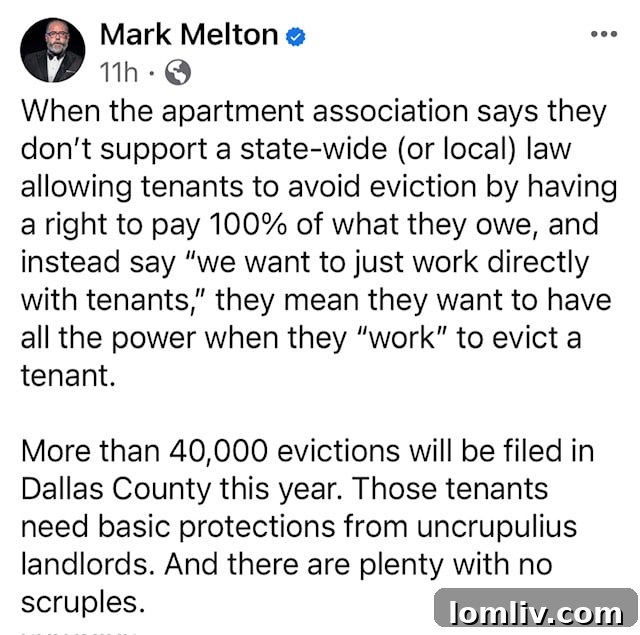
While the Texas Apartment Association champions the bill for creating consistent regulations statewide, tenant rights and anti-poverty advocates staunchly oppose it. Figures like Mark Melton of the Dallas Eviction Advocacy Center have emerged as vocal critics, highlighting the severe implications for renters should the bill pass. Melton’s work on the ground reveals a dire situation: he projects that over 40,000 eviction cases will be filed in Dallas County this year alone, a staggering number that underscores the fragility of housing security for many. This figure, often driven by temporary financial setbacks, illustrates the critical need for local protections.
Melton emphasizes that these tenants desperately need fundamental protections against what he describes as “unscrupulous landlords.” As he stated on social media, linking to a KERA News report by Christopher Connelly, “And there are plenty with no scruples.” He argues that without local ordinances offering a grace period, tenants are left with fewer options and less time to rectify situations, potentially leading to rapid displacement. The current Dallas ordinance serves as a critical shield, offering a humane approach to a complex problem, allowing tenants to recover from temporary financial setbacks without immediately losing their homes. Stripping away such protections, advocates warn, could dramatically escalate the number of evictions, deepen the existing housing crisis, and push more families into homelessness, creating a cascading effect on social services and public welfare.
The debate thus boils down to a fundamental philosophical difference: Should the state prioritize the administrative ease and consistency for landlords across diverse markets, or should local jurisdictions retain the autonomy to implement specific protections tailored to their unique housing crises and vulnerable populations? For tenant advocates, the answer is clear: local control allows for a more responsive and empathetic approach to housing instability, ensuring that basic human needs are met before economic efficiency. They argue that local governments are better equipped to understand the nuances of their communities’ housing markets and to implement policies that truly serve their residents.
The Legislative Journey and Broader Implications for Texas Renters
As of now, Senate Bill 986 has successfully navigated the Texas Senate, marking a significant step in its legislative journey. Its fate now rests with the House Business and Industry Committee, where it awaits a crucial hearing. This stage of the process is pivotal, as committee members will review the bill’s provisions, hear testimonies from both proponents and opponents, and ultimately decide whether to advance it to the full House for a vote. The outcome of this committee hearing will profoundly influence the future of landlord-tenant law across Texas and the degree of autonomy local governments will retain over housing policy.
Beyond Dallas, the implications of this legislation are far-reaching. If SB 986/HB 2045 becomes law, it could set a precedent for state preemption over local housing policies throughout Texas. This would mean that any city or county attempting to enact or maintain local tenant protections—whether related to eviction timelines, rental caps, or other housing stability measures—could find their efforts curtailed by state law. This power shift from local control to state-level regulation raises concerns among various municipalities about their ability to address unique local challenges effectively, especially in rapidly growing urban centers experiencing their own unique housing pressures.
The ongoing struggle between state and local authority over housing policy is a critical dimension of this debate. While proponents advocate for a streamlined, uniform approach to reduce complexity for property owners, critics argue that local governments are often best positioned to understand and respond to the specific needs and economic realities of their communities. The passage of this bill would not only impact Dallas’s current ordinance but also send a clear message about the state’s stance on landlord-tenant relations, potentially chilling future efforts by other cities to implement local tenant protections. The balance between promoting business interests and safeguarding the housing security of residents remains a central tension in Texas’s evolving housing policy discussion, a discussion whose outcome will shape the lives of millions of Texans for years to come.