Navigating North Texas Property Taxes at Year-End: A Guide for Homeowners, Buyers, and Sellers
By Lydia Blair
Special Contributor
For countless homeowners across North Texas, the final months of the year bring more than just holidays; they herald the arrival of property tax statements. Typically, these crucial documents for the current tax year begin to circulate, with payments generally due by January 31st of the following year. While you might still be awaiting your physical bill in the mail, it’s imperative to understand that your property tax obligations for the current year are already established and are swiftly approaching their due date.
Understanding and managing these property taxes, especially when involved in a real estate transaction, can often feel like navigating a complex labyrinth. This guide aims to demystify the process, offering clarity for homeowners, and particularly for those buying or selling property during this critical period. Staying informed is your best defense against unexpected complications.
Easily Access Your Property Tax Statement Online
Before your official bill even graces your mailbox, you can proactively access your statement online. Each county in North Texas maintains a dedicated tax assessor’s website where property owners can search for their tax information using their address or property ID. This digital access is not only convenient but also crucial for planning your finances or preparing for a home sale.
For residents of Dallas County, you can typically find your detailed tax statement here. Similar portals exist for Denton, Collin, Tarrant, and other surrounding counties. A quick online search for “[Your County Name] Tax Assessor” will lead you directly to the relevant platform.
Deconstructing Your North Texas Property Tax Bill: More Than Meets the Eye
One might assume a property tax bill would be straightforward: a single address, a single amount. However, in Texas, especially within densely populated regions like North Texas, your property tax statement is a mosaic of contributions to various governmental entities. While you might write one check to the county tax assessor, that payment is then meticulously distributed among several beneficiaries.
Let’s consider Dallas County as a prime example. A homeowner in Dallas might find themselves contributing to:
- Dallas County Taxes: For county-level services and administration.
- City of Dallas Taxes: Supporting municipal services such as police, fire, parks, and infrastructure.
- Hospital District Taxes: Funding local healthcare facilities and services.
- Community College Taxes: Contributing to the operational costs of local community colleges.
- School District Taxes (ISD): The largest portion often goes to the local independent school district, funding K-12 education.
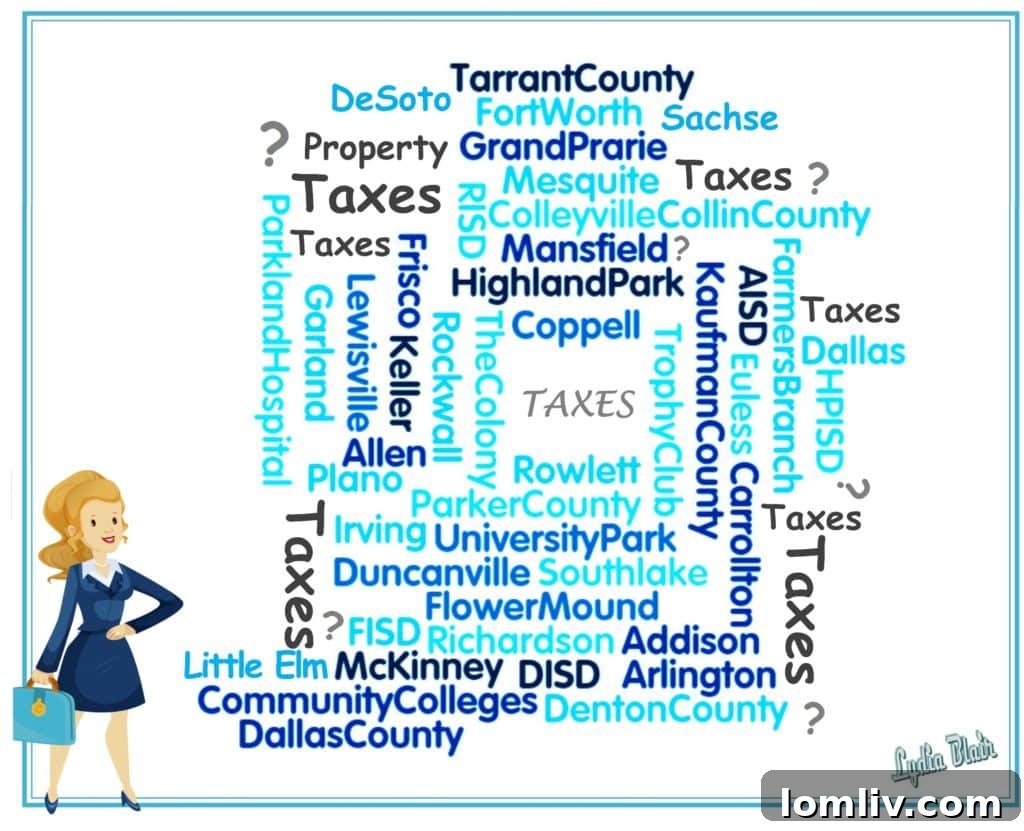
This structure means that even within Dallas County, your specific tax bill can vary significantly based on your exact location. For instance, you could reside within Dallas County but fall under the jurisdiction of Richardson ISD, Irving ISD, or Highland Park ISD, each with its own tax rate. Similarly, your municipal taxes might go to the City of Farmers Branch or DeSoto instead of the City of Dallas. The combinations of taxing entities are diverse and unique to every property’s geographical boundaries across North Texas. This intricate system underscores why understanding your specific tax breakdown is essential.
The Dynamic Nature of Tax Statements: Why Some Bills are Delayed
Here’s where the process can become even more intricate, particularly for those involved in real estate transactions during the latter part of the year. While many 2018 Dallas County taxes, for example, might have been posted promptly, certain entities may experience delays. Dallas ISD, for instance, often doesn’t finalize and post its tax rates until after its bond elections, which typically occur in early November. This means a significant portion of your overall property tax liability might remain undetermined for weeks, or even longer, after other components have been made public.
This staggered release of tax information creates a challenging environment for all parties involved in a property transaction. A property owner, buyer, or seller cannot have an exact and correct amount due until every single taxing entity that governs their property has officially released and posted its final tax statement. The waiting game can be frustrating, as these critical pieces of information might appear tomorrow, next week, or even later, impacting closing schedules and financial planning.
The Critical Role of Title Companies in Tax Proration
The timing of these tax statement releases profoundly impacts title companies, which play a pivotal role in ensuring smooth real estate closings. Their responsibilities include accurately prorating taxes between buyers and sellers and providing precise tax information to mortgage lenders. This function is vital for maintaining the integrity of the transaction and protecting all parties.
Traditionally, when you sell your property, the title company acts as an impartial third party. They handle the disbursement of sale proceeds, paying off your existing mortgage and any other liens on the property. Crucially, they also prorate the current year’s property taxes between the buyer and the seller. For example, if you owned your home for 100 days in the current tax year, the title company would typically withhold an amount equivalent to 100 days of the property taxes from your sale proceeds. This amount is then held in escrow by the title company to be used to pay the entire tax bill when it becomes due. This charge to the seller and corresponding credit to the buyer is a standard practice reflected on the closing statement. However, this established process often encounters unique challenges and adjustments during the year-end tax season.
Mortgage lenders, understandably, require absolute assurance at closing that there are no outstanding or unpaid taxes on the property being purchased. Title companies issue title insurance policies that include specific endorsements to the lender, guaranteeing that there are no “due and payable” property taxes remaining. It is a fundamental part of a title company’s duty to diligently verify the payment status of all property taxes and to issue title insurance accordingly, safeguarding both the buyer’s and lender’s interests.
The Gravity of Unpaid Property Taxes in Texas
To fully grasp the importance of these meticulous procedures, it’s essential to understand the serious implications of unpaid property taxes in Texas. Unlike some other jurisdictions, Texas law grants property tax authorities significant power. The most severe consequence of delinquent property taxes can be the foreclosure of the property itself. This underscores why title companies and lenders are so rigorous in ensuring all taxes are accounted for and paid at closing.
Revisiting the earlier point: your property tax bill, or at least a substantial portion of it, is now outstanding and considered “due and payable.” The exact amount and the specific components that are due depend entirely on your property’s location and the various taxing entities involved. Any taxes that have been posted and finalized by their respective jurisdictions are meticulously collected and paid at the time of closing. The proration of these posted amounts between the buyer and seller is a relatively straightforward calculation.
However, the real complexity arises with taxes that have not yet been posted (such as the aforementioned DISD taxes during an election year). These unposted amounts fall into a separate category and necessitate different handling strategies. The approach taken for these pending taxes can vary, often requiring a collaborative agreement among the mortgage lender, the title company, and both the buyer and seller, sometimes involving additional escrow agreements or indemnities.
Ensuring Accuracy: From Estimates to Actuals
The dynamic nature of tax information during this period means title companies and mortgage companies are often updating closing statements on a daily basis as new tax details become available. It is a strict protocol that payments made to tax authorities must always be based on actual, finalized tax statements, not mere estimates derived from previous years. Relying on estimates carries significant risks. If an incorrect amount is paid, a cascade of problems can ensue: determining who owes additional funds, who is entitled to a refund, and the administrative burden of correcting discrepancies.
In cases of overpayment, refunds are typically issued directly to the entity that made the payment – often the title company. The title company then has the responsibility to meticulously determine the rightful recipient of the refund, as they cannot retain it. Conversely, and often more problematic, is the scenario where the actual amount owed turns out to be more than what was paid at closing. Collecting additional funds from a seller or buyer after a transaction has closed can be an arduous and contentious process, highlighting the critical need for absolute accuracy from the outset.
These challenges create unique and often intense dynamics when it comes to buying or selling a home during the year-end tax season. Every party involved – the buyer, seller, lender, and title company – seeks the assurance that all “due and payable” property taxes are unequivocally settled. This assurance hinges on the title company either collecting and paying the property taxes directly at closing or presenting irrefutable proof that these taxes have already been paid. Such proof must originate directly from the tax office, in the form of an official Tax Certificate.
The Indispensable Tax Certificate: Your Proof of Payment
Both the title company and the buyer’s mortgage company rely heavily on a current and accurate Tax Certificate to ascertain the precise status of all property taxes owed. This official document, issued by the county tax office, lists all taxes assessed against a property, their current status (paid, due, or delinquent), and any outstanding balances. If the tax certificate clearly indicates a balance is due, then that amount must be collected and paid at closing. There is no acceptable substitute for this official verification.
But Wait, There’s More: Understanding Escrowed Taxes
Many homeowners choose to have their property taxes escrowed and paid by their mortgage company, simplifying their annual financial obligations. If you fall into this category and are selling your home, you might wonder how this impacts closing. Even with an escrow account, your share of the unpaid current year’s taxes will still be withheld from your sale proceeds at closing and paid on your behalf by the title company. The reason? It’s highly probable that your mortgage company has not yet disbursed those taxes, especially since the full tax bill might not have been finalized or due at the time of your closing. Furthermore, once your home sale closes and the existing loan is paid off, the mortgage company will no longer have an obligation to pay those property taxes. The title company, therefore, must ensure these taxes are settled to clear the property’s title.
Rest assured, the funds accumulated in your escrow tax account throughout the year are not lost. After your closing is complete and your mortgage loan is paid off, your mortgage company will typically refund the remaining balance of your escrow account directly to you. This process, while logical, often causes confusion and requires clear communication to avoid seller apprehension.
Why a Seller’s Receipt Isn’t Enough: The Need for Official Verification
A common question arises: couldn’t a seller simply pay their tax bill prior to closing and present the title company with a receipt as proof of payment? While seemingly logical, this approach is not accepted by title companies or lenders. The title company is legally required to obtain an updated Tax Certificate that explicitly shows a zero balance for all property taxes. This stringent requirement is a safeguard against potential fraud. A seller could, hypothetically, make a tax payment by check or credit card, obtain a receipt from the county, and then subsequently stop payment on the check or dispute the credit card charge. Without a verified zero-balance Tax Certificate, the property’s title would remain encumbered, exposing the buyer and lender to significant risk.
Navigating a Taxing Time: Communication is Key
For individuals actively buying or selling properties during this particular time of year, open and consistent communication with both their title company and their lender is paramount. This proactive approach helps to preempt potential surprises and misunderstandings at the closing table. Many sellers, for example, are genuinely caught off guard when they realize they must pay their share of the current year’s taxes at closing, despite having consistently made escrow payments to their mortgage company throughout the year. Similarly, some buyers may be surprised to learn they need to bring additional funds to closing to cover their portion of the current year’s taxes, which are now due. These scenarios, while sometimes unexpected for individual parties, are common occurrences in the world of year-end real estate transactions.
Indeed, this period can be a truly “taxing” time for all involved: buyers, sellers, mortgage lenders, and especially the diligent professionals at title companies who work tirelessly to ensure every detail is accurate and every obligation is met. By understanding the intricacies and maintaining clear lines of communication, everyone can contribute to a smoother, more predictable closing experience.
The opinions expressed are of the individual author for informational purposes only and not for the purpose of providing legal advice. Contact an attorney to obtain advice for any particular issue or problem.
Lydia Blair (formerly Lydia Player) was a successful Realtor for 10 years before transitioning to the title side of the business in 2015. Prior to selling real estate, she actively bought, remodeled, and sold homes (long before the term “house flipping” became a popular expression). She has navigated the real estate closing process countless times, serving in various capacities as a buyer, a seller, a Realtor, and currently as an Escrow Officer. In her role as an Escrow Officer for Carlisle Title, Lydia finds immense satisfaction in solving complex problems and efficiently cutting through bureaucratic red tape. The most rewarding aspects of her job are the moments she gets to hand people the keys to their new home or a well-deserved check from their sale.