By Lydia Blair
Special Contributor
Understanding the Ripple Effect: How a Government Shutdown Impacts DFW Real Estate
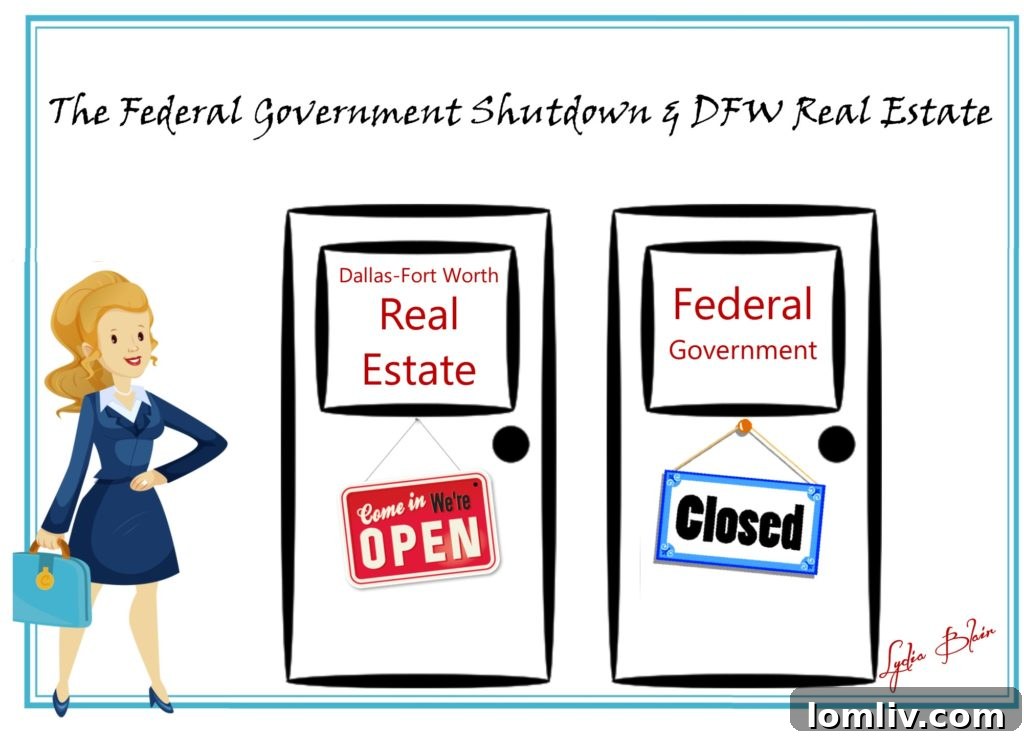
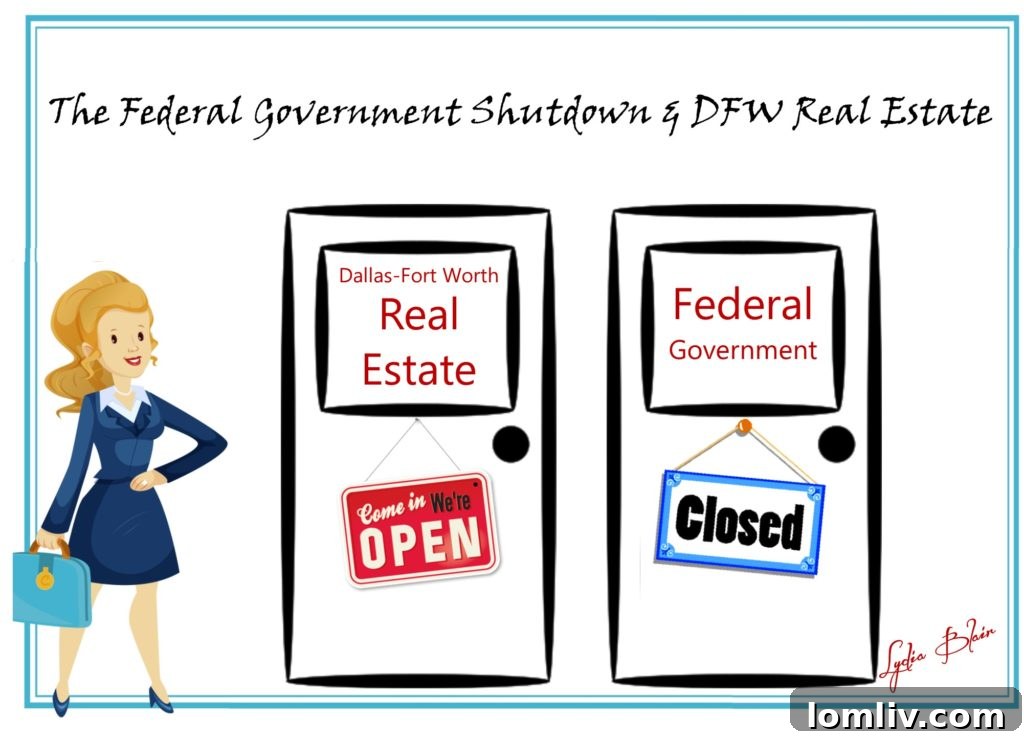
In an increasingly interconnected economy, a federal government shutdown, though an infrequent occurrence, sends ripples across various sectors. The real estate market, a cornerstone of economic activity, is certainly not immune. While some areas experience immediate and profound impacts, others feel a more subtle, delayed effect. For the vibrant Dallas-Fort Worth (DFW) real estate market, the immediate repercussions on title business and property closings might seem minimal. However, as the duration of a shutdown extends, the likelihood of a negative impact on DFW’s dynamic housing landscape dramatically increases.
Understanding these potential impacts is crucial for homebuyers, sellers, real estate professionals, and anyone involved in property transactions in the DFW metroplex. This article delves into the specific ways a government shutdown can interfere with real estate dealings, from mortgage approvals to title clearances, offering insights into what to expect and how to navigate these challenging periods.
Mortgage Approvals and Loan Processing: A Federal Bottleneck
The core of any real estate transaction for most buyers involves securing a mortgage. This process is inherently reliant on several federal agencies. A government shutdown typically mandates the furlough of “non-essential” government employees, and unfortunately, many roles vital to the mortgage and financing process fall into this category. Historically, shutdowns have significantly impacted departments such as the Department of Housing and Urban Development (HUD), the Internal Revenue Service (IRS), and specific functions within the Social Security Administration (SSA).
Impact on Key Federal Agencies:
- Department of Housing and Urban Development (HUD): During a shutdown, a substantial percentage, sometimes as high as 95%, of HUD employees can be furloughed. This is critical because HUD oversees the Federal Housing Administration (FHA), which insures FHA loans, a popular option for first-time homebuyers and those with lower down payments. Without operational staff, the processing, approval, and endorsement of FHA-insured mortgages can grind to a halt or face severe delays. This directly impacts lenders who rely on FHA backing to originate and fund these loans.
- Internal Revenue Service (IRS): Mortgage companies are legally required to verify a borrower’s income and employment history, often by obtaining tax transcripts directly from the IRS. A shutdown means that the IRS departments responsible for processing these requests operate at minimal capacity or cease operations entirely. This can lead to significant delays in verifying crucial financial information, preventing lenders from moving forward with loan approvals.
- Social Security Administration (SSA): Identity verification is another cornerstone of the loan application process. While the SSA’s direct involvement in real estate transactions might seem less obvious, their services are often used to verify a borrower’s identity and employment history, particularly if there are discrepancies or additional verification is needed. Delays here can also impede the mortgage approval timeline.
For individuals applying for a home loan in DFW, these federal bottlenecks translate directly into potential delays in receiving loan approval. What might typically take a few days could extend into weeks, pushing back closing dates and creating uncertainty for all parties involved. Buyers and sellers alike must be prepared for the possibility of adjusting their timelines, as the speed of federal agency operations is largely beyond their control during these periods.
Title Searches and Local Closings: A Glimmer of Stability
While the federal impacts on mortgages can be substantial, it’s reassuring to note that a brief federal government shutdown typically has a very limited impact on the core aspects of title searches and property closings, especially regarding state and local governmental functions. This is a critical distinction that often brings a sense of relief to the DFW real estate community.
Why State and Local Operations Remain Resilient:
- Decentralized Record Keeping: Most of the government entities that title companies regularly interact with operate at the state, county, or municipal level, rather than the federal. This includes county clerk offices, recorders’ offices, tax assessor-collector offices, and local courts. These entities are generally funded and managed independently of the federal government and thus remain operational during a federal shutdown.
- Accessibility of Records: Title plants, which are crucial for conducting thorough title searches, maintain extensive databases of public records. They can typically still access information regarding property records, existing liens, judgments, and legal descriptions from state and local sources. This means that the fundamental process of ensuring a clear title can continue unimpeded.
- Routine Business Unaffected: The day-to-day operations vital for closing sales largely continue as usual. Deeds can still be filed with county court records, local property tax statements can be confirmed, and the offices of surveyors, homeowners’ association (HOA) management companies, and appraisers are typically unaffected. These professionals and entities operate under state or local regulations and contractual obligations, allowing them to proceed with their services without federal interference.
Therefore, for the majority of property transactions in DFW that do not involve federal liens, the closing process can proceed relatively smoothly, assuming the buyer’s mortgage approval is secured or it is an all-cash transaction. The stability of state and local government services provides a crucial buffer for the real estate market during periods of federal inactivity.
The Challenge of Federal Liens: A Specific Obstacle
Despite the overall resilience of local closing processes, specific challenges emerge when federal government entities have existing financial claims on a property. This is where a shutdown can create a significant, albeit targeted, roadblock for clear title and successful closing.
Securing Payoff Amounts for Federal Debts:
- IRS Liens: If a property seller has an outstanding debt with the IRS, the IRS may place a federal tax lien on the property. For a title company to provide clear title and ensure the transaction closes without future encumbrances, the exact payoff amount of this IRS lien must be obtained directly from the IRS. During a shutdown, with IRS departments responsible for lien inquiries and payoffs operating at minimal staff or completely closed, obtaining this crucial information becomes impossible.
- HUD Loans and Liens: Similarly, if a property has a lien involving HUD—perhaps from a past FHA-insured mortgage where HUD paid a claim or a specific HUD program loan—the payoff amount must be confirmed by HUD. With the vast majority of HUD employees furloughed during a shutdown, securing these payoff figures is exceedingly difficult or outright impossible.
- Other Federal Entities: Any other federal government entity that might have a lien on a property (e.g., Small Business Administration, Department of Justice) would present similar challenges.
In such scenarios, a title company cannot and will not provide a clear title and title insurance, nor will it close the transaction, without confirming the payoff of all existing liens. This is a fundamental principle of title assurance designed to protect both the buyer and the lender. When federal departments are not operational, sellers with these specific federal liens find themselves in a holding pattern. There are no readily available workarounds, and the transaction effectively remains paused until the relevant federal agencies resume full operations.
Broader Economic Implications and the DFW Market Outlook
Beyond the immediate transaction-level impacts, a prolonged government shutdown carries significant broader economic risks that could indirectly affect the DFW real estate market. Economic experts frequently warn that a shutdown extending beyond two weeks can begin to negatively impact economic growth across the entire country.
Potential Long-Term Ripples:
- Erosion of Consumer Confidence: Uncertainty stemming from a prolonged shutdown can dampen consumer confidence. Potential homebuyers, worried about job security or the broader economic climate, might delay purchase decisions. Similarly, sellers might become hesitant to list their homes.
- Impact on Interest Rates: While not a direct consequence, market instability caused by a shutdown could, in some scenarios, influence investor behavior and indirectly affect mortgage interest rates, making borrowing more expensive.
- Reduced Economic Activity: Thousands of federal employees and contractors, including those in the DFW area, face furlough or delayed paychecks. This reduction in disposable income can lead to decreased spending, hurting local businesses and impacting the overall economic vitality that underpins a strong housing market.
- Market Momentum: DFW has experienced robust real estate growth in recent years. A protracted shutdown could disrupt this momentum, potentially leading to slower sales, increased inventory, or even subtle adjustments in home values if buyer demand significantly wanes.
For now, the immediate upset in DFW from a brief shutdown might not be acutely felt by the majority. However, the longer the federal impasse continues, the more likely these broader economic pressures will manifest, eventually creating a different kind of ripple through the DFW real estate industry. Vigilance and proactive communication among all parties remain paramount to navigating these uncertain times.
Navigating the Uncertainty: Advice for DFW Real Estate Stakeholders
Given the potential for disruption, how can DFW homebuyers, sellers, and real estate professionals prepare for or manage a government shutdown?
- For Homebuyers: If you are applying for a mortgage, especially an FHA or VA loan, understand that delays are possible. Communicate regularly with your lender about the status of your application and any federal verification processes. Have contingency plans for closing dates.
- For Home Sellers: Be flexible with closing timelines. If you suspect any federal liens might exist on your property (e.g., from past federal programs or tax issues), try to address them well in advance of a potential sale, or be prepared for significant delays if a shutdown occurs.
- For Real Estate Agents: Manage client expectations by educating them about the potential impacts. Encourage buyers to get pre-approved early and sellers to identify potential federal liens beforehand. Maintain open lines of communication with lenders and title companies.
- For Title Companies: Continue to monitor federal agency updates closely. Prioritize transactions without federal liens or those where federal verifications have already been completed. Communicate clearly with clients about any federal lien-related delays.
While government shutdowns are disruptive, understanding their specific mechanisms of impact on the DFW real estate market allows for better preparation and mitigation. The resilience of local operations, coupled with an awareness of federal bottlenecks, can help the DFW real estate community navigate these challenges with greater clarity and efficiency.
The opinions expressed are solely those of the individual author for informational purposes and should not be construed as legal advice. For specific issues or problems, please consult with a qualified attorney.
Lydia Blair (formerly known as Lydia Player) brings a wealth of experience to the real estate industry. After a decade as a successful Realtor, she transitioned to the title side of the business in 2015. Her journey in real estate began even earlier, with extensive experience in buying, remodeling, and selling homes long before “house flipping” became a popular term. Lydia has navigated the intricate real estate closing process countless times, serving in various capacities: as a buyer, a seller, a Realtor, and now as an Escrow Officer. In her role as an Escrow Officer for Carlisle Title, she is passionate about problem-solving and streamlining complex processes. For Lydia, one of the most rewarding aspects of her job is the moment she gets to hand over keys to new homeowners or a check to happy sellers.