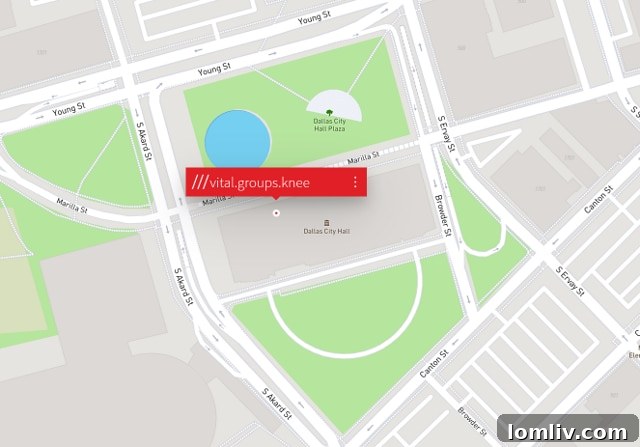
Imagine navigating the world with just three simple words. No complicated street numbers, no confusing intersections, no forgotten zip codes. This isn’t science fiction; it’s the reality offered by What3Words, a groundbreaking global addressing system revolutionizing how we pinpoint locations. For instance, the precise entrance of Dallas City Hall isn’t found at “1500 Marilla Street,” but rather at the memorable three-word sequence: Vital. Groups. Knee. This innovative platform has meticulously mapped the entire planet into a grid of 3-meter by 3-meter squares, assigning each a unique and unforgettable three-word address. What might initially seem like a playful linguistic exercise is, in fact, a powerful solution to some of the most persistent challenges in navigation, logistics, and emergency response. You can click here to explore your own three-word address and instantly grasp the simplicity and precision it offers.
The genesis of What3Words in 2013 stemmed from a clear and urgent need: the inherent imprecision and often non-existence of traditional addresses. Consider the everyday frustrations of deliveries – “which loading dock?” “which gate?” “where exactly in the park?” Beyond urban complexities, a staggering 75 percent of the world’s surface, including vast rural areas, developing nations, and even the open oceans, suffers from poor or completely absent addressing infrastructure. This critical gap impacts everything from humanitarian aid distribution to efficient business operations. What3Words emerged as a elegant solution, offering unparalleled precision to every corner of the globe, addressing these “last-mile” problems with remarkable clarity. This innovative approach to geocoding has attracted significant investor attention, with millions poured into developing and expanding this transformative technology, underscoring its potential to redefine global location services.
For consumers and real estate professionals alike, the free What3Words app, readily available for both Android and Apple users, unlocks a host of practical applications. One of its most compelling features is location pinpointing. In expansive rural landscapes, where traditional navigation often fails, What3Words provides an accuracy unlike anything previously experienced. Imagine selling a sprawling property with considerable acreage; instead of vague directions, buyers and Realtors can meet precisely on-property, eliminating the need for frantic arm-waving, horn-honking, or flashing lights. The app guides them to within a compact 10-foot by 10-foot square, ensuring a seamless and efficient meeting every time.
Beyond simple navigation, What3Words enhances communication and marketing in real estate. Agents can tag photos with specific three-word addresses, providing potential buyers not just a view of the property, but the exact spot where a picture was taken – perhaps showcasing a particular garden feature or a stunning view from a specific window. This level of detail helps buyers visualize the property more effectively and saves time during showings. For the digitally inclined, or perhaps the “digital egotist,” the ability to add a What3Words designation to photos of your lunch or a breathtaking sunset allows for precise sharing of moments and experiences. The convenience extends further with integrated speech recognition, enabling users to effortlessly remember or find precise locations without the hassle of typing, making the process intuitive and user-friendly for everyone seeking enhanced location accuracy.
Unpacking the Ingenuity: Background and Explanation
The Earth, with its vastness, is comprised of approximately 57 trillion of these 3-meter by 3-meter squares. To assign a unique three-word address to each, What3Words ingeniously leverages a carefully curated vocabulary. For English, it took just 40,000 words to generate these 57 trillion individual combinations. For the 26 other languages currently supported, the system is even more efficient, requiring only about 25,000 words (non-English versions primarily map dry land, simplifying the combinatorial challenge). The brilliance extends to its underlying algorithm, which intelligently assigns easier-to-remember words to more densely populated areas, reserving more obscure or complex combinations for less frequented regions. For instance, a random point in the vast Pacific Ocean might be assigned words like Marauding. Substantiates. Collating. This thoughtful design ensures practicality and ease of use where it matters most, making the system intuitive and efficient in urban environments.
One of the earliest and most impactful adopters of the What3Words system was the United Nations. In disaster zones, where roads can be washed away, landmarks destroyed, and traditional addressing systems rendered useless, the ability to pinpoint aid packages and personnel to a precise 3-meter square is invaluable. You might wonder why traditional GIS/GPS data isn’t sufficient. While technically accurate, who can easily remember or communicate complex GPS coordinates like 32.7762715, -96.7969417? No one. But people can effortlessly remember three simple words. Consider our past reliance on 10-digit phone numbers before the advent of cell phone contact lists made such memory tasks almost obsolete. The human brain is simply better wired for words and patterns than for long strings of numbers or letters.
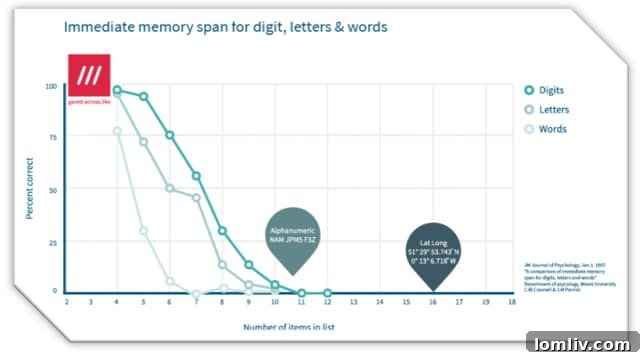
The visual representation above illustrates the impact of complexity on human memory for digits, letters, and words. While memory retention is nearly 100 percent for sequences of four or fewer, it rapidly declines as complexity increases. Although word memory might drop off quickly for random, unconnected words, it has the distinct advantage of transferring significantly more inherent information than individual letters or digits. To illustrate, consider the difference in inherent information or context between ‘7’, ‘P’, or ‘Picnic’. ‘Picnic’ conjures an entire scene, an activity, and a setting. Now, compare remembering the Dallas City Hall’s GPS address (32.7762715, -96.7969417) with “Vital. Groups. Knee.” The latter is undeniably far easier to recall and communicate, highlighting What3Words’ cognitive advantage.
This principle of human memory, particularly the ability to retain short sequences of three and four digits, was famously employed by Bell Labs in the design of phone numbers. It’s why phone numbers are universally structured into three-digit area codes, followed by three-digit central office prefixes, and finally, four-digit station numbers. This same psychological insight explains why most credit cards employ a cadence of three and four digits for their account numbers and security codes (with American Express being a notable exception). What3Words harnesses this fundamental aspect of human cognition, transforming cumbersome coordinates into easily digestible, memorable, and shareable word combinations.
Let’s revisit the Dallas City Hall example to fully appreciate the practical implications. The traditional address, “1500 Marilla Street,” identifies the entire building. What3Words, however, dissects the building’s entire footprint, including its surrounding grounds, into those precise 10-foot squares. Instead of attempting to describe your exact location to someone by saying, “I’m at 1500 Marilla Street, in the back parking lot near Browders Street,” followed by a flurry of increasingly frustrated “last-mile” calls like, “I’m on the east end… two rows from the back… about five spaces from the end… I’m wearing a blue shirt… can you see me, I’m waving my arms!”—you simply state Vital. Bells. Reduce. and you’re at the specific parking space. This eliminates confusion, wasted time, and the embarrassing spectacle of flailing arms, streamlining navigation in complex environments.
You might initially perceive this technology as interesting but perhaps a bit niche or even silly. However, its widespread adoption by critical organizations and major corporations speaks volumes about its undeniable utility. All manner of delivery services, including industry giants like Dominos Pizza, rely on What3Words for precise drop-offs. The Red Cross and the United Nations utilize it for critical humanitarian aid and emergency response, ensuring that help reaches those in desperate need without delay. Regular, large-scale events such as the UK’s Glastonbury Festival and the Farnborough Airshow depend on What3Words to manage complex logistics, direct attendees, and coordinate emergency services across vast, temporary sites. The automotive industry is also recognizing its power; Range Rover integrates What3Words for enhanced off-road mapping capabilities, and in a significant milestone last May, the Mercedes-Benz A-class became the first vehicle to embed this innovative technology directly into its infotainment system, underscoring its long-term vision and commitment, highlighted by Mercedes-Benz’s impressive 10 percent ownership stake in the business.
While you may not find yourself using What3Words every single day just yet, its value becomes immediately apparent in specific, high-stakes, or challenging scenarios. If you’re searching for something (or someone) in a remote, rural “boonies” area, or within a sprawling, vast location like a tailgate party, an expansive campground, or a crowded concert hall, What3Words will effortlessly guide you to the exact spot without the need for frantic gesturing or guesswork. For real estate developers targeting a specific demographic, a “vanity” What3Words address for a premium property can provide unique marketing appeal and “street cred,” offering a memorable differentiator far more impactful than a mere QR code. Furthermore, uniquely identifying every lot and home within a new development and tying those precise addresses back to specific marketing materials, floorplans, and virtual tours creates a more immersive and “sticky” experience in the minds of digital shoppers, enhancing engagement and ultimately driving sales. What3Words is not just an alternative; it’s a powerful enhancement to our digital and physical world, promising a future of seamless and precise navigation for everyone.

Remember: My focus consistently revolves around the dynamic world of high-rises, HOAs, and renovation projects. However, I also hold a deep appreciation for the delicate balance between modern and historical architecture, especially when viewed through the lens of the evolving YIMBY (Yes In My Backyard) movement. My writing in real estate has been recognized by the National Association of Real Estate Editors, earning three Bronze awards in 2016, 2017, and 2018, alongside two Silver awards in 2016 and 2017. If you have an intriguing story to share or perhaps an unconventional marriage proposal to make, don’t hesitate to reach out via email at [email protected]. You’re also welcome to look for me on Facebook and Twitter, though I playfully confess you won’t find me there.