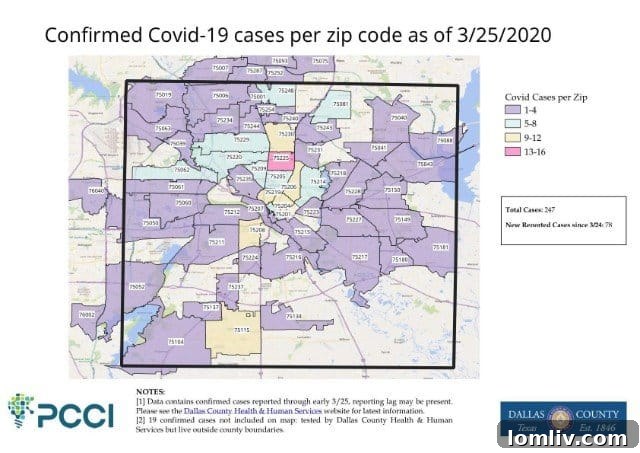
As of Wednesday, March 25, 2020, Dallas County identified its highest concentrations of confirmed COVID-19 cases within the 75225 zip code, encompassing areas like University Park. This early data point served as a critical indicator, highlighting how rapidly the novel coronavirus was establishing footholds even in affluent communities. While the specific geographic spread might evolve, this initial observation underscored a fundamental truth: the virus disregards socio-economic status, property values, or address. Its trajectory is dictated by human interaction, making every individual’s actions crucial in the collective effort to curb its reach.
The emergence of these hotspots early in the pandemic brought into sharp focus the primary transmission pathways of COVID-19. It wasn’t about where you lived, but rather how you lived and interacted with the world around you. Factors such as recent travel, participation in large social gatherings, and diligent hand hygiene emerged as pivotal in determining individual risk and, consequently, community spread. Understanding these dynamics became paramount for public health officials and residents alike, as the community grappled with an unprecedented health crisis demanding swift and informed responses.
A crucial aspect of confronting this novel pathogen, revealed through rigorous scientific inquiry, was the significant underestimation of actual case numbers. According to a study published in the journalScience, for every positively confirmed coronavirus test, there were an estimated five to ten additional unreported cases. This alarming disparity highlighted the insidious nature of the virus, indicating a far broader prevalence within communities than testing data alone could capture. The implications of this hidden burden were profound, emphasizing the urgency of universal precautions and the inherent challenges in controlling a disease with such a wide unseen spread.
This information is not intended to incite fear, but rather to illuminate the profound necessity of adhering to public health guidelines, particularly Dallas County’s shelter-in-place directive. The understanding that a significant portion of the infected population remained undiagnosed, coupled with the potential for asymptomatic transmission, fundamentally altered the approach to public safety. It underscored why everyone, regardless of symptoms or perceived risk, needed to minimize contact and stay home. You or individuals within your immediate neighborhood could unknowingly be carrying the novel coronavirus and inadvertently spread it to others without exhibiting any symptoms. This reality demanded a collective commitment to social responsibility and vigilance.
Navigating the Pandemic: Essential Guidelines for Realtors and the Real Estate Industry
The unique characteristics of the novel coronavirus posed significant challenges across various sectors, and the real estate industry was no exception. Given the high probability of asymptomatic transmission and the critical need to limit person-to-person contact, recommendations against traditional open houses and in-person showings became a cornerstone of public health strategy. While the act of an agent showing an unoccupied home to a single client might seem benign on the surface, the underlying risk of silent transmission was, and remains, substantial.
Consider the scenario: an agent, a client, or even a previous visitor to the property could be carrying the coronavirus without displaying any visible symptoms. The virus, capable of surviving on surfaces for varying periods, could be inadvertently transferred through shared doorknobs, light switches, countertops, or other frequently touched areas. If an agent or client is an asymptomatic carrier, they could easily transmit the virus to the other party. That individual then takes the virus home, potentially infecting their entire household, initiating a new chain of transmission within their community. This ripple effect underscores the immense responsibility placed on real estate professionals to prioritize public health above conventional business practices during a pandemic.
The Unseen Threat: Why Asymptomatic Transmission Matters
The concept of asymptomatic transmission profoundly impacted public health strategies and business operations. Unlike many diseases where symptoms serve as clear warnings, COVID-19 demonstrated an alarming ability to spread from individuals who felt perfectly healthy. This meant that relying solely on symptom screening was insufficient to prevent transmission, particularly in environments involving multiple interactions or shared spaces. For the real estate sector, where clients and agents often spend time together in enclosed spaces and touch various surfaces within a property, this characteristic of the virus necessitated a complete overhaul of standard operating procedures.
Understanding the widespread nature of undocumented infections, as highlighted by the Science study, further amplified these concerns. If a significant percentage of infected individuals are unaware of their status, then every interaction carries a potential risk. This reality compelled industries like real estate to adopt extremely cautious approaches, moving beyond personal assessment of health to universal preventive measures. Realtors, by the very nature of their work, interact with numerous individuals and properties, making them potential conduits for virus transmission if proper precautions are not rigorously followed.
Adapting Real Estate Practices for Public Safety
To mitigate these risks, the real estate industry, particularly in North Texas, was urged to embrace innovative solutions that minimized direct contact while still facilitating necessary transactions. The era of bustling open houses, where numerous potential buyers would freely explore a property, had to be temporarily suspended. In its place, virtual alternatives rapidly gained prominence:
- Virtual Tours: High-quality 3D tours and immersive video walkthroughs allowed prospective buyers to experience a property from the comfort and safety of their homes.
- Video Consultations: Agents leveraged video conferencing platforms for initial client consultations, property discussions, and even virtual showings, maintaining personal connection without physical proximity.
- Digital Documentation: The shift towards electronic signatures and online document exchanges streamlined transactions while drastically reducing physical paperwork and in-person meetings.
- Limited & Controlled Showings: When an in-person viewing was absolutely essential, stringent protocols were implemented. This included limiting the number of people in a property at any given time, requiring masks and hand sanitization, and pre-sanitizing high-touch surfaces.
These adaptations were not merely temporary inconveniences; they represented a fundamental shift in how the industry operated, underscoring the adaptability and resilience of real estate professionals. By embracing technology and prioritizing health, Realtors could continue to serve their clients effectively while fulfilling their ethical obligation to community safety.
The Realtor’s Ethical Imperative: Beyond Business as Usual
The guidelines issued during the pandemic transcended mere operational adjustments; they touched upon the core ethical responsibilities of real estate agents. A Realtor’s role often involves being a trusted advisor, and during a public health crisis, this trust extends to safeguarding clients’ health and well-being. Continuing with “business as usual” practices, such as traditional open houses, not only risked clients and communities but also undermined the public trust in the profession.
The call for Realtors to “play by the rules” was a plea for collective responsibility. It acknowledged that the actions of individual agents had far-reaching consequences for public health. By adhering to recommendations against in-person showings and open houses, real estate professionals demonstrated their commitment to broader societal welfare, fostering a safer environment for everyone in North Texas. This commitment helped reinforce the crucial message that controlling the pandemic required a unified effort, with every sector doing its part.
Sustaining Community Health: A Collective Effort
The experience of the pandemic, particularly during its early stages when data like the Dallas County hotspots emerged, served as a powerful reminder of our interconnectedness. The spread of a virus in one zip code could quickly become a concern for neighboring communities, highlighting the importance of universal adherence to public health measures. Dallas County’s proactive stance on shelter-in-place was a critical step in mitigating the virus’s spread, aimed at reducing the transmission rate and preventing healthcare systems from being overwhelmed.
Ultimately, the health and safety of our communities depend on the conscious choices made by individuals and businesses alike. For real estate professionals, this meant transforming traditional practices to align with public health imperatives. For every resident, it meant internalizing the message that staying home, practicing social distancing, and maintaining rigorous hand hygiene were not just personal choices but acts of collective responsibility. The insights gained from tracking early outbreaks, combined with a scientific understanding of viral transmission, provided a clear roadmap for action, demonstrating that vigilance, adaptation, and solidarity are our strongest defenses against an evolving health crisis.