

As a woman navigating the complexities of modern life, the idea of owning property without a man’s co-signature feels like a fundamental right, an unquestionable aspect of financial independence. Yet, this freedom, which many of us now take for granted, is a relatively recent achievement, built on the tireless efforts of generations of women who fought for equality. While Women’s History Month may have officially concluded, its spirit of recognition and empowerment continues to resonate, especially when we consider the remarkable strides women have made in the world of real estate. At daltxrealestate.com, we believe it’s essential to not only acknowledge this progress but also to understand the historical context and ongoing challenges facing women as homeowners and heads of households.
This journey from dependence to autonomy in property ownership is a testament to legislative changes, shifting societal norms, and the sheer determination of women seeking to build their own futures. From the foundational legal frameworks that once restricted women’s property rights to the current landscape where single women are a dominant force in the housing market, the narrative is one of significant transformation. We will explore the pivotal moments that shaped this evolution, delve into contemporary statistics that highlight both triumphs and disparities, and consider the empowering role women play within the real estate industry itself, paving the way for even greater equity and independence.
Paving the Way: The Equal Credit Opportunity Act and Women’s Financial Autonomy
It’s easy to look at today’s housing market and see single women as a powerful demographic. As of 2023, single women comprise a significant 17 percent of homebuyers, making them the second-largest buyer group, surpassed only by married or unmarried couples. This statistic, impressive as it is, represents a dramatic shift from a not-so-distant past. Imagine a time when a woman, regardless of her income or creditworthiness, could not secure a mortgage without a male co-signer. This was the prevalent reality for women in the United States between 1900 and 1974, a period during which financial institutions routinely denied credit based on gender.
Even more startling is the period before 1900, when legal statutes often prevented women from holding property in their own names altogether. Under common law principles such as “coverture,” a married woman’s legal identity was subsumed by her husband’s. Her property, income, and even her legal rights became his. This system effectively denied married women any independent financial standing, making the concept of female homeownership, let alone independent ownership, a distant dream. Single women faced similar, though sometimes less explicit, barriers rooted in societal expectations, limited access to professional careers, and systemic biases within the financial sector that constrained their ability to accumulate wealth and credit.
The landscape began to change definitively with the passage of the Equal Credit Opportunity Act (ECOA) in 1974. This landmark federal legislation was a game-changer, prohibiting discrimination in any credit transaction based on sex, marital status, race, religion, national origin, age, or receipt of public assistance. Suddenly, lenders could no longer deny a woman a mortgage simply because she was single, divorced, or married and choosing to apply for credit independently. It dismantled a discriminatory system that had unfairly constrained women’s economic freedom for centuries, unlocking unprecedented opportunities for financial independence and wealth building by legally recognizing women’s right to credit on an equal footing with men.
The impact of ECOA was almost immediate and profoundly transformative. Women wasted no time in seizing their newfound financial autonomy. While couples, whether married or unmarried, have consistently held the top position for homeownership, single women rapidly ascended to the second spot by 1981. This swift rise underscored a deep-seated desire among women to establish roots, build equity, and control their own living spaces, a desire previously suppressed by legal and societal barriers. Today, the numbers tell an even more compelling story: single women proudly own and occupy an impressive 10.7 million homes across the U.S., significantly outnumbering the 8.2 million homes owned by single men. This demonstrates not just a legal change, but a profound cultural and economic shift, cementing women’s crucial and expanding role in the national housing market.

The Contemporary Landscape: Women’s Homeownership Trends and Persistent Challenges
The journey towards equitable homeownership for women has been marked by remarkable progress, reflecting broader societal shifts and increased economic empowerment. Data from the National Association of Realtors (NAR) illustrates this trend vividly: the homeownership rate among women in the U.S. climbed steadily from 50.9 percent in 1990 to an impressive 61.2 percent by 2019. This substantial increase highlights women’s growing presence and influence in the housing market, demonstrating a sustained commitment to investing in real estate as a cornerstone of personal and financial security, and a testament to their increasing economic power.
Beyond individual homeownership, women are increasingly heading households, signifying a monumental shift in domestic and economic leadership. Census data from the same period reveals that the share of households led by single women expanded from 17.6 percent to 22.6 percent. This trend signifies a move away from traditional household structures, with more women confidently taking on the primary role of household decision-maker and provider. Furthermore, even within married two-earner households, the dynamics are evolving. The proportion of women identified as heads of household saw a significant surge, rising 24.3 percentage points from 21.8 percent in 1990 to 46.1 percent in 2019. This indicates a growing recognition of women’s equal, if not primary, contribution to household leadership and financial management within marital partnerships, challenging long-held patriarchal norms.
Unpacking the Persistent Gender Gap in Housing
Despite these undeniable gains, the path to full equity in homeownership remains uneven, with several studies highlighting a concerning gender gap that suggests women still face disadvantages in the housing market. A recent Yale study, for instance, revealed that women typically pay approximately 2 percent more for housing when purchasing and, conversely, sell for about 2 percent less than men. This seemingly small percentage can translate into tens of thousands of dollars over the lifetime of homeownership, significantly impacting wealth accumulation and widening the economic divide.
Further compounding this issue, research by mortgage startup Ownup found that women pay higher mortgage rates than men in a staggering 49 states. This pervasive disparity can stem from a variety of interconnected factors, including the persistent gender pay gap, which can affect women’s credit scores and perceived financial risk by lenders. Additionally, potential unconscious biases in lending algorithms or negotiation processes, as well as differences in financial literacy and access to competitive credit options, can contribute to these higher costs. Moreover, Zillow data from 2020 indicated that homes owned by women tend to have a lower overall value, averaging about 92.3 percent of the value of male-owned homes. This might be influenced by factors such as the types of properties women tend to purchase (e.g., smaller homes, different neighborhoods), their primary motivations (e.g., proximity to schools, safety, community over pure investment potential), or even subtle biases in property appraisals that undervalue female-owned assets.
Addressing these complex disparities requires a multi-faceted approach, including continued advocacy for equal pay, increased financial literacy for women, and heightened awareness among lenders and real estate professionals about potential unconscious biases. Understanding these challenges is crucial for empowering women to navigate the housing market more effectively, ensuring their investments yield equitable returns and that true financial equality in homeownership becomes a reality.
Women Shaping the Industry: Leadership in Real Estate

While the narrative of women in homeownership has evolved dramatically, their role in the real estate profession itself has a rich, albeit challenging, history. Women have always been a vital force in the industry, contributing locally and nationally. However, like many professional fields, the early days were marked by significant exclusion. When the National Association of Realtors (NAR) was founded, its membership was exclusively male, reflecting the prevailing societal norms and professional barriers of the time. Women aspiring to careers in real estate faced an uphill battle, often relegated to clerical roles or operating in a heavily male-dominated landscape.
The doors to NAR began to open for women in 1910, a significant step forward that allowed female agents to gain professional recognition and access to a wider network. Yet, true integration took decades. By 1975, women represented a third of its members, signaling a growing presence and a turning tide. Today, the profession has truly embraced diversity, with a remarkable 66 percent of Realtors being women. This majority presence has undoubtedly reshaped the industry, bringing new perspectives, client-centric approaches, and a deeper understanding of diverse family and individual needs into the forefront of real estate practices. Women’s natural abilities in communication, empathy, and relationship-building have made them exceptionally effective in a service-oriented industry like real estate.
Beyond sheer numbers, women have ascended to the highest echelons of leadership within NAR, breaking significant glass ceilings and inspiring future generations. The association named its first woman president in 1992, a momentous occasion that symbolized a profound shift towards inclusive leadership. Since then, six more women have held the prestigious position, demonstrating a sustained commitment to diversity at the highest levels of the organization. Among these trailblazers is Leslie Rouda Smith, a respected local leader from Dallas-Fort Worth who served as NAR President last year. Her journey, and that of other female leaders, exemplifies resilience and vision, inspiring countless women to pursue fulfilling careers in real estate and to aim for leadership roles, ensuring that the industry continues to evolve with diverse and powerful voices at its helm.
Texas vs. The Nation: A Look at Women’s Homeownership in the Lone Star State
Given Texas’s unique cultural and economic landscape—characterized by rapid growth, a competitive housing market, and diverse demographics—it’s natural to wonder how women’s homeownership trends in the Lone Star State compare to national figures. The encouraging news is, according to the Texas Association of Realtors’ (TAR) 2022 numbers, the picture is strikingly similar to the national averages. This consistency underscores a universal drive among women across the country to secure their place in the housing market, regardless of regional differences, and highlights the shared aspirations of women to achieve financial independence through property.
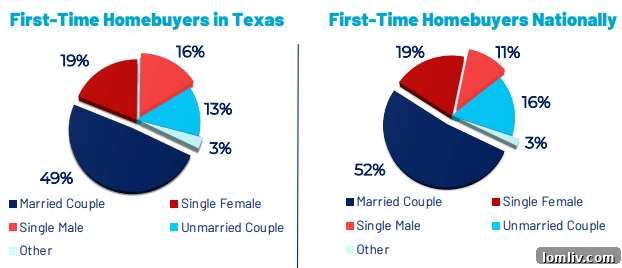
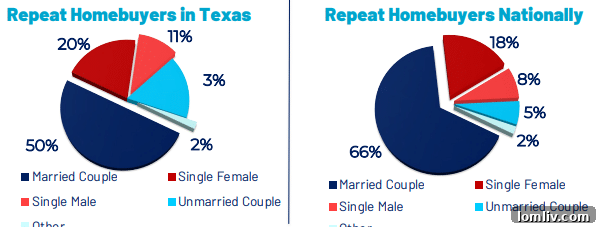
When examining market share across various buyer categories, single women consistently emerge as a formidable force in Texas. In both the crucial first-time buyer and repeat buyer segments, single women hold the second-highest market share, demonstrating their significant and sustained engagement in the market. For first-time buyers, single women represent 19 percent of the market, mirroring the national average of 19 percent. Among repeat buyers, their share stands at 20 percent, slightly outpacing the national 18 percent. These figures strongly indicate that women in Texas are not only entering the market but are also successfully navigating subsequent purchases, reflecting long-term engagement and strategic investment in real estate, thereby contributing significantly to the state’s economic vitality.
The visual data, often presented in comparative charts (as seen below), clearly illustrates these trends, providing a compelling snapshot of single women’s significant contribution to the Texas housing economy. These statistics reinforce the narrative of empowered female homebuyers and their critical role in driving market activity, contributing to the overall stability and growth of the real estate sector in one of the nation’s most dynamic and expanding states. The consistent performance of single women in Texas’s housing market affirms their pivotal role in shaping its future.
Beyond the Numbers: Real-World Insights and Overcoming Bias

While statistics paint a broad picture, understanding the real-world implications of these trends requires hearing from those on the front lines of the industry. To gain this invaluable perspective, we spoke with Ashley Gentry, a seasoned Realtor and manager with Redbranch Realty, and the esteemed 2023 MetroTex President-Elect. Her experiences over the past few years perfectly echo the national data: single women are indeed the predominant demographic among single purchasers she assists, demonstrating their continued drive towards homeownership.
Gentry enthusiastically affirmed the growing empowerment of women in real estate. “Women are empowered to procure real estate,” she stated, emphasizing the deeper, strategic motivations behind these purchases. “It’s about home ownership, thinking long-term, and wealth building.” This insight highlights that for many women, buying a home isn’t just a transaction; it’s a strategic investment in their future, a foundation for stability, and a deliberate means of accumulating personal wealth and securing their financial independence for years to come.
Reflecting on the swift rise of single women to the second-largest buyer group in 1981, Gentry offered compelling insights into potential underlying reasons for this rapid ascent. She suggested that intrinsic motivations often drive women toward homeownership, perhaps more so than their male counterparts. “Some women more naturally want to put down roots, create a homestead, and focus on the future — whether it’s about having a family or not,” Gentry explained. She humorously added, “I’ve had lots of clients that are looking for the perfect home for their pets while single men may tend to be more transient.” This observation, made with a shared understanding that generalizations don’t apply to everyone (as we both had a good laugh about “not all men” and “not all women”), speaks to a common desire among many women to create a stable, personalized sanctuary and a sense of belonging.
The Crucial Role of an Expert Agent in Navigating Bias
When confronted with the unsettling statistics – that women often pay more for their homes and mortgages and sell for less – Gentry provided a truly insightful perspective, one that underscores the invaluable role of a skilled real estate agent. “This is why you need a great agent working with you,” she asserted, acknowledging that while it might sound self-serving, her conviction runs deep. “People have all sorts of biases about all sorts of things, and your agent is there to take bias out of the equation.”
This statement is more profound than it appears. A competent real estate agent serves as a crucial advocate, especially for female buyers and sellers who might otherwise encounter subtle or overt biases. They possess expert market knowledge to ensure fair pricing and accurate valuations, robust negotiation skills to counteract any unconscious bias from sellers, lenders, or appraisers, and the ability to identify and challenge discriminatory practices. Whether it’s negotiating the purchase price, scrutinizing appraisal reports for fairness, or securing favorable mortgage terms, a dedicated agent acts as a protective shield and an informed guide. In an industry where subtle biases can still impact financial outcomes, having a knowledgeable, assertive, and ethical agent is not merely a convenience, but a strategic necessity for women seeking to maximize their real estate investments and achieve true financial equality.
Looking Ahead: The Future of Women in Homeownership
The journey of women in real estate and homeownership is a powerful narrative of progress, resilience, and increasing empowerment. From the restrictive legal frameworks of the past to the liberating reforms of the Equal Credit Opportunity Act, women have consistently pushed boundaries to achieve financial independence through property ownership. Today, single women are a driving force in the housing market, establishing homes, building equity, and leading households at unprecedented rates. This growing influence is not only a testament to their ambition but also a vital component of the nation’s economic vitality, contributing to community stability and growth.
However, as we celebrate these significant achievements, it’s equally important to acknowledge the persistent challenges. The lingering gender gap in housing costs, mortgage rates, and property values serves as a clear reminder that the quest for full equity is ongoing. Addressing these disparities requires continued vigilance, advocacy for fair practices, and a commitment from all stakeholders in the real estate ecosystem to eliminate unconscious biases. The invaluable role of a skilled and ethical real estate agent, as highlighted by industry leaders like Ashley Gentry, becomes paramount in helping women navigate these complexities and ensure equitable outcomes, protecting their investments and future.
The future of women in homeownership is undeniably bright, characterized by increasing autonomy, strategic investment, and a growing voice in shaping the real estate industry itself. As more women confidently enter the market, take on leadership roles, and advocate for fairness and transparency, the dream of truly equal access and opportunity in real estate moves ever closer to reality. This ongoing evolution is not just about homes; it’s about building stronger, more inclusive communities, fostering greater economic security for women, and ultimately creating a more equitable society for all, where every individual has the chance to realize their dreams of homeownership.