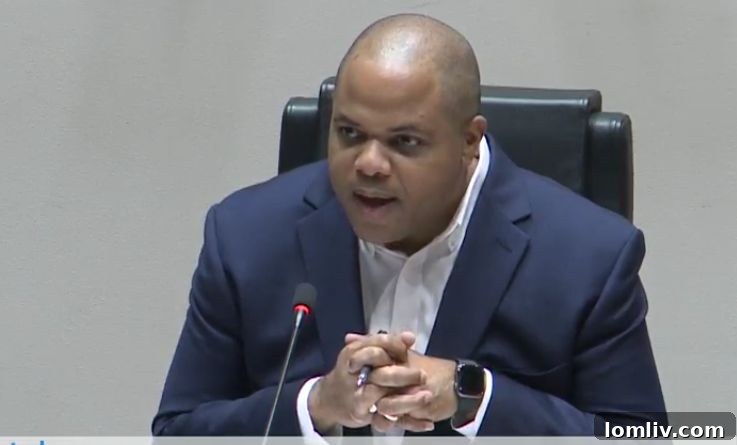
Dallas City Hall has once again become the stage for a compelling political drama, underscoring persistent tensions between key figures at the helm of the city’s governance. At the heart of this unfolding narrative are Dallas City Manager T.C. Broadnax and Mayor Eric Johnson, whose disagreements have recently flared over the crucial allocation of $1.1 billion in bond funds for the upcoming year. This isn’t the first time the two leaders have found themselves at odds; a recurring pattern of contention has characterized their professional relationship, deeply influencing policy discussions and the strategic direction of one of America’s fastest-growing metropolitan areas. The current dispute, centered on the recommendations for the 2024 bond program, brings to light fundamental questions about policy authority, citizen participation, and the balance of power within the city’s council-manager system of government.
Last year, City Manager T.C. Broadnax faced significant pressure, with calls for his dismissal echoing through City Council chambers. Despite the initial push for his removal, Broadnax managed a remarkable recovery, securing his position and even receiving a three percent increase to his substantial $410,919 salary. This decision, however, was far from unanimous. As previously reported, Mayor Eric Johnson, along with council members Paula Blackmon (District 9), Adam McGough (District 10), Gay Donnell Willis (District 11), and Cara Mendelsohn (District 12), cast dissenting votes against the proposed salary hike. Their opposition signaled an underlying friction that, far from dissipating, appears to have intensified, setting the backdrop for the current high-stakes debate over public spending and city priorities. This earlier conflict serves as a vital context, illustrating a history of strained relations and divergent perspectives between the city’s top administrative officer and its elected head, laying bare the power struggles inherent in municipal leadership.
For an in-depth understanding of the critical issues surrounding the 2024 bond program, particularly how housing and parks emerged as central priorities in the final push for $1.1 billion in funds, review previous reports on daltxrealestate.com.
The latest point of contention emerged following a critical Dec. 6 City Council briefing, where Dallas elected officials gathered to deliberate on the recommendations for the city’s impending $1.1 billion bond program. This massive investment package is designed to fund a wide array of municipal projects, from vital infrastructure improvements like streets and alleys to critical community needs such as housing and parks. The session was notably absent of Mayor Eric Johnson, with Mayor Pro Tem Tennell Atkins presiding over the extensive discussions. The focus of the briefing was the presentation from Arun Agarwal, chairman of the Community Bond Task Force (CBTF), a citizen-led panel tasked with gathering public input and formulating recommendations on how these significant bond funds should be distributed across Dallas. The CBTF’s work, a testament to civic engagement, represented months of dedicated effort by a diverse group of Dallas residents, aiming to ensure taxpayer dollars are spent in alignment with community needs and aspirations. The full video of the Dec. 6 City Council briefing offers further insight into these important deliberations.
The $1.1 billion bond program represents a monumental commitment to Dallas’s future, impacting every resident through improvements in public services and infrastructure. Bond programs are essential mechanisms for cities to finance large-scale projects that are too costly to fund through annual operating budgets. For Dallas, this particular bond package is earmarked for a range of critical areas, including enhancing the city’s aging road network, upgrading parks and recreational facilities, and significantly bolstering efforts to address the pressing issue of affordable housing. The Community Bond Task Force, comprising 90 dedicated members, undertook an exhaustive eight-month process to solicit feedback from various neighborhoods, conduct in-depth analyses, and ultimately synthesize these insights into a comprehensive set of recommendations. Their mission was to bridge the gap between administrative planning and citizen desires, ensuring the bond program genuinely reflects the collective vision for Dallas’s development and progress. This democratic process is fundamental to building public trust and ensuring accountability in government spending, as detailed in the comprehensive CBTF recommendations document.
However, the conclusion of the 10-hour briefing sparked immediate controversy. Following detailed presentations and impassioned testimony from over 100 residents who voiced their preferences for how the bond money should be allocated, City Manager T.C. Broadnax introduced a suggestion that immediately drew the Mayor’s ire. Broadnax proposed reconvening in January to review bond projects, but explicitly stated that staff recommendations, rather than the diligently prepared Community Bond Task Force recommendations, should serve as the baseline for these future discussions. This proposal, if adopted, would effectively sideline months of collaborative effort by the 90-member task force, potentially rendering their extensive work largely irrelevant in the foundational stages of decision-making. Such a move raised significant concerns about the value placed on citizen engagement and the transparency of the policy-making process within Dallas City Hall. The city staff’s detailed recommendations highlight the administrative perspective.
Throughout the lengthy Dec. 6 meeting, Broadnax delivered extensive remarks, acknowledging the City Council’s ultimate authority while also conveying the complex realities faced by city staff in balancing competing priorities. He highlighted a significant shift in community focus: “We got a new area of concern and desire, and that is housing at a much larger level,” Broadnax stated. He articulated the challenge this presents: “That has to come from somewhere if we’re going to do it. The baseline for streets as we would recommend is $500 million at a minimum. Everything else is where that number got moved back from to put more money into housing.” This statement reveals the inherent tension between funding critical infrastructure, which often demands substantial investment, and addressing urgent social needs like housing, which has gained increasing prominence in public discourse. Broadnax underscored the professional judgment of his staff, suggesting that their recommendations were grounded in practical expertise and comprehensive data, designed to ensure fiscal responsibility and effective project execution amidst the city’s evolving needs.
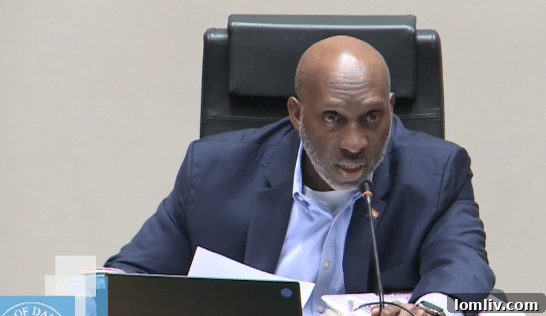
Broadnax further advised the council members on their options, suggesting they could conduct straw polling or hold individual meetings with city staff to articulate their specific desires regarding the bond program. However, his subsequent comments carried a stark, almost cautionary tone, emphasizing the difficult choices ahead. “Your task will not get any easier,” the city manager warned. “Your desires and hopes and dreams will probably be crushed, but we’ve got to get to a number — and you can’t tell me all year, and my team, that you care about streets and alleys and then we don’t fund them at least at the level consistent with what staff is telling you professionally…” This candid admonition underscored his belief in the professional assessments provided by city staff, implying that disregarding these expert recommendations could lead to unrealistic expectations or neglected essential services. He concluded with a challenge to the council’s priorities: “Again, it doesn’t matter to me. We’ll start with any number. We’ll start with [the CBTF] number, but it’s not going to be the same if you want to get all the hopes, dreams, and wishes that y’all talked about today met.” His words highlighted the practical constraints of a fixed budget and the necessity of making hard trade-offs that align with sustainable urban development.
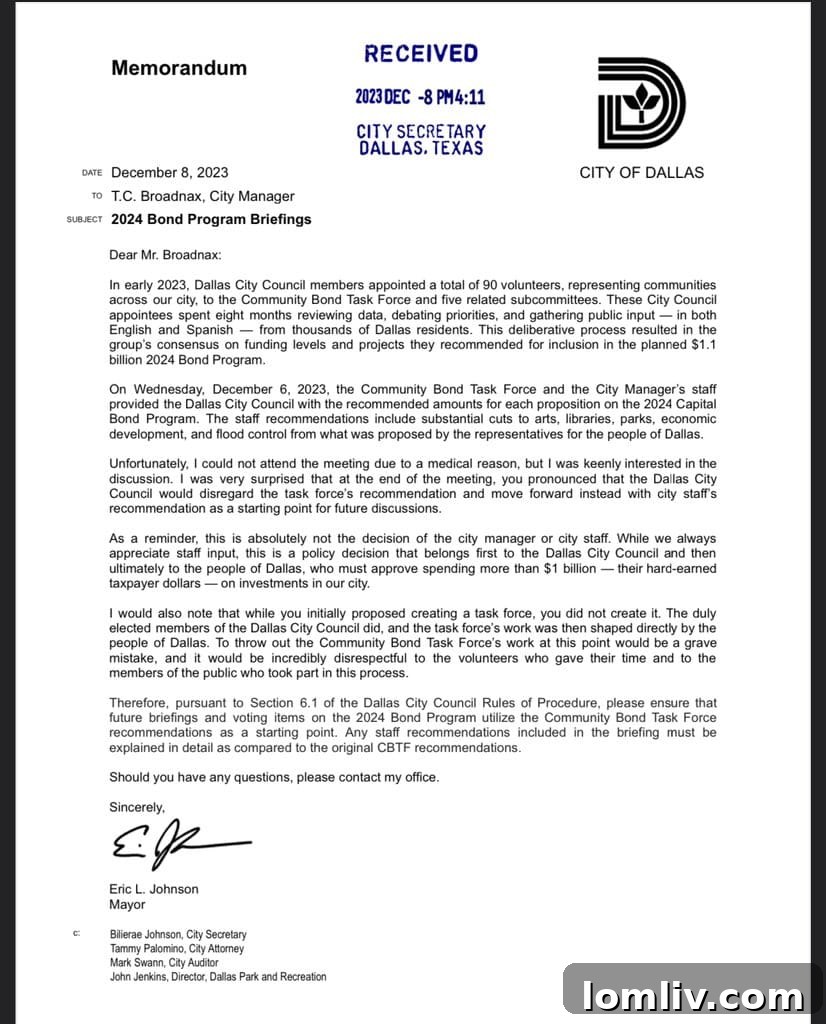
The City Manager’s remarks and his proposed deviation from the Community Bond Task Force’s work prompted a swift and authoritative response from Mayor Eric Johnson. On Friday, Dec. 8, Mayor Johnson filed a strongly worded memorandum directly addressing Broadnax, serving as a clear reminder of the chain of command and the fundamental principles of governance in Dallas. “I was very surprised that at the end of the meeting, you pronounced that the Dallas City Council would disregard the task force’s recommendation and move forward instead with city staff’s recommendation as a starting point for future discussions,” Johnson wrote in his memo. The Mayor unequivocally asserted the Council’s prerogative, emphasizing that policy decisions, especially those involving significant taxpayer funds, rest squarely with the elected officials and, ultimately, with the citizens they represent. He underscored the democratic process, stating: “As a reminder, this is absolutely not the decision of the city manager or city staff. While we always appreciate staff input, this is a policy decision that belongs first to the Dallas City Council and then ultimately to the people of Dallas, who must approve spending more than $1 billion — their hard-earned taxpayer dollars — on investments in our city.” This public declaration firmly re-established the boundary between administrative recommendations and political decision-making authority, reinforcing the mayor’s commitment to democratic principles.
The intricate history of T.C. Broadnax’s tenure and the initial challenges he faced, including when he almost got fired yet received a raise, offers crucial context to the ongoing political dynamics at Dallas City Hall.
Mayor Johnson further reinforced his position by reminding the city manager of the foundational role and democratic origins of the Community Bond Task Force. He stressed that the task force was not an arbitrary body but was specifically created by the elected council members themselves, and its extensive work was explicitly driven by the input and priorities of Dallas residents. This emphasis on citizen-led initiatives is a cornerstone of transparent and accountable local governance. “Therefore… please ensure that future briefings and voting items on the 2024 bond program utilize the Community Bond Task Force recommendations as a starting point,” Johnson’s memo mandated. He did not completely dismiss staff input but clarified its proper place: “Any staff recommendations included in the briefing must be explained in detail as compared to the original CBTF recommendations.” This directive ensures that while staff expertise is valued, it must be presented in a way that directly addresses and contrasts with the community’s articulated preferences, forcing a transparent comparison and justifying any proposed deviations. The Mayor’s memo clearly aims to uphold the integrity of the citizen engagement process and reaffirm the Council’s policy-setting role in guiding the city’s financial future, ensuring public trust and accountability.
This ongoing disagreement between Dallas’s top elected official and its chief administrator highlights a recurring challenge in municipal governance: balancing professional staff expertise with democratic accountability and citizen participation. The $1.1 billion bond program is not just about concrete infrastructure projects; it’s a reflection of Dallas’s priorities for its future, from maintaining essential services to investing in new growth areas like affordable housing. The way this conflict is resolved will have lasting implications not only for the allocation of these significant funds but also for the operational dynamics within Dallas City Hall. It will set a precedent for how citizen task force recommendations are treated and how much weight is given to public input versus administrative assessments. As the January meetings approach, all eyes will be on the Dallas City Council to see how they navigate this complex political landscape, ensuring that the final decisions truly reflect the will of the people and best serve the long-term interests of the vibrant city of Dallas. The resolution of this bond program debate will be a critical test of leadership and collaborative governance, shaping the city’s trajectory for years to come.