By Bob Hoebeke
President, Hoebeke Builders
In the complex world of home construction and renovation, a common misconception often leads homeowners down a path of unforeseen costs, delays, and stress. Many believe that hiring individual professionals one by one as needed is the most logical and economical approach. However, seasoned experts in the field understand a profound truth: building your complete team of professionals before the first design sketch or demolition swing is not only a smarter strategy but, surprisingly, the most cost-effective way to achieve your project goals. This integrated approach fundamentally reshapes the entire building experience, transforming potential pitfalls into seamless progress.
The adage, “There’s no ‘I’ in ‘team’,” perfectly encapsulates the philosophy behind this methodology. While it might seem counter-intuitive to invest in a full complement of experts—an architect, builder, interior designer, and landscaper—at the project’s inception, this proactive step acts as a powerful shield against common construction woes. It fosters an environment of collaboration, foresight, and shared responsibility that is simply unattainable when professionals are brought in sequentially or in isolation. The synergy created by a well-assembled team lays a robust foundation for success, ensuring that every facet of your dream home is meticulously planned and expertly executed from day one.
The Strategic Advantage: Why Assemble Your Team First?
The decision to build your professional team upfront is a strategic investment that yields substantial returns in efficiency, quality, and financial savings. It transforms the often-fragmented construction process into a cohesive, streamlined operation. Here are five compelling reasons why this “team-first” approach is the cheapest and most effective way to undertake your home construction or remodeling project:
-
Unparalleled Knowledge and Diverse Expertise: Each discipline within your project team—be it the architect, general contractor, interior designer, or landscape architect—brings a specialized lens through which they view and contribute to the project. The architect conceptualizes the aesthetic and structural integrity, ensuring functionality and compliance with building codes. The general contractor brings practical building knowledge, managing the budget, schedule, and construction logistics. The interior designer focuses on the functional flow, material selection, and overall ambiance of the living spaces, considering everything from lighting to furniture placement. The landscape architect integrates the home with its surroundings, addressing critical elements like site drainage, plant selection, outdoor living spaces, and preserving existing natural features. This collective knowledge is invaluable. Where one discipline might have a blind spot, another team member provides clarity, preventing costly oversights. For example, while the architect and builder can determine the finished floor grade, the landscape architect will ensure proper drainage away from the foundation and consider the impact on existing trees, averting potential flooding and environmental damage. This multi-faceted insight proactively identifies and resolves potential issues before they become expensive problems on site.
-
Powerful Synergy and Holistic Design: The concept of “four heads are better than one” rings especially true in construction. When all key professionals collaborate from the outset, they begin to see the project not as individual components but as a single, integrated vision. This collaborative environment encourages brainstorming, challenging assumptions, and creative problem-solving from diverse perspectives. Each team member contributes their unique insight, leading to innovative solutions and a more cohesive, harmonious design that truly reflects your vision. The “total effect is greater than the sum of the parts” because ideas are refined, optimized, and integrated across all disciplines. This synergy ensures that aesthetic beauty, structural soundness, interior functionality, and exterior harmony are not just individually achieved but are intricately woven together into a unified masterpiece.
-
Enhanced Efficiency and Streamlined Processes: Imagine a scenario where a single professional, a “Lone Ranger,” is hired first. They develop designs or plans which then must be presented and iteratively revised based on feedback from other professionals who join the project later. This sequential, back-and-forth process is inherently inefficient, riddled with delays, and prone to miscommunication. In contrast, when all disciplines are together in the same room from the initial planning stages, the pace of decision-making and problem-solving dramatically accelerates. Ideas are discussed, critiqued, and integrated in real-time. Potential conflicts between design elements, construction methods, interior finishes, or landscape integration are identified and resolved immediately, rather than becoming costly change orders later. This integrated approach significantly reduces rework, eliminates redundancies, and ensures that everyone is on the same page, moving forward with a clear, unified plan.
-
Robust Accountability and Quality Assurance: The principle of “iron sharpens iron” perfectly describes the dynamic within a well-formed team. When professionals are working in close collaboration, there’s a natural and healthy challenge system in place. Each team member is aware of their responsibilities and the impact their work has on others. This creates a strong sense of collective ownership and individual accountability. Regular team meetings become platforms for progress reviews, where work is presented, discussed, and constructively critiqued. This peer-review mechanism ensures higher quality outputs, as each expert’s work is implicitly vetted by others who understand the project’s overall goals. A team member who fails to deliver on time or with the expected quality quickly impacts the entire project, fostering an environment where everyone is motivated to perform their best and meet deadlines, knowing that their contribution is vital to the team’s collective success.
-
Significant Cost Savings Through Value Engineering: Perhaps the most compelling reason to assemble your team early is the direct financial benefit. Planned together equals fewer mistakes, and fewer mistakes translate directly into less money spent. An integrated team facilitates “value engineering”—a systematic method to improve the ‘value’ of goods or products and services by using an examination of function. This means the team actively seeks ways to achieve the desired aesthetic, functionality, and quality at the most economical price point without compromising integrity. They can collaboratively explore alternative materials, optimize structural designs, or suggest more efficient construction techniques that reduce costs without sacrificing the vision. For example, an architect might design a complex feature, but the builder might suggest a simpler, equally effective construction method, while the interior designer might propose a more budget-friendly finish that achieves the same high-end look. This proactive problem-solving and optimization in the planning phase prevent costly redesigns, emergency repairs, and expensive change orders that often plague projects initiated without comprehensive upfront planning. The initial investment in a well-rounded team often pays for itself many times over through these cumulative savings.
Doing Your Homework: The Power of Pre-Construction Planning
Once your project team is carefully programmed and empowered with a shared vision and clear objectives, the majority of the critical planning happens around a conference room table. This is a stark contrast to traditional methods where significant planning and problem-solving occur out in the field, where costs become exponential. Every hour spent in strategic planning at the conceptual stage saves countless hours and thousands of dollars during construction. If your team has meticulously done their “homework,” there’s no reason why 80 percent of the project’s critical decisions and problem-solving can’t be completed indoors, away from the expensive complexities of the construction site.
The greatest benefit of this intensive, collaborative planning is that each discipline essentially “builds” your home in their mind and on paper before ground is even broken. During these in-depth sessions, every detail is scrutinized. Potential kinks in the design, unexpected material requirements, and logistical challenges are discovered and resolved proactively. Unusual or long lead-time materials are identified and ordered well in advance, avoiding costly delays. Project milestones are meticulously established, making labor scheduling much more efficient and predictable. This virtual construction process allows the team to identify interdependencies, optimize workflows, and anticipate potential hurdles, devising solutions long before they manifest physically.
Suddenly, a two-dimensional plan conceived and detailed around a conference room table transforms into a comprehensive, three-dimensional blueprint that is remarkably simple and straightforward to build on-site. This thorough pre-construction planning minimizes surprises, reduces waste, and ensures that the physical construction phase proceeds with unparalleled smoothness and precision. It empowers the construction crews with clear instructions and a well-defined pathway, significantly enhancing productivity and reducing errors.
Remember the Core Principles: T.E.A.M.
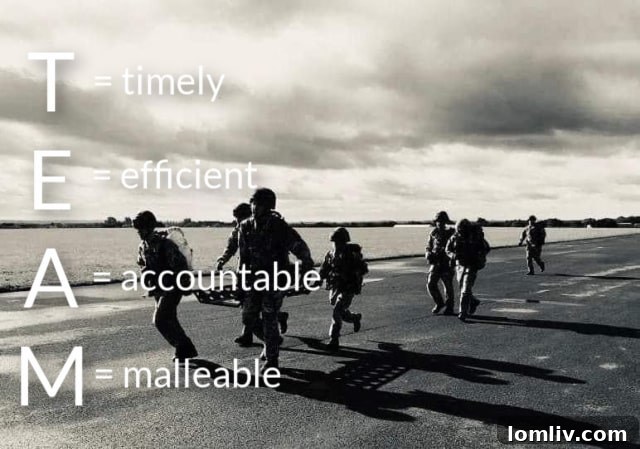
The essence of a high-performing construction team can be encapsulated by the acronym T.E.A.M., embodying the fundamental qualities that contribute to project success:
T = Timely: A well-coordinated team ensures that deadlines are met, and the project progresses according to the established schedule. Their collaborative planning identifies potential delays early and devises strategies to mitigate them, keeping the project on track and avoiding costly extensions.
E = Efficient: Efficiency is a hallmark of a collaborative team. Through shared knowledge and streamlined processes, resources are optimized, waste is minimized, and tasks are completed with maximum effectiveness. This efficiency directly contributes to cost savings and a faster project completion.
A = Accountable: Each member of an integrated team holds themselves and their peers accountable for their contributions. This collective responsibility fosters a commitment to quality and ensures that every aspect of the project adheres to the highest standards. Challenges are met head-on, and solutions are found through mutual effort.
M = Malleable: A truly effective team is adaptable and flexible, able to pivot and adjust to unforeseen circumstances or evolving client needs without derailing the entire project. Their combined expertise allows them to creatively solve problems and implement changes efficiently, maintaining project momentum and client satisfaction.
Ultimately, your carefully selected and empowered team is shaped to meet your unique needs and aspirations, functioning with only a minimum number of project obstacles. This proactive, collaborative approach not only ensures a superior outcome but will unequivocally save you a ton of money and a significant amount of stress throughout your home building or remodeling journey.
NEXT WEEK: We will delve deeper into defining your Project Team’s specific disciplines and gain a comprehensive understanding of how each can optimally work for you.
From developing a personalized “Lifestyle Inventory” to meticulously building and monitoring your Project Team, Hoebeke Builders Consulting Services provides all the essential tools and expertise necessary to dramatically increase your project’s efficiency, while concurrently decreasing your project’s overall cost and complexity. Discover how we can help realize your vision at www.hoebekebuilders.com