Selling a property can be an intricate process, fraught with numerous details that demand careful attention. When that property happens to be governed by a Homeowners Association (HOA), sellers often anticipate certain standard procedures and costs. However, a significant yet subtle change introduced by the Texas Real Estate Commission (TREC) in April 2021 to the “Addendum For Property Subject to Mandatory Membership In A Property Owners Association” has been catching many Texas sellers by surprise, leading to unexpected and often substantial closing costs. This often-overlooked amendment, impacting how specific fees are allocated between buyers and sellers, has transformed what was once a minor line item into a potential financial headache for those looking to close a sale.
Understanding the nuances of HOA regulations and the associated contractual obligations is paramount in the Texas real estate market, where planned communities and HOAs are increasingly prevalent. This addendum, though a seemingly small document, holds considerable weight in the overall sales contract, directly influencing who pays for various association-related charges. Before this pivotal change, the division of responsibilities for fees such as transfer costs and capital reserves was relatively clear. Now, sellers must navigate a new landscape where they could be liable for thousands of dollars that they previously might not have considered their obligation. Being prepared and thoroughly informed about these revisions is no longer just good practice; it’s a financial imperative for any Texas homeowner preparing to sell a property under an HOA.
The Evolution of HOA Fee Allocation: Before April 2021
To fully grasp the impact of the 2021 amendment, it’s essential to understand the structure and intent of the HOA addendum prior to its revision. For years, the TREC addendum served as a critical component of contracts for properties subject to mandatory HOA membership, clearly delineating the financial responsibilities between the buyer and the seller for various association-related fees. This document played a vital role in preventing disputes and ensuring transparency regarding closing costs related to the HOA.
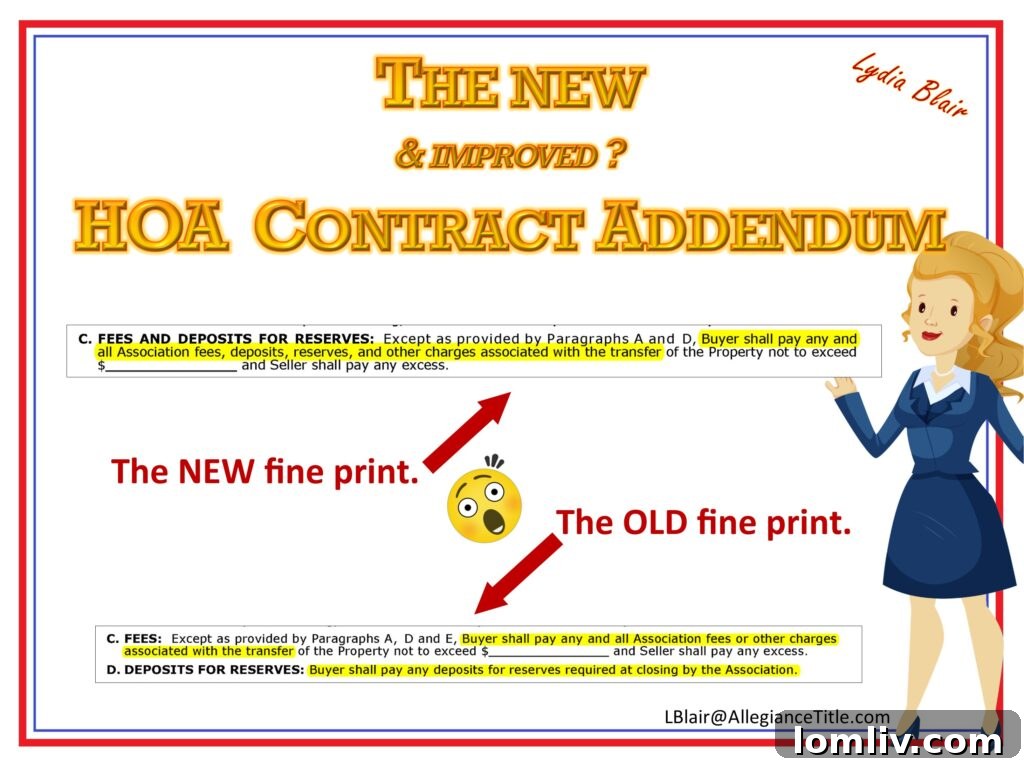
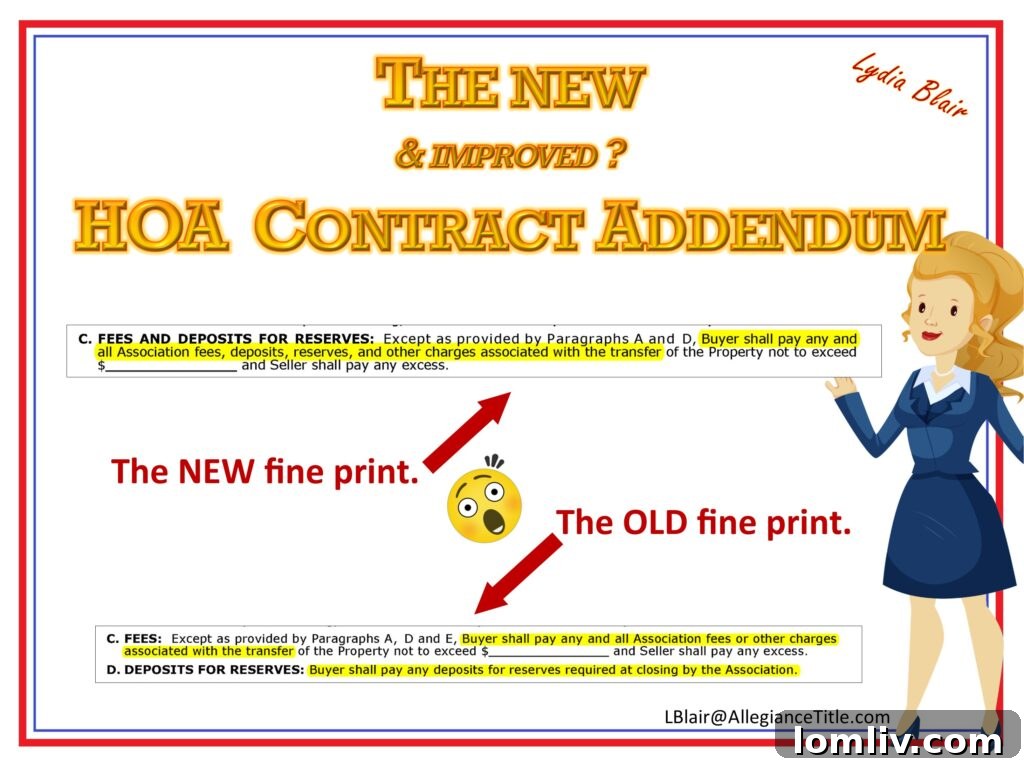
Under the previous iteration of the HOA addendum, specifically Paragraph C, the buyer’s financial liability for “association fees or other charges associated with the transfer” was explicitly limited. Typically, buyers would agree to cover an amount ranging from $100 to $300, which was intended to cover standard administrative transfer fees. Any amount exceeding this buyer-specified limit for these particular charges would then automatically become the seller’s responsibility. This arrangement was generally well-understood and rarely caused significant issues, as basic transfer fees seldom surpassed a few hundred dollars.
Crucially, the old addendum also featured Paragraph D, which specifically addressed “deposits for reserves required by the Association.” This paragraph unequivocally stated that the “buyer shall pay any deposits for reserves required by the Association.” This clause made logical sense from the perspective of many HOAs: a new owner joining the community would contribute to its long-term financial health by paying into the reserve fund, which is typically used for major capital improvements and unexpected expenses that benefit all members. This clear division meant that sellers, having likely paid their own reserve contribution when they originally purchased the home, were generally not burdened with this expense again upon selling.
This previous structure provided a predictable framework for both parties. Sellers knew they would cover certain excess transfer fees, and buyers understood their obligation for reserve contributions. This clarity allowed for smoother transactions and fewer surprises at the closing table, as the distribution of these specific HOA-related costs was well-defined within the contract addendum.
A Slight Change Can Mean a Big Bill: The April 2021 Amendment
The landscape of HOA-related closing costs dramatically shifted in April 2021 with a subtle but profoundly impactful revision to the TREC Addendum For Property Subject to Mandatory Membership In A Property Owners Association. While the form’s lengthy title remained the same, a seemingly minor tweak to its language fundamentally altered how certain significant financial burdens are allocated. This change, easily overlooked by even seasoned agents and sellers, has become a source of considerable frustration and unexpected expense for many Texas homeowners.
The core of this amendment lies in the revised Paragraph C of the new HOA addendum. Where it once limited the buyer’s responsibility solely for “association fees or other charges associated with the transfer,” it now expands the scope to include “association fees, deposits, reserves and other charges associated with the transfer.” At first glance, this might appear to be a simple consolidation of terms. However, the critical impact becomes clear when observing how buyers continue to fill in the same modest amounts—typically between $100 and $300—for their limit in this combined category. This modest figure, which once comfortably covered administrative transfer fees, is now meant to encompass a much broader and potentially far more expensive array of charges, including reserves.
The true bombshell, however, is the complete deletion of the standalone Paragraph D. As discussed, this previous clause explicitly mandated that the “buyer shall pay any deposits for reserves required by the Association.” With its removal, the responsibility for reserve deposits is no longer a distinct buyer-only obligation. Instead, these potentially hefty “deposits and reserves” are now lumped together with the general transfer fees under the buyer’s specified limit in Paragraph C. This means if an HOA charges a capital reserve fee of, say, $3,000, and the buyer’s negotiated limit in Paragraph C is only $200, the seller is now contractually obligated to pay the remaining $2,800. This stark contrast from the previous addendum, where the buyer would have paid the entire $3,000 reserve fee, represents a massive shift in financial responsibility.
The subtlety of this change makes it particularly insidious. Many sellers and even their agents, accustomed to the old addendum, may not immediately recognize the profound implications of deleting Paragraph D and expanding Paragraph C’s language. The critical phrase “deposits, reserves” can be easily skimmed over, especially when the buyer’s filled-in limit remains low. Consequently, the moment of realization often comes far too late in the transaction process, typically just before closing, when the HOA’s demand for the capital reserve contribution surfaces, leaving the seller to absorb the bulk of an unexpected and significant charge. These newly assigned seller responsibilities come in addition to the long-standing seller expense for the resale certificate and all other required HOA documents that must be provided to the buyer, further increasing the seller’s total closing costs.
Be Ready For The ‘Buy-In’: Understanding HOA Reserves
The financial impact of the amended HOA addendum hinges almost entirely on the presence and magnitude of what are commonly referred to as HOA reserves. These funds, distinct from regular monthly or annual dues, play a crucial role in the long-term financial health and stability of a community governed by an HOA. However, their various names and the specific ways they are assessed can often lead to confusion, making it imperative for sellers to understand exactly what they are and why they are collected.
HOA reserves go by many names: capital reserves, capital contribution, mandatory reserves, reserve deposit, or simply a ‘buy-in’ fee. Regardless of the terminology, their fundamental purpose remains the same: to accumulate funds for significant, non-recurring expenses that benefit the entire community. These are not funds for routine maintenance like lawn care or garbage collection. Instead, they are earmarked for large-scale projects, major repairs, and long-term capital improvements that maintain or enhance the property values and quality of life within the association. Examples of how reserve funds might be utilized include:
- Replacing aging roofs on common buildings or community structures.
- Resurfacing private roads or parking lots within the development.
- Major repairs or renovations to community amenities like swimming pools, clubhouses, or fitness centers.
- Upgrading irrigation systems, landscaping, or entry gates.
- Funding large-scale projects to address unexpected structural issues or infrastructure failures.
These fees are typically charged to new buyers in a development, serving as their initial contribution to the community’s reserve coffers. The idea is that each new homeowner contributes a share towards the collective future expenses, ensuring that when major projects arise, the HOA has sufficient funds without having to levy a special assessment on current residents. This approach helps maintain predictability in monthly dues and protects property values by ensuring amenities are well-maintained.
The critical factor for sellers under the new addendum is the potential heft of these reserve fees. Unlike the nominal transfer fees, capital reserve contributions can be substantial. It’s not uncommon to see these “buy-in” fees range anywhere from $1,000 to $10,000, and in some luxury communities or those with extensive amenities, they can even exceed this range. This is why many sellers are now facing an “ugly surprise” at closing. When they discover that the capital reserve fee, which their HOA documents might still suggest is a buyer’s responsibility, is now mostly their burden due to the contractual shift in the TREC addendum, the impact on their net proceeds can be significant and entirely unanticipated.
Imagine a scenario where a seller purchased their property a few years ago and duly paid a $2,500 HOA capital contribution as part of their closing costs. Now, selling that same home, they find themselves contractually obligated to pay a similar fee on behalf of their buyer, simply because the buyer’s agreed-upon limit in the addendum is a mere $150, barely covering a basic transfer fee. This double payment for the same type of contribution, effectively subsidizing the buyer’s entry into the community’s reserve fund, can be a bitter pill to swallow for sellers who believed they had already fulfilled that obligation. It’s a clear demonstration of how a seemingly minor textual change can translate into a major financial liability, impacting a seller’s bottom line by thousands of dollars.
Navigating the New Landscape: Advice for Texas Sellers
The implications of the revised TREC HOA addendum are profound, making proactive diligence and informed decision-making more crucial than ever for sellers in Texas. Given that many HOA management companies themselves may be unaware of the subtle nuances of this recent TREC change, relying solely on their guidance can be misleading. While many HOA documents may still stipulate that capital reserve fees are a buyer’s responsibility, the legally binding contract signed by the seller—the TREC addendum—will prevail in determining financial obligations at closing. Therefore, sellers must take direct action to protect their interests.
Proactive Information Gathering is Key
The first and most critical step for any seller is to obtain and thoroughly review all relevant HOA documents as early as possible in the selling process. This includes the HOA’s Declaration of Covenants, Conditions, and Restrictions (CC&Rs), bylaws, and most importantly, the schedule of fees associated with property transfers. Specifically, look for any charges categorized as “capital contribution,” “reserve fee,” “buy-in fee,” or “mandatory reserve deposit.” Understanding if your HOA charges such a fee, and what its exact amount is, is the foundation for avoiding surprises.
Scrutinize the Addendum and Negotiate Strategically
When it comes time to review the “Addendum For Property Subject to Mandatory Membership In A Property Owners Association” as part of the sales contract, sellers must exercise extreme caution. Pay meticulous attention to Paragraph C, which now lumps “association fees, deposits, reserves and other charges associated with the transfer” under the buyer’s responsibility limit. Do not simply accept a low figure, such as the traditional $100-$300, without considering the full implications. If your HOA charges a significant capital reserve fee, this is the moment to negotiate. Sellers can propose a higher buyer limit in Paragraph C to cover a larger portion, or even the entirety, of the capital reserve fee. For example, if the reserve fee is $2,000, consider negotiating the buyer’s limit to $2,000 or more in Paragraph C. This requires open communication with your real estate agent and potentially a different negotiation strategy with the buyer.
Understand Contractual Primacy
It’s vital to remember that the TREC addendum, once signed by both parties, becomes a legally binding part of your contract. Even if your HOA’s governing documents state that a specific fee is the buyer’s responsibility, the signed addendum dictates the division of costs between the buyer and seller in the transaction. If the addendum limits the buyer’s contribution for “deposits, reserves” to a low amount, the seller is contractually bound to cover any balance. This highlights the importance of thorough review and negotiation before signing.
Educate Your Real Estate Agent
Sellers should ensure their real estate agent is fully aware of these recent changes and their potential impact. A knowledgeable agent can guide you through the process, help you identify potential reserve fees, and advise on negotiation strategies to mitigate your financial exposure. An informed agent is your best advocate in navigating this complex contractual shift.
Consider Professional Legal Counsel
For any particular issue, complex situation, or if there is uncertainty regarding the interpretation of the addendum or HOA documents, contacting a qualified real estate attorney is always advisable. Legal professionals can provide specific advice tailored to your unique circumstances, ensuring that your interests are protected and you fully understand your obligations and rights under the contract.
Conclusion: Selling Smart in the New HOA Landscape
The April 2021 revision to the TREC Addendum For Property Subject to Mandatory Membership In A Property Owners Association represents more than just a bureaucratic update; it signifies a substantial shift in the financial responsibilities for sellers in Texas’s vibrant real estate market. What was once a clear division of costs, with buyers typically shouldering capital reserve contributions, has now been consolidated into a single, often under-negotiated line item that can leave sellers with unexpected bills ranging from hundreds to thousands of dollars. The deletion of Paragraph D and the broadened scope of Paragraph C mean that sellers can no longer assume that significant “buy-in” fees will be solely the buyer’s burden.
The key takeaway for every homeowner preparing to sell a property under an HOA in Texas is the absolute necessity of vigilance and proactive planning. Do not rely on outdated assumptions or the general knowledge of HOA management companies, which may not be fully apprised of this TREC contractual change. Instead, take the initiative to meticulously review all HOA documents for capital reserve fees, discuss these findings thoroughly with your real estate agent, and critically examine the terms of the HOA addendum in any prospective contract. By understanding the potential costs upfront and strategically negotiating the buyer’s limit for these combined fees, sellers can prevent an unpleasant surprise at the closing table and ensure their transaction proceeds as smoothly and profitably as possible.
In a dynamic real estate environment, staying informed about contractual changes is not just about compliance; it’s about protecting your equity and maximizing your return. For Texas sellers, being ready for the “buy-in” means being prepared, proactive, and precise in their approach to the amended HOA addendum.
The opinions expressed are of the individual author for informational purposes only and not for legal advice. Contact an attorney for any particular issue or problem.