Transform Your Space: A Comprehensive Guide to Modern Mosaic Tile Trends
Not so long ago, the allure of exquisite stone mosaic tiles felt like an exclusive luxury, reserved only for the most lavish home renovations. Homeowners and designers alike would often find themselves budgeting upwards of $100 per square foot for even small accent pieces, such as those delicate shampoo niches in a bathroom. But times have dramatically changed. The widespread adoption of advanced technologies, particularly water jet cutting for natural stone, has revolutionized the mosaic tile industry, making these beautiful and intricate designs far more accessible and affordable than ever before. This exciting shift has brought sophisticated stone mosaics into the reach of a broader audience, democratizing what was once a high-end design element.
For those embarking on a renovation journey, especially in the Dallas area, two prominent showrooms stand out for offering an extensive selection directly to consumers: Floor & Decor and The Tile Shop. These establishments provide a fantastic opportunity to explore the latest trends and classic designs in person. Let’s dive into what makes each unique and how you can navigate their vast offerings to find the perfect mosaic for your next project.
Navigating Dallas’s Premier Tile Showrooms: Floor & Decor vs. The Tile Shop
While both Floor & Decor and The Tile Shop boast an impressive array of mosaic patterns, they tend to cater to slightly different aesthetic preferences. From my observations, The Tile Shop often features a more curated collection with a leaning towards intricate, “swirly,” and decorative designs that evoke a sense of refined elegance and perhaps a more feminine touch. Think delicate patterns, softer lines, and ornate details perfect for creating a luxurious feel.
Conversely, Floor & Decor frequently showcases a broader range of geometric designs. These often incorporate clean lines, bold shapes, and a more structured aesthetic that might appeal to those favoring a contemporary, masculine, or minimalist style. It’s a generalization, of course, as both stores offer a diverse selection, but understanding these subtle leanings can help guide your initial exploration. Whether your taste veers towards sharp angles and strong forms or soft curves and intricate motifs, both showrooms offer ample inspiration.
Conveniently located southwest of the LBJ Freeway and I-35E in Dallas, these two tile havens are mere blocks apart. This proximity makes it incredibly easy to visit both in a single outing, allowing for direct comparison and a comprehensive view of current mosaic tile options before making your final decision. Taking the time to visit both can significantly enrich your understanding of available styles, materials, and price points.
Embracing Modernity: Identifying and Avoiding Dated Tile Trends
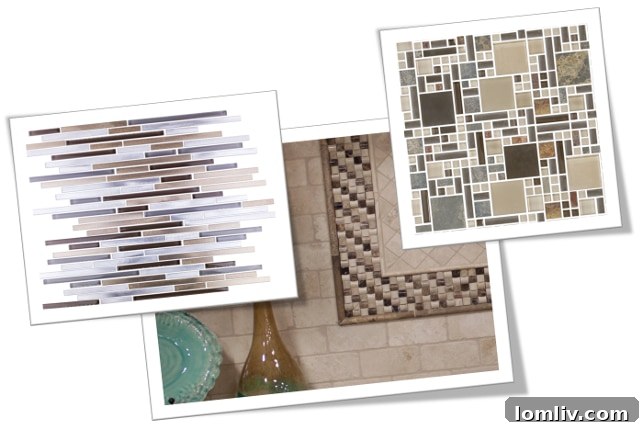
Just as fashion evolves, so do interior design trends. When selecting mosaic tiles, it’s crucial to distinguish between timeless classics and fleeting fads to ensure your renovation remains fresh and sophisticated for years to come. Looking at some past popular styles, it becomes clear that certain looks have run their course. For instance, the prevalence of skinny, stacked pencil tiles—whether in glass, stone, or porcelain—is now widely considered dated. The attempt to modernize them by installing them vertically often doesn’t salvage their appeal; they simply echo a design era that has passed.
Similarly, the once ubiquitous combination of travertine, beige tones, and Mediterranean-inspired patterns has largely fallen out of favor. These elements, while charming in their time, now evoke a specific period that many homeowners are actively moving away from. The bold, grid-like “Mondrian” or “Partridge Family bus” aesthetic, characterized by strong, contrasting blocks of color or material, has also joined the ranks of styles best left in the past. Even natural slate, unless thoughtfully integrated into a truly rustic or log cabin aesthetic, can often appear heavy and outmoded in contemporary settings. Incorporating these outdated designs today can inadvertently signal that your home’s aesthetic is rooted in an earlier decade, perhaps from too many late-night HGTV reruns. The good news is, if these styles currently adorn your home, it’s a perfect opportunity to refresh and update your space!
Choosing Longevity: Investing in Timeless Mosaic Designs
When selecting mosaic tiles, aim for designs that possess an inherent elegance and versatility, allowing them to adapt to evolving decor styles. Classic geometric patterns, monochromatic schemes, and natural stone textures tend to offer greater longevity. Consider how a tile will look not just next year, but five or ten years down the line. Opt for materials and patterns that blend seamlessly with various color palettes and furniture styles, providing a foundation that can be easily updated with accessories and paint rather than requiring another costly tile removal.
Exploring Mosaic Tile Price Points and Design Possibilities
Mosaic tiles are available across a wide spectrum of price points, offering beautiful options for nearly every budget. Let’s explore what you can expect at different tiers, starting with more economical choices.
Budget-Friendly Mosaics: Starting Around $10 per Square Foot
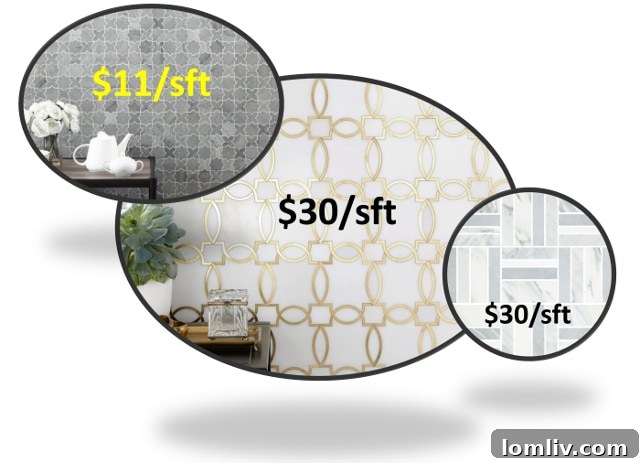
At the more accessible end of the spectrum, around $10 per square foot, you’ll discover mosaics crafted primarily from a single type of stone, cut into various shapes. These often create a sophisticated tone-on-tone effect, offering an interesting visual pattern without the strong contrast that might feel overwhelming in some spaces. This subtle approach makes them a safer and highly versatile choice for many home aesthetics. Imagine a blend of light gray marble in different sizes or finishes creating a nuanced texture; it’s enough to add visual interest without being overtly “busy.” In my own home, I’ve successfully used variations of the same tile in subtly different dimensions, achieving a custom look that’s both understated and engaging, a delightful step away from plainness.
Beyond single-stone designs, this price bracket also includes mosaics made from less expensive yet still attractive materials, such as various types of stone, glass, and porcelain. These options often present opportunities for creative applications in smaller areas where you want a refined look without a significant financial commitment, like a kitchen backsplash accent or a powder room wall.
Mid-Range Mosaics: Elevating Your Design for Around $30 per Square Foot
As you move up to approximately $30 per square foot, the visual complexity and material quality of mosaics begin to expand significantly. Here, you’ll encounter designs that feature more intricate patterning, often incorporating a wider range of materials or more sophisticated cuts. The middle example in the image above, with its graceful curved gold accents, embodies a more feminine elegance. This type of mosaic would be an exquisite choice for a powder room, where a small space can be dramatically transformed and up-classed with a relatively modest investment. The gold elements catch the light beautifully, adding a touch of understated luxury without breaking the bank.
In this mid-range, you’ll also see a greater variety of mixed-material mosaics, perhaps combining stone with glass or polished with honed finishes, offering more depth and character to your surfaces. The increased design sophistication at this price point allows for greater creative expression in areas where you want a focal point without splurging on ultra-premium materials.
The Enduring Appeal of Linear and Geometric Mosaic Forms
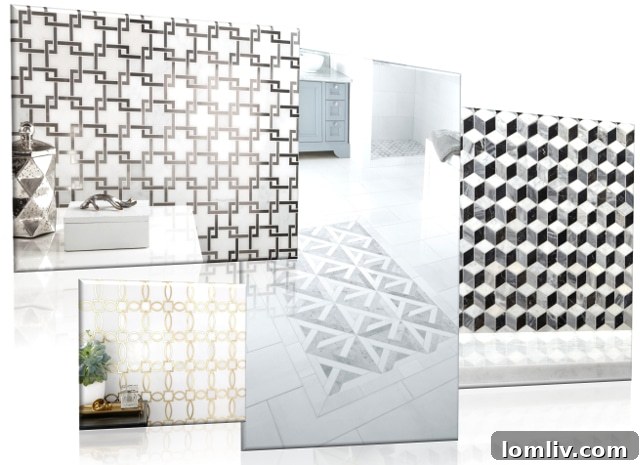
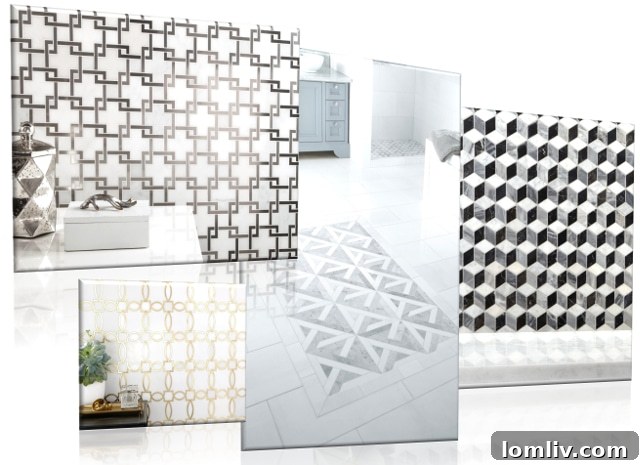
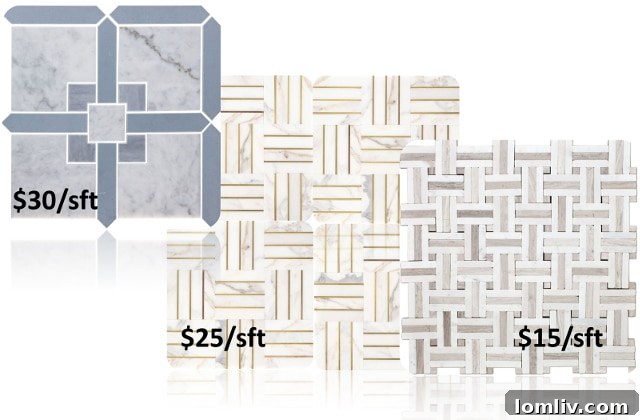
Linear forms in mosaic tile offer a timeless appeal, expressed through a multitude of designs. The upper left example presents a classic pattern of larger blocks interconnected by thick stone lines. This design harks back to early Greek and Roman architectural motifs, embodying a sense of enduring elegance and structural beauty. Such geometric patterns are remarkably versatile and are available with various main shapes—squares, hexagons, octagons, and circles—allowing for customization to fit any design vision, from traditional to contemporary.
The middle design in this trio is arguably my favorite for a sophisticated bathroom floor. It masterfully blends the luxurious veining of Calacatta marble with delicate filets of gold marble, creating a modern interpretation of a traditional basket weave pattern. The interplay of white, grey, and gold hues results in a visually rich surface that exudes both warmth and opulence. For a true basket weave aesthetic, the example on the right offers a classic yet modern take. Its elusive gray tones, which I find particularly appealing for their ability to complement a wide range of colors, would be ideal for a shower floor and matching shampoo niche. This design could even extend to a feature wall within the shower, creating a cohesive and serene sanctuary.
Design Tips for Geometric Mosaics:
- Scale Matters: Consider the size of the room when choosing geometric patterns. Larger patterns can make a small room feel grand, while smaller, intricate patterns can add detail without overwhelming.
- Grout Choice: Grout color can dramatically alter the look of geometric tiles. A contrasting grout will emphasize the pattern, while a matching grout will create a more subtle, cohesive surface.
- Focal Points: Use geometric mosaics to define specific areas, such as a fireplace surround, a kitchen island base, or an entryway floor.
Embracing Boldness: Unique and Expressive Mosaic Choices
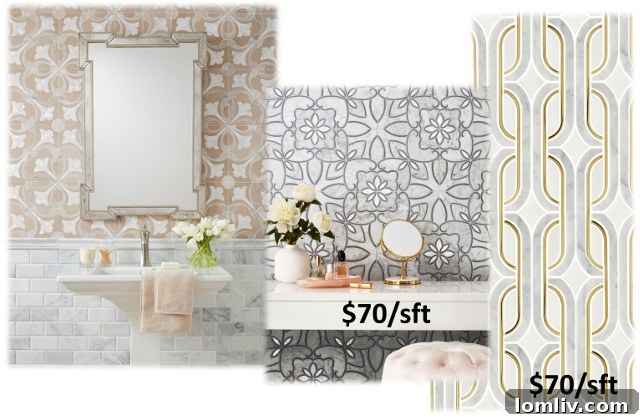
This particular grouping challenges traditional notions of mosaic tile, pushing the boundaries of design. Initially, when I encountered the sheet of tile on the left, I worried its floral motif might be too delicate for my personal geometric preference. However, witnessing it installed on a wall, beautifully complemented by a classic subway tile, completely transformed my perspective. The crosses within the design satisfied my love for strong lines, while the softer colors and subtle floral elements introduced a balanced elegance, proving that contrasting elements can indeed create a harmonious and captivating look. This mosaic offers a wonderful blend of strength and softness, ideal for a unique accent.
The middle example leans distinctly into a more overtly feminine aesthetic, so much so that the manufacturer thoughtfully displayed it in front of a makeup counter. Its delicate, intricate patterns and soft color palette are perfect for creating a glamorous and inviting vanity area or a luxurious powder room. On the right, we see a mosaic that is distinctly Art Deco or Mid-Century Modern inspired, featuring elongated stone “C” shapes and shimmering gold metallic filing. While undeniably stylish and eye-catching, this design carries a strong period-specific identity. It’s the kind of tile one might find as a delightful, unexpected discovery three layers deep when stripping wallpaper from an older, character-filled home – charmingly nostalgic but perhaps not for every long-term renovation. Embracing such a bold, distinctive tile often means being prepared for its inherent trendiness and considering its potential replacement down the line, perhaps alongside a matching brass faucet.
Tips for Incorporating Bold Mosaics:
- Accent Walls: Bold mosaics are perfect for creating a stunning accent wall in a bathroom, entryway, or even a small kitchen nook.
- Small Doses: If a full wall feels too much, consider using a bold mosaic in a shower niche, as a small border, or on a vanity backsplash.
- Balance: Pair highly patterned or colorful mosaics with more subdued, neutral surrounding elements to maintain balance and prevent sensory overload.
The Versatility of Geometric Mosaics: From Subtle to Striking
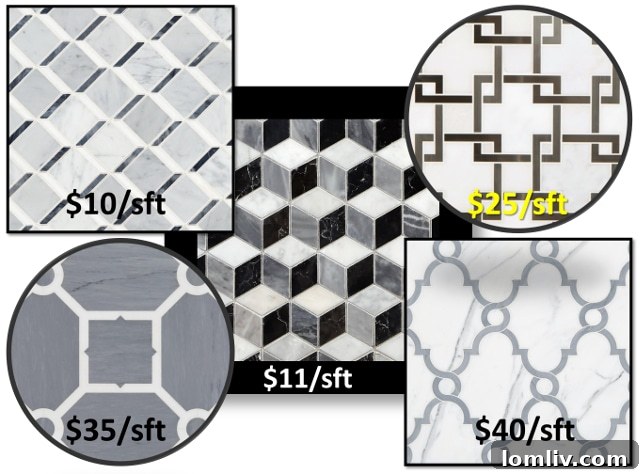
This compelling grouping of geometric mosaics, all sourced from Floor & Decor, showcases the incredible range and versatility available, with prices spanning from a surprisingly affordable $10 per square foot to a still-reasonable $40 per foot. Each design possesses unique qualities that I find appealing for different applications. The center pattern, with its captivating, almost M.C. Escher-like optical illusion, is exceptionally striking. Its dynamic visual quality makes it ideal for smaller doses – perhaps a dramatic shower floor, a distinct fireplace surround, or a narrow backsplash. Applying it across an entire room could be overwhelming, turning a stimulating design into a dizzying experience.
In contrast, the outer examples in this collection offer a more balanced geometric aesthetic that would be well-suited for larger applications. I would confidently use either of these on both floors and walls, though still with a thoughtful approach to scale. While they are more forgiving than the central Escher-esque pattern, moderation is key to allowing their intricate designs to truly shine without dominating the entire space. These geometrics can add architectural interest and a contemporary edge to kitchens, bathrooms, and even entryways, providing a sophisticated backdrop or a captivating focal point.
Considerations for Geometric Installation:
- Layout Planning: With complex geometric patterns, it’s crucial to plan your layout carefully beforehand to ensure the pattern repeats correctly and to minimize awkward cuts.
- Subfloor Preparation: A perfectly level and stable subfloor is essential for achieving a flawless finish with any mosaic, especially intricate geometric designs.
- Sealing: Many natural stone mosaics require sealing to protect against stains and moisture. Always check manufacturer recommendations.
Beyond Stone: The Unique Charm and Functionality of Wood Mosaics
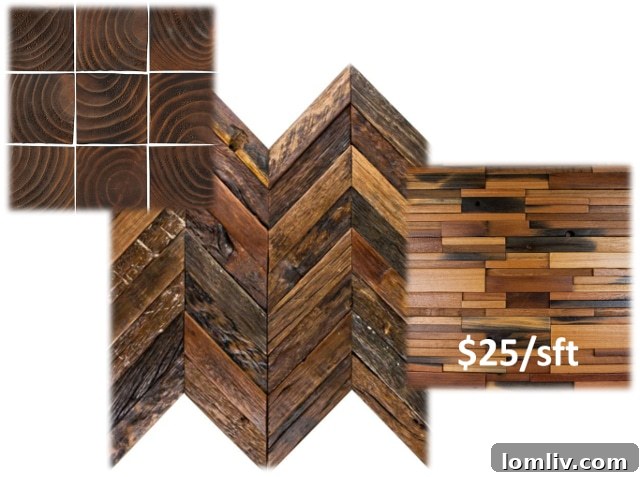
While stone, glass, and porcelain typically dominate the mosaic tile market, wood mosaics offer a distinct alternative that brings warmth, texture, and a unique functional benefit to interior spaces. These are primarily wall applications rather than floor tiles, and they serve a dual purpose that sets them apart from their hard-surface counterparts. Aside from their undeniable aesthetic appeal, wood mosaics are exceptional sound dampeners. Unlike traditional stone, glass, or porcelain tiles, which tend to reflect sound, wood naturally absorbs it. The more textured or “crinklier” the surface, the greater its ability to negate sound reflection, making rooms feel quieter and more acoustically comfortable.
From left to right, the examples above beautifully illustrate the diverse expressions of wood mosaics: a sleek, modern interpretation that brings a contemporary edge; a rustic reclaimed herringbone pattern that exudes character and history; and a captivating wood “stacked-stone” effect, mimicking the natural ruggedness of stone but with the inherent warmth of wood. These unique textures and patterns can transform a plain wall into a striking feature, adding depth and organic beauty to any room. Ideal for living areas, bedrooms, or home offices where acoustic comfort is desired, wood mosaics offer a fresh and innovative approach to wall coverings, merging natural beauty with practical benefits.
Your Next Steps: Visiting the Showrooms
Feeling inspired? The best way to finalize your mosaic tile selection is to see and touch these beautiful materials in person. Make sure to visit Floor & Decor, with seven convenient metroplex locations, and explore any of The Tile Shop’s five showrooms. Experiencing the textures, colors, and patterns firsthand will undoubtedly help you make the perfect choice for your home renovation project.

Remember: My focus spans high-rises, HOAs, and general renovation insights. I also hold a deep appreciation for modern and historical architecture, always considering it in balance with the vital YIMBY movement. My writing has been recognized by the National Association of Real Estate Editors, earning me three Bronze (2016, 2017, 2018) and two Silver (2016, 2017) awards in 2016, 2017, and 2018. If you have a compelling story to share or even a whimsical marriage proposal, feel free to reach out via email at [email protected]. You’re welcome to try and find me on Facebook and Twitter, though I playfully admit, you likely won’t succeed!