
From staff reports

Texas in the National Spotlight: A Balanced View from U.S. News & World Report’s Best States Rankings
The Lone Star State, an iconic symbol of resilience and diverse landscapes, consistently captures national attention. Yet, when it comes to comprehensive state performance, how does Texas truly fare? A recent analysis from U.S. News & World Report‘s revered “Best States” ranking offers a nuanced perspective: Texas isn’t at the top of the heap, nor is it languishing at the bottom. It occupies a middle ground, demonstrating significant strengths while grappling with considerable challenges.
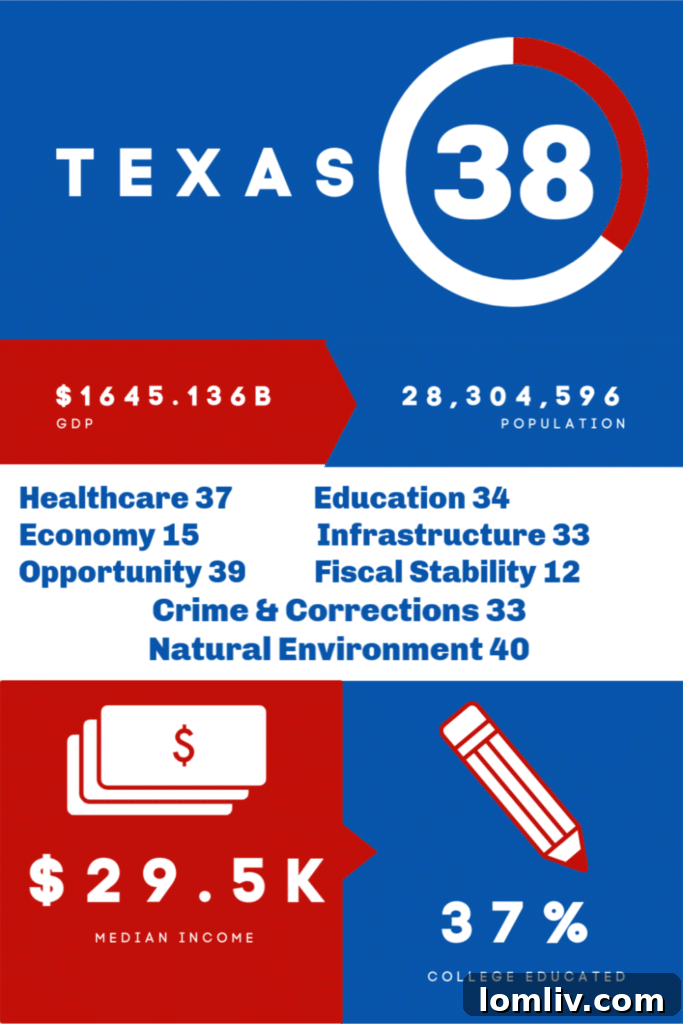
In the latest iteration of the comprehensive report, Texas secured the 38th position overall among all U.S. states. This ranking, while not stellar, highlights a state that operates with remarkable efficiency in certain sectors, particularly its financial health and economic dynamism. However, it also underscores areas where significant improvement is not just desired, but critically needed to enhance the quality of life for its millions of residents.
The Lone Star State’s Pillars of Strength: Economy and Fiscal Stability
Texas truly shines in its economic prowess and fiscal prudence, earning top-tier national recognition in both categories. These areas represent the bedrock of the state’s appeal to businesses and individuals alike, driving population growth and innovation.
A Powerhouse Economy (Ranked 15th Nationally)
Texas’s economy is a colossus, consistently ranking among the strongest and most diverse in the United States. Its 15th place ranking is a testament to its robust job market, low unemployment rates, and a business-friendly environment that attracts significant domestic and international investment. The state’s economic engine is fueled by a rich tapestry of industries:
- Energy Sector: A long-standing leader in oil and natural gas production, Texas continues to drive global energy markets. This sector provides numerous high-paying jobs and contributes substantially to the state’s GDP.
- Technology and Innovation: Major hubs like Austin, Dallas, and Houston have fostered thriving tech ecosystems, often dubbed “Silicon Hills” or “Silicon Prairie.” Giants like Dell, Tesla, and Samsung have significant presences, alongside a burgeoning startup scene. This diversification away from traditional energy industries is crucial for long-term economic resilience.
- Manufacturing: From aerospace to petrochemicals, Texas boasts a formidable manufacturing base, offering a wide array of skilled employment opportunities.
- Trade and Logistics: With its strategic geographic location and major ports, Texas is a gateway for international trade, facilitating the movement of goods across North America and beyond.
- Healthcare and Biomedical: World-renowned medical centers, particularly in Houston’s Texas Medical Center, contribute significantly to both the economy and the health services landscape.
This economic dynamism translates into opportunities for many, though the distribution of these opportunities remains a critical concern, as highlighted by other rankings.
Fiscal Prudence (Ranked 12th Nationally)
Beyond its vibrant economy, Texas is also lauded for its sound fiscal management, securing the 12th spot nationally. This strong ranking in fiscal stability reflects a commitment to responsible budgeting and a relatively low tax burden, which often appeals to businesses and individuals seeking financial predictability. Key aspects contributing to this strength include:
- Conservative Budgeting: The state typically operates with a balanced budget, avoiding excessive debt and maintaining healthy reserve funds, often referred to as the “Rainy Day Fund.”
- Favorable Tax Climate: Texas is one of a handful of states without a personal income tax, relying primarily on sales and property taxes. While this structure has its critics regarding equity, it is often cited as a major draw for businesses and high-income earners.
- Economic Growth Supporting Revenues: The continuous expansion of the state’s economy naturally leads to increased tax revenues, further solidifying its fiscal position without needing to significantly raise tax rates.
These fiscal strengths provide a stable foundation for the state, enabling it to weather economic downturns and invest in future growth, even if those investments don’t always fully address every societal need.
Areas Needing Attention: Challenges and Opportunities for Improvement
Despite its formidable economic and fiscal strengths, Texas faces significant hurdles in other crucial areas. The U.S. News & World Report analysis specifically “dinged” the state for its performance in opportunity, healthcare, and natural environment.
Bridging the Opportunity Gap
The low ranking in “opportunity” points to a critical challenge for Texas: ensuring that all residents have an equitable chance to succeed, regardless of their background or location. This metric typically assesses factors like economic opportunity, equality, and affordability. For Texas, this often means addressing:
- Income Inequality: While the state offers high-paying jobs, there can be significant disparities in income and wealth, particularly along demographic lines.
- Access to Quality Education: Gaps in educational attainment and access, especially in underserved communities, can limit future opportunities for many.
- Affordability: Rapid growth in major metropolitan areas has led to rising housing costs, making it difficult for many residents to afford to live where they work.
- Social Mobility: The ability for individuals to move up the economic ladder can be constrained by various systemic factors.
Addressing these disparities is crucial for fostering a truly inclusive and prosperous society within Texas.
Navigating Healthcare Challenges
Healthcare is another area where Texas struggles, reflecting a complex web of issues related to access, cost, and health outcomes. Challenges include:
- High Uninsured Rate: Texas has historically had one of the highest rates of uninsured residents in the nation, impacting access to preventive care and necessary medical treatments.
- Rural Healthcare Access: Many rural areas face shortages of healthcare professionals, hospitals, and specialized services, forcing residents to travel long distances for care.
- Public Health Issues: The state grapples with various public health concerns, including obesity rates, diabetes, and maternal mortality, particularly affecting vulnerable populations.
- Policy Debates: Ongoing debates surround Medicaid expansion and other policies aimed at improving healthcare accessibility and affordability for all Texans.
Improving healthcare access and quality is paramount for the well-being of the state’s rapidly growing population.
Protecting the Natural Environment
Texas’s vast size and diverse ecosystems come with unique environmental challenges, contributing to its lower ranking in the “natural environment” category. Issues often include:
- Air and Water Quality: Rapid industrialization and urban growth can place strains on air and water quality, especially in heavily populated and industrial regions.
- Climate Change Impacts: Texas is susceptible to extreme weather events, including droughts, floods, and hurricanes, which highlight the need for robust climate resilience strategies.
- Conservation Efforts: Balancing economic development with the preservation of natural habitats, wildlife, and open spaces is an ongoing challenge.
- Pollution Control: Managing industrial emissions and waste effectively is critical for protecting public health and natural resources.
Sustainable development and stronger environmental protections are essential for preserving Texas’s natural heritage and ensuring a healthy future for its residents.
A Look Back: Texas’s Performance Trends
The current 38th ranking is part of a trend that reflects both consistency and fluctuation in Texas’s performance over recent years. Understanding these historical positions provides valuable context for the state’s ongoing journey.
- 2018 Ranking: The state was positioned slightly higher at 36th overall. Similar to this year, it demonstrated strong performance in economy and fiscal stability. However, challenges in quality of life (a low 46th rank), education, and healthcare were also prominent, indicating persistent areas for improvement.
- 2017 Ranking: Texas once again landed at the 38th spot, mirroring its current position. In that year, its economy was exceptionally strong, achieving an impressive 6th place nationally. Yet, this economic strength was somewhat overshadowed by a remarkably low ranking in infrastructure (49th), suggesting significant needs in road, bridge, and internet connectivity.
These historical data points reveal a consistent pattern: Texas reliably performs well in economic and fiscal metrics, reflecting its foundational strengths. However, it equally struggles with quality of life indicators, social services, and foundational infrastructure, underscoring the challenges of balancing rapid growth with comprehensive public welfare.
Deciphering the Rankings: The U.S. News & World Report Methodology
The “Best States” ranking by U.S. News & World Report is not a casual assessment but a meticulously constructed analysis. The methodology draws on “thousands of data points to measure how well states are performing for their citizens,” providing a holistic view of state governance and societal well-being. The key metrics considered include:
- Health Care: Access, quality, and public health outcomes.
- Education: Quality of K-12 and higher education, attainment rates.
- Economy: Economic growth, employment, and business environment.
- Infrastructure: Quality of roads, bridges, public transit, and internet access.
- Public Safety: Crime rates and correctional systems.
- Fiscal Stability: State government debt, budget balancing, and long-term financial health.
- Opportunity: Economic opportunity, equality, and affordability for residents.
- Natural Environment: Air and water quality, pollution, and climate resilience.
Each of these categories is weighted and aggregated to produce the overall ranking, offering a comprehensive snapshot of a state’s strengths and weaknesses. For Texas, this multi-faceted approach clearly highlights its dual nature: a land of immense economic promise and significant social and environmental challenges.
Texas in a National Context: Comparing Strengths and Weaknesses
To put Texas’s 38th place into perspective, it’s useful to glance at the top and bottom performers. Washington state consistently ranks at the top of the list, boasting a robust GDP of $524.323 billion and consistently achieving top 25 scores across virtually every measured metric. This illustrates a state that has largely succeeded in balancing economic growth with high quality of life and strong public services.
Conversely, states like Louisiana and Alabama frequently find themselves at the bottom of the list, indicating systemic challenges across a broader spectrum of indicators. Texas’s mid-tier ranking suggests it has avoided the widespread struggles of the lowest-ranked states while still having considerable ground to cover to reach the comprehensive excellence of the top performers.
Looking Ahead: Texas’s Path to Improvement
The U.S. News & World Report’s “Best States” ranking serves as more than just a scorecard; it’s a valuable tool for policymakers, residents, and businesses to understand where Texas stands and where it needs to go. While its economic engine continues to roar, sustained progress requires concerted efforts in areas like:
- Investing in Human Capital: Enhancing educational opportunities and outcomes for all Texans is crucial for future economic competitiveness and social mobility.
- Expanding Healthcare Access: Addressing the uninsured rate and bolstering rural healthcare infrastructure will improve the well-being of millions.
- Sustainable Growth: Implementing policies that balance rapid development with environmental protection is essential for the long-term health of the state.
- Promoting Equity: Working to reduce disparities in opportunity and ensure that the state’s prosperity benefits all its diverse communities.
Texas remains a state of incredible dynamism and growth. Its ability to leverage its strengths while proactively addressing its weaknesses will define its trajectory in the coming years and ultimately determine its standing as truly one of the “Best States” for all who call it home.
To delve deeper into the specific breakdown for Texas, click here. For the complete national report and rankings, click here.