Navigating the Modern Housing Market: A Deep Dive into Wealth, Homeownership, and Generational Divides
For many younger generations, the dream of accumulating substantial wealth increasingly feels like a distant fantasy, often achievable only with familial support, perhaps from a generous grandparent. The financial landscape has shifted dramatically since 1995, even before the onset of the Great Recession. Data reveals a stark decline in the median wealth across younger age groups: individuals aged 25-34 saw their wealth plummet by 39 percent, those aged 35-44 experienced a 27 percent reduction, and the 45-54 age bracket witnessed a 15 percent decrease. While there were some encouraging gains reported between 2013 and 2016, these were clearly insufficient to offset the considerable long-term losses accumulated over decades.
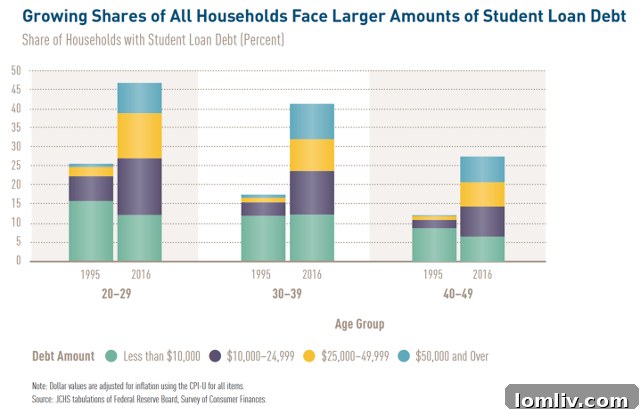
The primary culprits behind this unsettling trend are deeply intertwined: the overwhelming burden of student loan debt and the significant decline in homeownership rates. It’s no exaggeration to say that the exponential growth of student loan obligations has substantially hampered the ability of younger individuals to enter the housing market. The subsequent image powerfully illustrates why saving for a down payment has become an insurmountable hurdle for many aspiring young homebuyers.
The Homeownership Paradox: A Report from Harvard JCHS
According to the highly anticipated annual report from the Harvard Joint Center for Housing Studies (JCHS), released recently, a curious and telling paradox emerges in the American housing market. Households comprising individuals over 65 years old represent the sole age demographic that has actually seen an increase in homeownership rates when compared to 1987, now standing at a robust 78.7 percent. In sharp contrast, homeownership rates across all other age groups have collectively declined by an average of 7.3 percent over the last three decades. This generational divide is largely attributable to historical financial realities: older cohorts were far less likely to incur student loan debt, and certainly not at the steeply escalating levels that have burdened students annually for more than 30 years.
Home Equity: The Bedrock of American Wealth
For the vast majority of Americans, wealth accumulation is profoundly dependent on home equity. The period following the 2008 Recession, specifically from 2013 to 2016, saw the average American household wealth rise by a notable 16 percent, a surge predominantly fueled by appreciating home values. During this time, homeowners witnessed their median net wealth climb from $201,600 to $231,400. However, the fortunes of renters painted a vastly different picture, with their median wealth actually dropping from $5,600 to $5,000 in the same period. This stark comparison highlights an astonishing disparity: homeowners’ median net wealth increased by a staggering 46 times that of renters, underscoring the critical role of property ownership in building financial stability.
Even individuals who chose to downsize from homeownership to renting for a “headache-free life,” and who were considered wealthy, inadvertently left significant wealth-building potential behind. For households in the top quarter of incomes, homeowners boasted a median wealth of $710,000, while their equally high-earning renter counterparts had a median wealth of just $116,900. The distinction is clear: owning property, regardless of income level, establishes a fundamental pathway to greater financial security and growth.
The Enduring Racial Wealth Gap in Housing
Beyond the homeowner-renter divide, the landscape of wealth in America is further complicated by profound racial disparities. In 2016, the median wealth for white households stood at $162,800, a figure that was ten times higher than the median wealth of black households ($16,300) and eight times that of Hispanic households ($21,400). This alarming gap, however, does narrow considerably when comparing only homeowner households, shrinking to 2.5 times. While this indicates that homeownership can mitigate some of the racial wealth disparity, it by no means eradicates it, suggesting deeper systemic issues at play within economic structures and access to opportunity. This persistent gap highlights the need for targeted policies that address historical disadvantages and ensure equitable access to wealth-building assets like real estate for all communities.
The Imperative of Property Ownership in Today’s Economy
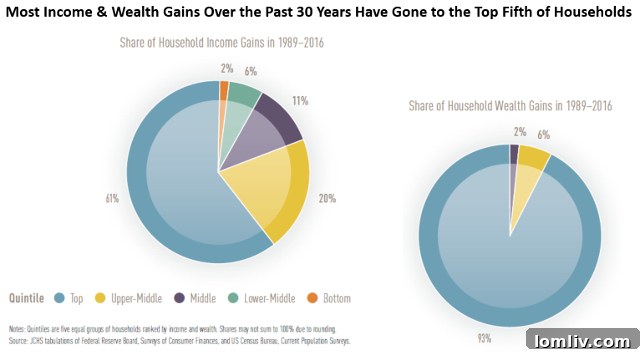
The overarching message from these trends is unequivocally clear: regardless of one’s racial background or current financial standing, acquiring a home—either through purchase or inheritance—is paramount for wealth creation. This imperative becomes even more critical for those who are not already wealthy, as the Harvard report meticulously details: “Measured from 1989, $50 trillion of the $54 trillion gains in real household net worth went to the top 20 percent of households, while some $23.6 trillion went to the wealthiest 1 percent.” These figures underscore a stark reality: the vast majority of economic growth has concentrated at the very top, leaving the remaining 80 percent of the population with dwindling opportunities for significant wealth accumulation outside of asset ownership.
One might logically point out the risks, such as purchasing a home in 2007 just before the housing bubble burst and then being forced to sell while underwater due to job loss. Such a scenario would indeed have been financially devastating, and that perspective is absolutely valid. However, looking beyond the immediate impacts of the Recession, had those homeowners been able to hold onto their properties—perhaps by renting out the entire home or individual rooms—they would almost certainly find themselves in a significantly better financial position today. This is because home prices in nearly all areas of the Metroplex have now surpassed the highs seen during the pre-Recession bubble. Homeownership is, by its very nature, a long-term commitment, characterized by periods of both appreciation and depreciation. Yet, the act of getting onto the property ladder and steadfastly remaining there is fundamentally critical for gaining wealth in an economic system that is undeniably stacked against 80 percent of the population.
Innovative Pathways to Homeownership: Co-buying and Beyond
Given the significant barriers to entry for individual homebuyers, particularly younger generations burdened by debt and rising costs, alternative strategies are becoming increasingly vital. If purchasing a home independently is currently beyond your financial reach, consider the pragmatic option of co-buying with a roommate or trusted partner. This growing trend reflects a crucial shift in how younger adults approach homeownership. Statistics indicate that 20 percent of today’s renter households consist of unmarried adults, a demographic that has doubled in real numbers to 9.2 million households. If individuals are comfortable signing a joint lease, extending that commitment to a mortgage offers a tangible pathway to asset ownership.
The benefits of co-buying are substantial. It allows for the pooling of resources for a down payment, splitting mortgage payments, and sharing maintenance costs, thereby making homeownership immediately more affordable. The strategy is simple: purchase a property together, build equity as the house appreciates, and then, when the market allows, split the profit from a sale to each acquire individual homes. This approach not only provides a foothold in the property market but also accelerates wealth building, offering a realistic solution for those eager to escape the rental trap and begin their journey towards financial independence.
Analyzing the Rental Market: Dallas as a Case Study
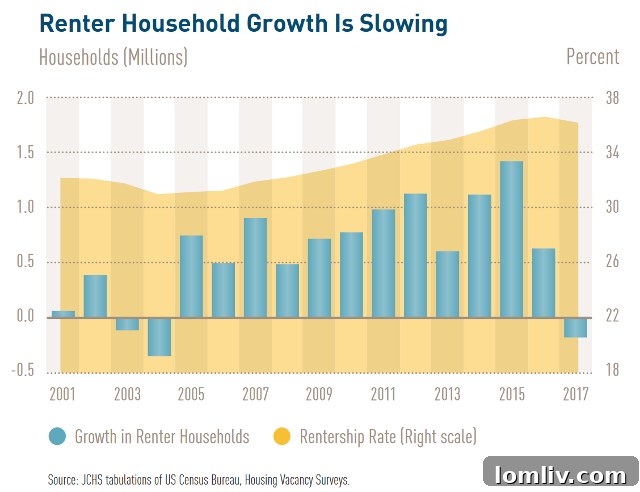
The dynamics of the rental market are equally telling, with Dallas serving as a striking microcosm of national trends. In 2017, Dallas emerged as a leader in construction, issuing a remarkable 62,500 building permits—a figure that surpassed New York City by 12,000 and doubled Los Angeles. A significant portion of these permits was allocated for new apartment complexes, raising questions about potential oversupply. The Harvard JCHS report indicates a notable shift in the rental landscape: in the second half of 2017, 180,000 fewer households rented, marking the first decline since 2004. This decreased the share of renters by 0.5 percent between 2016 and 2017. However, this seemingly small percentage is quite misleading. During that year, the number of households under age 35 that rented dropped by a substantial 224,000, a decrease largely offset by a growth of 230,000 renters over age 65. This demographic shift suggests that while younger individuals are increasingly looking towards homeownership, older generations are moving into the rental market, perhaps seeking the convenience and reduced responsibility that renting offers.
The Luxury Apartment Conundrum and Market Softening
A deeper look into the rental market reveals another significant trend: two-thirds of renting households earned less than $60,000, and a third earned less than $25,000. Yet, over the past five years, apartment construction has heavily concentrated on the luxury segment, catering to professionals earning over $100,000 annually. This trend has been undeniably prevalent across Dallas, with one opulent apartment building rapidly succeeding another without apparent abatement. However, the prevalence of “move-in specials” in the luxury apartment market over the past year might signal a softening demand or perhaps a saturation point, suggesting that the supply of tenants willing or able to afford sky-high rents is diminishing. The “amenity wars” are also raging fiercely within the rental world, with complexes constantly adding high-end features like swimming pools (present in 86% of newer buildings compared to 69% in 1990) and in-unit laundry (89% of new units vs. 61% of existing units). While data on high-end fitness facilities, spas, elaborate meeting rooms, media rooms, and concierge services are not explicitly provided, a similar upward trend in lavish offerings is certainly observable, further driving up lease payments and potentially attracting older, wealthier tenants seeking a lifestyle of convenience.
Millennials: Reshaping the Housing Landscape
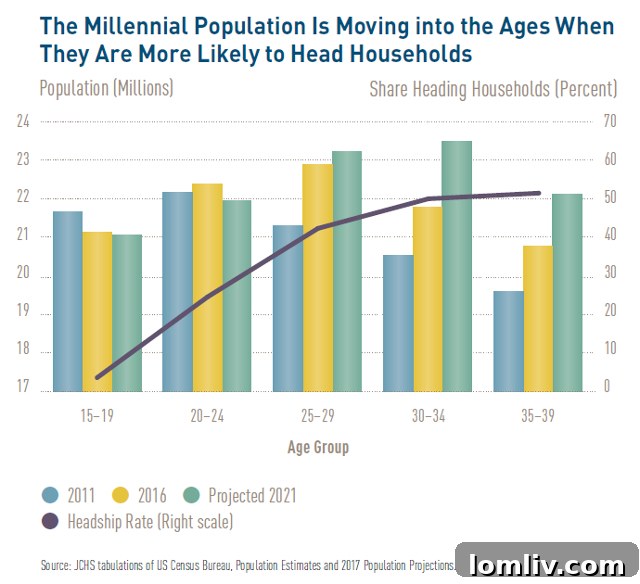
Whether spurred by the eventual extinguishment of student loan debt, the relentless escalation of rent prices, or the sudden realization of “Oh crap, I’m 30, I should buy a house,” Millennials are decisively on the move, and their sheer numbers are reshaping the housing landscape. Unsurprising news emerges from the 2018 Survey of Consumer Expectations, which reports that, finances aside, a significant 67 percent of renters would prefer to own a home, compared to just 19 percent who prefer renting. Furthermore, from an investment perspective, 61 percent of these same renters expressed confidence that buying in their current ZIP code would constitute a sound investment.
For the past three years, household formations have consistently grown, ranging between 800,000 to 1.1 million annually. While these figures represent a strong recovery from the Recession’s trough, they still fall approximately 250,000 short of the typical 1.35 million formations per year observed in the lead-up to the economic downturn. In 2011, when the Millennial wave was primarily aged 20-24, only 25 percent lived independently. By 2016, this group, now older, saw their independent household percentage grow to 42 percent, projected to reach 50 percent by 2021. While these numbers sound promising, they reflect a slower pace of independence compared to prior generations, a delay largely attributed to the heavy burden of student loan debt. Consequently, the number of young adults aged 24-34 living with parents or relatives remains at an all-time high and is continuing to increase, currently standing at 26 percent. Despite the slowing rate of household formation as a percentage of the overall population, the sheer demographic size of the Millennial generation is the driving force behind the overall increase in household formations, indicating a massive, albeit delayed, entry into independent living and homeownership.
The Deepening Crisis of Housing Affordability for the Non-Wealthy
The struggles faced by the non-wealthy in the housing market present no surprises. The persistent challenges of income inequality, deeply entrenched racial disparities in employment and education opportunities, and the continuously escalating costs of housing collectively place immense and ever-increasing strain on already precarious budgets. These systemic issues create a formidable barrier to economic mobility and secure housing for millions of Americans, perpetuating a cycle of financial vulnerability.
Government Assistance: A Drop in the Ocean
Between 1987 and 2015, government initiatives aimed to provide assistance to an additional 950,000 very low-income households. While this figure might initially sound commendable, its positive impact is overshadowed when considering the larger context: the number of households qualifying for government housing assistance concurrently grew by a staggering six million. This means that as a nation, our capacity to help declined from assisting 29 percent of eligible households to just 25 percent during a period when the overall population surged from 195 million to 327 million. This trend unequivocally illustrates a worsening situation, moving from “worse to worser” in terms of providing adequate support for those most in need.
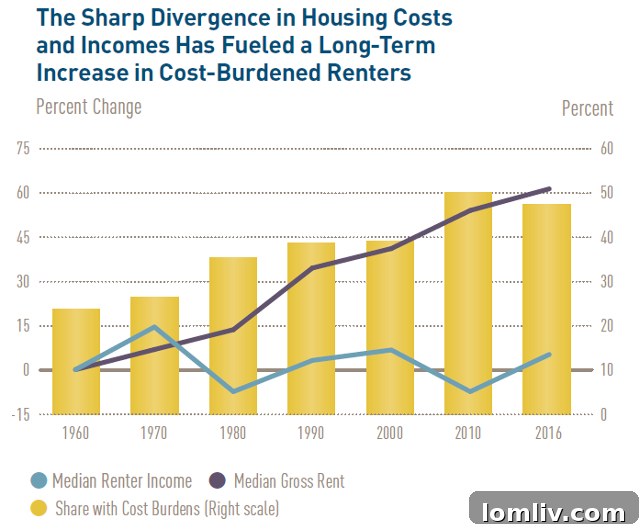
The statistics on housing cost burden paint an even grimmer picture. In 2001, 31.6 million households were considered “cost burdened,” meaning they spent more than 30 percent of their income on housing. By 2016, this number had swelled by 6.5 million, reaching an alarming 38.1 million households. Even more concerning, the number of households paying more than half their income for housing increased by 3.6 million between 2001 and 2016. Reflecting on the 1960s, during President Lyndon B. Johnson’s “War on Poverty,” 23.8 percent of renters were cost burdened. By 2016, this rate had doubled, starkly illustrating what some might term a “War on Poor People.” The most straightforward explanation for this critical state of affairs is the dramatic imbalance between housing costs and wages: while median rents surged by an astounding 61 percent, wages for the average worker increased by a mere five percent during the same period. Homeowners, by contrast, fared better, with median home values increasing by 112 percent on the back of a 50 percent rise in wages, further highlighting the diverging fortunes of renters and homeowners.
Glimmers of Hope and Lingering Challenges in the Housing Sector
The Harvard report isn’t exclusively a harbinger of doom and gloom. In fact, it meticulously illustrates a nation that is still actively working its way out of the lingering effects of the Recession in several critical aspects. Encouragingly, Millennials are gradually shedding their debt shackles – a burden largely unrelated to the recession itself – and are increasingly entering the homebuying market. Housing starts, while not yet fully at pre-recession levels, are showing signs of nearly returning to normalcy, albeit grappling with persistent challenges such as high land costs, labor shortages, and the disruptive impacts of global trade wars. Furthermore, the perceived over-rotation towards apartment construction appears to be cooling, signaling a market adjustment as Millennial renters transition into homeownership.
The Immigration Factor: A Demographic and Economic Wildcard
Finally, the role of immigration has emerged as a significant wild card in the housing equation. The United States traditionally relies on immigration to bolster its declining birth rate, thereby ensuring population growth and, consequently, household formation. However, recent policy changes enacted by the federal government have led the Census Bureau to project a cut of 300,000 in average annual immigration through 2035. One can infer that projected declines beyond the current administration may reflect a negative “comet-trail” of the US’s desirability as a destination, assuming that the nation’s anti-immigrant fervor eventually recedes. This reduction in immigration translates directly into a substantial decrease in future housing demand, an impact that will be disproportionately felt in high-immigrant states such as Texas. Compounded with the construction trades’ heavy reliance on immigrant labor, these factors suggest that new construction costs are unlikely to stabilize in the foreseeable future, adding another layer of complexity to the already challenging housing market.

Remember: High-rises, HOAs, and renovation are my primary focus. However, I also deeply appreciate modern and historical architecture, always balancing these interests against the vital discussions sparked by the YIMBY movement. My writing has been recognized by the National Association of Real Estate Editors, earning me two Bronze awards (2016, 2017) and two Silver awards (2016, 2017) in both 2016 and 2017. Should you have a story to share or even a unique marriage proposal to make, please don’t hesitate to reach out via email at [email protected]. You’re welcome to search for me on Facebook and Twitter, though finding me might prove to be an interesting challenge.