Unpacking the PD-15 Traffic Study: Navigating Redevelopment in Dallas
For residents and stakeholders deeply invested in the future of the PD-15 area, traffic has long stood as a primary concern, often cited as a major hurdle against any significant redevelopment. However, a recently released, comprehensive traffic study has the potential to fundamentally shift this conversation, offering data-driven insights that could render past arguments moot.
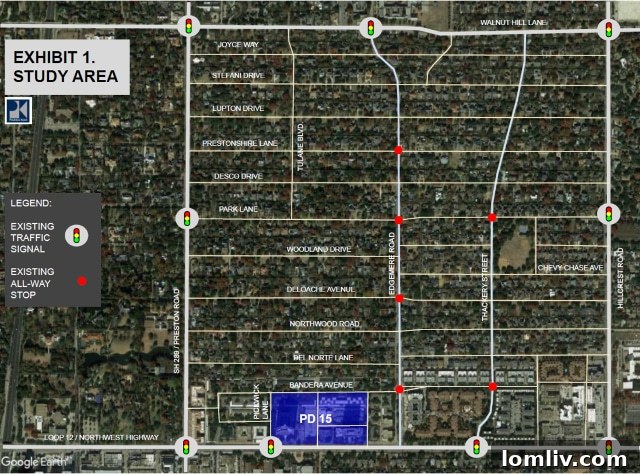
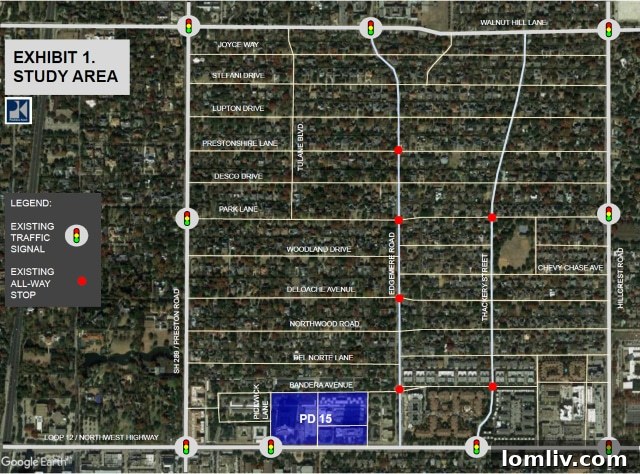
Commissioned by the Preston Place condos and meticulously conducted by Pacheco Koch, a renowned engineering firm, this in-depth traffic analysis was made publicly available recently, providing crucial information for the community. As depicted in the accompanying map, the study area extends far beyond the immediate confines of PD-15, encompassing a broader region bounded by key arterial roads: Preston Road, Northwest Highway, Walnut Hill Lane, and Hillcrest Road. This expansive scope is particularly good news for the surrounding and beloved Pink Wall and Preston Hollow neighborhoods, ensuring that the study’s findings consider the wider impact on residential areas and major thoroughfares alike.
The report itself is an extensive document, spanning 120 pages of detailed analysis, methodology, and recommendations. Supplementing the main report are two additional 15-page sub-reports, each dedicated to exploring the feasibility and potential impacts of installing new traffic signals at either Edgemere Road or Tulane Boulevard, specifically where they intersect with Northwest Highway. This level of detail underscores the thoroughness of the study, providing a robust foundation for informed decision-making. While the report is comprehensive, it’s designed to be accessible, with the first 19 pages offering a digestible overview for those seeking a quick but meaningful understanding of its core findings.
What truly distinguishes this Pacheco Koch report from many other traffic studies is its forward-thinking approach. It not only meticulously documents current traffic patterns and existing infrastructure challenges but also presents extensive recommendations for optimizing the flow of traffic now and in the context of future development. While I find myself largely in agreement with the majority of its conclusions, one specific recommendation—the proposal to open Tulane Boulevard to Northwest Highway—presents a point of divergence. But before delving into specific solutions and potential reconfigurations, let us first examine the foundational traffic numbers and projections that set the stage for these discussions.
Reflecting on an earlier column I wrote on April 24, a reader posed a pertinent question regarding my estimation of the traffic impact from PD-15 redevelopment. My response at the time was an informed armchair assessment, acknowledging the necessity of awaiting professional analysis to provide definitive insights. Now, with the Pacheco Koch study in hand, we can directly compare those initial thoughts with expert data.
Evaluating Traffic Projections: My Estimates vs. Expert Findings
Several key distinctions emerged when comparing my preliminary calculations with the professional study. Firstly, my initial “trip” estimations were based on round-trip movements, whereas the study employs the industry-standard “trip ends” metric, which categorizes each “in” or “out” movement as a distinct half-trip. Secondly, my projections primarily focused on the redevelopment of three known low-rise complexes—Preston Place, Royal Orleans, and Diplomat—as Diamond Head condos were not, to my knowledge, under contract or actively seeking one at the time. Consequently, while I calculated approximately 360 new units based on an assumed density of 90 units per acre across roughly four acres, Pacheco Koch’s study accounts for an additional 180 units by including Diamond Head’s two acres in their full build-out scenario, leading to a more comprehensive assessment.
Despite these methodological differences, the study’s resulting estimate for traffic generation was remarkably consistent with my own. It concludes that each new dwelling unit would contribute an average of 4.4 one-way trips per day, which equates to just over two round trips. My independent calculations had projected 2.2 roundtrips, or precisely 4.4 one-way trips per unit. This uncanny convergence of numbers is quite striking!
I had also hypothesized that the actual number of trips could decrease depending on the proportion of one-bedroom units and single-occupant dwellings. Given the existing high percentage of single-occupant units within the area, I continue to believe this factor remains a valid consideration, potentially tempering the ultimate traffic impact.
Beyond the baseline 90 units per acre, the study also meticulously evaluated a scenario where developers opt for the incentives outlined in the draft PD document, allowing for an increased density of up to 125 units per acre. This foresight provides a critical understanding of the maximum potential traffic implications under different development parameters.
Understanding the Traffic Numbers: Context and Capacity
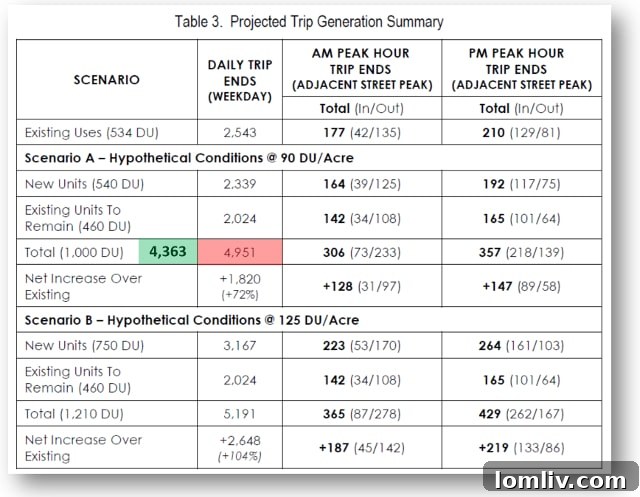
At the baseline density of 90 units per acre, the study projects an overall increase in total traffic by 72 percent from current levels. To put this into perspective, this translates from the existing 2,024 one-way trips per day generated by Athena and Preston Tower to an estimated 4,363 total one-way trips at full build-out. One might initially wonder how 4,363 trips represent a 72 percent increase when it is more than double the current 2,024. The explanation lies in the existing low-rise units, which currently account for 519 one-way trips that are incorporated into the future total of 4,363 trips. When the density is increased to 125 units per acre, the traffic projections rise by 104 percent above current levels, reaching an estimated 5,191 one-way trips per day.
Focusing again on the 90 units per acre scenario, the report provides granular detail on peak hour impacts. During the morning rush hour, a combined total of 306 in/out trips are expected, compared to today’s 177 one-way movements. This signifies an addition of approximately 128 cars per hour, or roughly two extra cars per minute, supplementing the current average of 2.73 cars per minute (resulting in approximately five cars per minute during peak). In the evening rush hour, peak ins/outs are projected at 357 total, up from today’s 210. This amounts to an additional 2.45 ins/outs per minute, added to the existing 3.5 one-way trips (translating to roughly six cars per minute during the evening peak).
Crucially, these additional vehicles will not converge on a single point or travel in unison. The study intelligently estimates that traffic distribution will be approximately 50 percent from/to the west, 40 percent from/to the east, and 10 percent from the north via Edgemere Road. This balanced distribution should significantly alleviate traffic concerns for single-family homeowners situated to the north of the development.
While these figures might sound substantial at first glance, a deeper contextual understanding reveals a more manageable scenario. A significant portion of daily traffic—approximately one-third—occurs during the concentrated two hours of morning and evening rush. Even within these peak periods, the average addition is merely three cars per minute, further segmented by direction (in/out, north, east, west). For those not part of the peak-hour commute, the impact is expected to be negligible, barely registering as a blip in the overall flow.
To further underscore this point, the City of Dallas Thoroughfare Plan designates an operational capacity of 10,000 vehicles per day for a two-lane road, which is representative of the interior roads within the Pink Wall neighborhood. The plan also considers any road operating at less than 65 percent capacity to offer a “good level of service.” Currently, daily traffic volumes on Pickwick Lane (1,671 vehicles), Bandera Avenue (1,184 vehicles), and Edgemere Road (2,274 vehicles) are, at their worst, only 23 percent of this capacity. Even under the highly improbable scenario where all additional traffic from redevelopment was diverted onto just one of these roads, it would still not exceed 47 percent capacity with 90 units per acre, or 54 percent at 125 units per acre. Given that traffic naturally disperses across multiple routes, the actual impact on any single road is expected to be considerably less, well within acceptable service levels.
Strategic Traffic Signal Enhancements: Focused Solutions for Key Intersections
Optimizing Flow at Pickwick Lane
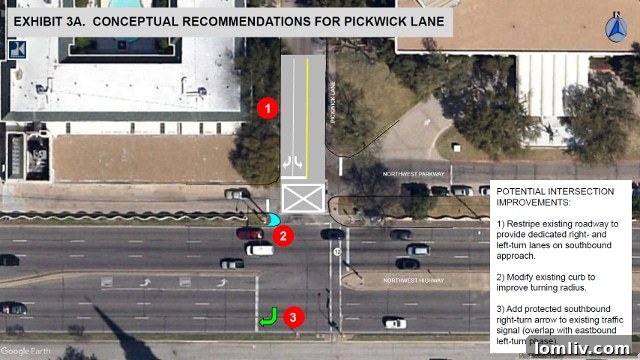
The Pacheco Koch report offers illuminating insights into the traffic dynamics at Pickwick Lane. It concludes that any perceived delays at this intersection are not inherently due to Pickwick’s capacity but rather stem from the disproportionately longer green light durations allocated to Northwest Highway traffic. This common issue, endemic to smaller roads intersecting major arteries, results in a comparatively shorter green light cycle for Pickwick. Furthermore, while the current signal system does detect vehicles waiting on Pickwick, its effectiveness is limited by the precise location of detection. The frontage road, specifically, fails to adequately “report” waiting vehicles, preventing the system from intelligently adjusting and shortening the red light for Pickwick traffic.
To maximize traffic flow and enhance efficiency at Pickwick, the report puts forth several actionable recommendations. It suggests the elimination of parking along Pickwick near the signal, which would create space for the installation of a dedicated right-turn lane. This structural improvement, coupled with the long-awaited implementation of a protected right-turn arrow (synchronized with the left-turn arrow from eastbound Northwest Highway onto Pickwick), promises significant relief. For any Imperial House or Preston Tower residents who might express concern over the loss of parking along Pickwick, it’s important to recall that the original PD-15 documents explicitly state: “Parking is prohibited on both sides of Pickwick Lane from Northwest Highway to Bandera Avenue.” This clarifies that any current parking in that zone is, in fact, non-compliant with existing regulations.
Reimagining Edgemere Road: Functionality and Aesthetics
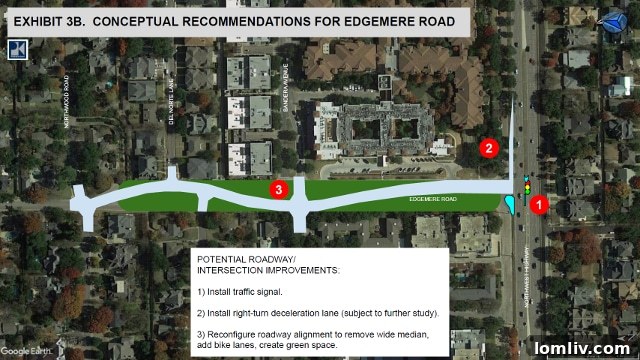
The proposals for Edgemere Road are particularly compelling and innovative. I have long pondered the potential of the expansive 45-foot-wide median that stretches almost from Northwest Highway to Northwood Road. My initial hope was for the city to leverage this space to install an underground water vault, an essential infrastructure solution to mitigate neighborhood flooding, perhaps even initially envisioned beneath Preston Place. While a water vault is not part of the current plan, the report recommends a significant makeover for this central green median—a space currently underutilized, primarily serving as a walking path. The proposed changes would subtly introduce a more sinuous curve to the road, effectively slowing traffic and redistributing the green space to both sides of the roadway. This approach, which I find highly appealing, enhances both aesthetics and safety, though I still believe incorporating a water vault beneath it would be an ideal fusion of function and design.
These aesthetic and functional improvements serve as a precursor to the study’s recommendation for a new traffic signal at the intersection of Edgemere Road and Northwest Highway. I must admit, however, that I harbor reservations about this particular plan for two primary reasons. Firstly, the most direct access to this intersection from the proposed development would involve navigating the frontage road. Secondly, making a left or right turn directly from the frontage road at this proposed signal would likely present a significant safety hazard, almost necessitating a U-turn in one direction for many drivers. To mitigate such risks, I personally prefer to avoid Edgemere and instead use Thackery, where turns are executed at safer right-angles. A new signal at Edgemere, while seemingly offering a solution, could inadvertently encourage safety-conscious drivers to undertake a circuitous “zig-zag” route through the neighborhood—turning left onto Diamond Head Circle, then left to Baltimore, right to Bandera, and finally right onto Edgemere—to avoid direct frontage road turns. Despite these specific concerns, the overall vision for the Edgemere greenway is truly an A+ concept.
Advocating for Tulane Boulevard: A Direct Route Solution
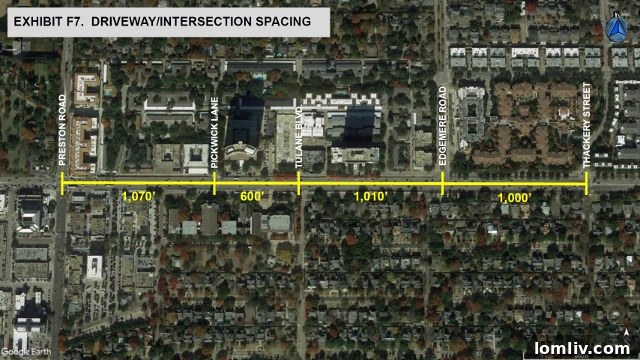
I have long been a vocal proponent of opening Tulane Boulevard directly to Northwest Highway, believing this would provide the most efficient and direct conduit for shunting new development traffic onto a major thoroughfare. The Texas Department of Transportation (TxDOT) has expressed reservations regarding this proposal, primarily due to Tulane’s proximity to Pickwick Lane—approximately 600 feet—which they deem too close for another traffic signal. My counter-argument posits that with modern, intelligently synchronized traffic signals, the precise distance between intersections becomes less critical, as the flow can be seamlessly coordinated across multiple points.
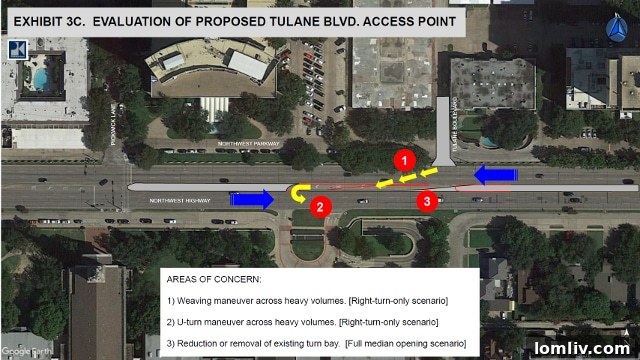
Another frequently raised concern regarding the opening of Tulane Boulevard is its potential interference with the First Baptist Church’s elongated left-turn lane on Northwest Highway, particularly impactful during busy Sunday mornings. The solution to this, in my view, is straightforward and eminently achievable.
The pragmatic answer lies in one of two approaches: either slightly shortening the church’s turn lane by a car length or two to accommodate the new intersection, or, more innovatively, extending the turn lane *through* the new Tulane intersection. This latter solution is not unprecedented; turn lanes are routinely designed to extend across intersections on numerous highways throughout Dallas. Establishing a traffic signal at Tulane Boulevard would effectively eliminate the undesirable “zig-zagging” through residential streets that a signal at Edgemere Road might inadvertently encourage. The effort to engineer an optimal intersection at Tulane is undoubtedly worthwhile, especially considering that the church’s turn lane primarily serves a limited few hours of Sunday morning traffic, making its re-evaluation a reasonable compromise for broader community benefit.
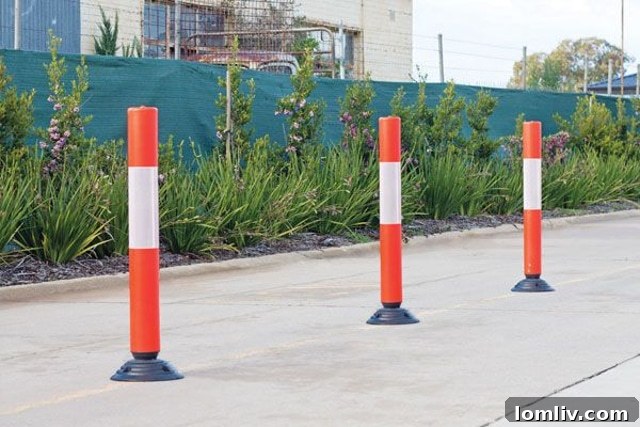
There remains a glimmer of hope for enhancing Tulane Boulevard’s connectivity. While a full traffic signal might face persistent opposition (a battle still worth fighting), there’s a strong possibility that Tulane could be opened to permit exiting westbound traffic to turn right onto Northwest Highway, and similarly, allow eastbound traffic to turn right and enter Tulane. This partial opening would offer considerable benefits without the complexities of a full signal.
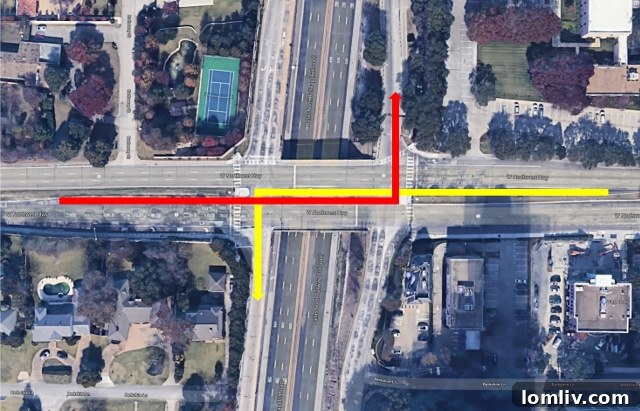
A specific concern often raised is the potential for drivers exiting Tulane to “cut across” Northwest Highway, then swiftly enter the church’s left-turn lane to execute a U-turn onto eastbound Northwest Highway. This maneuver, similar to those attempted when exiting Preston Center Plaza for a quick left onto Pickwick, poses safety risks and disrupts flow. A simple yet effective solution involves deploying a flexible blockade (as illustrated above). Such a barrier would physically prevent these dangerous cutovers into the church’s turn lane, ensuring safer and more predictable traffic patterns.
Conclusion: Data-Driven Planning for a Thriving Community
Overall, the traffic estimates stemming from the comprehensive redevelopment outlined in the Pacheco Koch study align remarkably well with my initial assessments—indicating a fairly minimal impact on the broader traffic network. The proposed mitigation strategies for Pickwick Lane, Tulane Boulevard, and Edgemere Road are well-considered and warrant serious exploration by both the City of Dallas and the affected neighborhoods. These solutions represent a proactive approach to managing growth and preserving community quality of life.
During the April 18th City Plan Commission (CPC) meeting on PD-15, the lead speaker for the opposition, Carla Young, raised questions about the fundamental validity of traffic studies themselves. She also explicitly stated that even if the study were to conclude that development impacts on traffic would be light, the opposition would still reject the city’s draft PD. This stance, she clarified, stems from a broader disagreement with the entire PD-15 rewrite process and its outcomes. This highlights a recurring challenge in urban planning: objective research and verifiable data often struggle to gain traction when confronted by pre-existing beliefs or fundamental opposition to a project.
Much like many contemporary debates, solid research and empirical data frequently fail to sway those whose positions are firmly entrenched, seemingly pre-programmed to discredit anything that conflicts with their desired narrative. Consequently, it is entirely reasonable to anticipate a significant amount of “study poo-pooing” and dismissal from the opposition during the upcoming June 6th CPC meeting, regardless of the report’s robust findings.
For those interested in delving deeper into the specifics of this pivotal document, the full report is available for review. Click here to access the comprehensive Pacheco Koch traffic study.

A Note from the Author: My primary focus areas consistently revolve around high-rise living, homeowner associations (HOAs), and property renovation trends. However, I also hold a profound appreciation for the delicate balance between modern and historical architecture, particularly when viewed through the lens of the YIMBY (Yes In My Backyard) movement, which advocates for progressive urban development. My commitment to insightful reporting has been recognized by the National Association of Real Estate Editors, which honored my writing with three Bronze awards in 2016, 2017, and 2018, as well as two Silver awards in 2016 and 2017. Should you have a compelling story to share, a perspective to contribute, or perhaps even a marriage proposal, please don’t hesitate to reach out via email at [email protected]. While you are welcome to search for me on Facebook and Twitter, you might find my digital footprint elusive, but the invitation to connect remains open.