In 1988, a most unusual question was posed to me by my husband: “Do we want a parrot?” This wasn’t a casual proposition; it was a unique opportunity wrapped in a medical necessity. A patient of my husband’s, facing surgery, found herself unable to afford the deductible. Her unconventional solution? To barter a magnificent yellow-naped Amazon parrot. Even then, these intelligent and vibrant birds commanded a substantial sum, but for this woman with limited resources, finding a good home for her cherished bird was paramount.
At that time, my life was a whirlwind. I was navigating the delightful chaos of raising two young children, aged four and seven, alongside managing one dog. Simultaneously, I was dedicated to assisting my husband in establishing his burgeoning medical practice while striving to maintain some semblance of an editorial career. Adding a parrot, an animal renowned for its demanding nature and long lifespan, seemed like an unimaginable undertaking. Yet, as soon as the children laid eyes on the stunning creature, they were utterly captivated. Their instant adoration was infectious, and I, too, quickly succumbed to the parrot’s charm. What I soon discovered, however, was that caring for a parrot demanded at least as much dedication and effort as caring for a dog, if not more.
Parrots, as I quickly learned, are energetic and, at times, messy companions. They have a peculiar habit of spewing food, and occasionally droppings, from their cages. Their vibrant feathers and fine dander seemed to float through every corner of our home. They are also notoriously talkative, a trait our already boisterous family didn’t mind in the slightest. In fact, our household was so full of lively conversation that I often wondered if anyone could ever truly get a word in edgewise against the cacophony of human and avian voices.
Beyond their vocal prowess, parrots possess an insatiable urge to shred almost anything for entertainment. Their fast metabolisms mean they eat and, consequently, poop almost constantly. This necessitates daily cage cleaning to prevent an overwhelming accumulation. Many a morning, I found myself absorbed in reading the news while meticulously scrubbing cages. It was during one such chore, amidst a layer of green droppings, that I stumbled upon one of the best interest rates I’d ever seen, leading us to refinance our home and even build a tennis court. Such were the unexpected revelations of parrot ownership.
Navigating a Gender Identity Mystery: Jose Becomes Josie
A few years into our journey with “Jose” (as the parrot was originally known), we moved to a new home boasting a much larger yard. This expansion allowed us to welcome more furry friends, eventually bringing our dog count to four. As our family grew, so did our commitment to Jose, and we even built a new laundry room specifically designed to accommodate our avian companion.
The name “Jose” reflected the patient’s belief that our new feathered friend was male. However, my husband, an obstetrician-gynecologist with a keen eye for biological nuances, always harbored a suspicion that the parrot was, in fact, female. This created a rather amusing and perplexing gender identity crisis within our household, long before the broader cultural conversations surrounding pronouns and identity became prevalent. Was Jose a boy or a girl? And how on earth would we ever definitively find out?
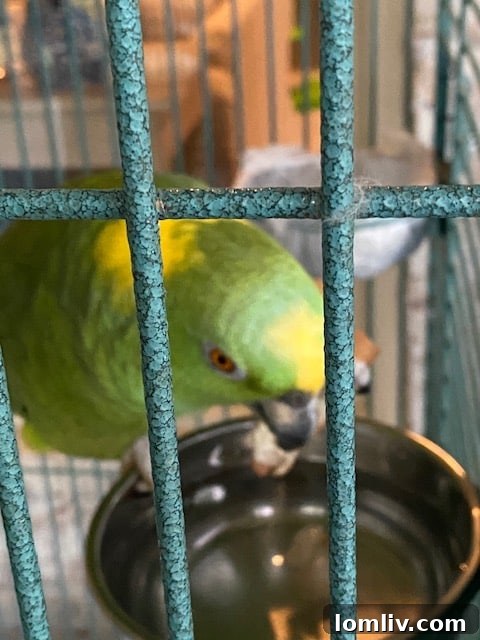
During pleasant weather, Jose enjoyed the fresh air and sunshine in an outdoor cage during the day, coming indoors each night and throughout the colder winter months. We established a lovely, sunny spot for the parrot in our new laundry room, a practical location that helped contain the inevitable dander and feathers. One of Jose’s favorite in-cage pastimes was to create what we affectionately called “soup” – diligently mixing her bird pellets or bread crusts into her water bowl, a charming if somewhat messy endeavor.
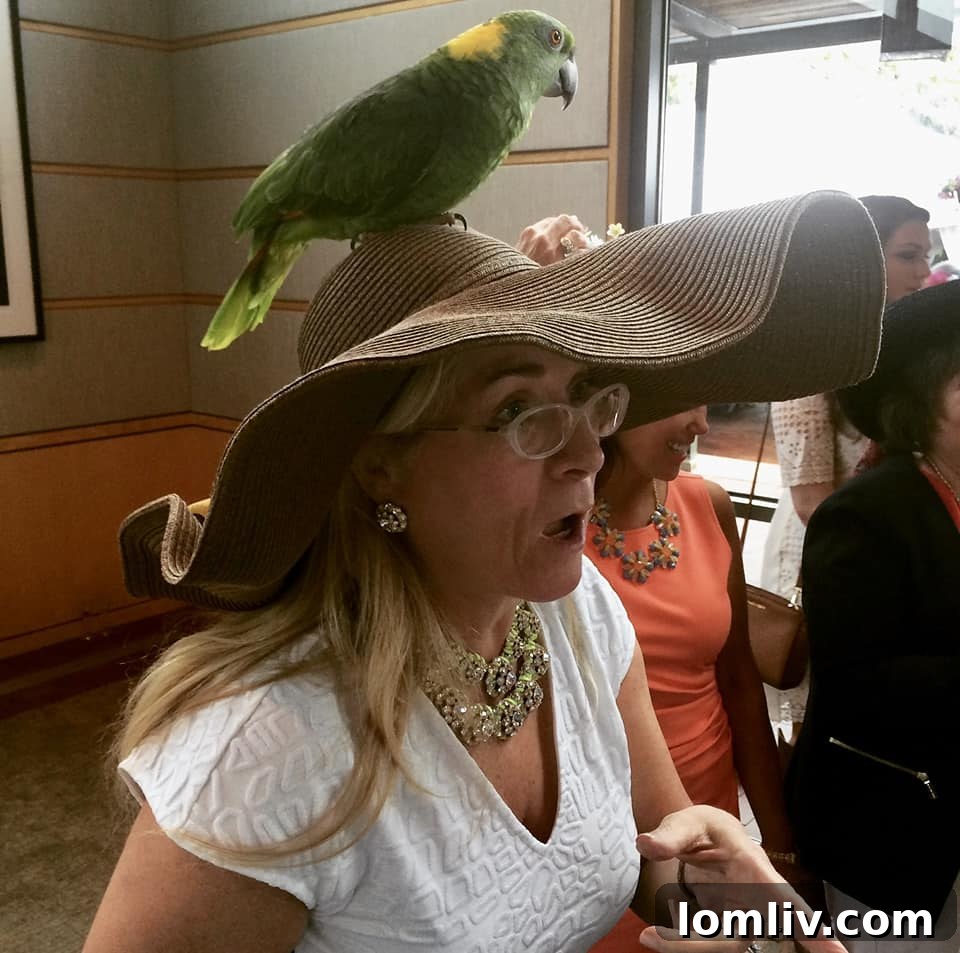
Jose’s incredible mimicry skills quickly became a source of endless amusement and occasional surprise. One of the very first phrases she learned to articulate was, “I could have danced all night.” This undoubtedly stemmed from my habit of playing Rogers and Hammerstein musicals, particularly after attending a performance of Porgy and Bess the night she arrived. My voice, it seemed, was the first she chose to imitate. Her repertoire soon expanded to include a rather dramatic “I’m gonna cry ah ha ah ha!”, perfectly mimicked from perching near our children as they bickered on their outdoor swings. She also developed an uncanny and remarkably accurate imitation of a fire engine siren, a sound she frequently heard due to our first home on Melissa Lane being very close to the Midway Road fire station on Northaven.
Over the next decade, Jose, who would later become Josie, lived with us on Park Lane, becoming an integral part of our family’s social fabric. She entertained countless guests at both high school and adult parties, no doubt consuming a variety of unauthorized treats from curious hands. She observed countless tennis games from her perch and once even got lost in a tree while we were away, causing a frantic search upon our return. Her more mischievous side surfaced occasionally; she bit several people, most notably giving my husband a painful case of Achilles tendinitis after repeatedly biting the back of his calf while he knelt in a closet, a painful incident she seemed to find hilarious. My son, too, was a frequent target, as she would lunge at him every time he walked past her cage. My daughter, a lifelong animal lover, recently confessed that Josie once nearly ripped off her fingernail!
Despite her occasional bites, which were mostly gentle nips for me, I felt a certain level of understanding with her. She also formed a strong bond with our first housekeeper from El Salvador, who adored Josie. We even attempted obedience school at SummerTree Animal Clinic, an experience that often saw Josie sent to “time-out.” During one memorable session, she almost got into a tussle with a much larger macaw. The macaw swiped at her with its tail, prompting Josie to size up its formidable beak, undoubtedly thinking, “Um, better not — that beak is way bigger than mine.” Indeed, a macaw’s beak can close with a force of 500 pounds per square inch. We both wisely kept our distance.
Josie’s Unexpected Reality TV Debut: From Pet to Star
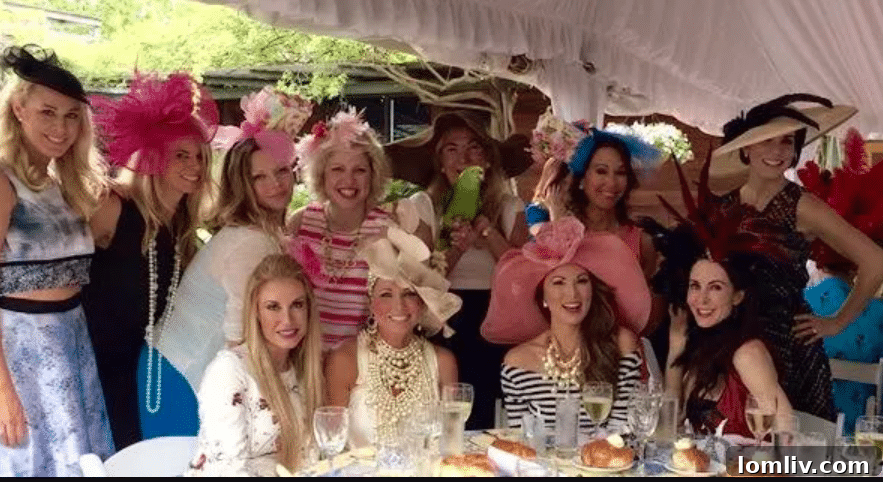
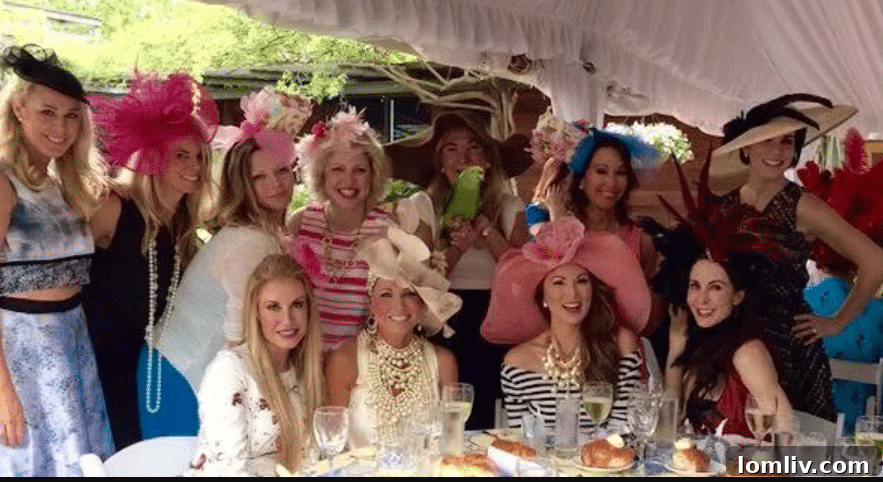
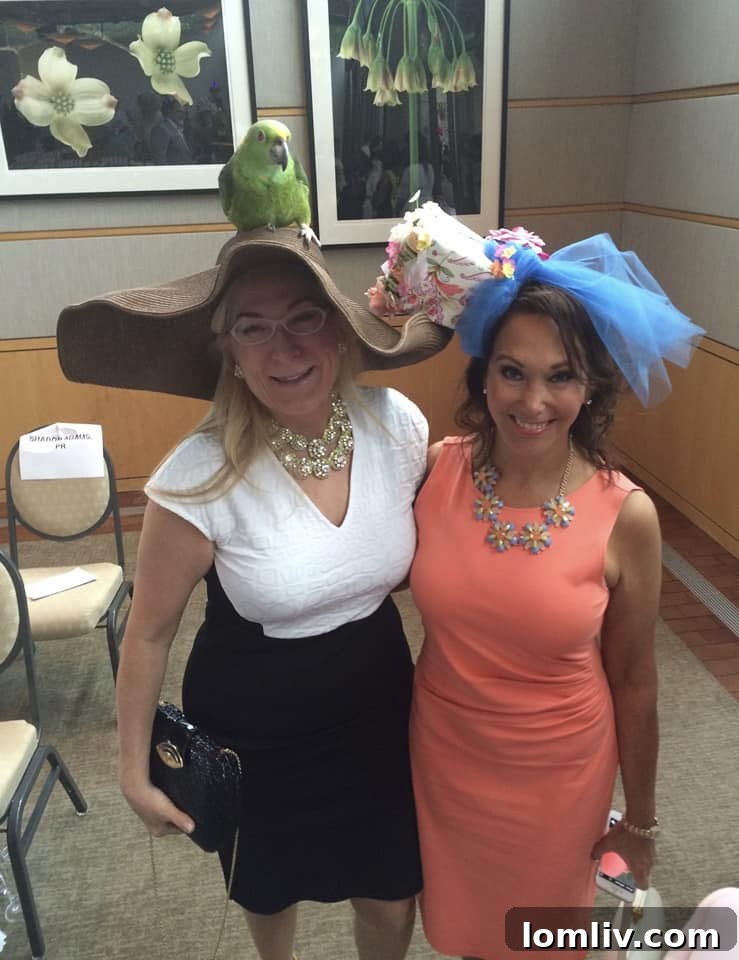
As Josie aged and continued to receive copious amounts of love and attention, her feisty spirit mellowed somewhat. Her capacity for surprise, however, remained. In 2016, a particularly delightful and unexpected event unfolded. I had completely neglected to plan my hat for the annual Mad Hatter’s Tea Party at the prestigious Dallas Arboretum. At the very last minute, in a moment of playful desperation, I grabbed the largest sun hat I could find and, on a whim, decided to bring Josie along. We embarked on our adventure with her comfortably nestled in a small car carrier. Upon arrival, I carefully placed her on my hat as I entered the event, hoping for the best.
What transpired next was nothing short of a dream for any aspiring animal celebrity. Josie, perched elegantly atop my hat, immediately captured the attention of the stars of Real Housewives of Dallas. The show, serendipitously, was filming at the luncheon that day. To my immense relief and pride, Josie was impeccably behaved; she didn’t even dare to leave a single dropping on my hat! Gina Ginsburg, one of the show’s personalities, was utterly smitten with Josie. Their instant connection was so profound that I briefly wondered if our beloved Josie had found a new, adoring companion, ready to embark on a life of reality television fame. It was a truly memorable moment that highlighted Josie’s unique charm and grace under pressure.
The intelligence of parrots is a topic of continuous fascination and research. It is often said that parrots possess the brains and cognitive abilities of a three-year-old human child. Remarkably, studies have even suggested that their problem-solving skills and intellectual capacity can surpass those of apes.
”Independently, parrots have evolved an enlarged area that connects the cortex and the cerebellum, similar to primates. This is another fascinating example of convergence between parrots and primates. It starts with sophisticated behaviours, like tool use and self-awareness, and can also be seen in the brain. The more we look at the brains, the more similarities we see.”
I witnessed compelling evidence of Josie’s remarkable intelligence almost every day. She was a regular Houdini, capable of escaping her cage with astonishing cunning if the bolts weren’t meticulously secured. Once on the loose, she wasn’t content with mere exploration; she would often chew on woodwork and furniture, leaving her mark around the house. On a few occasions, our dogs would corner her in a room, but thankfully, no bloodshed ever occurred. In these tense moments, I would simply calmly pick her up, return her to her “caja” (as we affectionately called her cage), and then embark on the familiar task of inspecting what new mischief she had gotten into, or what she had managed to eat or poop on.
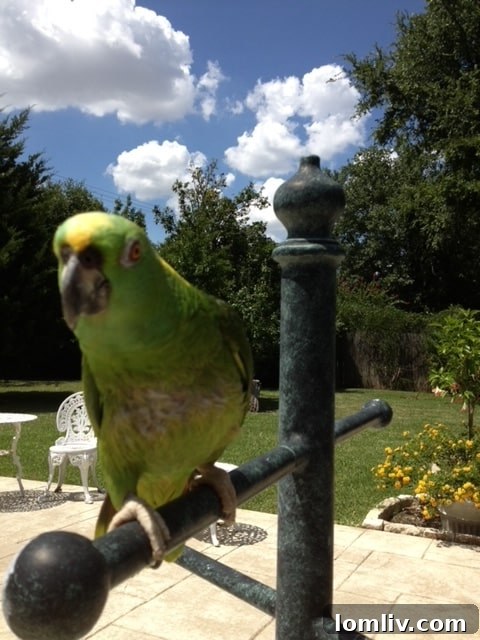
A home, I believe, is not merely a collection of walls and furniture; it’s a dynamic tapestry woven together by the people, the pets, and even the inanimate objects that inhabit it. The unique integration of all these elements creates an individualistic environment, often spawning its own brand of drama, humor, and indelible memories. Josie was undeniably a central thread in the fabric of our lives, adapting and thriving in every home we shared.
She seemed to enjoy all our residences, even the temporary rent house we occupied – and almost got evicted from – while our current home was under construction. For a long time, I suspected she loved her sunny Park Lane laundry room best, with its ideal exposure to natural light. However, in our newly built home, completed twenty years ago, we made a conscious effort to integrate her more fully into our family life. We created a special space for her in the kitchen and family area, ensuring she was always part of the activity. Additionally, a huge, shaded porch was made available for her summer comfort. Eventually, we screened the porch, not just for her comfort, but crucially, to protect her from the West Nile virus. Over the years, I replaced her outdoor cages roughly every five to seven years as the metal succumbed to the elements, and I found a beautiful, robust indoor cage for her at Rutherfords on Lover’s Lane. I had even recently begun to contemplate building a grand aviary for her, a testament to her enduring presence and our deep affection.
A Beautiful Bird, A Surprisingly Foul Mouth: The Sopranos Effect
In our new home, the proximity to family activities had an unexpected side effect. Josie became almost too integrated, absorbing not just our pleasant chatter but also, unbeknownst to us, some less savory aspects of our household environment. One day, as I was settling payment with a painter who had been working on our home, he reported, with a mixture of amusement and shock, that our beautiful bird possessed a surprisingly foul mouth.
“How so?” I asked, completely bewildered.
He explained, “Well, she was using the ‘F’ word, and I heard her repeat it consistently while painting the exterior porch and ceiling.”
My mind reeled. (Josie, it must be said, absolutely adored human company; she would even fluff up her feathers in greeting for the landscapers and pool cleaner, showcasing her extroverted nature.) Oh my, I thought, looking around the house for clues, where on earth could she have picked up such language? The mystery gnawed at me until one evening, as I was doing dishes and half-listening to the television, the answer became shockingly clear. I turned to my husband and asked him what he was watching. His response: The Sopranos.
“Turn that off immediately!” I exclaimed, a mix of horror and amusement washing over me. “Go upstairs if you have to watch it, or to your office. Never watch that in the family room again!”
“Why?” he asked, genuinely puzzled by my sudden outburst.
“Because,” I retorted, “the bird sounds just like Tony Soprano!”
Censoring her audible messaging proved effective in curbing her newfound bad language, and she eventually reverted to her charming repertoire of songs and crying imitations. However, she also began mimicking my husband by calling my name whenever he wasn’t home, a habit that freaked me out the first few times it happened, making me think he had returned unexpectedly.
Years later, we planned a trip to Japan, which necessitated boarding Josie at a specialized avian vet. The vet, however, required bloodwork to confirm she didn’t carry chlamydia. “She is not sexually active,” I told the vet, rather indignantly. They clarified: “Not that type of Chlamydia, they said: the bird type. They needed a blood test.” Seizing the opportunity, I asked, “Can you check the mystery of her sexual identity at the same time?” The sexual identity of parrots, I had learned, is only conclusively determined through a blood test. And so, according to her bloodwork, Jose was indeed a girl. We proudly re-christened her Josie.
The years continued to wear on, and Josie faced her share of health concerns. She was diagnosed with Bournovirus, though she remained largely asymptomatic, raising questions about the severity of the diagnosis. She also began to gain weight, a common issue for captive birds, which required us to closely monitor her diet and ensure she got sufficient exercise. We made it a daily routine for her to flap her wings rigorously. My husband, ever the creative caretaker, would sometimes take her for a bike ride, perched securely on his handlebars, or simply walk her around the block on his shoulder, providing essential stimulation and a change of scenery.
After the passing of our last dog in 2018, Josie became the undisputed queen of the house, a role she seemed to quite relish. This coincided with us beginning to travel more frequently. We never left her home alone, always arranging for someone to come in, feed her, clean her cage, and, crucially, engage her in conversation. Then, in 2020, the Doodles arrived, two energetic puppies. Once again, Josie found herself observing puppies trying to jump into her cage or barking excitedly at her. “Listen, dudes,” she would hiss back, in her own unique avian way, “I was here first, long before you guys. Cool it.” Her long reign had taught her resilience and a certain disdain for newcomers.
After 40-plus Years, A Swift and Heartbreaking Decline
In the midst of the ongoing whirlwind of work, life, family demands, various medical procedures, and the ceaseless energy of the Doodles, I confess I failed to notice the subtle signs that Josie was getting sick. I had installed a heater on the back porch for her comfort, but it had recently ceased to work. Consequently, I kept her indoors when the temperature dropped below 50 degrees Fahrenheit a few weeks prior, until I could purchase a new portable heater for her outdoor space.
On Thanksgiving morning, a day that should have been filled with gratitude and warmth, I carried out my usual routine. I placed Josie in her outdoor cage, switched on her brand-new, toasty heater, and filled her bowl with fresh food. She seemed content, happy even. That night, when I went out to bring her back inside, I made a heartbreaking discovery: I found her huddled at the very bottom of her cage. This, as any experienced bird owner knows, is the unmistakable and ominous sign of a gravely ill bird.
She was docile, almost rag-like, as I gently picked her up, carefully peeling her tiny claws from the cage bottom she clutched so weakly. I brought her inside, cradling her. She then plopped herself into her water bowl, and a flicker of concern shot through me – I wondered if she was attempting to lay an egg, which, at her age and condition, would be another deeply troubling sign, something I had always successfully discouraged. She then stumbled around her cage, one little foot unable to maintain a secure grip. She perched herself in a corner, her small head resting against a bar. Understanding the gravity of the situation, I made a soft, comforting nest on the floor of the cage, just in case.
By morning, there was no improvement. She had not eaten, nor had she passed any droppings. I called the vet first thing and secured an immediate appointment. The tests, when conducted, were frustratingly inconclusive regarding the exact nature of her ailment. However, the vet unequivocally confirmed that she was a very sick bird. “You know about the bottom of the cage,” she said, her voice gentle, acknowledging the unspoken understanding between us.
Finding vets equipped to care for birds, especially specialized emergency care, is a challenge. This particular vet, however, was highly knowledgeable about Amazons, and together, we could plainly see that the vibrant spirit had been stripped from our Josie. While some Amazons can live to a remarkable 80 or 90 years, Josie, at somewhere in her 40s, was succumbing to an unknown illness. We couldn’t pinpoint precisely what was wrong, but the thought of letting her suffer for even a few more days was unbearable. I was consumed by guilt for not having noticed how profoundly sick she had become. The vet, sensing my distress, kindly reminded me that parrots, as birds of prey, are masters at hiding illness. In the wild, appearing weak means becoming prey. Many humans, too, adopt this defensive behavior. Josie had buried her sickness so completely that I hadn’t even registered that she hadn’t been ringing her bell lately. Yet, only a few days prior, she had been chatting away. She certainly knew how to call us if she were frightened.
I recall one instance vividly: I was puttering in the kitchen, and Josie was on the porch. Suddenly, she let out a blood-curdling scream. I yelled for my husband, and we both ran outside, bracing ourselves to find some predator attacking our bird in her cage. There was no critter visible, but high above, a red-tailed hawk was swooping over our yard. Josie had spotted him from her cage, recognized the imminent danger, and had called us in sheer terror. I immediately brought her inside for the rest of the afternoon, shaken by the raw instinct she displayed.
A Different, Quieter House: Josie’s Enduring Legacy
Josie had been with us through nearly every home in our marriage, a constant presence through love, joy, and tragedy. She had met our now-deceased parents and friends, and through her sometimes-fierce nature, she had helped teach my grandchildren the invaluable lesson of never sticking a finger into a parrot cage. She had graced our lives for almost as long as my husband and I had been married, an integral thread in the tapestry of our family.
Our home now feels profoundly different, quieter, without Josie’s vibrant presence. I never could have dreamed I would parent a yellow-naped Amazon parrot, but she came into our lives in the most unexpected way and quickly became an irreplaceable part of our family, etched into our lore, and a cherished memory in each and every home we have ever lived in. Parrots are not like dogs; they don’t follow you around, and you generally cannot cuddle them with the same inherent trust. At obedience class, we learned that even while holding her on my lap and stroking her, a sudden startle could trigger a bite. This is because, unlike dogs, parrots have not undergone generations of domestication. Yet, they grace a room unlike any other pet: they are breathtakingly colorful, exquisitely beautiful, and always quietly present, often with a charming “hello.”
Now, we hope that Josie is flying freely with parrot angels, reunited with all our loved ones who have passed, swinging and ringing her little bell under the bright Honduran sun where she was born. In retrospect, I wish I had considered breeding her. The population of the yellow-naped Amazon parrot in Central America has plummeted by more than 50 percent, a tragic consequence of rampant deforestation and the illegal removal of these magnificent birds to be sold on the black market as pets. We were always told Josie was born a U.S. citizen, though we never knew her exact birthday. We simply tried to give her the best possible home and life we could. Now, in loving memory of Josie, we are committed to working towards stopping these birds from being torn from their natural habitats and to supporting efforts to replenish their beautiful populations.
If you feel moved to help protect these intelligent and endangered creatures, you can find out more from In Defense of Animals and contribute to their vital conservation efforts.