Paragraph 21: The Cornerstone of Effective Communication in Texas Real Estate Contracts
In the intricate world of real estate transactions, contracts serve as the blueprint for every step, detailing responsibilities, deadlines, and rights for all parties involved. While many clauses grab immediate attention, there’s one critical provision in the Texas residential real estate contract that, despite its profound importance, is frequently overlooked or hastily completed: Paragraph 21, pertaining to notices. Often referred to simply as “notices,” “notifications,” or “disclosures,” this paragraph is far more than just administrative text; it’s the lifeline for formal communication that can make or break a deal. Ignoring it can lead to significant delays, misunderstandings, and even legal complications.
The Texas residential real estate contract, specifically Paragraph 21, states:
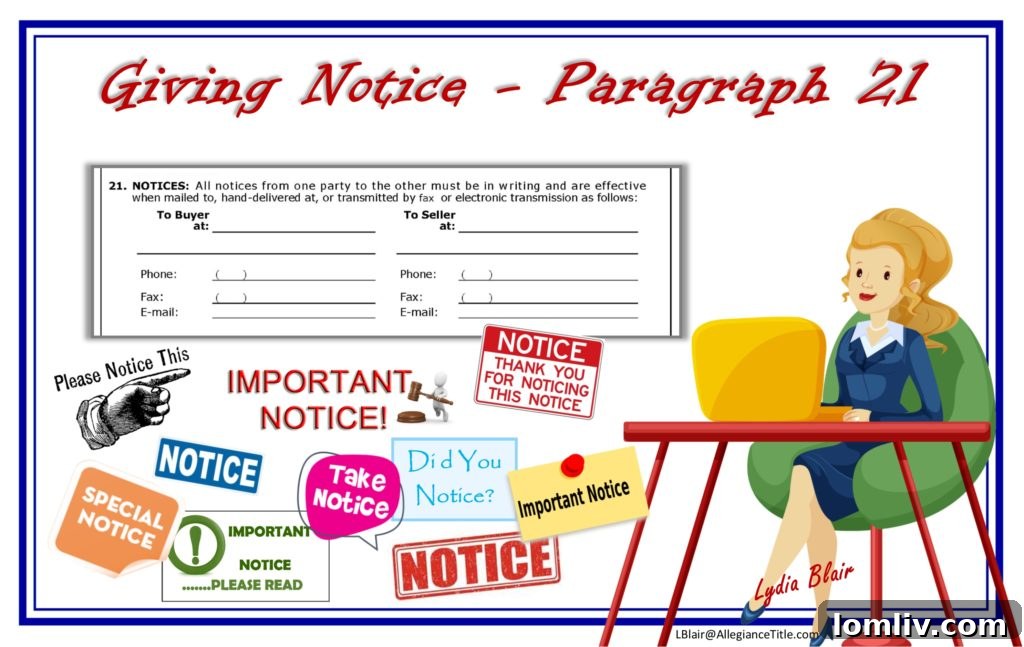
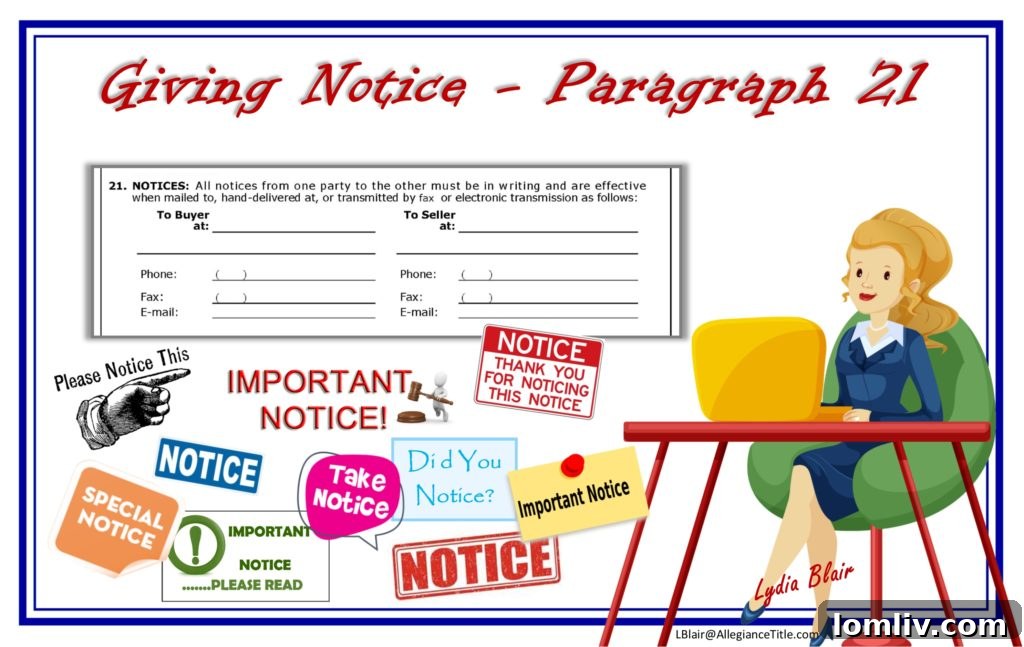
“All notices from one party to the other must be in writing and are effective when mailed to, hand-delivered at, or transmitted by fax or electronic transmission as follows:”
Following this statement, the contract provides dedicated spaces for the buyer’s and seller’s names, physical addresses, phone numbers, fax numbers, and email addresses. These seemingly simple blanks are, in fact, essential gateways for legally compliant communication throughout the transaction.
The Overlooked Dilemma: Why Paragraph 21 Matters More Than You Think
It’s an unfortunate reality that this crucial paragraph is often neglected. Estimates suggest that a significant portion—perhaps a third—of residential contracts submitted to title companies arrive without complete contact information for both the buyer and seller in Paragraph 21. This widespread oversight creates a host of potential problems, undermining the very foundation of clear and effective contractual communication. The question then arises: why is this such a big deal? Why do buyers and sellers need to openly disclose their contact details, and should their agent prioritize privacy by withholding this information? The answers lie at the heart of legal efficacy and transactional efficiency.
Ensuring Direct Communication with the Title Company and Other Key Parties
The primary reason for completing Paragraph 21 is to facilitate seamless and direct communication among all stakeholders. Without accurate contact information in this specific provision, how can the title company effectively reach you? The title company is responsible for delivering a wide array of critical documents, including the title commitment, survey, homeowners association (HOA) documents, and ultimately, the closing disclosures. These documents often contain vital information about the property’s title, potential encumbrances, and financial details of the transaction. If your email, phone, or physical address isn’t provided as stipulated, the title company has no official means of contacting you directly, potentially leading to significant delays and confusion.
Consider the ripple effect: a delay in receiving the title commitment could hold up the review period, push back financing deadlines, or even delay the closing date. Timely receipt of these documents is not merely a convenience; it’s often a contractual obligation that protects your interests as a buyer or seller. By providing your contact information in Paragraph 21, you empower the title company and other necessary parties to fulfill their duties efficiently, keeping your transaction on track and minimizing unnecessary hurdles.
The Legal Efficacy of Notices: When Blank Spaces Spell Trouble
Beyond practical communication, an even more significant consequence of neglecting Paragraph 21 pertains to the legal effectiveness of notices. The paragraph explicitly states that notices are not effective unless sent in writing and delivered via the methods specified within its terms. If Paragraph 21 remains blank, or only partially completed, a major issue arises when one party needs to formally notify the other of a critical action such as a change, a request, a termination, an objection, or a demand.
For example, how would a buyer legally notify a seller of an objection to the survey or title commitment within the stipulated timeframe? How could vital information about property defects or repair requests be formally communicated? The contract’s provisions are clear: title documents, for instance, are often required to be delivered per the address shown in Paragraph 21. There is no contractual requirement to deliver them elsewhere. Without this foundational communication framework, any attempts at notification could be challenged as legally ineffective, potentially leading to disputes, contract breaches, and even the collapse of the transaction.
Imagine a scenario where a buyer needs to terminate the contract during the option period. If Paragraph 21 is incomplete, and the termination notice isn’t delivered exactly as specified, the seller could argue that they never received proper notification, potentially holding the buyer liable for earnest money or even specific performance. This highlights the paragraph’s role not just in convenience, but in safeguarding the legal rights and obligations of both the buyer and the seller.
Timeliness is Everything: The Critical Clock of Real Estate Deadlines
Real estate transactions are inherently time-sensitive, governed by a series of critical deadlines. There are numerous instances in which a buyer or seller has a defined, often short, amount of time to respond once information or a notice is delivered. This “clock” of response time typically starts ticking precisely when a notice is delivered according to the information provided in Paragraph 21.
Consider the option period, where a buyer has a specific number of days to conduct inspections and potentially terminate the contract. Or the period for a buyer to object to the title commitment or survey. Or the deadlines for responding to repair requests or financing approvals. If the contact information in Paragraph 21 is incomplete or incorrect, a notice might be misdirected or delayed, consuming valuable response time. A delay of even a day or two in the delivery of a critical notice could cause a party to miss a deadline, thereby forfeiting their rights or incurring penalties. This could mean losing the right to terminate, being forced to accept unfavorable terms, or even losing earnest money.
By ensuring Paragraph 21 is fully completed, both parties protect their ability to receive timely notices and to initiate timely responses, preserving their contractual rights and keeping the transaction moving forward smoothly within the agreed-upon timelines. In real estate, where “time is of the essence” is a common phrase, having a clear and effective channel for communication is non-negotiable.
The Agent’s Role and the Burden of Relay
Occasionally, a real estate agent might insert their own email address and phone number as the sole contact in Paragraph 21, perhaps with the intention of shielding their client or centralizing communication. While an agent’s desire to facilitate the transaction is commendable, this practice can inadvertently create additional burdens and potential liabilities for them. Every party with a copy of the contract already has the agent’s information on the last page. If the only contact listed in Paragraph 21 is the agent’s, then official documents and notices will be sent exclusively to them.
This places the onus squarely on the agent to then promptly deliver all information and notices to their client. This added responsibility means the agent becomes the sole conduit for legally binding communications. If the agent is traveling, unavailable, or simply makes an error in forwarding a time-sensitive document, the client could miss a crucial deadline, and the agent could face accusations of negligence or breach of fiduciary duty. Most agents would prefer not to shoulder this additional, critical obligation for delivering official documents that are intended for their client’s direct review and action.
A better practice, if an agent wishes to remain fully informed of all official communications, is to simply add “cc:” and their contact information in Paragraph 21, alongside their client’s direct contact details. This ensures the client receives official notices directly, while the agent also stays in the loop without becoming the primary and sole point of contact for legally effective communication.
Privacy Concerns vs. Contractual Necessity
The question of privacy often arises when discussing the disclosure of contact information. While personal privacy is a valid concern, in the context of a legally binding real estate contract, certain disclosures are necessary for the transaction to proceed legally and efficiently. The contact information requested in Paragraph 21 is not for marketing purposes; it is explicitly for formal contractual communication. Entering into a contract inherently requires a degree of mutual transparency for the explicit purpose of fulfilling the agreement’s terms.
Ultimately, the limited disclosure of contact information in Paragraph 21 serves to protect both the buyer and the seller by ensuring they receive all necessary notices directly and promptly. This outweighs generalized privacy concerns within the specific scope of the real estate transaction. Agents can reassure their clients that this information is used solely for the contractual process and is essential for safeguarding their interests.
Best Practices: Always Complete Paragraph 21
Even the most diligent contract reader can lose focus by the time they reach Page 7 and Paragraph 21 of a lengthy real estate agreement. However, this is precisely the moment to pay close attention. It is imperative for both buyers and sellers, and their respective agents, to ensure that Paragraph 21 is meticulously completed. You want to guarantee that you will receive all official notices directly and promptly, and equally important, that you have a legally recognized means to deliver notices to the other party.
Here are key best practices:
- Verify All Blanks are Filled: Ensure every field—name, address, phone, fax, and email—is accurately completed for both the buyer and the seller.
- Confirm Accuracy: Double-check all contact details for typos or errors. An incorrect email address or phone number can render a notice ineffective.
- Mutual Completion: Always confirm that the other side of your deal has also fully and accurately completed their section of Paragraph 21. A complete paragraph on one side is only half the solution.
- Agent “CC” Option: If agents wish to be included in all formal notices, they should add “cc:” and their contact information clearly below their client’s details, rather than replacing them.
Conclusion: Don’t Let the Fine Print Undermine Your Deal
Paragraph 21 of the Texas residential real estate contract is not merely boilerplate language; it is a critical provision designed to ensure clear, timely, and legally effective communication between all parties. Its neglect can lead to substantial risks, including communication breakdowns with the title company, invalidation of critical notices, missed deadlines, and increased liability for real estate agents. By taking the few extra moments to meticulously complete this paragraph, buyers and sellers proactively safeguard their interests, streamline the transaction process, and prevent potential disputes. Make sure Paragraph 21 is always a top priority, ensuring that your real estate journey is as smooth and legally sound as possible.
The opinions expressed are of the individual author for informational purposes only and not for the purpose of providing legal advice. Contact an attorney for any particular issue or problem.
Lydia Blair (formerly Lydia Player) was a successful Realtor for 10 years before transitioning to the title side of the business in 2015. Prior to selling real estate, she actively bought, remodeled, and sold homes—long before “house flipping” became a popular expression. Her extensive experience means she has navigated the real estate closing process countless times, serving as a buyer, a seller, a Realtor, and now as an Escrow Officer. As an Escrow Officer for Allegiance Title at Preston Center, Lydia excels at solving complex problems and efficiently navigating through bureaucratic obstacles. She finds immense satisfaction in the most rewarding parts of her job: handing clients keys to their new home or a check from their sale.