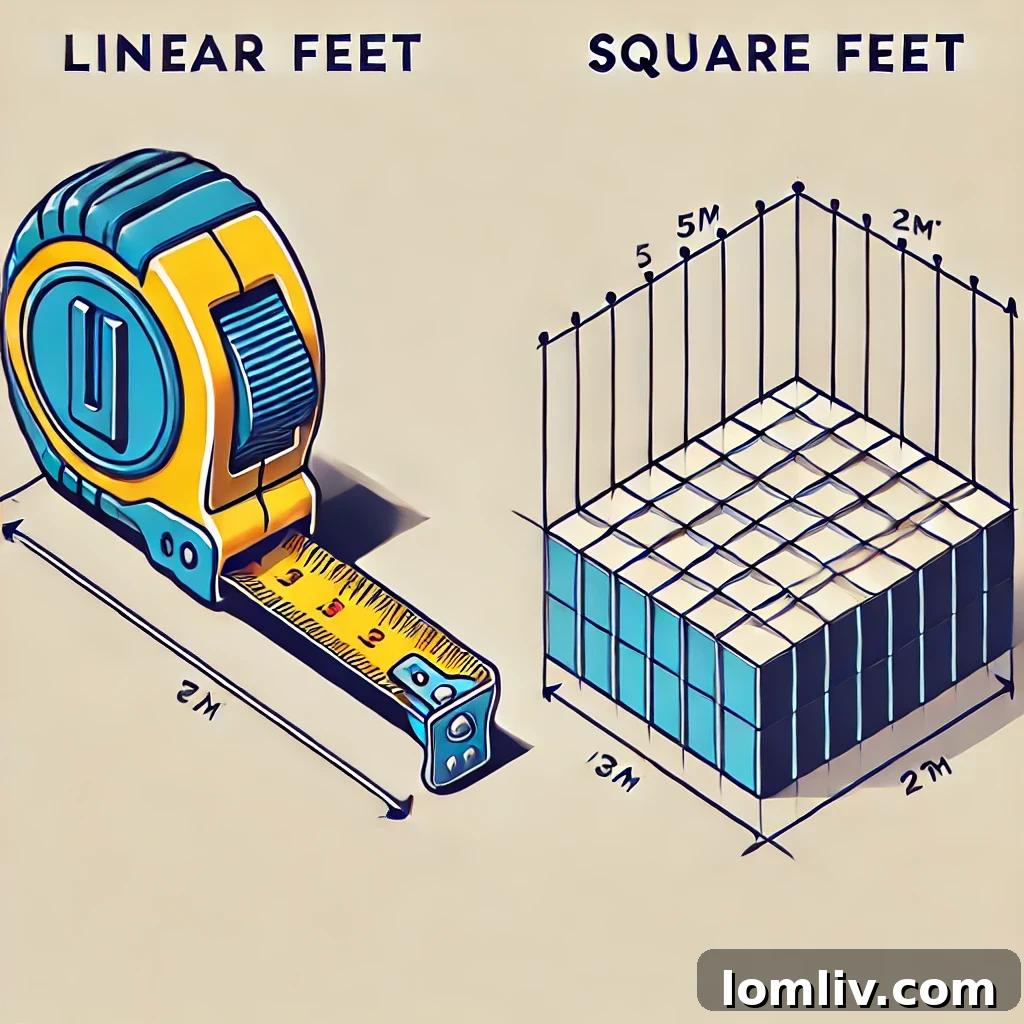
Embarking on a home project, planning a significant renovation, or simply purchasing materials for a DIY task requires a fundamental understanding of measurement units. Among the most commonly encountered, yet frequently confused, are linear feet and square feet. While both are essential for accurate material estimation, they serve distinctly different purposes. Misinterpreting one for the other can lead to frustrating and costly errors, resulting in either insufficient materials that halt your progress or excessive surplus that wastes money and space.
This comprehensive guide aims to demystify these crucial measurements. We will meticulously explore what linear feet and square feet represent, detail the straightforward methods for calculating each, and clarify their specific applications across various home improvement, construction, and design industries. By the end of this article, you’ll be equipped with the knowledge to confidently measure, calculate, and purchase materials with precision, ensuring your projects run smoothly and efficiently.
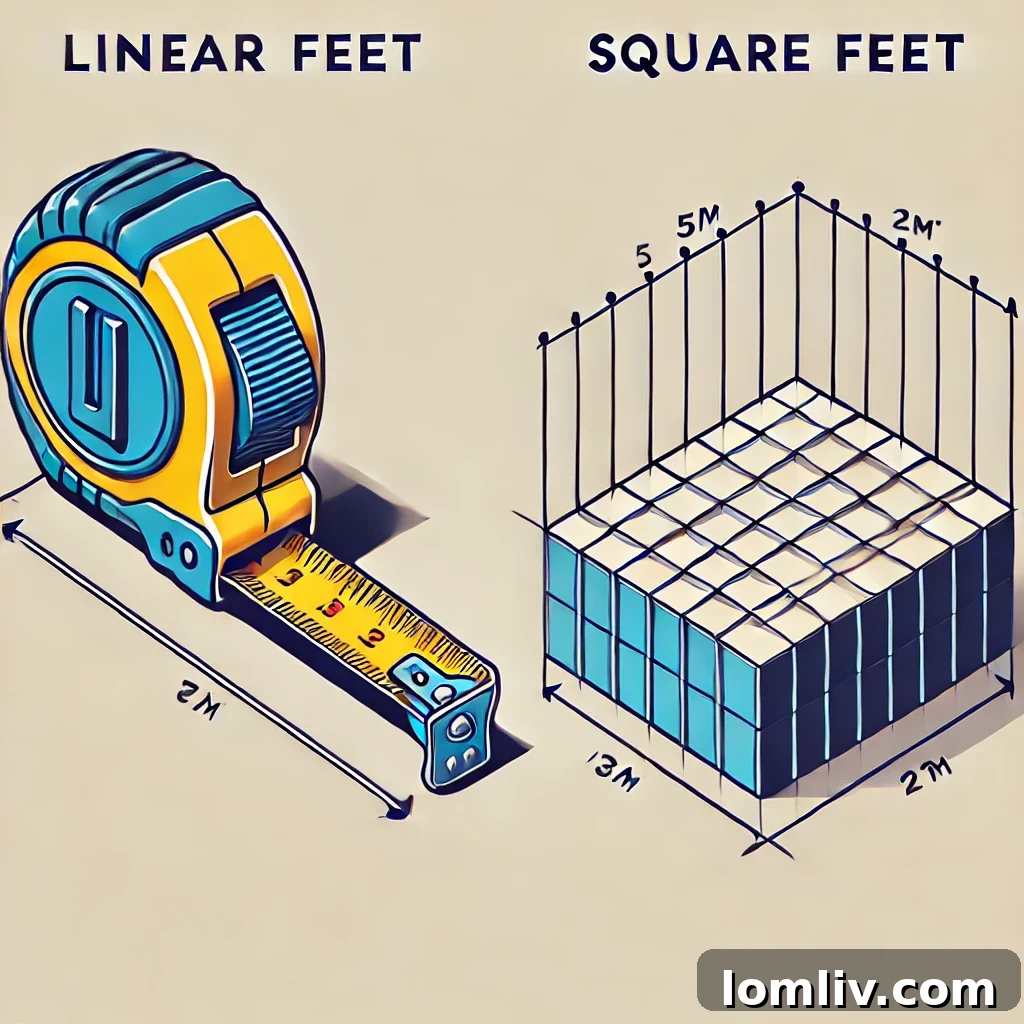
Understanding the Linear Foot: A Measure of Length
At its core, a linear foot is a unit of measurement that quantifies length in a single dimension. Imagine a straight line; a linear foot measures precisely how long that line is. It’s a fundamental concept in various trades and industries where the primary concern is the extent of a material along one axis. Unlike area or volume measurements, a linear foot disregards width, height, or thickness. This makes it an ideal measurement for items that are typically long and narrow, or materials sold in continuous strips or rolls.
For instance, when you walk into a lumberyard and ask for a 10-foot piece of wood, you are requesting a piece that is 10 linear feet long. The specific width and thickness of that board are separate specifications that don’t alter its linear foot measurement. Similarly, if you’re buying a length of pipe, a roll of fabric, or a section of countertop, the primary measurement used for pricing and quantity is almost always in linear feet. This unit simplifies purchasing and estimation for products where only the “run” or overall length matters for the initial quantity.
How to Accurately Calculate Linear Feet
Calculating linear feet is one of the simplest measurements you’ll encounter in home projects. It primarily involves measuring the length of an object or a required space in feet. The process is straightforward, but accuracy is key to avoiding material shortages or overages.
Step-by-Step Calculation:
- Measure the Length: Use a tape measure to determine the total length of the material or space you need.
- Ensure Units are in Feet: If your measurement is already in feet (e.g., 8 feet, 6 inches), simply note the feet. If you have fractional feet, you might convert inches to a decimal of a foot (e.g., 6 inches = 0.5 feet).
- Convert Inches to Feet (if necessary): If your measurement is entirely in inches, you must divide the total number of inches by 12 (since there are 12 inches in a foot).
Example Calculation:
- Let’s say you need a new piece of decorative molding for a wall that measures 96 inches long.
- To convert this measurement into linear feet, you would perform the following division: 96 inches ÷ 12 inches/foot = 8 linear feet.
- Therefore, you would need to purchase 8 linear feet of molding.
This method ensures you get the exact length required, preventing waste or multiple trips back to the store.
Common Applications of Linear Feet in Various Industries
The utility of linear feet spans across numerous industries and project types. Its simplicity makes it the go-to measurement for materials that are intrinsically linear in their form or application.
- Lumber and Woodworking: When purchasing wood for framing, trim, or decorative purposes, boards and planks are almost always sold by the linear foot. You specify the length you need, and the width/thickness are typically secondary specifications.
- Flooring and Carpeting (Rolls): While many flooring materials are sold by the square foot, certain types, especially carpet rolls or vinyl sheet flooring, may be priced or measured in linear feet, particularly when sold from a larger roll where the width is standardized.
- Countertops: Kitchen and bathroom countertops, whether custom-cut or pre-fabricated sections, are predominantly measured and priced by the linear foot. The depth of the countertop (typically 24-25 inches) is usually standard.
- Fencing: Estimating the materials for a new fence involves calculating the perimeter of your yard, which is a linear measurement. Fence panels, posts, and rails are frequently sold by the linear foot.
- Cabinetry: Kitchen cabinets, especially when estimating the cost of a full run of upper or lower cabinets, are often priced per linear foot. This provides a quick estimate for budgeting purposes, factoring in average cabinet sizes and installation.
- Fabric and Textiles: Whether for upholstery, drapery, or crafts, fabrics are typically sold by the linear foot (or yard) from a bolt, where the fabric width is a fixed characteristic.
- Piping and Conduit: For plumbing, electrical work, or irrigation systems, pipes, tubing, and electrical conduit are all measured and sold in linear feet, as their primary function is to extend over a certain distance.
Demystifying the Square Foot: A Measure of Area
In contrast to the one-dimensional linear foot, a square foot is a unit of area. It measures a two-dimensional space, accounting for both length and width. Imagine a square where each side measures exactly one foot; the area contained within that square is one square foot. This measurement is crucial for projects where you need to cover a surface, such as floors, walls, ceilings, or even land plots, where the spread of a material or the size of a space is the primary concern.
When you’re told a house is 1,500 square feet, it refers to the total living area, encompassing the length and width of all its rooms. If you’re buying flooring, you need to know the square footage of the room to ensure you purchase enough material to cover the entire floor. Understanding square feet is essential for visualizing and quantifying space, as well as for accurate material estimation for coverage-based applications.
Calculating Square Feet with Precision
Calculating square feet is a fundamental skill for anyone undertaking home improvements or dealing with property. It involves a simple multiplication of two dimensions.
The Basic Formula:
Square Feet = Length (ft) × Width (ft)
Step-by-Step Calculation for a Rectangular Area:
- Measure the Length: Measure one side of the area in feet.
- Measure the Width: Measure the adjacent side of the area in feet.
- Multiply: Multiply the length by the width. The result will be in square feet.
- Convert Inches (if necessary): If your measurements are in inches, convert them to feet first by dividing by 12, or multiply inches by inches to get square inches, then divide by 144 (12 inches/foot * 12 inches/foot = 144 square inches/square foot). It’s generally easier to convert to feet before multiplying.
Example Calculation:
- Suppose you have a room that is 10 feet long and 12 feet wide, and you want to install new flooring.
- Using the formula: Square Feet = 10 feet × 12 feet = 120 square feet.
- You would therefore need enough flooring material to cover 120 square feet.
For Irregular Shapes:
For rooms that aren’t perfectly rectangular or square, you can often break them down into smaller, manageable rectangles or squares. Calculate the square footage of each section and then add them together to get the total area. This strategy ensures you account for all corners and alcoves.
Key Uses of Square Feet in Home & Construction Projects
The applications for square footage are vast, touching almost every aspect of construction, renovation, and property management. It is the standard for quantifying surface areas.
- Flooring Materials: Tiles, hardwood, laminate, vinyl, and most carpet options are sold and priced by the square foot. Knowing the exact square footage of your room is non-negotiable for purchasing the correct quantity.
- Painting and Wall Coverings: The amount of paint you need to buy for a room is directly calculated from the square footage of its walls and ceiling. Similarly, wallpaper is purchased based on the total wall area it needs to cover.
- Real Estate: Square footage is a primary metric in real estate, influencing property value, rental costs, and overall market comparisons. It gives buyers and renters a clear understanding of the size of a living space.
- Landscaping: When installing sod, artificial grass, or determining the coverage area for mulch or gravel, square feet is the go-to measurement. It helps calculate how much material is needed to beautify outdoor spaces.
- Roofing: Shingles, roofing felt, and other roofing materials are estimated and purchased based on the square footage of the roof surface. This ensures adequate coverage and protection for your home.
- Insulation: Whether for walls, attics, or crawl spaces, insulation is bought based on the square footage of the area it needs to insulate. Proper insulation is key for energy efficiency.
- HVAC Sizing: Heating, ventilation, and air conditioning (HVAC) systems are often sized based on the square footage of the conditioned space, among other factors, to ensure efficient climate control.
Linear Feet vs. Square Feet: A Clear Comparison
The fundamental distinction between linear feet and square feet lies in the number of dimensions they measure. Grasping this difference is crucial for accurately planning and executing any project involving material procurement. Linear feet quantify a single dimension – length – while square feet quantify two dimensions – length and width, defining an area.
To further clarify, consider the following comparative table, which highlights the core features and applications of each measurement unit:
| Feature | Linear Foot | Square Foot |
|---|---|---|
| Measurement Type | One-dimensional (Length) | Two-dimensional (Area: Length x Width) |
| What It Measures | The extent of an item along a straight line | The size of a flat surface or space |
| Used For Materials Like | Wood boards, pipes, trim, fabric, fencing, countertops, cables | Flooring, paint, wallpaper, sod, roofing, drywall, insulation |
| Calculation Method | Direct measurement of length (e.g., in feet, or inches divided by 12) | Length (ft) × Width (ft) |
| Real-World Application | Buying a piece of lumber for a shelf; estimating fence length | Calculating how much carpet to buy for a room; determining paint coverage |
| Unit Symbol | ft or LF | sq ft or ft² |
This distinction is not merely academic; it directly impacts cost, material handling, and project timelines. Forgetting the width of a material when it’s critical (like flooring) or over-specifying width when only length matters (like piping) can lead to significant budgetary and logistical headaches.
When to Utilize Each Measurement: Practical Scenarios
Knowing when to apply linear feet versus square feet is the cornerstone of accurate project planning and budgeting. Choosing the wrong unit can throw off your entire material estimate, resulting in costly delays or surplus waste. Here’s a practical guide to help you decide:
- Opt for Linear Feet When:
- You are purchasing materials sold in fixed lengths or from a roll where the width is standardized and not variable, such as wood molding, baseboards, crown molding, plumbing pipes, electrical conduit, or long sections of fabric.
- You need to measure the perimeter of an area, like installing fencing around a yard, trim around a room, or decorative edging.
- You are buying countertops, where the depth is usually standard, and only the length of the counter space needs to be specified.
- Choose Square Feet When:
- You need to cover a flat surface, such as installing flooring (hardwood, tile, carpet), painting walls or ceilings, applying wallpaper, or laying sod in your garden.
- You are dealing with real estate, property valuation, or describing the size of a room, house, or land plot.
- You need to estimate materials that are spread over an area, like insulation, roofing shingles, or gravel for a pathway.
To put it simply: if the material’s primary function or form is about its extension in one direction, think linear. If it’s about covering a space or defining an area, think square. Always double-check how materials are sold by your supplier before making a purchase.
Converting Linear Feet to Square Feet: Bridging the Dimensions
While linear feet and square feet are distinct, there are scenarios where you might need to convert a linear measurement into an area measurement, or vice versa. The crucial piece of information needed for this conversion is the width of the material or space in question. Without knowing the width, a direct conversion from linear to square feet is impossible, as a linear foot inherently lacks the dimension of width.
The Conversion Formula:
To convert linear feet into square feet, you must know the fixed width (in feet) of the material you are working with. The formula is straightforward:
Square Feet = Linear Feet × Width (ft)
Example Calculation:
- Imagine you are purchasing a carpet roll that is 3 feet wide, and you need 10 linear feet of it to cover a hallway.
- To determine the total square footage of carpet you are buying, you would apply the formula:
- 10 linear feet × 3 feet (width) = 30 square feet.
- Thus, purchasing 10 linear feet of this carpet roll provides you with 30 square feet of material.
This conversion is particularly useful when dealing with materials like fabric, rolled flooring, or sheet goods that come in standard widths but are sold by length. It allows you to relate the amount of material you buy in linear terms to the actual area it will cover, helping you ensure you have enough for your project.
Cost Differences: Linear Foot vs. Square Foot Pricing Strategies
The pricing structure for materials often mirrors the way they are measured. Understanding whether a material is priced per linear foot or per square foot is vital for accurate budgeting and comparison shopping. This awareness can significantly impact your project’s overall cost and prevent unexpected expenses.
- Linear Foot Pricing: Materials sold by the linear foot typically have a fixed width or depth. The price you pay is solely dependent on the length you require. Examples include:
- Countertops: Often priced at X dollars per linear foot, with standard depths.
- Fencing: Sections or materials priced per linear foot of fence line.
- Lumber: Boards often have a price per linear foot, with specific dimensions (e.g., $1.50/linear foot for a 2×4).
- Trim & Molding: Priced based on the length needed to go around a room.
For these items, you’re paying for the run of the material, assuming standard dimensions for the other axes.
- Square Foot Pricing: Materials sold by the square foot are priced based on the total area they cover. This is common for materials that are applied to a surface. Examples include:
- Flooring: Hardwood, tile, and carpet are almost universally priced at X dollars per square foot.
- Paint: Coverage estimates are based on square footage, influencing how many gallons you buy.
- Roofing: Shingles and roofing systems are quoted and sold based on the square footage of the roof.
- Wall Coverings: Wallpaper and drywall panels are calculated by the square foot for purchasing.
Here, you’re paying for the coverage area, making it easy to compare costs for different materials intended for the same surface.
Smart Buying Tip: Experts universally recommend purchasing about 10% to 15% more material than your initial calculation. This buffer accounts for potential waste from cuts, errors during installation, or future repairs, saving you time and money by avoiding multiple trips to the store for a small quantity of material that might not be available later.
Frequently Asked Questions (FAQs)
To solidify your understanding, here are answers to some common questions regarding linear and square feet:
1. How do I accurately measure linear feet for my project?
To measure linear feet, simply use a standard tape measure or laser measure to determine the length of the item or space in a straight line. If your measurement is in inches, divide the total number of inches by 12 to convert it into feet. For example, 144 inches is equal to 12 linear feet. Always measure twice to ensure accuracy.
2. Can I directly convert square feet to linear feet?
No, not directly. You cannot convert square feet to linear feet without additional information. To perform such a conversion, you must know the specific width of the material or area in question. Once you have the width (in feet), you can divide the total square footage by that width to find the corresponding linear footage (e.g., 100 sq ft / 2 ft width = 50 linear ft).
3. Why do some materials use linear feet instead of square feet for pricing?
Materials sold by the linear foot are typically those whose primary dimension of interest is their length, and their width or depth is either standard or less critical for initial estimation. This applies to items that come in long strips, rolls, or lengths, such as wood trim, pipes, fabric, and pre-cut countertops. Pricing by linear foot simplifies estimation for these types of products.
4. How many linear feet are there in a 100-square-foot area?
This depends entirely on the width of the material you are using to cover that 100-square-foot area. For instance, if the material is 2 feet wide, you would need 50 linear feet (100 sq ft ÷ 2 ft width = 50 linear ft). If the material is 4 feet wide, you’d need 25 linear feet (100 sq ft ÷ 4 ft width = 25 linear ft). The width is a critical factor for this conversion.
5. Is “linear foot” the same as “running foot”?
Yes, “linear foot” and “running foot” are interchangeable terms that refer to the exact same unit of measurement. Both signify a measurement of length along a single dimension, without regard for width or depth. You may encounter either term, particularly in construction, textiles, or retail industries.
6. When should I consider wastage, and how much extra material should I buy?
You should always account for wastage, especially in projects involving cuts, intricate patterns, or potential errors. A common rule of thumb is to add 10% to 15% to your total calculated material needs. For complex layouts or patterns, this percentage might increase. This buffer helps prevent project delays and ensures you have enough material to complete the job without interruption.
7. Does the thickness of a material affect linear or square foot calculations?
No, the thickness of a material does not affect its linear foot or square foot measurement. Linear feet only account for length, and square feet only account for length and width (area). Thickness is a third dimension that would be relevant if you were calculating cubic feet (volume), but it is not part of linear or square foot calculations.
Conclusion: Empowering Your Project with Precise Measurements
Mastering the distinction between linear feet and square feet is not just a technicality; it is a foundational skill that empowers you to approach any home improvement, renovation, or construction project with confidence and efficiency. Linear feet, a simple measure of length, are essential for materials sold in strips or rolls, where a single dimension dictates quantity. Square feet, a measure of area, are indispensable for covering surfaces like floors, walls, and roofs, where both length and width are critical.
By accurately calculating and applying these measurements, you unlock significant benefits: you can create precise material estimates, optimize your budget by avoiding over-purchasing, and streamline your project timeline by preventing frustrating shortages. Always remember to scrutinize how materials are priced and sold, paying close attention to the unit of measurement. A quick double-check can save you both time and money, ensuring your hard work culminates in a successful and satisfying outcome.