Revolutionizing the Kitchen: Unpacking Oven Innovations – Genius or Gimmick?
In the dynamic world of home renovation and interior design, there’s a constant quest for fresh ideas and groundbreaking solutions. Homeowners, designers, and developers alike are always on the lookout for innovative products that elevate both the aesthetics and functionality of a living space. Yet, in this pursuit of novelty, we often encounter a fascinating spectrum of kitchen appliance innovations: some prove to be genuinely transformative, while others leave us questioning their very purpose. As someone deeply entrenched in the renovation process, I find immense satisfaction in discovering and integrating cutting-edge features. While certain staples, like the reliable Bosch dishwasher or the elegantly functional Grohe Ladylux kitchen faucet, have earned their permanent spots in my projects due to their undeniable quality, the thrill truly lies in exploring the uncharted territories of design and technology.
The journey of discovering new and exciting kitchen elements is often punctuated by moments of genuine revelation and occasional head-scratching bewilderment. We stumble upon designs that spark an immediate “Eureka!” – moments of brilliant insight where a problem is elegantly solved. Conversely, there are those innovations that provoke a less enthusiastic, more expletive-laden query: “What the *#%*?” This article delves into both sides of this coin, exploring a range of oven designs that push the boundaries of conventional kitchen appliances, examining whether they are destined for widespread adoption or merely a fleeting trend.
Eureka! Neff Slide & Hide Oven Doors: A Breakthrough in Accessibility and Ergonomics
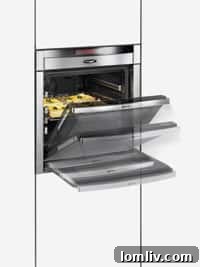
One of the most appreciated features in high-end ovens, particularly from brands like Gaggenau, has long been the side-swing door, which offers unobstructed access to the oven cavity. Taking this concept a step further, Gaggenau’s sister brand, Neff (predominantly available in Europe, especially the UK), has introduced a truly ingenious innovation: the “Slide & Hide” oven door. This design marvel allows the oven door to open conventionally, but with a simple lift of the handle, a sophisticated hinge mechanism disengages, enabling the door to retract smoothly and completely disappear into a specially designed cavity beneath the oven. The operation is remarkably fluid, reminiscent of the soft-close drawers found in modern cabinetry, providing a seamless user experience.
Initially, this might seem like an unconventional feature, perhaps even a trivial one. However, when considering kitchen design from an inclusive perspective, particularly for individuals with mobility challenges, the brilliance of the Slide & Hide system becomes immediately apparent. By tucking the door entirely away, users gain unrestricted access to the oven cavity from both the front and the sides. This greatly benefits those in wheelchairs, who can approach the oven without the barrier of a protruding hot door. It also provides invaluable assistance for tasks requiring both hands, such as carefully maneuvering a large roasting pan or a heavy turkey, eliminating the awkward reach over a hot, open door. This design significantly enhances safety and convenience in the kitchen, making cooking more accessible for a wider range of users.
While the ergonomic advantages are clear, one primary concern arises regarding temperature stability. With the entire door effectively “removed” from the oven opening, the potential for significant heat loss is a valid consideration. The impact on cooking times or energy efficiency compared to a traditional hinged door remains a point of speculation, requiring users to potentially adjust recipes or cooking methods. Despite this potential drawback, the functionality and thoughtful design for accessibility make the Neff Slide & Hide oven a genuinely exciting innovation in the appliance market. Its current unavailability in the US market is indeed a downside for American renovators and homeowners seeking this level of kitchen ingenuity.
What the *#%*? Gaggenau Lift Oven / Siemens Liftmatic: A Futuristic Fumble?
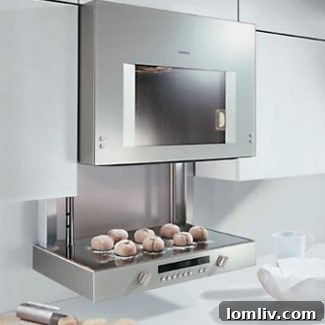
Back in 2007, the luxury appliance world witnessed the debut of the Gaggenau Lift Oven, marketed in Europe as the Siemens Liftmatic. (It’s worth noting that Gaggenau, Siemens, Bosch, Neff, and Thermador are all part of the same expansive appliance consortium, sharing technological synergies.) This innovative oven featured an elevator-like mechanism that lowered the oven floor, bringing food closer to the user. The initial impression was undeniably “Jetsons-esque,” evoking images of futuristic homes. However, my immediate reaction, and that of many others, was a resounding “What the *#%*?” Even when considering potential benefits for individuals with disabilities – a common justification for innovative designs – the practical utility of this oven remained elusive. It felt like an answer to a question nobody had asked, perhaps an oven designed more for admiration than for actual cooking.
From an engineering standpoint, the Lift Oven presented some intriguing theoretical advantages. The principle that “heat rises” was central to its design. When the oven floor lowered, the primary cooking cavity remained sealed at the top, theoretically minimizing heat loss. Siemens proudly presented data suggesting that while a traditional oven door opened for 15 seconds could cause a 400-degree oven’s temperature to plummet by almost half (though quickly recovered by stored heat in the walls), the Lift Oven, when “opened” for the same duration, experienced a mere 75-degree drop. This unique heat retention claim was certainly a marvel of engineering, promising greater efficiency and more stable cooking environments.
Despite its technical sophistication, the Lift Oven struggled to gain traction. In 2009, it received a facelift with sleeker controls, but this aesthetic upgrade was unfortunately accompanied by a substantial price hike. Increasing the cost of an already niche and slow-moving product is rarely a successful strategy. Consequently, the Gaggenau Lift Oven was discontinued a few short years later. While the Siemens version never made it to the US market, discounted examples of the Gaggenau model occasionally surface on platforms like eBay, serving as a reminder of an ambitious but ultimately unsuccessful foray into futuristic kitchen design. It underscores the critical lesson that even groundbreaking technology must align with practical user needs and market demand to achieve lasting success.
What the *#%*? Caple C5100 Lift Oven / Fulgor Hidden Oven: Countertop Conundrums
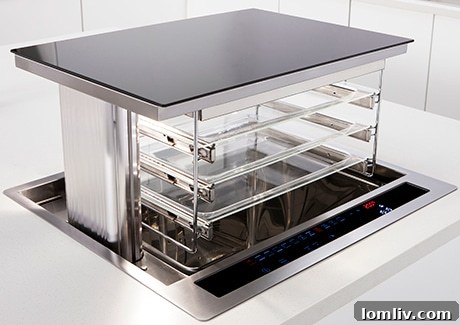
The innovation landscape also saw another duo of sister companies, the Italian brands Caple and Fulgor, venture into the realm of lift ovens. This collaboration was solidified after Fulgor’s acquisition by Italian cooking appliance manufacturer Meneghetti. The cross-pollination of ideas led to the development of these visually striking, futuristic lift ovens, offering a distinctly Italian take on the concept.
Known for their flair for stylish and unconventional designs, the Italian approach differed significantly from their German counterparts. Whereas Gaggenau’s design involved the oven floor lowering to countertop level, Caple and Fulgor envisioned an oven that elegantly elevated from within the kitchen counter. This design certainly encapsulates a “WOW-factor,” making a bold statement in any modern kitchen. Featuring clear glass shelves, it allows for a panoramic view of the cooking process, adding to its futuristic allure.
However, once again, the practicalities of everyday cooking present significant challenges. For a cook, the inability to conveniently view food without actively raising the oven unit is a major ergonomic drawback. Furthermore, the very act of raising the oven and exposing its cavity to the ambient kitchen air inevitably leads to considerable heat loss, potentially affecting cooking precision and energy efficiency. While its design is captivating, its functionality as a primary cooking appliance appears compromised.
Beyond its innovative lift mechanism, the Caple/Fulgor oven boasts a standard array of features, including 12 cooking functions, intuitive touchscreens, and grilling/broiler capabilities. But for serious home chefs, its inherent design limitations make it less appealing as a main oven. Instead, its true potential might lie in a more specialized role. Imagine installing this striking piece in a kitchen island, transforming it into the ultimate conversation-starting warming drawer for party appetizers. At approximately $2,200 (plus international shipping from Europe), it becomes a relatively accessible statement piece, perfect for those prioritizing aesthetic impact and unique entertaining solutions over conventional oven utility.
What the *#%*? Siemens iQ500 with a Vertical Drawer Door: A Recipe for Burns?
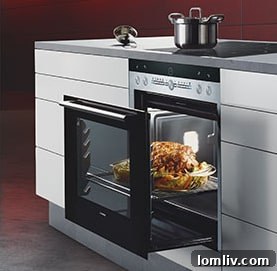
Moving on to another perplexing design from the European market, the Siemens iQ500 oven appears, at first glance, to be a rather conventional appliance. It’s a compact, Euro-standard 24-inch wide oven, equipped with a touchscreen display, self-cleaning functions, and all the typical features one would expect from a mid-range oven priced around $2,000 (€1,754.00). What immediately distinguishes – and mystifies – it is its unique, drawer-like door mechanism. Unlike traditional pull-down or side-swing doors, this door opens by sliding horizontally, yet it remains rigidly vertical in front of the oven cavity when open.
The rationale behind this particular door configuration is exceptionally difficult to discern. From a practical and safety standpoint, having a hot, rigid barrier directly in front of the oven opening seems like an ergonomic nightmare and a potential recipe for burning the cook. It obstructs direct access, forces awkward reaching, and contradicts basic principles of kitchen safety and user convenience. There appears to be no discernible advantage over standard door designs, which typically retract or swing clear to offer full, unencumbered access to the oven’s interior. As far as current information indicates, this specific Siemens iQ500 model is exclusively available in Europe. Given its questionable design and potential safety hazards, it’s not a stretch to predict that this innovation might soon join other ill-conceived appliance experiments, much like the Liftmatic, on the scrap heap of design history. Sometimes, simplicity and well-established ergonomics truly are superior to novelty for novelty’s sake.
Eureka-Maybe? French Door Wall Ovens: A Professional Look for the Home Kitchen
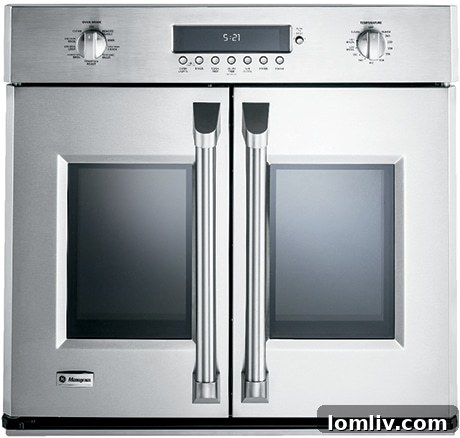
French door wall ovens have emerged as a prominent trend in contemporary kitchen design, borrowing their aesthetic from professional kitchens and, more commonly, from residential refrigerators. Just as side-swing door ovens aim to provide unencumbered access to the oven cavity, these split-door models promise a similar benefit. Marketing efforts often highlight their appeal as a space-saving solution, particularly for kitchens with tighter layouts. However, a closer examination reveals that this claim might not be entirely accurate.
While a side-swing oven door grants access from both the front and side, French door ovens restrict the cook to accessing the oven cavity straight-on. This straight-on approach means that the actual space required for comfortable operation is considerably more than marketing materials might suggest. You need clearance for the full extension of the open doors (typically around 15 inches on each side), plus the depth required for fully extended telescoping racks, and finally, the standing room for the cook directly in front of the oven. This combined measurement can easily extend to approximately 50 inches from the oven cabinet, which is hardly a “tight space” solution. In contrast, a side-swing door requires about 30 inches of clearance if the cook stands to the side of the opening, and even a traditional bottom-hinged oven door, when open, allows for side access, requiring a minimum of roughly 30 inches of space in front of it. Therefore, while visually appealing, French door ovens may not deliver on their promise of improved space efficiency in practice.
This trend appears to be another instance where manufacturers introduce new products to the market primarily to offer something “new” and to tap into the pervasive “professional chef” movement. This movement posits that home cooks can achieve superior results by using tools and appliances traditionally found in commercial kitchens. While it’s true that in past decades, home chefs were often limited by inferior domestic equipment (a challenge that pioneers like Julia Child helped to rectify), today’s high-end home appliances are remarkably sophisticated. French door ovens have indeed been a staple in professional kitchens for decades, utilized by commercial equipment manufacturers like Blodgett. However, at its core, an oven is designed to be a stable, temperature-controlled box. The configuration of its door, whether split or singular, has a relatively minor impact on this fundamental concept of heat retention and cooking performance. Thus, while offering a visually appealing and aspirational upgrade, the practical advantages of French door ovens for the average home cook remain debatable.
Eureka-Future! Electrolux Sous Vide Cooking System: Precision for the Home Chef
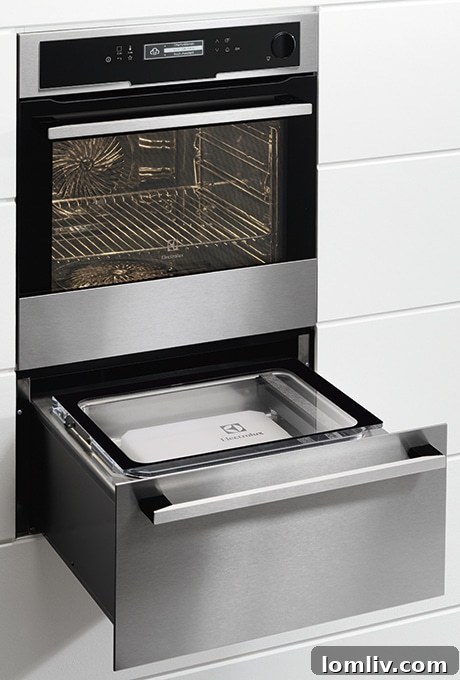
Sous Vide, a French term meaning “under vacuum,” represents one of the most significant advancements in culinary technique to transition from professional kitchens to the home. This method involves cooking foods in airtight plastic bags, submerged in a precisely temperature-controlled water bath or steam oven, typically at serving temperature (e.g., 130-140 degrees Fahrenheit). The genius of sous vide lies in its precision: because food is cooked at the exact temperature at which it will be served, it becomes virtually impossible to overcook. Furthermore, the vacuum-sealed environment ensures that foods retain all their natural moisture and flavors, resulting in consistently succulent and perfectly cooked dishes.
Although “invented” as early as 1799 by British physicist Benjamin Thompson, the technique was largely forgotten or ignored until its rediscovery by American and French chefs in the mid-1960s. For several years now, forward-thinking companies like Electrolux and others have been striving to integrate this sophisticated technology into the domestic kitchen, moving it beyond its extensive use in professional culinary environments. The reasons for this push are compelling: sous vide empowers even novice cooks to consistently achieve restaurant-quality results. Moreover, it opens up exciting possibilities for food manufacturers to produce pre-cooked, sealed, supermarket-ready meals that offer gourmet quality and convenience.
The Electrolux model, currently available in Europe, exemplifies this integration by combining a state-of-the-art steam oven with a built-in vacuum sealer. This comprehensive system allows accomplished home cooks not only to prepare meals with unparalleled precision but also to package their culinary creations for later enjoyment or batch cooking. Many other premium appliance manufacturers, including Gaggenau, Wolf, Miele, and Thermador, offer advanced steam ovens in the US market, which can be adapted for some sous vide applications. However, dedicated integrated sous vide systems are still relatively niche. The widespread adoption of sous vide in American homes, much like induction cooking, may take a decade or more to become truly mainstream. For some reason, the US market often exhibits a slower uptake of these cutting-edge culinary technologies, despite their proven benefits.
The “What the *#%@?” of “What the *#%@?”: CDA Designer Built-in Ovens
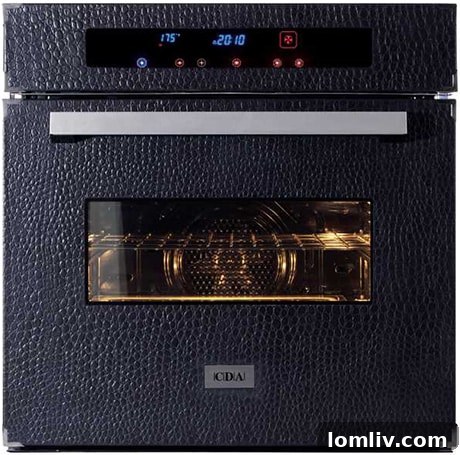
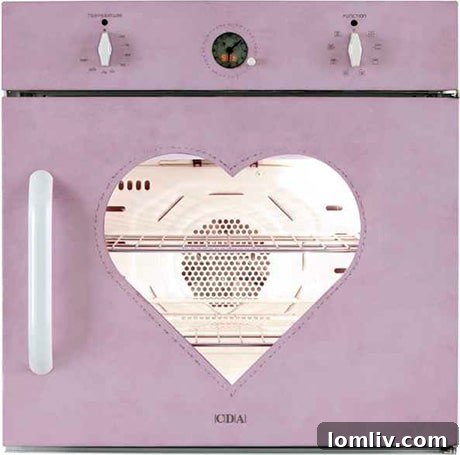
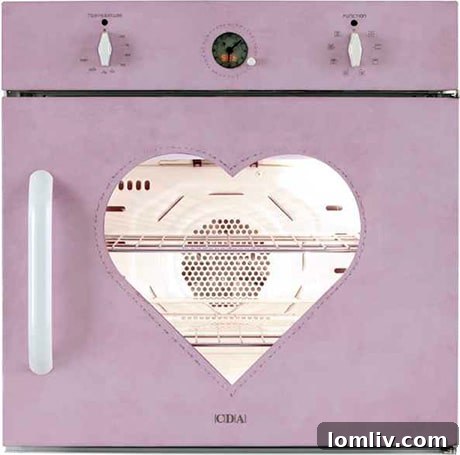
Finally, we arrive at an innovation that truly embodies the extreme end of unconventional design: the CDA Designer Built-in Ovens. From the UK-based manufacturer CDA, these ovens are part of a custom range that challenges all preconceived notions of what a kitchen appliance should look like. Forget stainless steel or enamel; imagine an oven clad in exotic materials like alligator skin, luxurious leather, or even dramatic snakeskin. This level of customization transforms a functional kitchen tool into an extravagant piece of bespoke furniture, designed to be a showstopper rather than merely a cooking device.
While undoubtedly unique and a testament to bold design, these ovens raise immediate and profound questions about practicality, durability, and safety in a high-temperature, grease-prone kitchen environment. How would such materials withstand the rigors of daily cooking, spills, and intense heat? What are the cleaning protocols for a leather-wrapped oven? And what are the implications for fire safety when flammable materials are integrated into an appliance designed to reach high temperatures? These designs represent the pinnacle of luxury customization, targeting a very niche clientele who prioritize unparalleled aesthetics and personalized statements above all else. They exist purely as objets d’art, pushing the boundaries of what is considered “appropriate” for kitchen appliances, moving far beyond the realm of functional utility into pure, unadulterated novelty. They serve as a vivid reminder that while innovation can solve problems, it can also, at times, create entirely new ones, especially when aesthetics overshadow fundamental design principles.
The Future of Kitchen Innovation: Balancing Vision with Practicality
The journey through these oven innovations highlights a fascinating tension in modern kitchen design: the constant interplay between visionary ideas and practical applications. From the accessible elegance of Neff’s Slide & Hide to the perplexing complexities of the Lift Ovens and the bold, yet questionable, aesthetics of CDA’s designer models, the appliance market is a vibrant crucible of experimentation. Some innovations, like the precision of sous vide, promise to genuinely revolutionize how we cook, offering tangible benefits for flavor, texture, and convenience. Others, however, serve as cautionary tales, demonstrating that even the most advanced engineering or striking design can falter if it neglects fundamental user needs, ergonomics, or cost-effectiveness.
As homeowners and renovators, it’s crucial to approach these new trends with a discerning eye. The allure of the “latest and greatest” can be powerful, but true innovation seamlessly integrates form, function, and enduring value. The kitchen remains the heart of the home, and its appliances should enhance, rather than complicate, the culinary experience. Moving forward, the most successful kitchen innovations will likely be those that strike a harmonious balance: leveraging advanced technology to solve real-world problems, improving accessibility, enhancing sustainability, and ultimately, making our lives in the kitchen more enjoyable, efficient, and inspiring.