

The landscape for short-term rental (STR) operators in Dallas is undergoing a significant transformation, marked by a residential ban announced in June and slated for enforcement by the end of the year. This pivotal decision has cast a shadow of uncertainty over countless property owners and managers, igniting widespread confusion and setting the stage for an anticipated legal battle. As the December deadline approaches, the city’s proactive measures and operators’ mounting concerns paint a complex picture for the future of vacation rentals in the Lone Star State’s bustling metropolis.
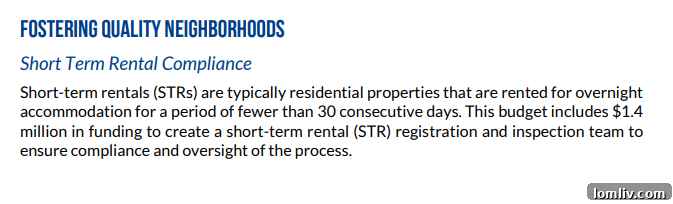
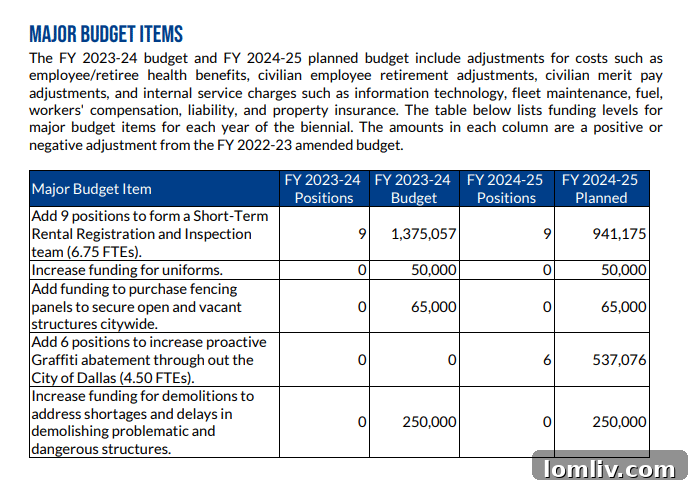
In a move to reinforce the new regulations, Dallas City Manager T.C. Broadnax unveiled his recommended budget on August 4th, proposing substantial investments in code enforcement. This budget includes the allocation of nine new code enforcement positions and a significant $1.4 million specifically earmarked for a novel short-term rental registration and inspection program. Concurrently, the controller’s office confirmed its commitment to diligently monitor the collection of hotel occupancy taxes (HOT), a revenue stream often associated with STR operations. These budgetary adjustments underscore the city’s intent to implement and sustain rigorous oversight of the STR market.
Responding to the growing need for clarity, the City of Dallas launched a dedicated resource page in early July. This online hub aims to serve as a central information point, offering answers to frequently asked questions, direct links to relevant city council briefings, and comprehensive details on applicable code ordinances. The city has also actively reached out to STR owners, providing guidance on how to ascertain their property’s zoning district. This crucial step effectively determines whether their current short-term rental operations align with the new regulations or if they are, in fact, operating outside the bounds of legality.
Despite these efforts, a palpable sense of uncertainty persists among STR operators. A primary concern revolves around the continued payment of Hotel Occupancy Taxes, especially for properties already deemed illegal under the new framework. Operators are grappling with whether they should cease these payments or risk potential legal repercussions. Furthermore, anxiety is high regarding retroactive fines; many are unsure if they will face penalties for operating their rentals during the transitional period while the city is still rolling out tracking software and staffing its enforcement teams. The current FAQ page, unfortunately, falls short in addressing these critical, time-sensitive questions, leaving operators in a precarious position as the enforcement deadline looms.
The city’s move signifies a broader trend among major municipalities grappling with the rapid expansion of the short-term rental industry. While proponents of STRs highlight economic benefits and property rights, critics often point to concerns over neighborhood character, housing affordability, and increased nuisance issues. Dallas’s ordinance attempts to strike a balance, albeit one that has generated considerable debate and dissent among various stakeholders.
Unpacking the Complicated Guidelines for Dallas Short-Term Rentals
The “Keep It Simple Solution,” which was officially adopted in June, has been widely interpreted as an outright ban on short-term rentals in residential areas. However, a closer examination reveals that the reality is far more nuanced, with the legality of an STR hinging critically on how the specific property is zoned within the Dallas city limits. This distinction is paramount and often misunderstood by both operators and the public.
As clarified on the city’s official FAQ page, “The zoning regulations are based on the zoning district a property is located in, not the type of structure.” This means that whether a property is a single-family home, a duplex, or a multi-unit dwelling is less significant than the underlying zoning classification of the land it occupies. Consequently, each property’s eligibility will be determined with precision, based on its unique zoning district, rather than relying on the types of properties or general residential character of the surrounding street. This granular approach requires operators to undertake thorough research into their property’s specific zoning designation to ensure compliance.
Adding another layer of complexity, homes situated in traditionally residential neighborhoods may still be rented out on a short-term basis if the guests intend to stay for periods exceeding 30 days. This provision offers a carve-out for longer-term stays, blurring the lines between traditional rentals and extended STRs. Moreover, multifamily short-term rentals are generally allowed by right in specific zones, acknowledging the different urban planning considerations for denser living environments. However, even these operations are not entirely without restriction; some multifamily STRs will be compelled to cease operations due to newly implemented density requirements, which aim to prevent an overconcentration of transient accommodations in certain areas, thereby preserving residential quality of life and infrastructure capacity.
The intricacies of these regulations demand a deep understanding from property owners. The city’s intention is to channel STR activity into more appropriate commercial or mixed-use zones, reducing their impact on areas primarily designated for permanent residency. This strategic redirection is at the heart of the “Keep It Simple Solution,” aiming to minimize disruption while still allowing for a regulated STR market in Dallas.
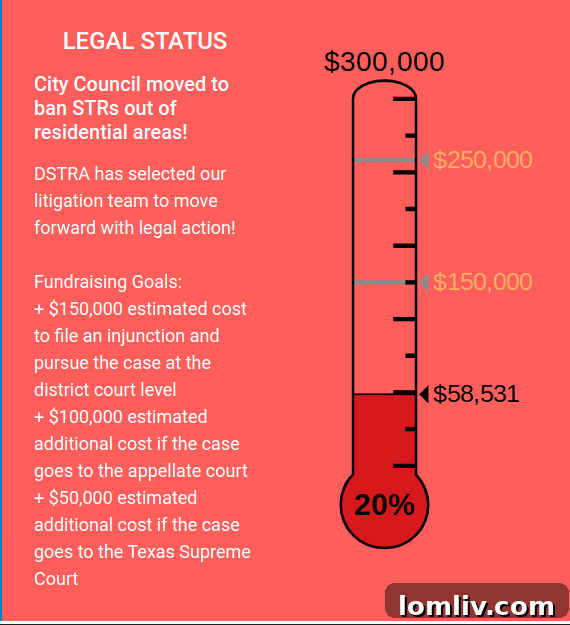
In the wake of these stringent new rules, the Dallas Short-Term Rental Alliance (DSTRA) has emerged as a vocal advocate for operators. Lisa Sievers, a prominent spokesperson for the Dallas Short-Term Rental Alliance and an experienced STR operator in District 2 since 2019, shared her perspective with daltxrealestate.com, indicating that a significant response from the alliance is imminent. “We will have more information coming for you soon and I will make sure that you get it as quickly as possible,” Sievers stated, hinting at strategic actions being formulated by the group. This suggests that the DSTRA is gearing up for a robust defense of its members’ interests, likely through legal channels, setting the stage for a potentially protracted dispute with the city.
The legal landscape surrounding STRs nationwide is fraught with complexities, and Dallas is certainly no exception. A recent federal court ruling in Austin, which found the city unlawfully prohibiting off-site operators from leasing STRs, sent ripples through the Dallas STR community. Austin news station KXAN reported on this development, a story quickly amplified by Dallas STR supporters who view it as a precedent that could bolster their local legal arguments. This ruling served as a potent reminder that legal action is not only possible but expected in Dallas, a reality some council members acknowledged during the June ordinance vote, bracing for a potentially lengthy and expensive legal battle for the city.
However, District 12 Councilwoman Cara Mendelsohn was quick to provide a counter-narrative, asserting that Austin’s ordinance differs fundamentally from the one adopted by the Dallas City Council this summer. In a public statement, Mendelsohn posted, “This doesn’t apply to the Dallas situation. Ours is modeled after the City of Arlington, which has already survived judicial review.” Her assertion aims to reassure residents and reinforce the city’s legal position, suggesting that Dallas has adopted a more resilient and legally sound framework. This distinction is crucial for understanding the city’s confidence in its stance and its preparation for potential lawsuits.
Councilwoman Mendelsohn further emphasized the broad public support for the new regulations, stating that few issues have united voters in Dallas as strongly as the debate over STRs. “People want real neighborhoods not empty homes, schools with neighborhood kids, vibrant local businesses, not all the code compliance [problems],” she wrote. This sentiment reflects a significant portion of the electorate that has expressed concerns about the impact of STRs on neighborhood stability, housing availability, and quality of life. The council’s decision, therefore, is not merely a bureaucratic one but also a response to considerable public pressure and community advocacy aimed at preserving the traditional character of residential districts.
Navigating City Communication and the Path Forward for STR Operators
In an effort to communicate the new regulations, Dallas Chief Financial Officer Jack Ireland dispatched a formal letter to registered STR operators on August 4th. However, much like previous communications from the city, this letter was perceived by many operators as lacking specific, actionable guidance. While it provided essential links to city codes and official websites, it largely refrained from addressing the immediate and pressing concerns articulated by those directly impacted, such as retroactive fines or the intricacies of HOT tax payments for newly deemed illegal properties. This perceived lack of direct, practical information has left many Dallas STR operators feeling unheard and poorly informed, exacerbating the already pervasive confusion.
The general consensus among Dallas STR operators, as conveyed to daltxrealestate.com, is that the city’s communication has been largely unhelpful and insufficient in clarifying the complex regulatory changes. This sentiment highlights a critical gap between the city’s administrative actions and the operators’ need for clear, concise, and empathetic guidance during a period of significant uncertainty and potential financial strain. Without more explicit direction, many operators are left to interpret dense legal documents and navigate the new landscape with limited support, increasing the risk of non-compliance due to misunderstanding rather than willful defiance.
Dear Property Owner/Manager,
On June 14, 2023, City Council defined short-term rentals (STRs) as land use and voted to restrict STRs to a list of allowable zoning districts, with enforcement commencing December 2023. Please review the new city ordinances and other resource information below to determine how these changes may impact your STR.
For a copy of ordinance number 32473 related to Regulations, please click on the following link: http://citysecretary2.dallascityhall.com/resolutions/2023/06-14-23/23-0833.pdf
For a copy of ordinance number 32482 related to Zoning, please click on the following link: http://citysecretary2.dallascityhall.com/resolutions/2023/06-14-23/23-0844.pdf
To determine the zoning district your property lies within, please visit the zoning map by clicking on the following link: https://developmentweb.dallascityhall.com/publiczoningweb/.
You will need to turn on base zoning layers and type in your property address for the zoning district of the property. For a zoning map tutorial, please visit: https://youtu.be/cQ5nHwj0dRU
For answers to questions regarding property uses, zoning interpretations and regulations, development regulations, build sites, permit processes, or inspections, please contact Development Services’ Zoning Consultation Team within Building Inspection at 214-948-4480 or in-person at 320 E Jefferson Blvd, Room 118, Dallas, Texas 75203.”
Jack Ireland, Dallas Chief Financial Officer
The city’s budget hearings are slated to continue through mid-September, providing an ongoing forum for discussion and clarification. During a recent Wednesday briefing, council members actively pressed for more granular details regarding the budgeting breakdown for STR enforcement and a comprehensive explanation of how the new enforcement mechanisms will practically function. In response, CFO Ireland assured council members that they could anticipate receiving answers to their specific questions via memo in the coming days. This indicates a continuing process of refinement and information dissemination, though its effectiveness in assuaging operator concerns remains to be seen. The coming months will be critical in shaping the future of short-term rentals in Dallas, with operators, city officials, and legal teams all keenly observing developments.