

Dallas-Fort Worth (DFW) continues to solidify its position as a dynamic economic powerhouse, attracting both businesses and individuals seeking opportunity. This vibrant North Texas region frequently makes headlines for its robust job market, particularly in high-growth sectors, and its evolving real estate landscape. From topping national lists for lucrative STEM careers to navigating shifts in the new home sales market, DFW offers a compelling case study in urban development and economic resilience. Understanding these interwoven trends is crucial for anyone looking to invest, relocate, or simply keep a pulse on one of America’s fastest-growing metropolitan areas. This week, we delve into the latest reports that underscore DFW’s prominence in the STEM job market, analyze the pulse of its new home sales, and examine broader national trends in home equity and underwater mortgages.
The synergy between a thriving job market and a responsive housing sector often defines the health of a major metropolitan area. For DFW, this relationship is particularly salient. As more companies flock to the region and a highly skilled workforce follows, the demand for quality housing grows, shaping market dynamics. We will explore how these elements play out, offering insights into what makes Dallas-Fort Worth a beacon for innovation and a complex, yet promising, real estate frontier.
Dallas-Fort Worth Tops National List for STEM Job Opportunities
The Dallas-Fort Worth metroplex has officially claimed the coveted top spot nationally as the best city for Science, Technology, Engineering, and Math (STEM) jobs, according to a recent announcement from the AEI Housing Center. This prestigious ranking highlights DFW’s strategic importance as a burgeoning hub for innovation and skilled talent, reinforcing its reputation as a magnet for professionals in critical industries.
The comprehensive analysis conducted by the AEI Housing Center evaluated various factors to determine the leading metropolitan areas for STEM careers. DFW’s overall top ranking is a testament to its multifaceted appeal. While securing the first position nationally for overall attractiveness to STEM professionals, the region also demonstrated significant strength in specific metrics. It was ranked seventh in the nation for total STEM employment, boasting an impressive 249,610 jobs. This substantial number underscores the sheer volume of opportunities available across a diverse range of technological and scientific fields within the metro area.
Furthermore, Dallas-Fort Worth distinguished itself with remarkable growth in STEM employment, ranking fourth nationally in job growth within these fields since 1990. This long-term trend signifies a sustained commitment to fostering an environment where STEM industries can flourish, driven by continuous investment and expansion across sectors like aerospace, information technology, telecommunications, and healthcare innovation.
Beyond job market performance, DFW also scored highly on a crucial quality of life metric: home affordability. Ranking ninth in the nation for home affordability, the region offers a compelling proposition for STEM professionals who are often concerned with the cost of living in major tech hubs. This balance of high-paying jobs and relatively accessible housing costs makes DFW an increasingly attractive destination for individuals and families seeking a high quality of life without the prohibitive expenses found in other major tech-centric cities.
Texas as a whole demonstrated its strength in the STEM sector, with Houston securing the second spot nationally and Austin following closely at fourth. This trio of Texas cities in the top five underscores the state’s economic vitality and its concerted efforts to cultivate ecosystems that support technological advancement and scientific discovery. The presence of major universities, a skilled workforce, and business-friendly policies have undoubtedly contributed to this success.
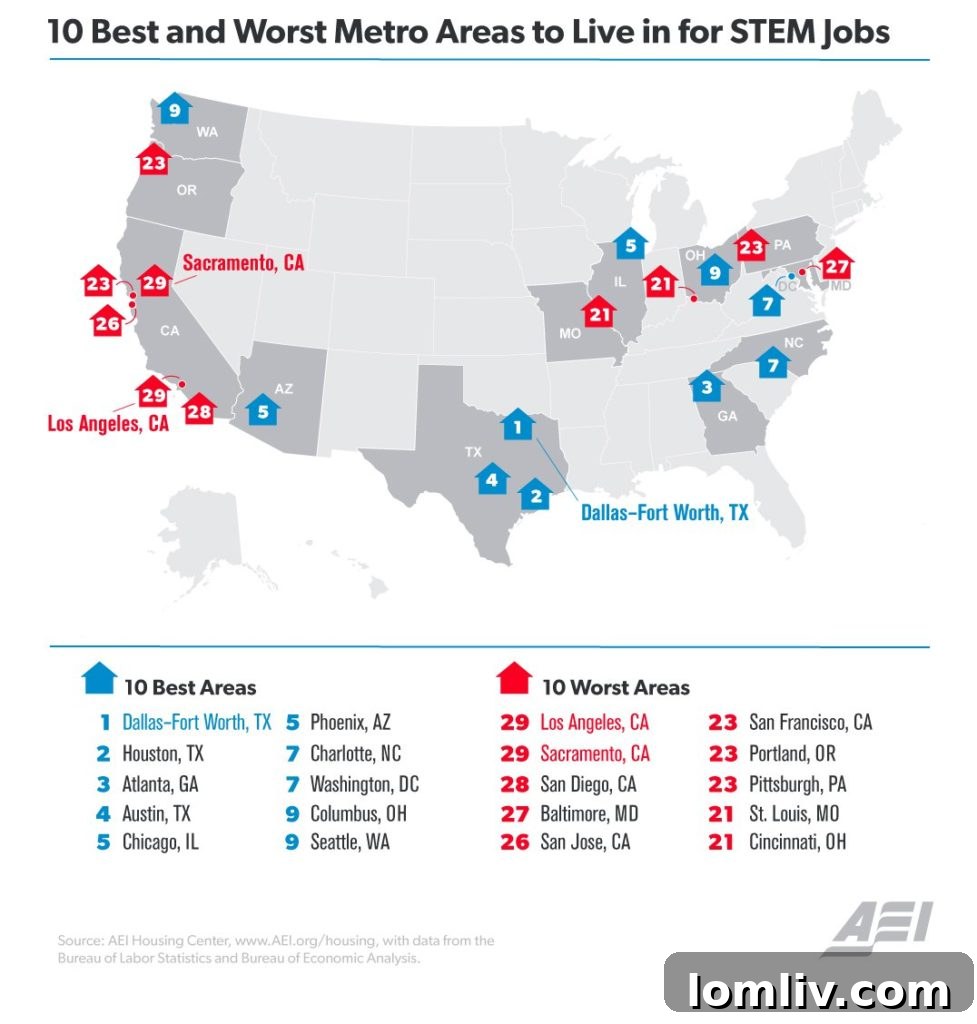
Source: AEI Housing Center
DFW’s New Home Market: Navigating Upticks and Lingering Concerns
The Dallas-Fort Worth new home market presented a mixed bag of results in April, showcasing both encouraging gains and areas of concern, according to the latest data released by HomesUSA.com. While overall new home sales, prices, and the pace of sales experienced a notable bump, a closer look reveals underlying complexities, particularly with pending sales figures.
April brought positive movement in several key indicators for DFW’s new home sector. The market saw an uptick in new home sales volume, average sale prices, and the speed at which homes were sold. These improvements suggest a resilient market capable of attracting buyers, despite various economic pressures. The average number of days a new home spent on the market in DFW improved slightly, dropping to 115.45 days in April from 115.70 days in March. While a marginal improvement, it signals a slightly faster absorption rate for available inventory.
Breaking down the sales figures, DFW recorded 1,352 new home sales in April, a modest increase from 1,347 sales in March. This slight rise, though small, indicates sustained buyer interest and a steady flow of transactions. Concurrently, the average price of a new home in DFW also saw an increase, reaching $374,847 in April compared to $373,262 in March. This upward trend in pricing reflects strong demand and potentially rising construction costs, contributing to the overall appreciation of new homes in the region.
However, the future outlook for the DFW new home market remains somewhat cautious, largely due to a concerning trend in pending new home sales. Locally and statewide, pending sales experienced a downturn, marking the fifth consecutive month of decline for DFW. In April, pending sales stood at 1,180, a decrease from 1,273 in March. Pending sales are a critical forward-looking indicator, representing homes that have gone under contract but have not yet closed. A consistent decline in this metric can signal a cooling of buyer interest or a slowdown in future transactions, suggesting that the recent uptick in closed sales might not be sustained.
Ben Caballero, the Addison-based owner of HomesUSA.com and a leading authority on the new home market, encapsulated this sentiment: “Dallas-Ft. Worth’s new home market last month has several bright spots, but the future looks a bit cloudy. Despite a strong month for new homes overall, pending home sales numbers remain a troubling number.” His assessment highlights the dichotomy of the current market: while active sales are performing well, the pipeline of future sales raises questions about the market’s trajectory in the coming months.
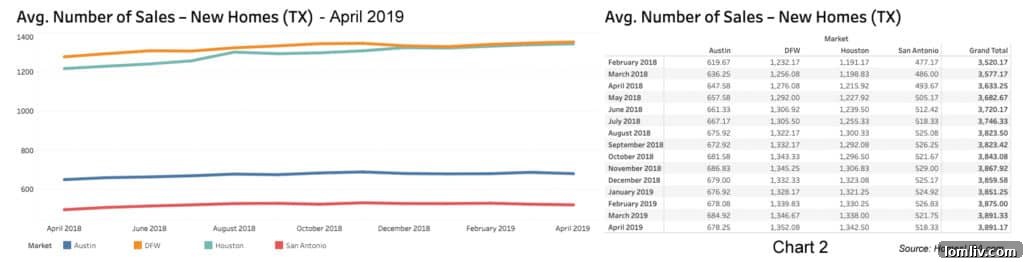
The dynamics of the DFW new home market are influenced by a confluence of factors, including population growth, interest rates, inventory levels, and consumer confidence. The region’s robust STEM job growth certainly fuels demand, yet affordability concerns and rising construction costs could temper future expansion. The mixed signals from April’s data underscore the need for continuous monitoring and adaptive strategies for both homebuyers and builders in this vibrant yet complex market.
Source: HomesUSA.com
National Housing Health: An Increase in Underwater Properties
Understanding the health of the national housing market involves looking beyond sales and prices to metrics like home equity and the prevalence of “underwater” properties. A recent report from ATTOM Data Solutions shed light on these critical indicators, revealing a slight but notable increase in the number of seriously underwater properties across the United States at the end of the first quarter of 2019.
According to ATTOM Data Solutions’ Q1 2019 U.S. Home Equity & Underwater Report, more than 5.2 million U.S. properties were considered “seriously underwater.” This figure represents a slight increase of 17,000 properties compared to a year ago, illustrating a subtle shift in the market. To put this in perspective, these underwater properties account for 9.1 percent of all U.S. properties with a mortgage. While this percentage is significantly lower than the peaks observed during the 2008 financial crisis, any increase in underwater properties warrants attention as it can have implications for individual homeowners and the broader economy.
A property is defined as “seriously underwater” when the combined outstanding balance of all loans secured by the property is at least 25 percent higher than the property’s estimated market value. For instance, if a home is valued at $200,000, it would be considered seriously underwater if the owner owes $250,000 or more on their mortgage. This situation can severely limit a homeowner’s financial flexibility, making it difficult to sell their home without incurring a loss, refinance their mortgage, or tap into their home’s equity for other financial needs.
The rise in underwater properties can be attributed to various factors, including localized declines in home values, interest rate fluctuations impacting refinancing options, or economic headwinds in certain regions. While the overall national market remains strong in many areas, these statistics remind us that housing market health can vary significantly from one zip code to another.
Conversely, home equity is a vital component of homeowner wealth. It represents the portion of a property’s value that the owner truly owns, calculated as the market value minus any outstanding mortgage debt. A robust economy and appreciating home values typically lead to increased home equity, providing homeowners with financial security and options. The ATTOM report also provides valuable insights into “equity rich” properties, where the combined loan amount is 50% or less of the estimated market value.
For those interested in how these national trends translate to specific local markets, ATTOM provided detailed maps illustrating both underwater mortgages and home equity by ZIP code. These visualizations would allow users to pinpoint areas where homeowners might be struggling with negative equity versus those enjoying substantial equity gains. While we cannot embed these interactive maps here, their availability underscores the importance of granular data in understanding the nuanced landscape of the U.S. housing market. Regions with strong job growth and stable economies, such as Dallas-Fort Worth, often exhibit better home equity positions compared to areas facing economic downturns or population decline.
Source: ATTOM Data Solutions