Dallas City Council Sets Property Tax Ceiling Amidst Heated Budget Debate and Calls for Relief
Dallas, TX – In a pivotal vote that underscores deep divisions over fiscal policy, the Dallas City Council has established its maximum property tax rate, or “ceiling,” at 73.93 cents per $100 assessed valuation. This decision, approved despite fervent appeals from Mayor Eric Johnson and District 12 Councilwoman Cara Mendelsohn, aligns with the proposal put forth by City Manager T.C. Broadnax. The council’s vote on Wednesday sets the highest possible rate for the upcoming fiscal year, though members still retain the option to adopt a lower property tax rate during the final budget vote scheduled for September 20.
The Epicenter of Disagreement: Broadnax’s Budget vs. Mendelsohn’s “No New Revenue” Plan
At the heart of the council’s spirited debate is City Manager T.C. Broadnax’s ambitious $4.63 billion proposed budget. Councilwoman Cara Mendelsohn has been a vocal critic, labeling the budget as “unacceptable” and advocating for a property tax rate that offers significantly more relief to Dallas residents. Mendelsohn articulated her concerns in a comprehensive memo to Mayor Johnson last week and further elaborated on her position in an influential opinion column published in The Dallas Morning News.
To counter Broadnax’s proposal, Mendelsohn introduced her meticulously crafted “no new revenue” plan. This initiative is designed to roll back departmental spending by implementing strategic cuts. Key components of her plan include reducing full-time equivalent positions that have remained unfilled, instituting city-wide budget reductions across various departments, and identifying other operational efficiencies. If adopted, Mendelsohn’s plan would slash Broadnax’s proposed budget by a substantial margin, exceeding $100 million. This proposal resonated strongly with Mayor Eric Johnson, who has consistently expressed his aspiration for Dallas to boast the lowest property tax rate among all major cities in North Texas, signaling his immediate and unequivocal support for Mendelsohn’s fiscally conservative approach.
Understanding the Proposed Tax Rate Ceilings and Their Impact on Homeowners
Mayor Johnson and Councilwoman Mendelsohn earnestly implored the council to set the tax ceiling at a significantly lower rate of 68.38 cents per $100 assessed valuation. Such a reduction, they argued, would translate into tangible relief for Dallas homeowners, specifically an approximate $83.62 decrease in the property tax bill for the owner of a home valued at the city’s median. This proposed rate represented a commitment to minimizing the tax burden on residents, especially in an environment of rising property values.
Chief Financial Officer Jack Ireland’s projections for tax implications were based on the assumption that homeowners possessed a homestead exemption, a crucial factor in mitigating tax increases. The median home value in Dallas saw a notable increase, rising from $320,900 in Fiscal Year 2023 to $334,710 for Fiscal Year 2024. These escalating values, coupled with the tax rate, directly influence the final tax bill for residents.
During Wednesday’s council meeting, Mendelsohn underscored the broader implications of the tax ceiling vote. “Today’s vote is not about individual line items in the budget,” she asserted. “It’s not about specific departments. It’s not about anyone’s district or citywide projects. It’s a decision that’s a policy statement on city spending and taxation.” Her statement highlighted the philosophical divide within the council regarding the city’s overall fiscal direction and its commitment to taxpayer relief versus maintaining current service levels.
Council’s Divided Decision and Alternative Proposals
Ultimately, by a vote of 10-4, the majority of the Dallas City Council opted to support District 7 Councilman Adam Bazaldua’s proposal to set the tax ceiling at 73.93 cents per $100 assessed valuation. It is critical to remember that this figure represents the maximum possible rate, not the final rate to be adopted in September. If this rate were to be approved as the actual tax rate in September, it would result in an estimated $64.99 increase in the tax bill for a homeowner with a property in the median value range, prompting concerns among those advocating for greater relief.
We can always go down, and it sounds like there’s an appetite to go down. What I don’t want to do is set an arbitrary ceiling number that gives the discretion to city staff to then re-present a budget with cuts that we did not have our fingers on. That’s what this elected body is here to do. In fact, I think it’s the biggest task that we have as the elected body of the Dallas City Council.
District 7 Council Member Adam Bazaldua
Councilman Bazaldua’s rationale centered on maintaining the council’s oversight and ability to make specific budget adjustments. He suggested that council members should propose amendments for strategic and targeted cuts to achieve desired property tax reductions, rather than preemptively lowering the ceiling and leaving the details to city staff. “I will personally commit to doing what it takes through this budget process so we can find something that not only provides relief but also is done diligently with all of our districts in mind and those services that will need to be impacted in consideration before we make those decisions,” Bazaldua affirmed, signaling his intention to engage deeply in the upcoming budget amendment process.
Further showcasing the council’s varied approaches, an amendment proposed by District 13 Councilwoman Gay Donnell Wills aimed to drop the ceiling slightly to 73.58 cents per $100 assessed valuation. While a modest reduction, this would still result in an average tax bill increase of approximately $55.62. Wills emphasized the opportunity to “reset the starting gate from which our fiscal grit can kick in.” She argued that this approach would allow the city manager to return with a revised budget, providing a new baseline from which the council could then propose amendments and represent their district priorities. “This city is unified around what our top priorities are,” Wills stated, emphasizing a collective vision despite differing approaches to achieving it.
Mayor Johnson’s Urgent Warning: Dallas at a Crossroads
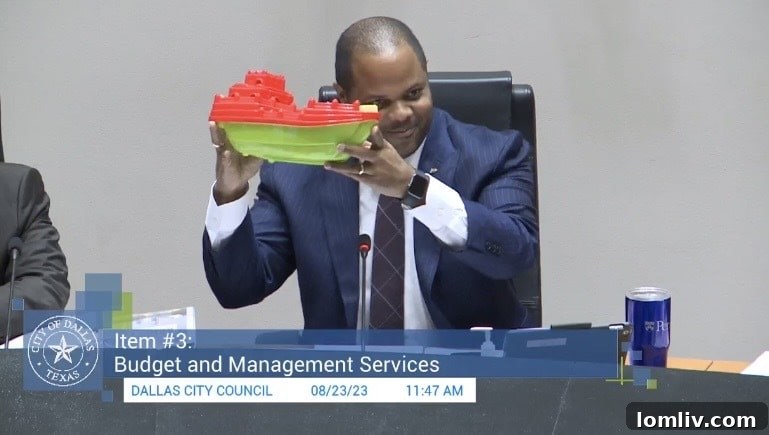
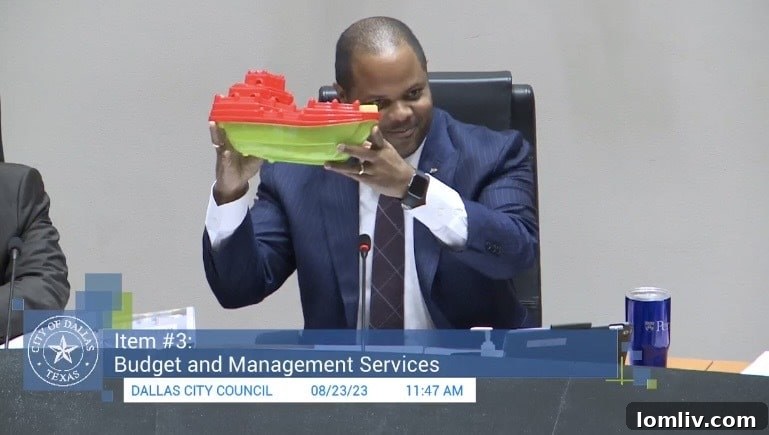
The gravity of the property tax situation was powerfully articulated by Mayor Eric Johnson, who employed a vivid and poignant metaphor to underscore his concerns. Holding up his child’s toy ship, Mayor Johnson dramatically compared the City of Dallas’s current trajectory regarding property taxes to the ill-fated Titanic headed directly for an iceberg. He recounted a conversation with his son about the Titanic, where his son questioned why the ship’s captain simply didn’t turn the vessel around.

“I think the problem was that they didn’t see it in time,” Johnson reflected. “By the time they saw the iceberg, it was too late to turn the ship around… It’s a metaphor for the situation we face right now.” He then directly linked the toy ship to Dallas’s present predicament. “This is us,” he declared, holding up the small vessel.
The mayor painted a stark picture of the potential consequences of inaction. “This property tax situation that we’re in, it’s an iceberg,” Johnson warned. “We can’t continue to tax people the way we’ve been taxing them and think they’re going to stay and continue to choose Dallas. That’s an iceberg. This is us, and we’re floating along. To me, of these options, only one of them represents turning this ship around and going the other direction.” This powerful analogy highlighted his belief that continuing with current tax policies would inevitably lead to an exodus of residents and businesses seeking more affordable alternatives.
Mayor Johnson starkly differentiated his preferred course of action from the proposals put forth by Councilmen Bazaldua and Wills, which he metaphorically dismissed as merely “moving deck chairs around on the ship.” For Johnson, such actions, while potentially well-intentioned, failed to address the fundamental and systemic issue of an unsustainable tax burden. He passionately urged his colleagues to adopt a more decisive stance. “I’m going to support turning the ship around for the residents of Dallas and the taxpayers in the city,” he affirmed. “I would recommend that we actually vote against my good friend Chairman Bazaldua’s motion… The least we can do is adopt the ‘no new revenue’ rate. Please, today, tell the city manager and tell his staff… to figure out a way to make all our equity goals doable with this pile of money.” His plea emphasized that fiscal prudence and equity goals should not be mutually exclusive.
The Broader Implications: Affordability, Competitiveness, and Resident Relief
City Manager Broadnax’s proposed tax rate of 73.93 cents per $100 assessed valuation represents a marginal decrease from last year’s rate of 74.58 cents. However, this slight reduction was widely viewed by dissenting council members as insufficient to provide meaningful relief to Dallas residents and businesses, especially given the continuous appreciation of property values. The cumulative effect of rising valuations and persistent tax rates places a substantial financial strain on property owners.
Councilwoman Mendelsohn’s memo further elaborated on the economic challenges faced by Dallas. “Dallas has an endless list of needs and opportunities to provide services,” she acknowledged, “but the residents and businesses are limited on how much they can pay as a reasonable portion of their income and will pay, given the proximity to other cities in which to live and conduct business with substantially lower tax rates.” This statement underscores a critical concern for Dallas’s long-term economic vitality: its ability to remain competitive and retain its tax base when neighboring municipalities offer more attractive tax environments.
The call for property tax relief is not confined to city hall. Belinda Epps, president of the influential MetroTex Association of Realtors, lent her organization’s powerful voice in support of Mendelsohn’s motion during Wednesday’s meeting. Epps emphasized the critical need to protect homeowners from increasing financial burdens. “Adopting a no-new-revenue-based budget will provide substantial property tax relief for property owners,” she stated. “Our ongoing concern is ensuring that property owners can continue to own property without the fear of being priced out of their homes due to continual rise in property tax liabilities.” Her remarks highlight the very real fear among many residents of being forced out of their homes by escalating property tax bills, even as their home values increase on paper.
While a general consensus exists among council members regarding the desirability of a lower tax rate, the specifics of how to achieve it remain a point of contention. The debate extended to which specific city services could or should be cut to balance the budget while simultaneously supporting a reduced tax rate. Another layer of complexity arose from the observation that, at the time of the debate, feedback from residents at budget town hall meetings had yet to provide a clear mandate on specific service cuts. This lack of explicit public input makes the council’s task of making difficult budgetary decisions even more challenging.
Looking Ahead: The Future of Dallas’s Fiscal Landscape
The path forward for Dallas’s budget and property tax rate is now set for a critical juncture. Proposed budget amendments from various City Council members are due by Friday and will be meticulously considered next week. These amendments will outline specific adjustments to Broadnax’s proposed budget, reflecting the individual priorities and fiscal philosophies of each council member. The final decision on the property tax rate and the city’s budget will be cast during the pivotal vote on September 20.
This upcoming vote is more than just a procedural formality; it is a defining moment for the City of Dallas. The choices made will not only determine the immediate financial health of the city but will also profoundly impact the long-term affordability for its residents, the attractiveness for businesses seeking a new home, and Dallas’s overall economic competitiveness within the rapidly growing North Texas region. The council’s decision will send a powerful message about its commitment to fiscal responsibility, taxpayer relief, and the sustainable growth of one of America’s largest and most dynamic cities.