The Rise of Super-Commuting: Navigating the Urban Exodus and Housing Crisis
The landscape of daily work life is undergoing a profound transformation. As the cost of living in urban centers continues its relentless ascent, a growing segment of the workforce finds itself increasingly pushed to the peripheries, leading to a dramatic surge in commute times. This phenomenon, often dubbed “super-commuting,” where individuals spend 90 minutes or more traveling to and from work each day, is more than just an inconvenience; it’s a symptom of deeper societal and economic shifts, particularly the escalating affordable housing crisis.
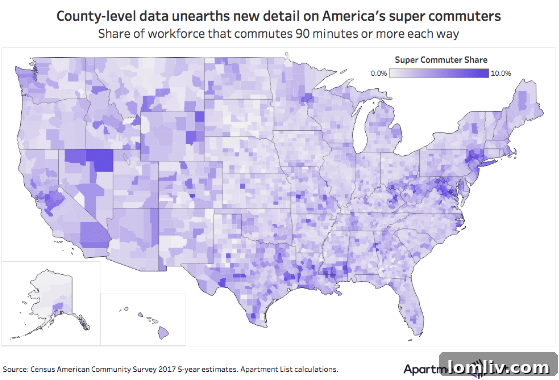
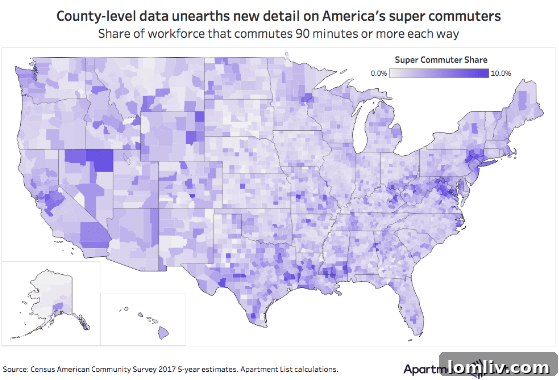
A recent comprehensive study by Apartment List sheds critical light on this burgeoning trend. From 2005 to 2017, the number of workers enduring commutes of 90 minutes or longer, each way, skyrocketed by an astounding 32 percent nationally. This growth rate is more than triple the 9 percent increase observed among workers whose commutes fall below the 90-minute threshold. The implications are far-reaching, impacting individual well-being, community structures, and regional economies.
Understanding the Super-Commuter Phenomenon
Super-commuting is not a uniform experience; it manifests differently across various demographics and geographic locations. The Apartment List study, meticulously analyzing data at the county level, revealed that while super-commuting has become more prevalent among middle-class workers seeking more affordable housing options, it also disproportionately affects low-income workers, many of whom are heavily reliant on public transportation networks that may not be optimized for efficiency over long distances.
The reasons behind this dramatic rise are multifaceted. At its core, the problem stems from a widening chasm between where jobs are concentrated and where affordable housing can be found. Major urban hubs, which serve as economic engines, often experience soaring housing costs that outpace wage growth. This forces workers, particularly those in essential service roles or entry-to-mid-level positions, to seek residences further afield, in more affordable suburban or exurban communities. This geographical displacement inevitably stretches commute times, transforming the daily journey into a significant portion of their waking hours.
Beyond the immediate financial pressures of housing, other factors contribute to the super-commuting trend. Urban sprawl, with its low-density development patterns, often necessitates longer travel distances. Infrastructure, particularly public transit, frequently struggles to keep pace with this outward expansion, leaving many commuters with no alternative but to drive, often on increasingly congested roads. The result is a cycle where the search for affordability leads to longer commutes, which in turn impacts quality of life and contributes to further urban decentralization.
The Dallas Metro Area: A Microcosm of National Trends
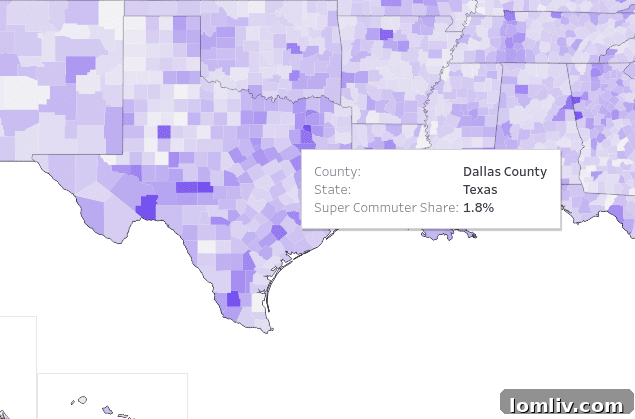
The Dallas-Fort Worth Metroplex, a rapidly growing and dynamic region, serves as a compelling case study for the national super-commuting trend. While Dallas and Collin counties, central to the metro area’s economic activity, report approximately 1.8 percent of their citizens as super-commuters, the figures begin to escalate as one moves further out. Denton County registers a slightly higher 2 percent, and Tarrant County stands at 1.7 percent. These numbers, though seemingly modest, represent thousands of individuals dedicating a substantial part of their day to commuting.
However, the data reveals a stark difference in counties on the metro’s outer edges. Hunt County, situated in the far Northeast corner of North Texas, stands out with a staggering 5.7 percent of its workforce identifying as super-commuters. This figure is nearly triple the rates seen in the more central counties and significantly higher than the national average of 2.9 percent. The high percentage in Hunt County underscores the reality that as affordability pushes workers further from major employment centers like Dallas, the daily journey becomes an arduous expedition. Residents of these outlying counties are often trading lower housing costs for a dramatically increased time commitment on the road, highlighting the difficult choices many families are forced to make in today’s economy.
The impact of super-commuting in the Dallas metro is particularly pronounced among those who rely on public transit. The study found that within the Dallas metro area, an alarming 13.1 percent of workers using public transit are super-commuters. This contrasts sharply with the 1.7 percent of super-commuters who travel by car. This significant disparity highlights a critical challenge: public transportation, while essential for many low-income workers and those without access to private vehicles, often struggles with efficiency over long distances. Routes might involve multiple transfers, less direct paths, or limited frequency, adding considerable time to the journey. This suggests that while public transit offers an indispensable alternative, its current infrastructure may inadvertently contribute to longer commutes for a vulnerable segment of the workforce.
The Far-Reaching Consequences of Extended Commutes
The rise of super-commuting has profound implications that extend beyond the individual’s daily struggle. On a personal level, long commutes are directly linked to increased stress, anxiety, and even physical health problems such as higher blood pressure, obesity, and sleep deprivation. The time spent commuting is time taken away from family, leisure activities, exercise, and community engagement, eroding work-life balance and overall quality of life. The financial burden is also substantial, encompassing not just fuel costs but also vehicle maintenance, insurance, and the opportunity cost of lost time.
From a societal and environmental perspective, the growth of super-commuting exacerbates urban congestion and contributes to increased greenhouse gas emissions, directly impacting air quality and climate change mitigation efforts. The constant strain on infrastructure demands significant public investment in road maintenance and expansion, often at the expense of other public services. Economically, while workers may find more affordable housing, businesses in urban cores may face challenges attracting and retaining talent due to the arduous commutes. This can lead to a less productive workforce and contribute to economic disparities within a region.
Addressing the Super-Commuting Challenge
Tackling the super-commuting crisis requires a multi-pronged approach involving urban planning, policy changes, and technological innovation. One crucial area is addressing the affordable housing shortage directly. This involves policies that encourage the development of diverse housing types, including mixed-income communities and high-density housing near transit hubs, to ensure that workers can afford to live closer to their jobs. Revisiting zoning laws that restrict housing supply can also play a pivotal role.
Investing in and expanding public transportation networks is equally vital. This means not just adding more routes but also improving efficiency, increasing frequency, and ensuring that transit options effectively connect residential areas with employment centers, especially in growing suburban and exurban corridors. For those who must drive, exploring solutions like smart traffic management systems, carpooling incentives, and dedicated HOV lanes can offer some relief.
Furthermore, employers have a role to play. Flexible work arrangements, including remote work options and staggered hours, can significantly reduce the need for daily commutes. Companies can also explore offering transit subsidies or encouraging carpooling initiatives. Ultimately, fostering communities where people can live, work, and thrive without sacrificing hours of their day to travel is key to building more sustainable, equitable, and vibrant regions.
Conclusion
The rise of super-commuting is a powerful indicator of the challenges facing our urban areas, driven primarily by the complex interplay of housing affordability and economic opportunity. The national trend of increasing commute times, vividly illustrated by data from the Dallas metro and beyond, underscores an urgent need for concerted action. By prioritizing thoughtful urban planning, investing in robust public transit, implementing progressive housing policies, and embracing flexible work models, communities can work towards a future where a shorter, less stressful commute is not a luxury, but a standard expectation. Addressing super-commuting is not just about saving time; it’s about enhancing quality of life, fostering economic stability, and building resilient communities for everyone.
To delve deeper into the insights from the comprehensive study by Apartment List, click here.