

Texas Relocation: Why the Lone Star State Remains a Top Destination for New Residents
Texas has long captivated the imagination of those seeking new beginnings, often celebrated for its vast opportunities and expansive landscapes. While the fundamental reason for this appeal—its robust job market—is widely acknowledged, delving into the specifics of “where” and “how many” people are moving offers a deeper understanding of this profound demographic shift. According to a significant relocation report from the Texas Association of Realtors, Texas has consistently ranked among the top relocation destinations in the United States, a trend that continues to shape its dynamic future.
This sustained influx of new residents is more than just a passing trend; it reflects Texas’s enduring strength and allure. As Vicki Fullerton, then chairman of the Texas Association of Realtors, stated, “The diverse job opportunities and high quality of life in Texas continues to drive in-state and out-of-state migration to Texas cities and counties, both big and small.” For several consecutive years, Texas has welcomed over half a million new residents annually from other states, cementing its status as a national leader in population growth and a powerhouse of opportunity.
The Irresistible Pull: Unpacking Texas’s Enduring Appeal
Extensive migration data from the U.S. Census Bureau consistently shows Texas as a highly sought-after destination. This phenomenon isn’t solely about escaping higher-cost regions; it’s about embracing a vibrant environment ripe with potential. Rogers Healy, founder of Rogers Healy and Associates and Healy Relocation, captured this sentiment perfectly: “People finally discovered Texas and all that it has to offer. Large corporations are moving their headquarters here, causing a major influx of relocation to Texas over the last couple of years — don’t think it’s going to slow down anytime soon.” This surge in corporate relocations, combined with a thriving ecosystem for small businesses and startups, acts as a powerful economic catalyst, continuously drawing talent and investment.
The “why” behind moving to Texas is multifaceted. Beyond direct employment opportunities, the state offers an exceptionally business-friendly climate. This includes the absence of a state income tax, a reasonable regulatory environment, and a vast, skilled workforce. Such conditions foster a fertile ground for companies across diverse sectors, including advanced technology, renewable energy, healthcare, manufacturing, and logistics. For individuals, this translates into abundant career pathways and significant professional growth potential. Moreover, while some urban areas are experiencing rising property values, the overall cost of living in Texas often remains considerably more affordable compared to major metropolitan centers on the East and West Coasts. This affordability allows new residents to enjoy a higher standard of living and achieve greater financial stability.
Texas Relocation Trends: A Detailed Look at Population Growth
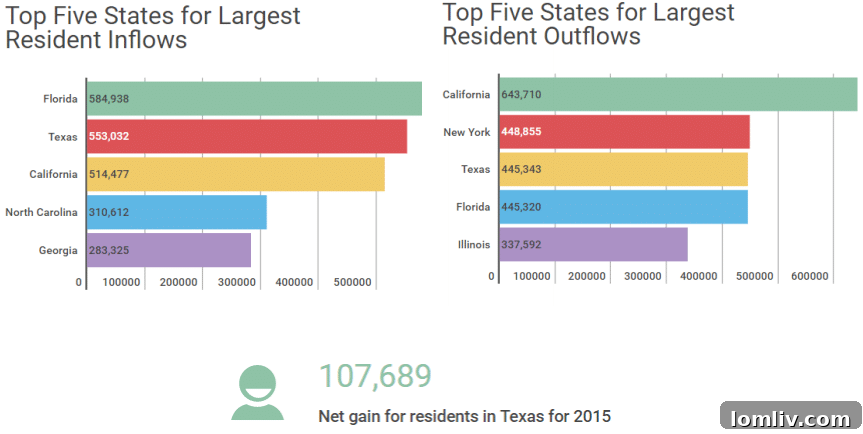
The Texas Relocation Report provides compelling data that underscores the state’s popularity as a destination. The analysis reveals a remarkable net gain of out-of-state residents, indicating a significant imbalance where more people are choosing Texas as their new home than those departing. This net gain represented a healthy increase year-over-year, signifying an accelerating trend in population growth.
According to the report, Texas experienced a net gain of out-of-state residents in 2015, with 107,689 more people moving to Texas than Texas residents moving out of state. This represented a 4 percent increase in the net gain of Texas residents from 2014, which saw 103,465 additional residents.
The total number of residents relocating to Texas from out of state in 2015 climbed 2.8 percent year-over-year, reaching 553,032 incoming residents. The largest contingents of new Texans originated from California (65,546), followed by Florida (33,670), Louisiana (31,044), New York (26,287), and Oklahoma (25,555).
While serving as a powerful magnet, Texas also registered a substantial number of its residents relocating out of state. In 2015, Texas ranked third nationally for residents moving away (445,343). The most popular out-of-state destinations for Texans were California (41,713), Florida (29,706), Oklahoma (28,642), Colorado (25,268), and Louisiana (19,863).
These figures illuminate a dynamic migration landscape. The robust inbound migration, particularly from densely populated and often higher-cost states like California and New York, points to individuals and families actively seeking enhanced economic prospects, a lower cost of living, and a perceived improvement in their quality of life. Conversely, the outbound migration, while smaller in scale, demonstrates that even in a high-growth state like Texas, there’s a natural ebb and flow of population, driven by personal circumstances, job transfers, or a desire for different regional environments.
Booming Metros and Thriving Communities: A Closer Look at Texas’s Growth Hotspots
The profound impact of this population surge is most palpable in Texas’s major metropolitan areas, which function as key economic drivers and cultural epicenters. The relocation report meticulously dissects these trends by metropolitan statistical areas (MSAs) and individual counties, revealing distinct patterns of concentrated growth.
Dallas-Fort Worth-Arlington: A Corporate Powerhouse and Diverse Lifestyle Destination
The Dallas-Fort Worth-Arlington MSA consistently leads the state in attracting out-of-state residents, having recorded the highest number of incoming individuals at 117,982 during the report’s period. This expansive North Texas region is a primary destination for corporate headquarters and major enterprises, fostering thriving job markets across finance, technology, logistics, and professional services. High-profile corporate relocations, such as those by Toyota and Liberty Mutual, have brought thousands of jobs to the area, creating immense demand within the housing market. Sandi Snyder, relocation director for Briggs Freeman Sotheby’s International Realty, validated this trend, noting, “We are experiencing increased relocation activity due to many major corporate relocations into the area. Due to companies such as Toyota and Liberty Mutual, the demand in the north continues to be strong.”
Within the dynamic DFW metroplex, specific communities are witnessing remarkable growth. Uptown Dallas provides a vibrant urban living experience, while rapidly expanding suburban areas like Frisco, McKinney, and Prosper are characterized by extensive new residential developments, highly-rated school districts, and family-friendly amenities. Snyder further confirmed, “Communities of interest that are on the rise are Uptown, Frisco, McKinney, and Prosper. We are seeing more inquiries for the areas of Little Elm and The Colony as well.” These areas offer a compelling combination of modern living, robust community engagement, and unparalleled access to the vast economic opportunities that define the DFW region, making them prime choices for relocating professionals and families.
Houston-The Woodlands-Sugar Land: Energy, Innovation, and Global Diversity
Following DFW, the Houston-The Woodlands-Sugar Land MSA attracted 101,604 out-of-state residents, solidifying its position as another premier relocation destination. Houston, a globally recognized hub for the energy industry, also hosts the world-renowned Texas Medical Center, which drives monumental innovation in healthcare and biomedical research. Its highly diversified economy, rich international community, and vibrant cultural attractions—ranging from world-class museums to an acclaimed culinary scene—all contribute to its widespread appeal. The expansive job market, coupled with a relatively affordable cost of living for a major global city, makes Houston an exceptionally compelling choice for a wide array of newcomers.
Austin-Round Rock: The Tech Hub and Cultural Capital
The Austin-Round Rock MSA, welcoming 46,598 incoming residents, completes the trio of top relocation destinations. Affectionately known as “Silicon Hills,” Austin is a burgeoning technology hotbed, drawing both established tech giants and innovative startups. Its iconic live music scene, emphasis on outdoor recreation, and uniquely progressive culture offer a distinct appeal that particularly resonates with younger professionals and entrepreneurs. While the cost of housing in Austin has seen a notable increase, its powerful job market and exceptional quality of life continue to attract a consistent stream of new residents.
County-Level Growth: North Texas Leads the Charge
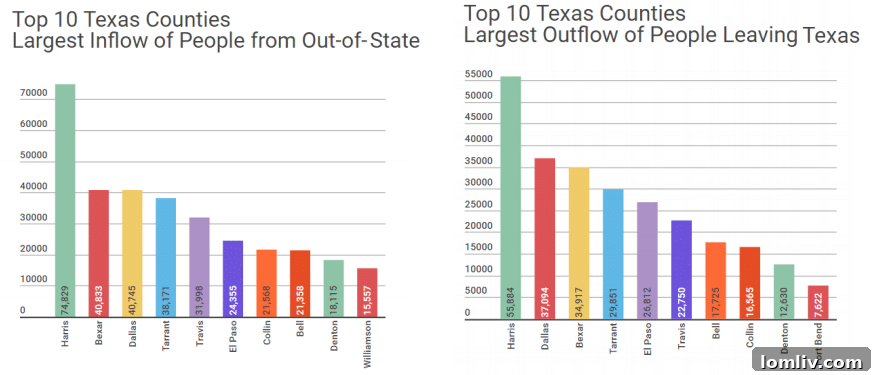
At the individual county level, the report unveiled clear patterns of demographic expansion. Harris County, home to the sprawling city of Houston, led the state with an impressive net gain of 18,945 residents relocating from out of state. However, a significant trend emerged in North Texas, where four of the top 10 counties experiencing the highest net gain of residents from out of state were located: Dallas, Tarrant, Collin, and Denton counties. This striking concentration of growth underscores the economic vitality and expanding opportunities found throughout the DFW metroplex and its surrounding communities.
These North Texas counties collectively offer an appealing blend of vibrant urban amenities, comfortable suburban living, and convenient access to major employment centers. Collin County, for instance, encompasses flourishing cities such as Plano, Frisco, and McKinney, which are renowned for their exceptional school districts, master-planned communities, and numerous corporate campuses. Denton County, including the city of Denton and significant portions of Frisco and Little Elm, provides a slightly more relaxed pace of life while remaining intricately connected to the robust DFW economic engine, making it a highly desirable location for new residents.
Looking Ahead: Sustaining Texas’s Remarkable Growth Story
As thousands more individuals and families choose Texas each year to advance their careers, cultivate their businesses, and raise their families, the imperative for proactive initiatives becomes increasingly critical. Protecting the state’s cherished affordability, ensuring robust and efficient mobility solutions, and fostering sustained economic prosperity are paramount for long-term success. As Vicki Fullerton insightfully concluded, “In the upcoming legislative session, Texas Realtors will be actively advocating for sustainable, long-term policies that will support our state’s enduring population growth.” This commitment to strategic foresight and planning is absolutely essential to guarantee that Texas can continue to accommodate its burgeoning population without compromising the very qualities that render it so attractive.
Texas’s dynamic growth narrative is far from complete. With its vibrant economy, rich and diverse culture, and high quality of life, the Lone Star State is exceptionally well-positioned to remain a leading destination for relocation for many years to come. Whether the driving force is corporate opportunities, the pursuit of a better lifestyle, or the simple, compelling appeal of a state that truly offers “all that it has to offer,” Texas continues to embrace new residents with open arms, shaping its future one newcomer at a time.