The Grocery Store Gold Rush: Unpacking the “Starbucks Effect” of Trader Joe’s and Whole Foods on Home Values
In the dynamic world of real estate, location has always been king. But beyond traditional factors like school districts, crime rates, and commute times, a new breed of amenity is increasingly dictating property values: the upscale grocery store. Specifically, the “Starbucks Effect” – a phenomenon where the mere presence of a popular retail chain can significantly boost surrounding home values – is now being observed with high-end grocers. The burning question on many homeowners’ and investors’ minds is: Which upscale grocery giant, Trader Joe’s or Whole Foods, holds the stronger “Starbucks Effect” power?
A fascinating analysis by RealtyTrac recently delved into this very topic, comparing the impact of these two beloved grocery chains on property appreciation nationwide. Their findings offer compelling insights for anyone looking to understand the subtle forces shaping modern real estate investment and home values.
Understanding the “Starbucks Effect” on Property Appreciation
For those unfamiliar with the concept, the “Starbucks Effect” posits that proximity to certain desirable retail establishments can act as a catalyst for property appreciation. It’s not just about caffeine; it’s about what a Starbucks signifies: a vibrant, desirable neighborhood with disposable income and a certain lifestyle. Homes in such areas often command higher prices due to perceived convenience and quality of life.
“Homes in the Dallas-Fort Worth metro appreciated 49.7 percent between January 1997 and December 2013,” Humphries said. “But if you look just at homes in the Dallas-Fort Worth metro and within a quarter mile of a Starbucks, you see the Starbucks effect: Those homes appreciated 56.9 percent.”
Humphries added, “We were surprised by how decisive the results were. Over the past 17 years, we found that homes within a quarter mile of a Starbucks doubled in value, whereas the average home in the U.S. appreciated 65 percent over the same time.”
This remarkable difference, where homes near a Starbucks doubled in value compared to a 65% national average appreciation, underscores the significant influence of these retail anchors. It suggests that these businesses aren’t just selling coffee or groceries; they’re selling an aspirational lifestyle, becoming integral parts of neighborhood development and desirability.
Trader Joe’s vs. Whole Foods: A Tale of Two Grocers and Their Real Estate Footprints
To truly understand the RealtyTrac analysis, it’s crucial to differentiate between Whole Foods and Trader Joe’s. While both are considered “upscale grocery stores,” their brand identities, target demographics, and typical location strategies often diverge, leading to different impacts on home values.
Whole Foods Market: Often dubbed “Whole Paycheck,” Whole Foods is synonymous with premium, organic, and gourmet products. Its stores are typically large, beautifully designed, and cater to a health-conscious, often affluent, clientele. Historically, Whole Foods tends to establish itself in already established, wealthy areas, reinforcing the existing property values of these affluent neighborhoods.
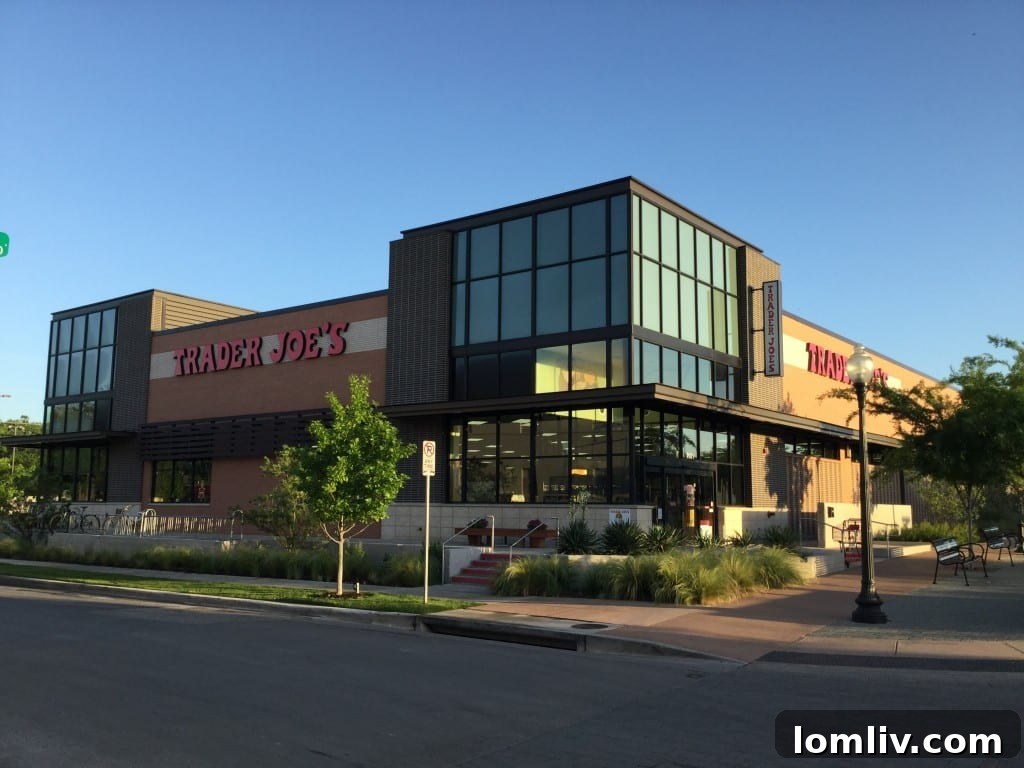
Trader Joe’s: In contrast, Trader Joe’s cultivates a quirky, fun, and value-oriented image. It offers a unique selection of private-label products, often at more accessible price points than Whole Foods, attracting a broader demographic that values quality, uniqueness, and a “treasure hunt” shopping experience. Trader Joe’s often ventures into up-and-coming areas or neighborhoods undergoing revitalization, sometimes acting as a catalyst for growth rather than merely reflecting existing affluence.
Considering the Dallas market as an example, Whole Foods locations are found in highly coveted areas like the Park Cities and Preston Hollow – already among the priciest neighborhoods. Trader Joe’s, however, has expanded into areas like Lower Greenville, Lake Highlands, and Inwood Village – all vibrant communities with great character and steadily rising home values, indicating their potential as drivers of appreciation.
The Numbers Speak: RealtyTrac’s Definitive Findings
RealtyTrac’s analysis provides concrete data that challenges some preconceptions about which chain has a more potent “Starbucks Effect” on residential real estate appreciation.
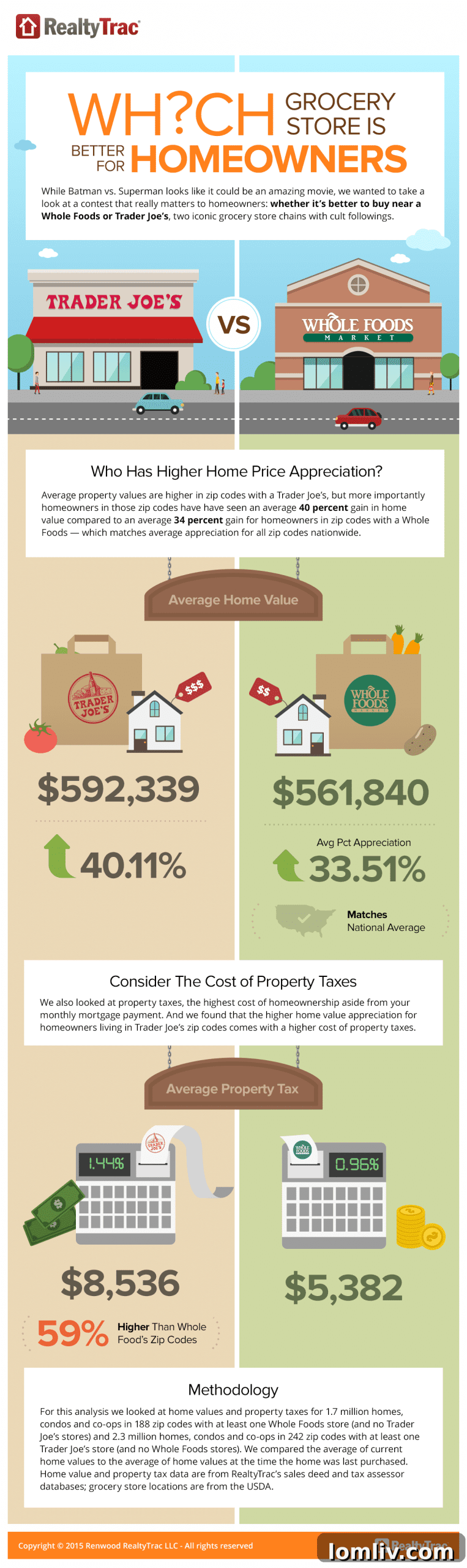
The headline finding is clear: Homeowners in Zip Codes featuring a Trader Joe’s experienced a 6 percent higher price appreciation compared to homeowners in Zip Codes with a Whole Foods. This difference, while seemingly modest at first glance, translates into substantial financial gains over time for homeowners. Imagine the long-term impact on your real estate investment!
Let’s delve deeper into the specific metrics provided by RealtyTrac:
- Home Value Appreciation Since Purchase: Homeowners near a Trader Joe’s saw an average 40 percent increase in home value since their purchase. This significantly outpaces the 34 percent appreciation for homeowners near a Whole Foods. Notably, the average appreciation for all zip codes nationwide also stood at 34 percent, suggesting that while Whole Foods locations maintain strong values, Trader Joe’s appears to offer an added boost.
- Average Home Values: Homes near a Trader Joe’s boasted a higher average value of $592,339. This is 5 percent more than the $561,840 average value for homes near a Whole Foods. The national average value of homes across all zip codes was $262,068, highlighting that both grocery chains signify premium locations, but Trader Joe’s seems to correlate with even higher absolute values.
- Annual Property Taxes: Reflecting the higher home values, homeowners near a Trader Joe’s paid an average of $8,536 in property taxes each year. This is a substantial 59 percent more than the $5,382 average for homeowners near a Whole Foods. For comparison, the average property tax across all zip codes nationwide was $3,239. Higher property taxes typically indicate higher home assessments, underscoring the greater market value in Trader Joe’s adjacent areas.
These figures paint a compelling picture. While both chains are undoubtedly attractive community amenities that enhance desirability, Trader Joe’s seems to have a more pronounced, catalytic effect on home values and their growth trajectory.
The “Why”: Unpacking the Differential Impact on Real Estate
The question naturally arises: Why does Trader Joe’s appear to outperform Whole Foods in terms of fostering property appreciation?
Trader Joe’s: A Catalyst for Growth
One key explanation lies in Trader Joe’s strategic placement. As noted, Trader Joe’s often moves into up-and-coming areas that are on the cusp of revitalization or have strong potential for growth. Its arrival can signal to other businesses and residents that an area is safe, desirable, and ripe for investment. This acts as a powerful neighborhood development accelerator. The demographic it attracts – often educated, health-conscious individuals and families who appreciate unique products and good value – are often precisely the kind of residents who contribute to a neighborhood’s upward trajectory.
Furthermore, Trader Joe’s unique shopping experience can foster a strong sense of community. Its smaller store footprint and focused product selection often make it a local hub, drawing residents from various parts of a neighborhood, enhancing its overall appeal and cementing its status as a desirable place to live. This “halo effect” translates directly into increased demand for housing and, consequently, higher real estate appreciation.
Whole Foods: A Confirmer of Existing Wealth
Whole Foods, by contrast, typically targets areas that are already established and affluent. Its presence confirms the existing wealth and desirability of a neighborhood rather than sparking new growth. While a Whole Foods is undeniably a valuable amenity that helps maintain high property values, it might not offer the same *catalytic* effect on appreciation that Trader Joe’s can provide in developing areas.
In essence, Whole Foods tends to be a reward for already-affluent areas, while Trader Joe’s can be seen as an investment in areas with high potential, driving a more significant percentage of new appreciation.
The Best of Both Worlds: When Trader Joe’s and Whole Foods Coexist
What about those fortunate areas that boast both? The article briefly mentions Lakewood in Dallas. It’s plausible that such neighborhoods represent the pinnacle of desirability, offering the best of both grocery worlds. Residents enjoy diverse shopping options, catering to different needs and preferences, further enhancing the area’s appeal and potentially pushing home values into the “off-the-charts” category.
Implications for Homebuyers, Sellers, and Real Estate Investors
The findings from RealtyTrac carry significant implications across the real estate market:
- For Homebuyers: When scouting for a new home, consider not just the current amenities but also the potential for future appreciation. Looking for up-and-coming areas where a Trader Joe’s is newly established or rumored to open could be a savvy long-term strategy. The convenience of unique, quality groceries becomes a compelling part of the lifestyle choices that drive residential decisions.
- For Home Sellers: If your property is near a Trader Joe’s, highlight this fact in your listings and marketing materials. It’s a powerful selling point that signals a desirable, growing neighborhood to potential buyers. Emphasize the ease of access to premium, yet value-driven, grocery options.
- For Real Estate Investors: Identifying areas poised for new Trader Joe’s locations could be a strategic move. Investing in properties in these areas before the full “Trader Joe’s Effect” takes hold could yield substantial returns on property appreciation. Understanding these market trends is crucial for successful portfolio growth.
This trend also underscores the broader impact of “experiential retail” on urban planning. Grocery stores, once purely functional, are now lifestyle brands that shape communities and drive economic growth, becoming central to the overall livability and attractiveness of neighborhood development.
What would you rather live near? The data suggests that for maximizing home value appreciation, proximity to a Trader Joe’s might be the more potent choice. However, both stores undoubtedly contribute positively to a neighborhood’s appeal, offering quality groceries and amenities that enhance the daily lives of residents.
Conclusion: The Enduring Influence of Upscale Grocers on Real Estate
The “Starbucks Effect” is clearly not limited to coffee shops. The detailed analysis by RealtyTrac unequivocally demonstrates that upscale grocery stores like Trader Joe’s and Whole Foods exert a significant influence on real estate appreciation. While both chains are strong indicators of desirable living environments, Trader Joe’s appears to have a more pronounced impact on accelerating home values, especially in up-and-coming areas.
This phenomenon underscores a vital lesson for anyone involved in the real estate market: the presence of certain retail brands is more than just a convenience; it’s a powerful economic indicator and a driver of property values. As consumers increasingly prioritize healthy living and unique shopping experiences, these grocery anchors will continue to shape market trends, neighborhood desirability, and, ultimately, the financial trajectory of countless homes across the nation. Therefore, when considering your next move or investment, don’t overlook the humble, yet mighty, grocery store.