Rethinking Light Rail: A Multi-Billion Dollar Bet on Urban Transformation
A thought-provoking piece published in the Wall Street Journal recently ignited a critical discussion about the staggering investments in light rail systems across America, particularly in sprawling Sunbelt cities. The central, almost sacrilegious question raised: are the billions poured into light rail truly yielding the anticipated returns, especially when it comes to real estate development and urban revitalization?
Cities like Los Angeles, Phoenix, Denver, and Charlotte, N.C., all synonymous with car-centric cultures, are collectively channeling billions of dollars into ambitious light rail infrastructure projects. These ventures are typically financed through a combination of local sales taxes and substantial federal funding, underscoring a nationwide commitment to shifting urban mobility paradigms. The proponents of these systems often cite a compelling list of benefits: encouraging dense, transit-oriented development, alleviating traffic congestion, significantly boosting real estate values around station hubs, and contributing to a greener, more sustainable urban environment.
The Promise of Public Transit: A Vision for Sunbelt Cities
For decades, the American dream was inextricably linked to the automobile. However, as urban populations grow and environmental concerns mount, cities are actively seeking alternatives to car dependence. Light rail, with its promise of efficient, high-capacity transportation, stands as a cornerstone of this new vision. It’s often presented as a catalyst for transforming car-dominated landscapes into vibrant, pedestrian-friendly communities.
Experts often point to the potential for “transit-oriented development” (TOD), a planning concept that emphasizes compact, mixed-use communities built around transit stations. The theory suggests that by providing convenient access to public transportation, these areas become highly desirable, attracting residents, businesses, and ultimately, driving property values upwards. Furthermore, reducing the number of cars on the road translates into cleaner air and less reliance on fossil fuels, aligning with broader climate goals.
Light Rail’s Impact on Real Estate: A Mixed Bag of Results
While the theoretical benefits are clear, the real-world impact of light rail on property values has been a subject of extensive research and varying outcomes, painting a nuanced picture rather than a uniform success story.
The Phoenix Success Story: A Blueprint for Value Growth
One notable success comes from Phoenix, Arizona, where a comprehensive study illustrated a tangible uplift in property values. A 2014 study of the Phoenix area’s light-rail system, co-written by Arizona State University professor Michael Kuby, clearly demonstrated an increase in both residential and commercial property values following the system’s introduction. This positive effect was observed extending for more than a mile from the light rail stations, suggesting a broad economic ripple effect throughout the surrounding communities. This case often serves as a beacon for cities aspiring to leverage transit for economic development, highlighting how strategic planning and market conditions can align with infrastructure investment.
Charlotte’s Nuanced Experience: Beyond Simple Correlation
Conversely, the experience in Charlotte, N.C., presented a more ambiguous scenario. A 2012 study analyzing property values near its light-rail system stations yielded what researchers termed a “mixed bag of results.” While some high-end developments did emerge in proximity to stations, critics argue that these luxury properties might have materialized regardless of the light rail, driven more by existing market demand and developer interest than by the transit line itself. This outcome raises important questions about correlation versus causation, suggesting that light rail might, in some instances, simply accelerate or redirect existing development trends rather than creating new economic activity from scratch.
Skepticism from the Experts: The ‘Robbing Peter to Pay Paul’ Argument
The complexities surrounding light rail’s economic impact have led to significant skepticism from some policy experts. Randal O’Toole, a prominent transportation and land use expert associated with the conservative Cato Institute, offers a critical perspective on the motivations behind these massive investments. He contends that local governments are often incentivized to invest in light rail primarily “because the federal government is offering money for it,” rather than as a purely organic response to local needs or clear economic rationale.
O’Toole further elaborates on the concept of property value enhancement, suggesting that any boost in values around transit lines may not represent a net gain for the entire urban area. Instead, he posits, “it does so at the expense of values somewhere else in the same city or urban area.” This “robbing Peter to pay Paul” analogy implies a redistribution of existing wealth and desirability within a city, rather than a genuine creation of new economic value. Such an argument challenges the notion that light rail inherently generates widespread prosperity, instead highlighting potential zero-sum dynamics within a competitive real estate market.
Dallas’s Dilemma: Missed Opportunities at CityPlace
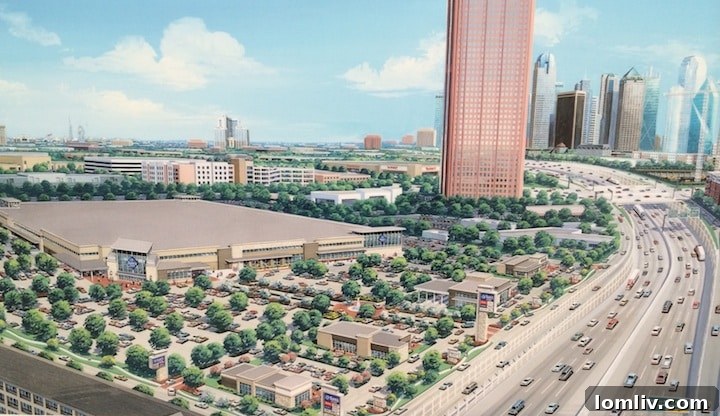
The debate resonates keenly in Dallas, a city grappling with its own ambitious transit goals. Consider the DART station prominently located on Central Expressway at CityPlace. One might expect a hub of dynamic, mixed-use development – perhaps housing, retail, and office spaces – designed to maximize the transit access. Yet, what stands directly across from it? A large-format Sam’s Club. This scenario, often lamented by urban planners and residents alike, exemplifies what many see as a missed opportunity for truly integrated transit-oriented development.
Critics argue that such developments prioritize immediate financial returns over long-term urban planning and community building. Instead of fostering vibrant, walkable communities that fully leverage transit accessibility, developers occasionally opt for “the quick buck” by erecting structures that cater to car-dependent consumers, undermining the very goals light rail is meant to achieve. While areas like Haskell are undeniably undergoing significant transformation, the CityPlace example serves as a potent reminder of the challenges in aligning developer interests with broader urban planning visions for sustainable growth and transit integration.
Beyond Property Values: The True Mandate of Transit
Amidst the robust debate concerning real estate values, transportation researchers often interject a crucial reminder: the “primary goal of rail projects isn’t necessarily to boost property values, but to increase the options for how people get from one place to another.” This fundamental objective underscores the social equity and accessibility aspects of public transportation, providing alternatives for those who cannot or choose not to drive, thereby enhancing overall urban mobility and quality of life for a diverse population.
Nevertheless, the aspirational link between transit and desirability remains strong. Like a high-end appliance brand symbolizing quality, rail line stations often inherently make adjacent real estate more attractive, even for individuals who may never actually use the trains. Researchers at UC Berkeley have observed that the most successful rail systems tend to be concentrated in areas already characterized by high population density and significant employment centers. This suggests that light rail thrives where there’s an existing demand for connectivity, rather than solely creating it.
The Millennial Shift: A Generation Redefining Urban Mobility
A significant demographic factor influencing urban planning is the evolving preferences of younger generations. Economist Jed Kolko, a senior fellow at UC Berkeley and formerly the chief economist for Trulia, has analyzed Census Bureau data revealing a clear trend: today’s 18 to 34-year-olds are increasingly gravitating towards alternatives to car ownership. This “Millennial shift” is driven by a confluence of factors including economic pressures, environmental consciousness, and a desire for walkable, amenity-rich urban environments where car dependency is minimized.
The author humorously suggests a personal theory for this phenomenon: that Millennials spent “too much time in cars while we chauffeured them all over” during their formative years, leading to an aversion to driving in adulthood. Whatever the root cause, this demographic preference presents a compelling argument for investing in robust public transit and creating denser, more walkable urban cores. Yet, even with this generational shift, the question persists: does proximity to a rail station reliably translate into higher property values across all contexts?
Chris F. Campbell, a long-term resident of Phoenix’s Roosevelt Row and owner of RooPho Realty LLC, offers a ground-level perspective. He notes that the Roosevelt Row neighborhood, a vibrant Arts District, was experiencing significant growth and revitalization even before the $1.4 billion light-rail system became operational. Furthermore, Campbell points out a common frustration: the rail line, while a public amenity, often proves to be much slower than simply driving, especially for journeys outside peak hours or to less connected destinations. This highlights that while transit can be a factor, it doesn’t always supersede the convenience and speed of private vehicles, especially in sprawling cities.
The Dallas Arts District provides an interesting parallel. It has successfully drawn residents and fostered a thriving cultural scene through its unique offerings and urban ambiance, demonstrating that a strong sense of place and community can attract inhabitants even without direct, heavy rail integration.
Los Angeles: A Car Culture in Flux, and Lessons for Dense Development
The federal government’s commitment to funding light rail appears unwavering, almost “come hell or high water,” until local communities decide to push back. Even in Los Angeles, a city legendary for its entrenched car culture—a lifestyle that rivals or even surpasses Dallas/Fort Worth in its dependency—residents are reaching a breaking point with ever-increasing traffic congestion. Paradoxically, even with LA’s multi-billion dollar light rail investments, there’s growing resistance to the very high-density, tall projects that are supposed to maximize the benefits of transit. These developments, designed to bring more people closer to stations, are now being viewed by some as generators of even more traffic and strain on existing infrastructure.
At least one influential group in Los Angeles is actively advocating for a two-year moratorium on high-density projects, and several mixed-use developments proposed near station stops have been voted down by local communities. This pushback illustrates a critical tension: while light rail aims to reduce car dependence, the accompanying push for increased density can sometimes exacerbate local traffic and infrastructure challenges, leading to community resistance that complicates urban planning efforts.
Dallas’s Future: Embracing Walkability and Sustainable Growth
Could a similar scenario unfold in Dallas? There’s already considerable chatter within the city that popular areas like Uptown and parts of Oak Lawn are becoming excessively congested, perhaps due to inadequate zoning or an unsustainable pace of high-density development. The question then becomes: do we, like the Angelenos, need to reassess our development strategies and potentially “cool it” on unchecked high-density growth?
There’s a growing sentiment that Dallas, a city long defined by its freeways, is just beginning to embrace a more pedestrian-friendly future. As Mr. Han, owner of a craft beer restaurant in Los Angeles, observes about his city’s evolving habits: “It used to be that no one walked anywhere in Los Angeles, even if you were going to the corner store five blocks away. But slowly that mentality has been changing, and it’s giving people more options.” This cultural shift towards walkability and diverse transportation options is a powerful undercurrent that urban planners in Dallas must acknowledge and cultivate.
The Road Ahead: Navigating the Complexities of Urban Rail Investment
In conclusion, the journey of light rail investment across Sunbelt cities is multifaceted and fraught with complexities. While the ambition to curb car culture, promote sustainable development, and enhance urban mobility is commendable, the actual impact on real estate values and community development is far from guaranteed. Success appears to hinge on a delicate balance of federal incentives, local market conditions, meticulous urban planning, and community buy-in. It’s clear that light rail is not a panacea; its effectiveness as an engine for urban transformation and property value enhancement is highly dependent on how cities integrate it into a broader, holistic vision for sustainable, livable, and truly connected communities.