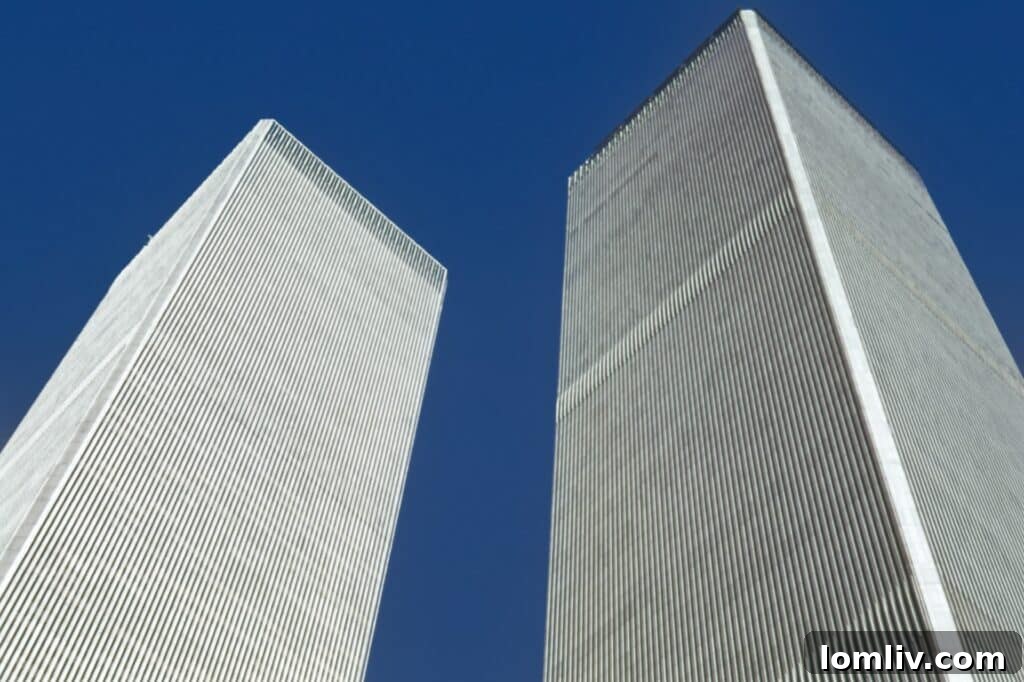
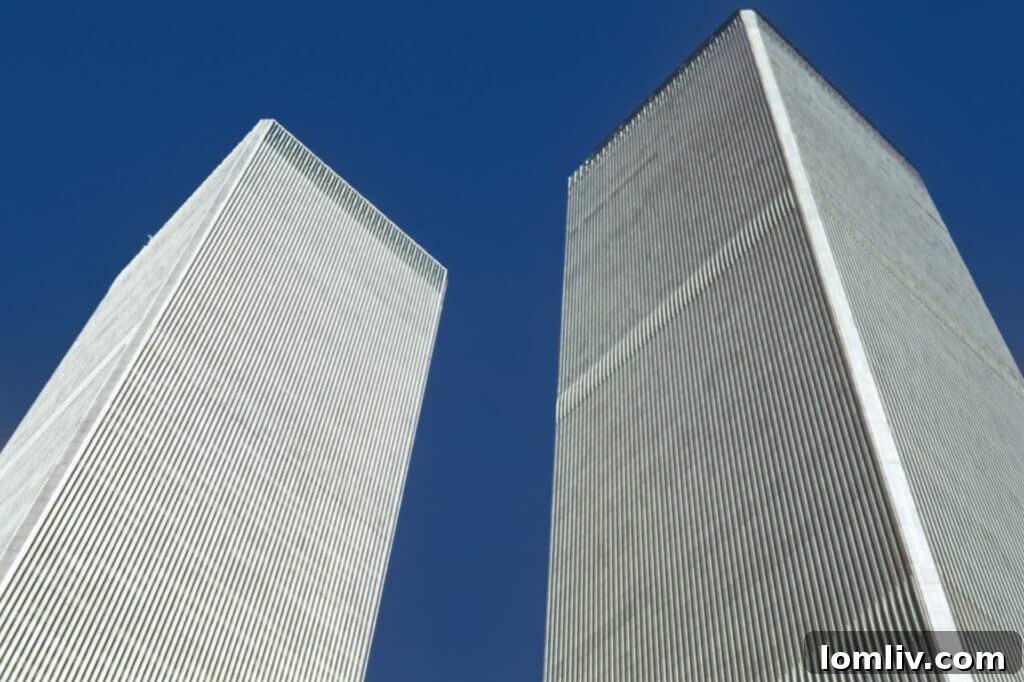
As the solemn anniversary of September 11th approaches each year, it brings with it a wave of profound reflection, a reminder of a day that indelibly altered the fabric of America. More than two decades have passed since the 9/11 terrorist attacks, yet the memories remain as vivid and impactful as if they occurred yesterday, forever marking a pivotal moment in our national history. It was a day that transcended mere news; it was a deeply personal and collective experience, etching itself into the hearts and minds of millions across the globe.
The morning of September 11, 2001, dawned like any other, but within hours, it transformed into a nightmare that reshaped our understanding of security, vulnerability, and resilience. I vividly recall the words of Dan Rather, spoken with raw emotion, lamenting that the lines from “America the Beautiful” – “Thine alabaster cities gleam / Undimmed by human tears!” – would never again carry the same innocent meaning. His sentiments echoed the national grief, recognizing the profound loss of an unspoken sense of invincibility that had long characterized the American spirit. This catastrophic event was, as my mother poignantly described it, our generation’s Pearl Harbor—a sudden, unprovoked assault on our homeland, striking at the very heart of our most iconic cities and symbols of freedom and commerce.
Every American old enough to remember can recount precisely where they were and what they were doing when the news broke. The images of the World Trade Center towers ablaze, the Pentagon scarred, and the field in Shanksville, Pennsylvania, forever changed, are seared into our collective consciousness. We felt an overwhelming sense of helplessness, a gut-wrenching grief not just for the thousands of lost loved ones but for strangers whose lives were abruptly extinguished. The skies above America, usually bustling with aircraft, fell eerily silent for four unprecedented days, shut down under Operation Yellow Ribbon as all civilian planes were ordered to land at the nearest available airport. In this vacuum of flight, we turned to our televisions, desperately seeking any news, any insight, any glimmer of understanding as to why this unimaginable tragedy had befallen us. In the face of a common enemy, an unexpected unity emerged, strangers comforting strangers, sharing stories, and finding solace in shared sorrow.
And we will never, ever forget the lives lost, the heroes who emerged, and the day that redefined our nation.
The passage of time means that a new generation has emerged, one that learns about 9/11 not through lived experience but through the pages of history books. I now have four grandchildren, born between three and ten years after the attacks, who will encounter this defining moment of American history much as we once studied World War II. It becomes our sacred responsibility to answer their inevitable questions, to present the facts with clarity and compassion, and to convey the profound impact of that day. My own memories are replete with anxious moments: a child attending college in upstate New York, a brother-in-law navigating the chaos of Manhattan, and countless friends spread across the city. I meticulously read every victim’s obituary in The New York Times, each story a testament to a life cut short. I followed the agonizing clean-up efforts in lower Manhattan, hearing firsthand accounts from friends who witnessed the devastation and the extraordinary resilience of New Yorkers. In the immediate aftermath, there was an overwhelming instinct to seek refuge, to gather my family close, to “cocoon” within the safety of home until the world felt secure once more. I even urged my daughter, then a college sophomore, to consider finding refuge with her grandparents in New York or, if necessary, driving to Canada. She later recounted comforting friends whose parents and loved ones were lost in the Twin Towers. Unlike the COVID-19 pandemic, when we were forced to stay home to protect our healthcare system amidst extreme uncertainty, post-9/11, we wanted to stay home, driven by a primal urge for safety and solace.
That September, my pool contractor arrived, finally back in the U.S. He had been stranded abroad when the airlines were grounded, recounting his arduous journey back to America by boat, car, and even, for a portion, on foot. A true patriot, he declared he would have crawled across continents to return to American soil and back to his home in Texas. Such stories of determination and love for country were common, illustrating the deep sense of national identity that resurfaced in the face of adversity.
This very website launched its first post on October 7, 2010. That date, by stark coincidence, was precisely eleven months before the hijacked American Airlines Flight 11 and United Airlines Flight 175 would bring down the iconic Twin Towers of New York City, symbols of American economic prowess. It was eleven months before American Airlines Flight 77 tragically crashed into our nation’s Pentagon, the headquarters of the U.S. Department of Defense. And it was eleven months before United Airlines Flight 93, heroically diverted by its passengers, crashed into a field in Shanksville, Pennsylvania, preventing further catastrophe. The timing serves as a poignant reminder of the enduring significance of those eleven months and the event that redefined the path of a nation.
Twenty-two years after the 9/11 terrorist attacks on the World Trade Center, the meticulous and heartbreaking work of identifying victims continues. More than 40% of those who perished in the collapse of the towers have yet to be officially identified. Medical examiner officials in New York remain tirelessly committed to this sacred duty, utilizing advanced forensic science to bring closure to families. In fact, just last week, two more victims were identified, a testament to the unwavering dedication to every life lost. American Airlines Flight 11 struck floors 93 to 99 of the North Tower (1 WTC) at 8:46 a.m. Eastern Standard Time, while at 9:03 a.m., hijacked United Flight 175 hit floors 77 to 85 of the South Tower (2 WTC). At the time of impact, an estimated 16,400 to 18,000 people were present within the WTC complex, a sprawling 16-acre commercial development with the Twin Towers as its undeniable centerpieces. The scale of the human tragedy, combined with the sheer audacity of the attacks, remains almost unfathomable.
In the aftermath, as we know, a significant demographic shift began. Many residents and businesses started moving out of major urban centers. My own neighbors, who officed in the Twin Towers and miraculously escaped, were among those who sought new beginnings outside the immediate hustle of the city. New York City, with its indomitable spirit, recovered. It painstakingly cleaned up an unfathomable mess of human remains and physical destruction, rebuilding with a resilience that inspired the world. Yet, the brutal lessons of 9/11 instilled a profound sense of introspection across the nation, making our homes seem more important and vital than ever before. This subtle, yet powerful, shift contributed to drawing people away from hyper-dense urban centers like New York City, fostering the growth and blossoming of smaller, more accessible cities such as Nashville, Atlanta, Pittsburgh, Dallas, Austin, St. Louis, and even Houston. People began to re-evaluate their priorities, seeking communities that offered a different balance of urban amenities and perceived security.
This trend, arguably initiated by 9/11, was further amplified and accelerated decades later by the COVID-19 pandemic. The global health crisis pushed remote work into the mainstream, freeing many from the necessity of living in expensive, densely populated urban areas near their offices. This created an unprecedented surge in interest and population growth in non-metro regions. As noted by Bloomberg, for the first time in three decades, the number of people living in non-metro areas outgrew the urban population in 2021, a trend that continued last year. However, this growth wasn’t uniformly distributed. The top 10 counties experiencing the largest population gains saw an average increase of 5%, significantly outpacing the national average of 0.4%, indicating targeted migration toward specific, desirable rural and suburban locales. This phenomenon underscores a continued re-evaluation of living spaces and priorities in post-crisis America.
The number of people living in non-metro areas outgrew the urban population for the first time in three decades in 2021, and the rural population expanded again last year. But growth wasn’t evenly distributed, with the top 10 counties with the largest population gains growing by an average 5%, according to Census data. That’s more than the national average of 0.4%
Bloomberg
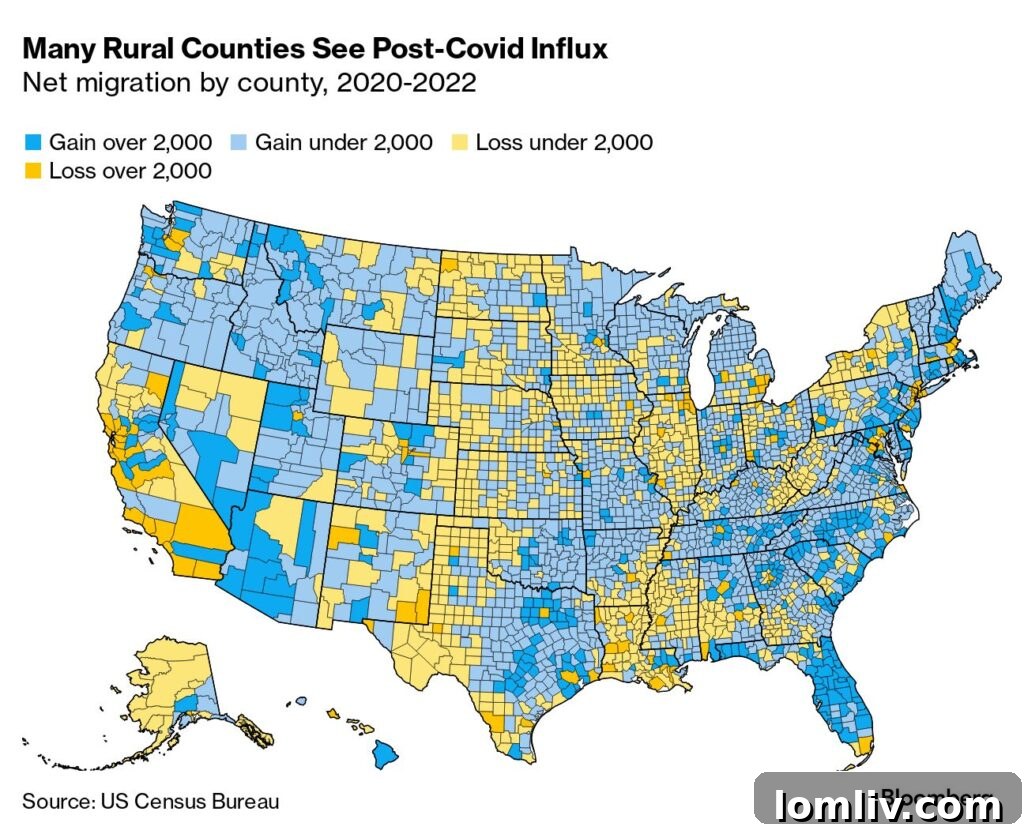
For example, if you zero in on Texas, you can observe a distinct pattern: the yellow dot representing Dallas indicates a population loss of over 2,000 residents, yet it is surrounded by vast swathes of deep blue, signifying gains of over 2,000 residents across miles of its surrounding areas. This localized demographic shift illustrates the broader national trend of decentralization, with people opting for suburban or exurban living even within major metropolitan regions.
The roots of this profound societal recalibration trace back to 9/11, after which the real estate market experienced significant shifts following the Great Recession of 2008, only to be dramatically intensified by the COVID-19 pandemic two decades later. Today, my heart mourns for all those who never returned to their homes after those fateful flights, for those who went to work believing in their capacity to contribute as productive, team-building human beings. I mourn for all the firefighters, police officers, and other first responders who, with unparalleled selflessness – as they always do – rushed into towers of burning steel, defying danger to try and save lives. I mourn for their loved ones, who carry an indelible pain. And I mourn for the enduring impact 9/11 had on our nation’s psyche, forcing us to confront fragility while simultaneously revealing our immense strength and unity. The memory of that day serves as a perpetual reminder, a commitment that we will never forget.
To gain a deeper understanding of this pivotal moment, if you have never visited the Bush Museum near SMU, I highly recommend exploring its powerful memorial dedicated to 9/11. Additionally, for a comprehensive chronological overview of the events of that tragic day, the University of Virginia Miller Center offers an insightful timeline of the September 11 terrorist attacks. These resources serve as vital touchstones for remembrance and education.