The Heated Debate Over White Rock Trail Elementary: Community Resistance in Lake Highlands
In the vibrant Lake Highlands area of Dallas, a fundamental question hangs in the air: If a school is built against the strong objections of its future neighbors, will it truly serve the community? This profound question lies at the heart of a significant local debate concerning the proposed White Rock Trail Elementary. On one side, the Richardson Independent School District (RISD) advocates for a specific site, bordered by Walnut Hill, White Rock Trail, and DART tracks, asserting its viability as the optimal choice to address pressing school overcrowding. On the other, a united front of parents and residents vehemently opposes the location, arguing it is inherently dangerous, financially imprudent, and potentially legally unfeasible due to a decades-old public deed restriction.
This escalating controversy underscores the complex challenges faced by growing urban school districts and the communities they serve. Balancing the critical need for educational infrastructure with local quality of life concerns often leads to deeply entrenched conflicts, and the case of White Rock Trail Elementary in the heart of Lake Highlands is a prime example of such a struggle, capturing the attention of residents and urban planners alike.
“We Have a Voice”: Leading the Opposition in Lake Highlands
The organized opposition has coalesced into a powerful grassroots movement known as “We Have a Voice.” Rahul Yodh, acting as the group’s spokesperson, acknowledges the undeniable issue of overcrowding at White Rock Elementary, recognizing that a solution is necessary. However, he firmly believes that the proposed site for White Rock Trail Elementary is fundamentally flawed and ill-suited for its intended purpose.
“We absolutely understand the need for a new school to alleviate the immense pressure on White Rock Elementary, but this specific location is simply unsuitable from every practical and community standpoint,” Yodh stated. He highlighted the depth of local dissent, noting, “Our precinct was one of the very few that voted against the bond in May, clearly indicating a strong lack of confidence in the district’s planning. We have consistently expressed our firm opposition, yet it feels as though Richardson ISD has largely dismissed our legitimate concerns and community feedback.”
To quantify the community’s discontent, Yodh revealed that over 1,500 emails detailing opposition have been sent to Dallas City Councilman Adam McGough, whose district encompasses White Rock Valley within Dallas city limits, despite being part of the Richardson ISD attendance zone. “An overwhelming 86.4 percent of those emails are explicitly against the school at this site,” Yodh emphasized. He further contextualized this figure by comparing it to local electoral engagement, stating, “For perspective, only about 750 people from our precinct cast ballots in the last council election. This demonstrates an exceptional level of community engagement and unified opposition to the proposed White Rock Trail Elementary location, reflecting a deeply held conviction among residents.”
RISD’s Stance: Addressing Enrollment Growth and Ensuring Transparency
Tim Clark, Communications Director for Richardson ISD, countered by asserting the district’s unwavering commitment to transparency and stakeholder engagement throughout the planning process for the new elementary school. He pointed to a regularly updated website specifically designed to provide the most current project status and answer community questions regarding the Lake Highlands growth initiatives.
“Throughout this comprehensive process, the district has actively engaged with a diverse array of stakeholders, including residents with valid concerns about the proposed site, as well as parents who strongly support the new school to alleviate overcrowding,” Clark explained. He underscored RISD’s primary responsibility: “RISD is tasked with accommodating the very substantial and ongoing enrollment growth within the White Rock Elementary attendance boundary. The Board members recognize that finding a perfect solution that satisfies every single individual or group is simply not feasible when addressing such a complex and vital need for public education infrastructure.”
The Elephant in the Room: A Decades-Old Public Deed Restriction
Among the myriad of reasons cited by “We Have a Voice” for the White Rock Trail site’s unsuitability, one stands out as the most formidable challenge and potential legal hurdle for Richardson ISD: a public deed restriction. Years ago, neighbors proactively petitioned for and successfully secured a deed restriction on this very plot of land, specifically limiting its permissible uses. This historical legal instrument could fundamentally impede the construction of White Rock Trail Elementary.
Rahul Yodh recounted the origins of this crucial restriction: “My next-door neighbor, who has been a valued member of this community for four decades, along with her husband and brother-in-law, went door-to-door, gathering signatures and support to ensure this deed restriction was passed and put into effect in the 1970s. This was a direct effort by residents to shape the future of their neighborhood.”
He further elaborated on its significance: “There’s a genuine, deep-rooted neighborhood element to this. These residents had the incredible foresight to establish that deed restriction to protect their community’s character. Crucially, it’s a public deed restriction, not a private one, meaning its enforceability extends broadly and impacts any potential development, including a school.” The distinction between a public and private deed restriction is vital here, as public restrictions are typically more challenging to overturn and carry greater legal weight, often enforced by the city or a public body, making the deed restriction a significant legal challenge for RISD.
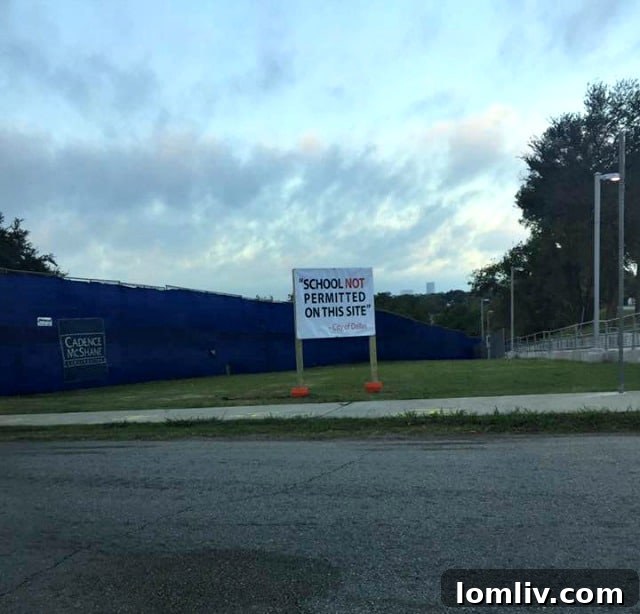
Adding weight to the opposition’s argument, a recent demolition permit shared by Councilman McGough on his Facebook page explicitly acknowledges this legal hurdle. The permit, dated September 16, includes a telling remark in its application notes: “Note: School is not permitted on this site.” This direct acknowledgment from city officials clearly indicates the city’s awareness and initial interpretation of the deed restriction’s implications for the proposed White Rock Trail Elementary.
Despite this, Clark conveyed the district’s confidence: “RISD believes it possesses the legal grounds to construct a school on this site and is actively collaborating with City staff to address and resolve this particular issue,” he stated, indicating that the district anticipates a legal battle or a process to challenge or circumvent the existing restriction, potentially prolonging the White Rock Trail Elementary project timeline.
Beyond Legalities: A Host of Unsuitable Site Characteristics for White Rock Trail Elementary
The deed restriction, while significant, is just one of many concerns for “We Have a Voice.” The group has compiled an extensive list of practical issues that they argue render the White Rock Trail site profoundly unsuitable for an elementary school, affecting both safety and the community’s quality of life.
Traffic Congestion and Significant Safety Hazards
“The site is strategically bounded by the only industrial site in District 10,” Yodh began, painting a grim picture of its challenging surroundings. “Furthermore, it’s flanked by active DART tracks, a busy access ramp, the heavily trafficked Walnut Hill Lane, and then White Rock Trail, which is a two-lane road that simply cannot be widened without significant disruption to the neighborhood and substantial infrastructure investment.”
The inability to widen White Rock Trail is a critical point. Yodh explained that expansion would necessitate residents on the street surrendering portions of their land, a contentious and highly resisted proposition. Moreover, “a little further south, the road traverses a floodplain and is riddled with drainage ditches – meaning any attempts at widening would trigger a complex and protracted engagement with the Army Corps of Engineers, adding immense cost and delay to the project, not to mention environmental complications.” This confluence of factors points to a perpetually congested and potentially hazardous area, raising serious questions about the daily safety of hundreds of young students, their parents, and the quality of life for neighborhood residents. The proposed two-story school, complete with a parking garage, is projected to generate even more traffic on White Rock Trail (for detailed building specs, see this packet from Richardson ISD). While RISD has conducted traffic studies suggesting re-timing traffic signals during school hours, crucial city traffic studies are still pending, leaving residents skeptical about the true traffic impact.
Sacrificing Walkability: A Core Lake Highlands Neighborhood Value
For the Lake Highlands community, walkability is not merely a convenience; it is a cherished aspect of their lifestyle and neighborhood identity. The group passionately argues that building a school on such a heavily trafficked and narrow site would irrevocably sacrifice this vital characteristic. “I personally witness children and their parents walking past my home every single morning, heading to the existing White Rock Elementary,” Yodh shared. “This culture of walking is deeply embedded in our neighborhood’s identity, something residents value immensely as it fosters community and healthy living.” The proposed White Rock Trail Elementary, they contend, would necessitate more car traffic, diminish pedestrian safety, and erode the very essence of what makes the existing White Rock Elementary and its surroundings so appealing, creating a less desirable community environment.
Topographical and Environmental Challenges of the Proposed Site
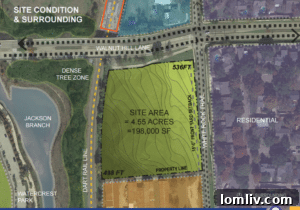
The lot size itself presents significant hurdles for a functional elementary school. “At just four and a half acres, the site is exceptionally small for a modern elementary school campus, especially one intended to accommodate growing student populations,” Yodh continued. “Even more problematic, it’s not a flat plot; it’s situated on a considerable slope, with a dramatic 39-foot change in elevation across its area. This challenging topography alone makes it incredibly difficult and prohibitively expensive to build on, requiring extensive and costly site preparation, retaining walls, and complex foundation work just to make it usable.” Such a compact and uneven site also raises serious concerns about adequate outdoor play spaces, athletic facilities, and green areas crucial for a child-friendly learning environment, potentially compromising the educational experience at White Rock Trail Elementary.
Furthermore, the proximity to an industrial site raises environmental concerns beyond just noise. Residents worry about potential air quality issues, odors, and the safety risks associated with industrial operations or the transport of hazardous materials near a school designed for young children. These factors, combined with the floodplain location, compound the environmental and safety challenges of the proposed site, creating a less than ideal setting for an elementary school.
Underestimated Costs and Questionable Financial Stewardship of Bond Money
The opposition group also scrutinizes the district’s financial projections for White Rock Trail Elementary. “RISD claims the school will cost $30 million,” Yodh stated, “but their figure conveniently omits the substantial costs of land acquisition and demolition, which can be millions of dollars. When you factor in these critical elements, plus a conservative 10 percent overrun that is common in construction projects of this scale, especially with challenging topography, the total expenditure easily balloons to $39 to $40 million.” This significant discrepancy raises serious questions about the district’s transparency in cost reporting and its responsible stewardship of public bond money approved by voters for educational needs, not inflated construction costs at problematic sites.
The Search for Alternatives: Were Other School Site Options Dismissed?
While “We Have a Voice” believes it is ultimately Richardson ISD’s responsibility to identify a suitable location, they have actively highlighted several viable alternatives that they contend were prematurely dismissed. “There are certainly better alternatives available within the Lake Highlands area,” Yodh insisted. “However, RISD appears to have made up its mind early in the process. They allocated a mere three weeks to actively search for land, which is an alarmingly short period for such a critical decision impacting public education for decades.”
Yodh outlined a contentious timeline, beginning in November 2015 when a community member first raised the overcrowding issue at a school board meeting. The community was advised to await demographic information scheduled for release in January. “The demographic data arrived in January, and remarkably, by the 26th of that same month, RISD was already in negotiations to purchase this specific property,” he noted, suggesting a predetermined agenda rather than a comprehensive search for the best site for White Rock Trail Elementary.
Further exacerbating community frustration, Yodh revealed, “Councilman McGough had diligently worked to negotiate a land swap with the Dallas Parks and Recreation Department. This presented a genuinely viable and community-friendly option, potentially providing more green space and a better environment, yet RISD inexplicably rejected it.” The group also points to other available commercial properties that, despite potentially higher land acquisition costs, might offer significantly lower construction expenses due to more favorable topography and fewer existing infrastructure challenges. “They include land costs when discussing alternative properties but conveniently exclude them when justifying this specific site, creating a misleading financial picture,” Yodh added, expressing a sentiment of being ignored. “They consistently seem to push through our opposition without genuinely listening to the community’s legitimate concerns about school site selection.”
Clark defended the district’s process, stating, “During discussions related to bond planning and addressing enrollment growth, RISD initiated evaluations of potential sites for land acquisition in the fall of 2015, specifically targeting areas experiencing the most significant enrollment growth within Lake Highlands.” He elaborated, “The area is densely developed, and both on-market and off-market properties and sites were thoroughly evaluated. The White Rock Trail site underwent evaluation in early 2016, with architects confirming its capacity to accommodate an elementary school.”
Clark concluded, “Based on comprehensive evaluations of all sites in the area, RISD staff concluded that the White Rock Trail site represented the best available location. It would provide the Board of Trustees with a direct option to alleviate enrollment growth precisely within the K-6 attendance area experiencing the highest levels of growth in RISD.” He further clarified that “RISD continued to evaluate sites even after the White Rock Trail property was purchased, and through this ongoing assessment, it was once again determined that the WRT location remained the most suitable site for a new school among all available options in the area.” The district claims to have considered over 15 potential sites, including existing district-owned land, with discussions held in closed sessions to maintain competitive negotiations, a practice that sometimes limits public transparency.
Community Engagement: A Dialogue or a Monologue?
In a recent development, the district announced its intention to form a committee of neighborhood stakeholders to address community concerns regarding the White Rock Trail Elementary project. However, Yodh expressed skepticism regarding its inclusivity. “I immediately sent emails to the board, inquiring whether ‘We Have a Voice’ would be represented on this committee, ensuring a direct voice from the opposition,” he recalled. “The response? Crickets. I haven’t received a single reply.” He noted that the committee, as currently constituted, comprises district officials, PTA presidents, Dad’s Club presidents, and representatives from homeowners associations—a composition that, according to Yodh, may not fully capture the breadth and intensity of the opposition, leading to questions about genuine community engagement.
A Glimpse into the Future: Litigation and Threats of Overflow
Yodh anticipates a confrontational path forward for the White Rock Trail Elementary project. “They will inevitably apply for the necessary permits, the City will likely deny them based on the existing deed restriction and known site challenges, and then it will undoubtedly escalate into litigation,” he predicted. He reiterated the core arguments of the opposition: “Regardless of school boundaries or demographic makeup, the site is demonstrably unsafe, lacks walkability, will create immense traffic problems, and is simply too expensive for the taxpayers. It’s an irresponsible use of public funds.” He concluded with a passionate plea for fiscal responsibility: “Yes, the voters approved this bond money, but it is imperative that you spend it wisely and responsibly, choosing a site that genuinely benefits the children and the community, not just a convenient plot of land.”
Adding another layer of tension, families within the White Rock Elementary zone report being cautioned that if this specific site is rejected due to community opposition, their children could face reassignment to schools located significantly further from their homes, an implicit threat that has caused considerable distress.
“If the district intends to undertake a comprehensive redrawing of attendance boundaries, we understand that as a necessity in a growing district,” Yodh clarified. “What we vehemently oppose is the perceived threat: that if this project fails, our children will be arbitrarily pulled from White Rock Elementary and sent to the Lake Highlands school furthest away – which is Thurgood Marshall Elementary, a significant distance for many families.” He pointed out a more logical alternative within existing capacity: “Lake Highlands Elementary is not at capacity and is geographically closer for many of these students. For instance, only 350 children actually reside within Lake Highlands Elementary’s official attendance zone, yet its current attendance is 650 due to transfers and special programs. Its capacity stands at 750.” This suggests that a more nuanced approach to capacity management exists without resorting to distant overflow threats.
Clark addressed the overflow scenario: “The earliest a new school could realistically open is for the 2018-19 school year. Should any planning or construction delays occur, this timeline could extend to the 2019-2020 academic year. Meanwhile, White Rock Elementary’s enrollment is projected to exceed 1,000 students by 2018, underscoring the urgency of a solution.” He added, “Additional portable classrooms at WRE are no longer considered a viable option from a school operations standpoint. Therefore, once different grade levels reach full capacity—which is highly probable during pre-registration in the spring—students would be temporarily assigned to other RISD schools that possess available capacity in their respective grade levels through a process known as overflow.”
Regarding specific overflow destinations, Clark explained, “The district will not have a clear understanding of which other schools will have available space in various grade levels for the 2018-19 school year until late spring or summer of 2018. Given the projected high number of students requiring overflow, a combination of schools will likely accommodate WRE students until the new school can open. This could potentially include both Lake Highlands and Thurgood Marshall elementary schools, among others, depending on available space, which is a fluid situation.”
History Repeats Itself? A Cautionary Tale from 1996 in Lake Highlands
Long-standing residents of the Lake Highlands neighborhood suggest that Richardson ISD may be overlooking crucial lessons from its own past, specifically a remarkably similar situation from 1996. “RISD faced a remarkably similar situation back in 1996 regarding a proposed educational facility,” Yodh recounted. “At that time, they proposed building a freshman center on White Rock Trail, approximately 1,100 feet from the current controversial site for White Rock Trail Elementary. That proposed location was on the south side, where nursing homes now stand.”
He continued, highlighting the parallels: “They purchased that piece of land, immediately encountered overwhelming neighborhood opposition due to various concerns, and ultimately, after significant community pressure, they backed off. The freshman center was eventually built at its current, more suitable location, demonstrating that community input can, and should, influence district decisions.”
Yodh shared a poignant anecdote from that time: “My neighbor recalls asking the school board members, ‘How many of you have actually visited this proposed site?’ Only three out of seven raised their hands. It turned out that particular site was also in a floodplain, presenting similar environmental and cost challenges to what we see today.” This historical precedent serves as a powerful reminder for the community and a cautionary tale for the district, suggesting that ignoring local concerns and site challenges can lead to costly delays and community dissatisfaction.
Uncertainty for the Future of White Rock Trail Elementary
Rahul Yodh, whose own children attend private schools, reflects on the broader implications should RISD press forward with the current site for White Rock Trail Elementary. “The families who would be zoned for this new school are generally affluent and have the financial means to opt for private education,” he observed. “So, if the district proceeds with building on such a contentious and problematic location—one riddled with deed restriction, traffic impact, and environmental concerns—I genuinely wonder how many parents will ultimately choose to send their children there.” This potential flight of students to private schools could undermine the new school’s effectiveness, create socioeconomic disparities, and further complicate enrollment projections for the district, raising questions about the long-term viability and success of the project. The battle for White Rock Trail Elementary is far from over, representing a critical test of community power versus district authority in the evolving landscape of urban education in Lake Highlands.