

Texas Property Tax Reform: Unpacking SB 2 and the Quest for Fairness
Texas homeowners have long grappled with the burden of rising property taxes, a persistent issue that has fueled calls for significant reform. The proposed Senate Bill 2 (SB 2) emerged as a legislative effort to address these concerns, aiming to provide much-needed relief to taxpayers across the state. This comprehensive look delves into the intricacies of Texas’s property tax system, the core issues highlighted by legislative reports, and the potential impact of SB 2, while also pointing out critical areas that still demand attention for a truly equitable system.
The journey into understanding Texas property taxation often begins with official reports that lay bare the system’s complexities and shortcomings. A detailed interim report by the Senate Select Committee on Property Tax Reform & Relief serves as the foundational document for discussions around SB 2. This extensive 90-page analysis meticulously outlines the challenges faced by homeowners and sets the stage for legislative action designed to stem the tide of escalating tax bills. However, even a deep dive into such official documents reveals underlying issues that continue to confound efforts towards complete transparency and fairness.
The Elephant in the Room: Non-Disclosure of Real Estate Sales Prices
One glaring omission from many discussions on Texas property tax reform, and a critical factor influencing valuation accuracy, is the state’s non-disclosure policy regarding real estate transaction sales prices. Texas remains one of a handful of states where actual property sale prices are not publicly recorded or made readily available to Central Appraisal Districts (CADs). This lack of transparent data profoundly impacts the entire valuation process, creating a system that is inherently flawed and often perceived as unfair.
Without access to accurate, up-to-date sales data, CADs are forced to rely on less precise methods for property valuation, making it incredibly difficult to achieve truly accurate assessments. This data gap disproportionately benefits the affluent, who often own higher-priced properties. Anecdotal evidence, and even a quick glance at multi-million dollar properties in major Texas cities like Dallas, reveals a consistent pattern: these high-value estates are rarely appraised at figures close to their actual market value or asking price. Conversely, lower-priced properties tend to be appraised with greater accuracy, meaning their owners effectively bear a larger proportional share of the tax burden.
This systemic issue is further exacerbated by a well-established tactic among the wealthy: hiring tax consultants to challenge CAD valuations. While their homes are listed for millions more than their assessed value, these property owners often successfully argue for lower appraisals, thereby reducing their tax obligations. This practice, widely criticized and even highlighted in national political discourse, underscores how the non-disclosure of sales prices creates loopholes that primarily benefit those with the resources to exploit them, perpetuating an inequitable system. True reform, therefore, must confront this fundamental lack of transparency at its core.
An Opaque System by Design: Appraisals and Taxation
Beyond the sales price non-disclosure, the overall property tax system in Texas often appears opaque, leading many taxpayers to question its fairness and integrity. Understanding one’s property tax bill requires dissecting two primary components: the assessed value, determined by the CAD, and the rate of taxation, set by various local entities. Both elements can be protested by property owners, though the process is often fraught with challenges and costs.
The Central Appraisal District (CAD) and Appraisal Review Board (ARB) Process
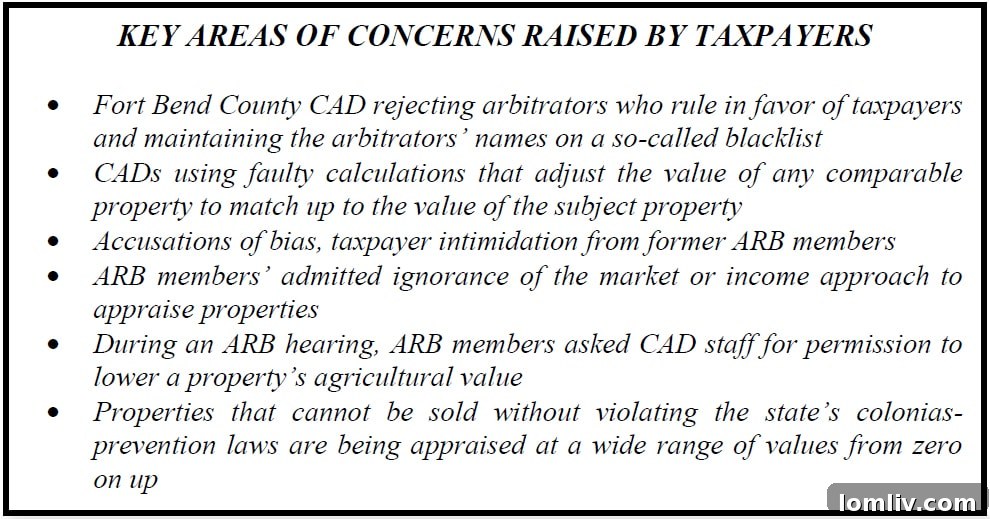
Central Appraisal Districts are tasked with determining the market value of properties within their jurisdiction. However, the methodology CADs employ is frequently perceived as complex and lacks transparency, often described as a “witch doctor formula” by frustrated homeowners. This obscurity contributes significantly to taxpayer distrust. While property owners have the right to protest their appraised value to an Appraisal Review Board (ARB), testimony consistently suggests that taxpayers feel the system is rigged against them and they do not expect to be treated fairly by the ARB.
Reports have even cited instances where CADs maintained “blacklists” of ARB members – public citizens appointed to these boards – effectively disinviting them in subsequent years if they were deemed “too soft” on homeowners. Such practices reinforce the perception of a biased system, further eroding public confidence and making meaningful protest challenging for the average citizen. It’s no wonder homeowners feel the deck is stacked against them when the very mechanisms designed for oversight appear to be manipulated.
Components of the Taxation Rate: M&O vs. I&S
Once an appraisal value is set, the tax rate is applied. This rate is comprised of various components, primarily driven by local taxing entities such as school districts, cities, and counties. For cities and counties, two main components often stand out: Maintenance and Operations (M&O) and Interest & Sinking (I&S).
- Maintenance and Operations (M&O): This portion of the tax rate funds the day-to-day expenses of local government, covering everything from public safety and parks to administrative costs. M&O rates are more flexible and can be adjusted annually based on budgetary needs.
- Interest & Sinking (I&S): This component is specifically earmarked for the repayment of debt, primarily from bonds issued for large infrastructure projects like roads, facilities, or school construction. I&S rates are generally more stable, moving primarily with changes in bond interest rates and debt repayment schedules.
A critical aspect of the M&O rate is the “rollback rate.” Currently, if a taxing entity’s M&O revenue growth exceeds 8 percent annually, it can trigger a rollback election, allowing citizens to vote on whether to reduce the tax rate. While 8 percent may seem like a reasonable threshold, it’s a CAD-wide figure, not specific to individual properties. For homesteaders, individual property values can increase by up to 10 percent per year due to state caps, meaning tax bills can rise significantly even if the overall CAD revenue growth stays below the 8 percent trigger. Furthermore, taxing entities can perpetually levy taxes just under the 8 percent threshold (e.g., 7.99 percent), leading to substantial cumulative increases over time without ever triggering a vote. Adding to this complexity, new construction and first-time homestead exemptions are often excluded from rollback rate calculations, further masking the true extent of tax revenue increases, especially in rapidly developing areas like Dallas.
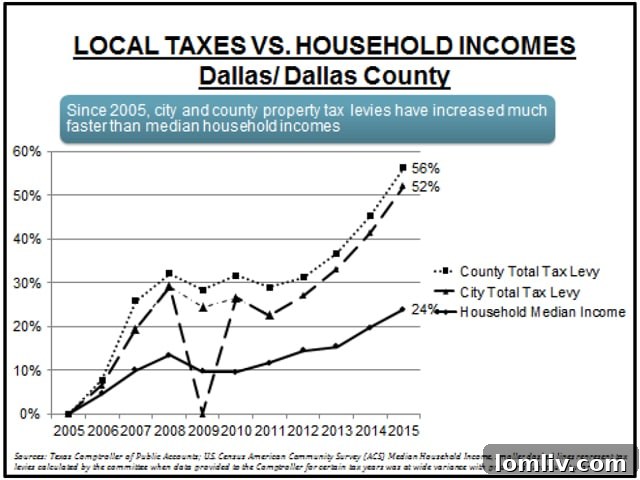
The impact of this system is starkly illustrated by examples from Texas’s largest metropolitan areas. In Dallas, for instance, despite static city and county tax rates from 2012 to 2015, property values soared by over 19 percent in both taxing units during the same period. The result for homeowners? A more than 19 percent increase in their tax bills without any explicit rate hike by their local governments. This “taxation by valuation” effectively allows cities to collect significantly more revenue while claiming they haven’t raised tax rates, shifting the blame to rising property values and appraisals.
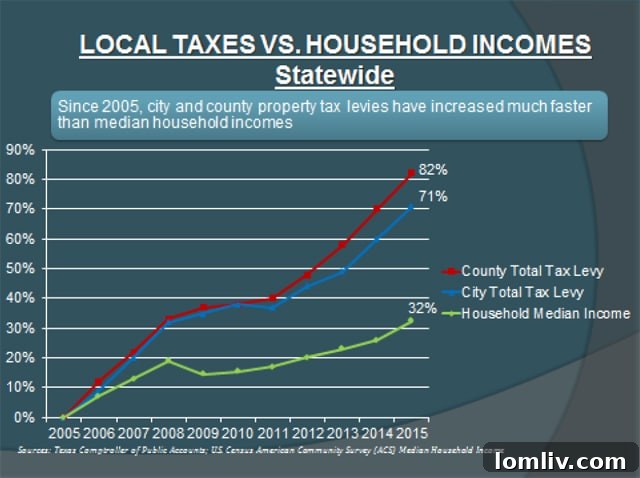
This challenge is not unique to Dallas. Tarrant County has been identified as the state’s most complained-about county regarding property taxes, according to State Senator Paul Bettencourt, the author of SB 2. Similarly, Bexar County (San Antonio) has experienced a staggering 30 percent increase in total property tax revenue over three years. Across Texas’s largest cities, property taxes have outpaced household income growth by 2.5 to 3 times since 2005, creating an unsustainable financial strain for many families. This growing disparity between tax increases and stagnant wages lies at the heart of the current tax ideology debate.
The Disconnect: Stagnant Wages vs. Soaring Property Values
Public opinion on taxation has shifted dramatically over decades. In the past, citizens were often more accepting of higher tax rates because those rates represented a smaller proportional impact on their overall buying power. However, with decades of stagnant wage growth coupled with increasing costs of living, property taxes now consume a disproportionately larger share of household income. Had wages kept pace with inflation, or even doubled or tripled since the early 2000s, public sentiment regarding tax bills would likely be vastly different. The current outrage stems from a fundamental economic imbalance where income growth has failed to keep pace with asset inflation and the resulting tax burden.
This duality of stable tax rates and skyrocketing appraised values creates a convenient mechanism for local leaders to sidestep accountability. City officials can proudly proclaim they haven’t raised tax rates, all while enjoying a newfound surge in revenue. Central Appraisal Districts, in turn, can argue they are simply fulfilling their duty of appraising property, without directly “raising taxes.” Yet, despite these claims, the overall pot of money collected from taxpayers continues to expand significantly. This system effectively allows various entities to point fingers at each other, leaving homeowners feeling unheard and burdened.
SB 2: A Glimmer of Hope for Reform?
Against this backdrop, SB 2 proposes several key reforms aimed at increasing taxpayer control and transparency. One of the central tenets of the bill is to lower the existing 8 percent rollback rate to 4 percent. Crucially, under SB 2, crossing this lower 4 percent threshold would automatically trigger a tax ratification election, similar to how school tax votes are conducted. This proposed change would make it significantly easier for citizens to challenge and potentially roll back excessive tax rate increases, shifting the power dynamic back towards the taxpayers.
Currently, protesting tax rate increases is an arduous process. It requires a petition signed by 7 percent of registered voters within 90 days to trigger a rollback election. This high bar and short timeframe often make successful petitions nearly impossible, allowing higher rates to be adopted without public consent. SB 2’s automatic election trigger would fundamentally change this dynamic, forcing taxing entities to be more fiscally conservative or face a direct vote from their constituents.
Addressing Voter Suppression in Tax Elections
Another critical area SB 2 seeks to reform is the manner in which special tax elections are scheduled and conducted. The current system has revealed practices that can only be described as forms of voter suppression, leading to alarmingly low turnout and outcomes that do not reflect broad public will.
The report cites Galveston County as a prime example. Between 2008 and 2016, five school tax votes were scheduled, with voter turnout ranging from a dismal 4 to 11 percent. None of these elections were strategically aligned with major national or state election dates, ensuring minimal public engagement. One election was even scheduled just days before Labor Day, predictably garnering the lowest turnout of four percent. This deliberate scheduling strategy, often targeting periods of low public interest, effectively manipulates election outcomes in favor of tax increases.
Furthermore, these special school or property tax elections are not held to the same stringent standards as “real” general elections. They are not required to use county administrators, nor do they always comply with standard requirements for polling stations or electronic voting machines. Reports even detail instances like a Houston MUD election held in a residential garage, or “rolling voting” in Plano where polling locations shifted throughout the day to areas likely to favor the tax. These practices undermine the integrity of the democratic process.
Adding to these concerns, general elections require 78 days to prepare necessary ballots for absentee voters. In contrast, tax ratification elections often only require 30 or 45 days, significantly reducing the window for absentee voters to participate. Shorter preparation windows also mean less time for publicizing the vote, further contributing to low awareness and turnout.
SB 2 proposes a straightforward solution: requiring all such tax-related votes to be held concurrently with national or statewide elections in November. This common-sense reform would dramatically increase voter participation and ensure that decisions on crucial tax matters are made by a broader, more representative electorate. It will be telling to observe which Central Appraisal Districts and taxing entities voice the strongest opposition to this measure, as their resistance would likely stem from a vested interest in maintaining the current low-turnout system.
The Unaddressed Core: Sales Price Transparency for True Reform
While SB 2 represents a significant step forward in property tax reform, particularly in empowering taxpayers through a lower rollback rate and fairer election scheduling, it still sidesteps the “flaming pink elephant” of real estate purchase price disclosures. Without full transparency in actual sales data, the system remains fundamentally flawed, and true equity will be elusive.
Imagine a scenario where CADs had immediate access to real sales data and were mandated to appraise properties at their actual market value. Not only would the wealthy finally be compelled to pay their fair share, but the resulting surge in accurate property valuations and subsequent tax revenue increases would undoubtedly blow past even a 4 percent rollback rate. This would automatically trigger numerous elections on tax rates across the state, forcing a direct conversation between taxpayers and their local governments about spending and priorities.
It is almost guaranteed that faced with widespread public elections on tax rates, the Texas Legislature and cities across the state would be forced to find ways to reduce those potentially “whopping big bills” before they became due. The political pressure from an engaged and informed electorate would be immense, as failure to address these concerns would inevitably lead to significant electoral consequences for incumbents. This highlights why accurate data, particularly real estate sales prices, is not just about fairness but is a powerful tool for democratic accountability. While SB 2 is a commendable effort, it will remain incomplete without addressing this one, very important, flaming pink component.
Conclusion: Towards a Fairer Texas Tax System
The debate surrounding Texas property taxes is complex, deeply rooted in economic disparities, systemic opaqueness, and legislative challenges. SB 2 aims to tackle several critical issues, from lowering the rollback rate to reforming special election processes, all of which are vital steps toward greater taxpayer empowerment. However, the journey toward a truly equitable and transparent property tax system in Texas will remain unfinished until the fundamental issue of real estate sales price non-disclosure is addressed. Only then can homeowners be assured that their property values are assessed accurately, and their tax burdens are truly reflective of a fair and transparent market.
***
About the Author
Focusing on high-rises, HOAs, and renovation, this author also appreciates modern and historical architecture, often engaging with the YIMBY movement. Recognized with Bronze and Silver awards from the National Association of Real Estate Editors in 2016, the author is dedicated to insightful real estate commentary. Interested in hosting a Candysdirt.com Staff Meeting event or have a compelling story to share? Reach out via email at [email protected].