In today’s fast-paced digital economy, the seamless movement of money is more crucial than ever. From paying bills online to purchasing a new home, electronic transfers have become the backbone of financial transactions. While the ease and speed of sending money digitally are often taken for granted, it’s vital to understand that not all money transfers are created equal. Among the most common methods for electronic fund transfers (EFTs) are wire transfers and Automated Clearing House (ACH) transfers. Though both facilitate the digital movement of money from one bank account to another, they operate distinctly, each with its own advantages, limitations, and ideal use cases.
The term electronic funds transfer (EFT) serves as a broad umbrella, encompassing a wide array of financial transactions. Beyond wire and ACH transfers, EFT payments include e-checks, ATM withdrawals, point-of-sale (POS) transactions, direct deposits, and even peer-to-peer payment apps. This digital evolution has largely replaced cumbersome paper-based systems, offering unparalleled convenience and efficiency. However, for critical transactions, such as closing on a real estate property, knowing the nuanced differences between specific EFT methods like wire and ACH is not just helpful—it’s absolutely essential for ensuring the smooth and secure completion of your financial commitments.
Wire Transfers: Speed, Security, and Finality for High-Stakes Transactions
Wire transfers represent a direct and highly efficient method for sending funds electronically from one bank account to another. Often considered the premium option for money movement, wire transfers are characterized by their speed and the finality of the transaction. When funds are sent via wire, they are typically available in the recipient’s bank account within a matter of hours, often much faster, making them instantly accessible. This near real-time settlement is a primary reason why wires are the preferred method for large transactions where time is of the essence, and immediate access to funds is critical.
The process of a wire transfer involves a direct communication channel between the sending and receiving financial institutions. Unlike other methods that rely on batch processing, a wire transfer is processed individually, ensuring prompt delivery. This directness contributes to their reliability; once funds have been wired and processed, reversing the transfer is exceptionally difficult, if not impossible. This finality, while a significant advantage for recipients needing immediate assurance of funds, also underscores the importance of absolute accuracy and verification by the sender.
While wire transfers offer unparalleled speed and reliability, they are not without cost. Both the sender and, in some cases, the recipient may incur fees. These wire transfer fees are set independently by each financial institution and can range significantly, typically from $10 to $100 per transaction, depending on whether it’s an outgoing or incoming transfer, and if it’s domestic or international. Despite these costs, the assurance of rapid and final settlement often justifies the expense for critical transactions.
The inherent directness and speed of wire transfers make them particularly attractive for high-value transactions like real estate closings. Title companies, responsible for ensuring clear property ownership and facilitating the secure transfer of funds, almost exclusively prefer wire transfers. They offer a level of security and dependability that surpasses other methods, including cashier’s checks, which can be prone to counterfeiting and take longer to clear. However, this preference comes with a critical caveat: wire transmissions are unfortunately frequent targets of sophisticated scams. It is paramount for clients to meticulously confirm the recipient’s identity and account details through independent and verified channels (e.g., calling the title company on a known, publicly listed number, not one provided in an email) before initiating any wire transfer. Wire instructions will always include the bank routing number, account number, and the precise name of the party receiving the money, all of which must be double-checked with extreme caution.
ACH Transfers: The Cost-Effective Choice for Everyday Electronic Payments
An Automated Clearing House (ACH) transfer is another powerful electronic method for moving money, but it operates on a fundamentally different principle than a wire transfer. Imagine ACH as the digital equivalent of sending a check, but without the paper. This system has rapidly become a cornerstone of modern finance, extensively used for automated bill payments, direct payroll deposits, and popular person-to-person payment apps like PayPal, Venmo, or Zelle. ACH transfers are processed through a central network, the Automated Clearing House, which facilitates a vast volume of debit and credit transactions across U.S. financial institutions.
The operational model of ACH involves processing transfers in large batches or groups, typically multiple times a day, rather than individually in real-time. This batch processing approach is what makes ACH transfers incredibly cost-effective. Most ACH transfers are either free for the sender or involve a minimal fee, usually just a few dollars, making them an appealing option for consumers and businesses alike. This low cost is a significant advantage, especially for frequent or recurring transactions where the amount is smaller and immediate settlement isn’t the highest priority. Consumers frequently leverage ACH for utility payments, loan installments, insurance premiums, and various subscription services, appreciating the convenience of automated, low-cost recurring payments.
However, the cost-effectiveness of ACH comes with a trade-off: speed. Because transactions are processed in batches and require clearing through the ACH network before being settled by the receiving bank, ACH transfers typically take longer to complete than wire transfers. While some may clear within a few hours, it’s more common for ACH payments to take anywhere from 1 to 3 business days, and sometimes even longer, to fully process and for funds to become available in the recipient’s account. This extended processing time makes ACH transfers unsuitable for situations where immediate fund availability is critical, such as real estate transactions.
Moreover, another key differentiator and a significant concern for high-value, time-sensitive transactions is the reversibility of ACH payments. Unlike the finality of wire transfers, ACH transfers can often be reversed under certain circumstances, such as unauthorized transactions or errors. The specific criteria and timeframes for stopping an ACH transfer are determined by each bank and the ACH network rules, but this inherent reversibility introduces an element of risk for recipients who require guaranteed funds. For instance, in real estate sales, the closing cannot be completed, and property ownership does not legally transfer until all funds are confirmed and irrevocably processed by the title company. ACH payments simply do not meet the definition of “good funds” as stipulated by regulations like the Texas Insurance Code, Title XI, Section 2651.202, which requires funds to be immediately available and irrevocable. Sending a title company an ACH transfer for closing funds is a recipe for delays, potential complications, and ultimately, a failed closing.
Wire vs. ACH: A Comparative Analysis and Why the Choice Matters
Understanding the fundamental differences between wire and ACH transfers is not merely an academic exercise; it has real-world implications for financial security, transaction efficiency, and legal compliance. Here’s a concise comparison of their key attributes:
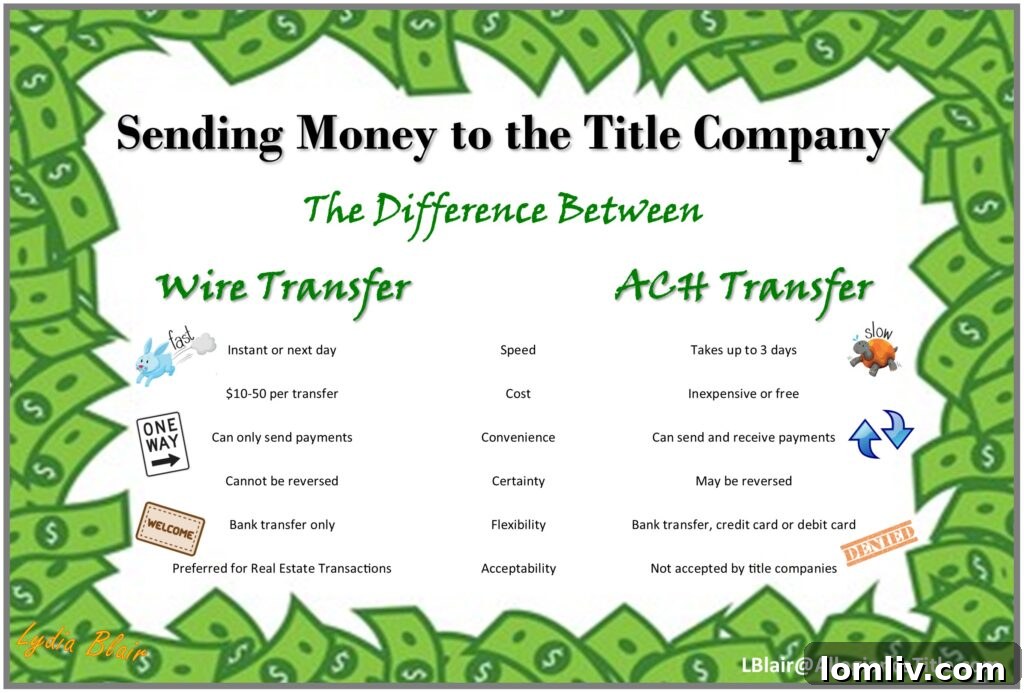
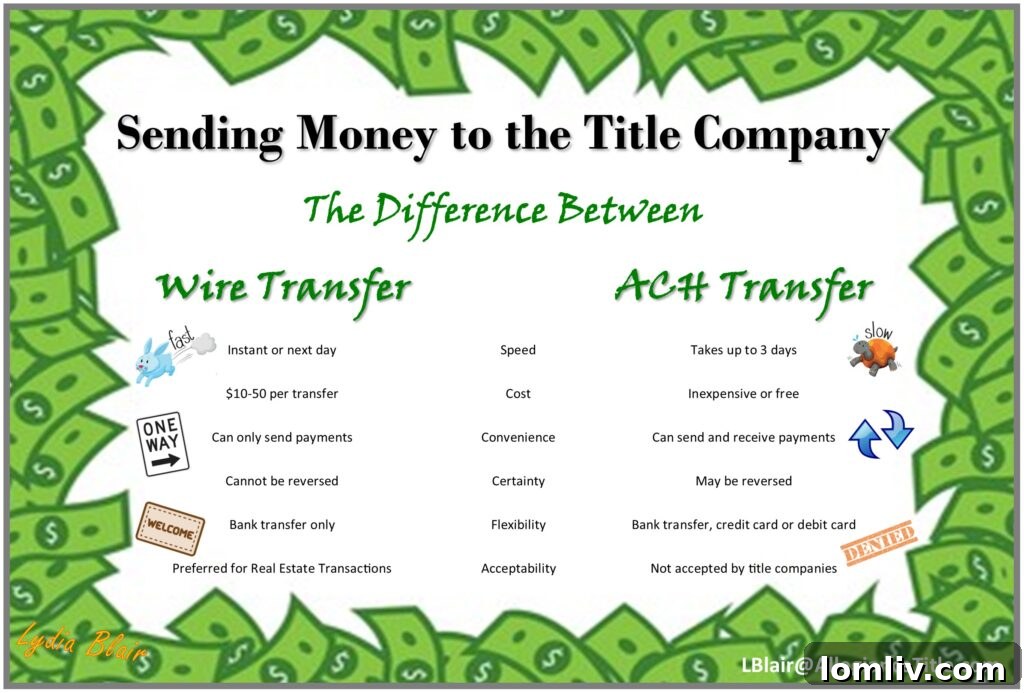
- Speed: Wire transfers offer near real-time settlement, with funds often available within hours. ACH transfers typically take 1-3 business days to clear, due to batch processing.
- Cost: Wire transfers usually involve higher fees for both sender and sometimes receiver (ranging from $10-$100). ACH transfers are often free for the sender or incur very low fees (a few dollars).
- Finality/Reversibility: Wire transfers are generally irreversible once sent, providing immediate finality. ACH transfers can often be reversed within certain timeframes or under specific conditions.
- Security: Both methods are secure when handled correctly, but wire transfers are a prime target for fraud due to their high value and finality, requiring extreme vigilance. ACH offers some protection with its reversibility feature for unauthorized transactions.
- Use Cases: Wire transfers are ideal for time-sensitive, high-value, and critical transactions like real estate closings, large business payments, and international transfers. ACH transfers are best suited for recurring payments, direct deposits, bill payments, and everyday consumer transactions where immediate funds aren’t paramount.
The choice between a wire transfer and an ACH transfer hinges entirely on the specific needs of the transaction. For routine payments like utility bills or payroll, the cost-effectiveness and convenience of ACH transfers make them an excellent choice. However, for situations demanding immediate and guaranteed fund availability, especially when large sums of money are involved and the transaction’s success depends on it, wire transfers are the undisputed preferred method.
The Critical Choice for Real Estate Transactions: Always Wire
For anyone involved in buying or selling property, the distinction between wire and ACH transfers is not just important; it is paramount. Real estate transactions operate on strict timelines and legal requirements, with the concept of “good funds” being central to the closing process. Good funds, by definition, are funds that are immediately available for disbursement by the title company without any risk of reversal or future clawback. This is precisely why wire transfers are the only acceptable method for sending closing funds to a title company.
Attempting to use an ACH transfer for a real estate closing is a perilous path that can lead to significant delays, potential legal complications, and even the collapse of the transaction. The multi-day clearing period of ACH transfers directly conflicts with the immediate “good funds” requirement. Furthermore, the inherent reversibility of ACH payments poses an unacceptable risk to title companies, who are legally bound to ensure that all funds are fully settled and irrevocable before transferring title and disbursing money to various parties involved in the sale.
It is the buyer’s responsibility to ensure that “good funds” reach the title company on time, and this invariably means using a confirmed wire transfer. If your bank representative mistakenly advises that wire and ACH transfers are interchangeable, they are incorrect, particularly concerning real estate. Always follow the explicit instructions provided by your title company to the letter. These instructions are designed to protect all parties involved and ensure a smooth, secure, and legally compliant closing.
In conclusion, while both wire and ACH transfers are invaluable tools in the digital financial landscape, their differences are profound and critical. For the vast majority of everyday transactions, ACH offers a convenient and affordable solution. However, when it comes to high-value, time-sensitive, and legally binding transactions like real estate purchases, wire transfers stand as the indispensable method, providing the speed, finality, and security required to navigate these complex financial landscapes successfully. Always verify, always follow instructions, and always opt for a wire transfer for your real estate closing funds.