Revolutionizing Homebuilding: Austin’s 100-Home 3D-Printed Community
The global construction industry has long grappled with formidable challenges, from persistent supply chain disruptions to critical labor shortages. These hurdles have not only inflated costs but also slowed down the delivery of much-needed housing. In this climate of innovation and necessity, a groundbreaking development in Austin, Texas, is poised to redefine the future of homebuilding: the world’s largest community of 3D-printed homes.
This ambitious project is the brainchild of a powerful collaboration between two industry titans: Lennar Homes, one of the nation’s leading homebuilders, and ICON, an Austin-based construction technology firm at the forefront of advanced robotic construction. Together, they announced plans for a pioneering 100-home development in the vibrant city of Austin, signaling a monumental shift towards more efficient, sustainable, and resilient construction methods. Esteemed architectural firm Bjarke Ingels Group (BIG) is lending its renowned design expertise to shape the aesthetic and functional blueprint of this revolutionary neighborhood.
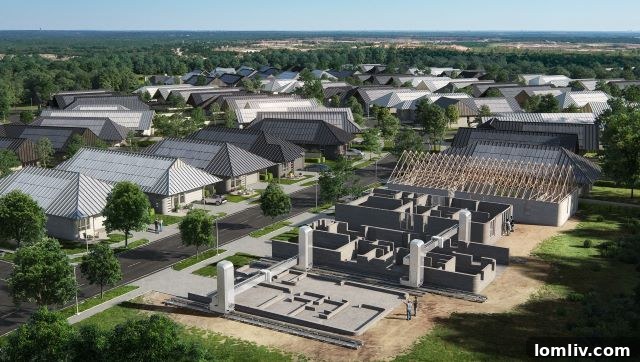
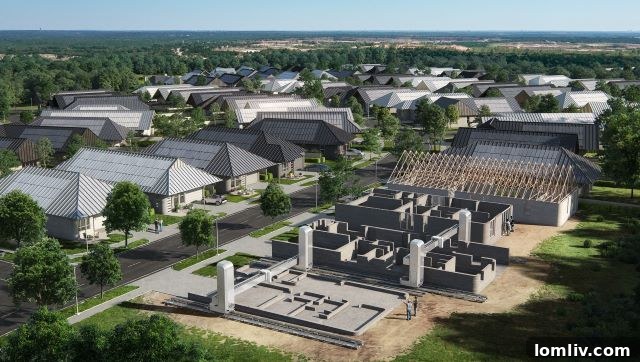
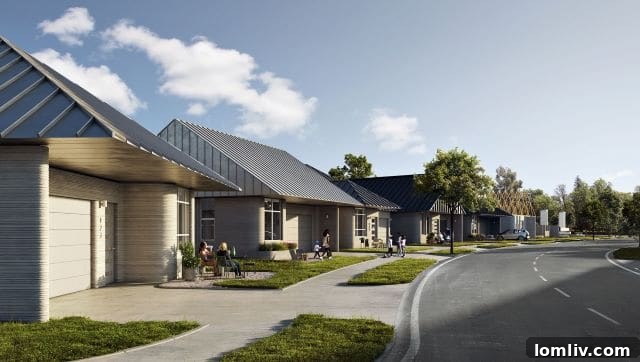
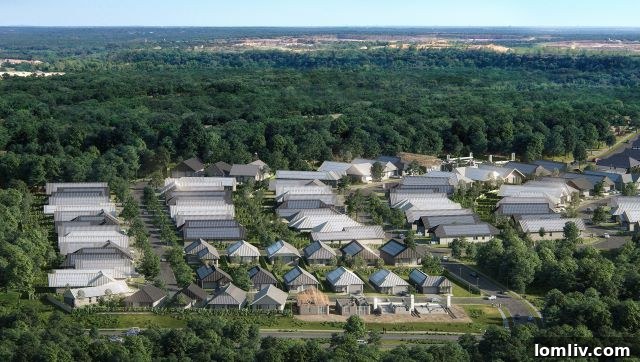
The announcement was accompanied by captivating digital renderings that offered a glimpse into this futuristic community. These visualizations showcased an array of homes, each distinct yet harmoniously integrated, topped with advanced photovoltaic roofs designed to harness solar energy. The core innovation lies in the construction process itself: houses will be printed directly on-site using ICON’s proprietary robotic technology and a specialized, concrete-based building material. This method bypasses many traditional construction constraints, promising a faster, more economical, and environmentally friendlier approach to building.
The Science Behind the Structure: ICON’s Advanced 3D Printing Technology
ICON’s technology represents a paradigm shift in how homes are constructed. The company proudly asserts that its method is significantly faster and more cost-effective than conventional construction techniques, which heavily rely on steel, aluminum, and lumber—materials often subject to price volatility and supply chain bottlenecks. At the heart of ICON’s process is a sophisticated system featuring five app-controlled robotic printers, each a formidable piece of machinery weighing nearly two tons. These robotic marvels are engineered to extrude a specially formulated concrete mix known as Lavacrete. Imagine the precision and fluidity of a Dairy Queen soft-serve machine, but on an industrial scale, laying down concrete at an impressive rate of five to seven linear inches per second, layer by meticulous layer, to form the walls of a house.
Lavacrete is more than just concrete; it’s a high-performance material designed for durability, thermal efficiency, and structural integrity. Its unique composition allows for rapid curing, enabling the continuous build-up of layers without extensive waiting periods. This material, combined with the precision of robotic automation, drastically reduces the construction timeline. A typical single-family home, which might take months to build using traditional methods, can have its structural shell printed in a matter of days or even hours. This speed is critical for addressing urgent housing demands and increasing the overall output of residential units.
Beyond speed and cost, ICON’s 3D printing technology champions sustainability. The additive manufacturing process inherently generates less waste compared to conventional methods, which often involve significant material cut-offs and discarded components. Furthermore, the ability to print on-site minimizes transportation costs and associated carbon emissions. The integration of photovoltaic roofs into the Austin community design underscores a holistic commitment to energy efficiency and a reduced environmental footprint, aligning with global efforts towards greener building practices.
Could 3D-Printed Technology Transform Dallas-Fort Worth’s Housing Market?
While Austin leads with this groundbreaking initiative, the question naturally arises: how applicable and effective would 3D-printed technology be in other burgeoning markets like Dallas-Fort Worth (DFW)? DFW stands as one of the fastest-growing metropolitan areas in the United States, with housing developments continually emerging across its suburbs, exurbs, and even rural fringes. Despite persistent supply chain and labor challenges, the demand for housing in DFW remains insatiable, making it a prime candidate for innovative construction solutions.

To gauge the potential impact of 3D printing in DFW, we consulted with several active development firms. Among them, Tom Woliver of Dallas-based Oxland Advisors offered a thoughtful and pragmatic perspective. Woliver, known for his meticulous approach to development—only proceeding when feasibility is unequivocally clear and data-driven insights support the venture—expressed cautious optimism regarding the 3D-printed housing concept. He acknowledged it as “a very interesting innovation,” recognizing its significant potential to disrupt traditional building paradigms.
However, Woliver also tempered his enthusiasm with a realistic assessment of the implementation timeline for such transformative technologies. “It is exciting to see this new innovation in a much-needed industry,” he noted, “however, it often takes years to decades to implement these new technologies.” This statement highlights a crucial aspect of technological adoption: the journey from invention to widespread application is rarely instantaneous. It requires overcoming numerous practical, regulatory, and societal hurdles.
Woliver meticulously outlined three critical stages that the 3D-printed housing concept must navigate to achieve widespread success and integration into markets like DFW:
1. Training and Education for a New Workforce
The advent of 3D printing in construction necessitates a profound shift in the skills required within the labor force. Traditional trades—carpenters, masons, electricians—will still be vital, but new roles will emerge alongside them. There will be a significant demand for individuals proficient in operating and maintaining advanced robotic printers, managing digital blueprints, understanding material science specific to Lavacrete-like compounds, and integrating smart home technologies. This demands robust new training programs, vocational certifications, and educational pathways to prepare a workforce capable of servicing and expanding these innovative products. Without adequately trained personnel, even the most advanced technology cannot scale effectively.
2. Adapting Building Codes and City Ordinances
One of the most substantial regulatory barriers for any new construction technology is the existing framework of building codes and city ordinances. These regulations, often developed over decades, are designed around conventional construction materials and methods. For 3D-printed structures, which utilize novel materials and a fundamentally different construction process, current codes may not directly apply or may require extensive interpretation and amendment. Woliver emphasized, “it will likely take decades for the building codes and city ordinances to catch up on what the acceptable practices are.” This process involves rigorous testing, demonstration of structural integrity, fire safety evaluations, and environmental impact assessments to gain approval from regulatory bodies. Municipalities and national standards organizations will need to collaborate closely with innovators like ICON to establish new, specific guidelines that ensure safety and quality for 3D-printed homes.
3. Market Acceptance and Long-Term Scalability
Beyond the technical and regulatory aspects, the successful adoption of 3D-printed housing hinges on market acceptance. Consumers, lenders, and insurance companies must all develop confidence in the long-term durability, value, and insurability of these homes. While initial projects generate considerable excitement, widespread acceptance requires proving their resilience through various environmental conditions, demonstrating their energy efficiency over time, and ensuring that their resale value holds comparable to traditionally built homes. Overcoming skepticism and building trust takes time, requiring successful early projects to serve as compelling proof points. Only then can the technology truly scale to address housing needs on a broad scale.
Despite these significant considerations, Woliver concluded on a note of undeniable optimism: “All this being said, it is only a matter of time before these types of innovations enter into this much-needed industry.” His foresight underscores the inevitability of such advancements, driven by the persistent pressures on the housing market and the compelling advantages offered by 3D printing.
In-Depth Look at the Technology and Its Impact
The concept of a 100-home 3D-printed community in Austin isn’t merely a theoretical blueprint; it’s built upon prior successful implementations and rigorous testing. ICON, demonstrating the viability of its technology, previously partnered with Kansas City developer 3Strands to construct a series of 3D-printed homes in East Austin. This pilot project yielded impressive results: four homes, ranging in size from approximately 1,000 to 2,000 square feet, had their structural components printed in less than a week. This rapid construction pace underscores the transformative potential of ICON’s proprietary 3D printing technology, which is capable of producing structures up to 3,000 square feet, offering substantial living spaces for diverse family needs.
In the expansive 100-home Austin community, Lennar’s role is equally crucial. While ICON’s robotics handle the foundational printing of the home shells, Lennar will integrate all the essential finishing components: installing roofs, windows, doors, and applying interior and exterior finishes. This collaborative model leverages the strengths of both companies, combining ICON’s innovative speed and precision with Lennar’s extensive experience in mass-market home construction and quality finishing. This synergy is vital for bringing these pioneering homes to market efficiently and at scale.
While the benefits of 3D printing are compelling, it’s also important to acknowledge that, like any emerging technology, it comes with its own set of drawbacks and challenges. Publications such as Ars Technica have scrutinized ICON’s claims regarding construction brevity and environmental savings. These reviews often delve into aspects such as the energy consumption of the printers themselves, the sourcing and sustainability of Lavacrete’s components, and the long-term performance of these novel structures compared to established building types. Addressing these challenges transparently and continuously improving the technology are crucial for its sustained success and widespread acceptance.
The Austin community, slated for completion in the near future, represents more than just an assembly of houses; it symbolizes a pivotal moment in the trajectory of community-scale development. Jason Ballard, co-founder and CEO of ICON, encapsulated this significance in a statement, calling the Austin neighborhood “a watershed moment in the history of community-scale development.” This bold declaration highlights the project’s potential to serve as a global blueprint, inspiring similar initiatives worldwide and proving that scalable, sustainable, and affordable housing solutions are not just aspirational but achievable through technological innovation.
The implications of this technology extend far beyond residential housing. The speed and cost-efficiency of 3D printing make it an ideal solution for emergency housing in disaster zones, rapid deployment for military bases, or even construction in remote or off-grid locations. Looking further into the future, the ability to print structures with minimal human intervention and specific material compositions could even pave the way for lunar or Martian habitats, pushing the boundaries of human habitation beyond Earth.
To delve deeper into the intricate details of this transformative technology, its operational mechanics, and frequently asked questions, we encourage you to explore ICON’s comprehensive FAQ section. This resource offers valuable insights directly from the innovators themselves, providing a clearer understanding of the capabilities and future vision of 3D-printed construction.
The emergence of 3D-printed homes in Austin stands as a beacon of innovation, demonstrating a viable path forward for addressing the complex challenges facing the global housing market. By combining advanced robotics, sustainable materials, and visionary design, ICON and Lennar are not merely building houses; they are constructing the foundation for a more efficient, affordable, and sustainable future in homebuilding.