
Dallas-Fort Worth Housing Market Soars: A $38 Billion Surge in 2020
The year 2020 will forever be remembered for its global challenges, marked by significant health crises and widespread economic uncertainties. Yet, amidst these unprecedented conditions, one sector demonstrated remarkable resilience and growth: the Dallas-Fort Worth (D-FW) housing market. Defying expectations, D-FW’s real estate sector recorded an extraordinary surge in home values, cementing its status as a robust and thriving economic engine.
Despite the prevailing disheartening statistics that dominated news cycles, the D-FW metropolitan area delivered a powerful economic success story. According to a comprehensive report from Zillow, Dallas-Fort Worth home values collectively gained an astonishing $38 billion last year. This monumental increase was primarily fueled by a potent combination of escalating residential property values and a robust pace of new construction, significantly adding to the region’s overall market capitalization and wealth.
To truly grasp the immense scale of this $38 billion appreciation in the D-FW housing market, consider these compelling comparisons. This staggering sum is equivalent to the current market value of more than 25 AT&T Stadiums, each valued at approximately $1.5 billion – a truly immense visualization of wealth. Furthermore, it represents over nine times the estimated $4.2 billion net worth of prominent Dallas Mavericks owner Mark Cuban, as meticulously reported by Forbes’ real-time tracker. These analogies underscore not just the sheer volume of the financial increase but also the incredible wealth generation that occurred within the D-FW residential sector, directly benefiting homeowners and boosting the regional economy.
A Decade of Unprecedented Growth: D-FW’s Enduring Real Estate Strength
The stellar performance witnessed in 2020 was not an isolated event but rather a powerful continuation of a sustained, long-term growth trajectory for the Dallas-Fort Worth housing market. Over the past decade, D-FW home values have collectively surged by an impressive total of more than $330 billion. This remarkable long-term appreciation is a testament to the region’s consistent appeal, dynamic economic vitality, and sustained demand, translating to the value of roughly 220 AT&T Stadiums when considering its initial valuation.
This remarkable decade-long expansion has firmly solidified D-FW’s position as a national real estate powerhouse. Zillow’s comprehensive analysis places the region 11th nationally in terms of total residential values, a significant achievement for any metropolitan area. This high ranking reflects Dallas-Fort Worth’s ongoing status as a magnet for major corporate relocations, robust job creation across diverse industries, and consistent population growth, all of which contribute to an insatiable and ever-increasing demand for housing.
The diverse economic base of D-FW, coupled with a relatively affordable cost of living when compared to more expensive coastal metropolitan areas, and a vibrant cultural scene, continues to attract new residents and businesses alike. These fundamental strengths underpin the enduring stability and growth of the D-FW housing market. The consistent rise in property values has been a significant boon for existing homeowners, fostering substantial equity gains and contributing directly to household wealth. For astute investors, the D-FW market has proven to be a reliable and highly lucrative environment, consistently offering strong returns on residential property investments. The synergistic combination of robust demand, often limited housing inventory in desirable areas, and a steady influx of new residents creates an exceptionally favorable environment for continued appreciation and market expansion.
National Housing Boom: Texas Leads the Way in Property Value
The robust performance witnessed in Dallas-Fort Worth was, in fact, part of a broader, nationwide housing market surge that characterized 2020. Across the United States, home values collectively grew by an astounding $2.5 trillion over the year. This represented the largest annual increase recorded since 2005, a period just before the significant housing market correction. The unique circumstances of the pandemic paradoxically fueled this boom, with historically low mortgage interest rates, a widespread shift towards remote work prompting desires for more spacious living, and a general re-evaluation of personal living situations driving unprecedented buyer demand across various property types and locations.
Within this expansive national landscape, the state of Texas emerged as a pivotal and leading player, solidifying its position as the country’s fourth-most valuable residential market. The Lone Star State proudly boasts over $2.1 trillion in total residential properties, an immense figure that underscores its significant contribution to the national total and its economic might. This substantial valuation is a direct reflection of Texas’s rapid and sustained population growth, its business-friendly policies that continue to attract major corporations seeking relocation, and a consistently robust job market that draws new residents from across the nation and even internationally.
The appeal of Texas for both businesses and individuals is multi-faceted and compelling. Its lack of a state income tax, combined with a highly diverse economy spanning critical sectors such as technology, energy, healthcare, and manufacturing, creates an exceptionally favorable environment for both career advancement and personal prosperity. This continuous influx of new residents necessitates a strong and expanding housing supply, driving both vigorous new construction activity and competitive resale markets across the state’s major metropolitan areas, including Dallas-Fort Worth, Houston, Austin, and San Antonio. The consistent demand ensures healthy property appreciation.
Expert Insights on a Record-Breaking Housing Market
Leading real estate economists have provided invaluable insights into the complex factors underpinning this historic market performance. Zillow economist Treh Manhertz succinctly captured the intensity of the market dynamics in his report, stating, “2020 was a record-breaking year for the housing market with intense competition among buyers driving up home prices.” This intense competition was a defining characteristic of the year, frequently leading to spirited bidding wars, offers significantly above asking price, and remarkably rapid sales cycles, especially for well-maintained properties situated in highly desirable neighborhoods.
Manhertz further emphasized the profound significance of the year’s gains, noting, “The housing market gained more than in any year since the Great Recession.” This powerful comparison draws a clear line between the recovery and subsequent boom phases, indicating a powerful and sustained rebound that has not only recovered any lost ground from previous downturns but has also propelled the market to new, unprecedented heights. The confluence of pent-up demand, consistently limited housing inventory across many regions, and extremely attractive borrowing costs created a perfect storm for widespread price escalation and robust market activity.
Beyond traditional economic drivers, the profound shift in consumer preferences during the pandemic also played a crucial role. With a greater proportion of the workforce transitioning to remote or hybrid work models, the demand for larger homes, dedicated home office spaces, and properties offering desirable outdoor amenities surged dramatically. Suburban and exurban areas, once seen as secondary markets, experienced renewed interest and explosive growth as city dwellers sought more space, greater affordability, and a different lifestyle, further decentralizing demand and contributing to widespread price appreciation across various housing segments and geographical areas.
Looking Ahead: Zillow’s Optimistic 2021 Housing Forecast
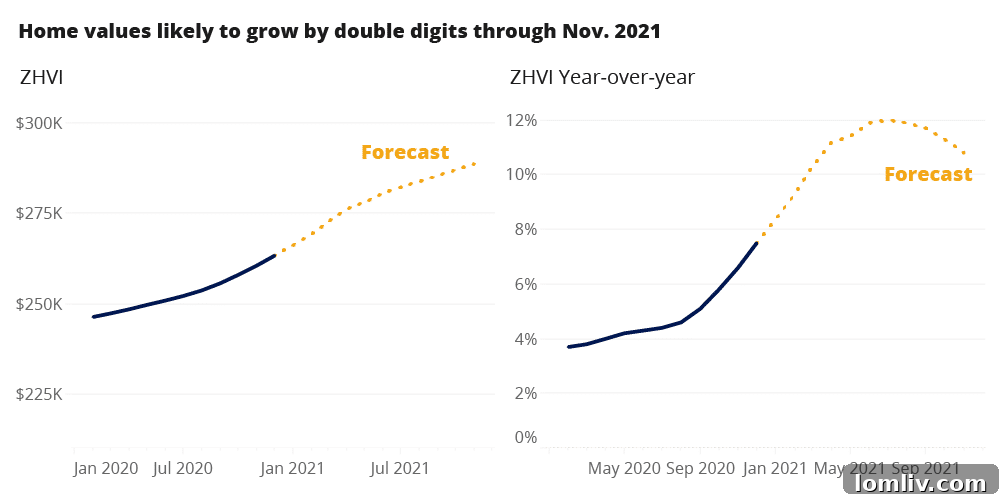
The immense momentum generated in the Dallas-Fort Worth housing market and across the nation in 2020 is widely expected to carry forward, promising another robust and dynamic year for the real estate sector. Zillow, a leading authority in real estate analysis, projects that home values could gain even more substantially in 2021, building upon the impressive foundation meticulously laid in the previous year. This optimistic forecast is carefully based on several key indicators and powerful economic tailwinds that continue to shape the evolving real estate landscape.
Central to Zillow’s forward-looking projections are the ongoing market momentum, consistently rising mortgage applications, which signify strong buyer confidence, and a healthy pipeline of pending home sales. These critical metrics collectively signal sustained buyer interest, strong consumer confidence, and a healthy transaction volume throughout the market. As homes continue to sell quickly and often above list price, it creates a self-reinforcing cycle of confidence among potential sellers and a sense of competitive urgency among prospective buyers, keeping the market vibrant.
Zillow economist Matthew Speakman further elaborated on these compelling driving forces, providing deeper context. He stated in the report, “Continued low mortgage interest rates and favorable demographic tailwinds are both expected to contribute to a strong year for home sales in 2021.” Consistently low mortgage interest rates dramatically enhance purchasing power, making homeownership more accessible and significantly more affordable for a broader segment of the population. This powerful financial incentive remains a primary and undeniable catalyst for sustained demand across all housing types.
Moreover, favorable demographic tailwinds, such as the large millennial generation entering their prime home-buying years, continue to provide a substantial and reliable base of new demand for housing. This extensive demographic cohort, combined with other individuals and families seeking to upgrade, downsize, or relocate, ensures a steady stream of prospective buyers actively entering the market. These powerful underlying factors, alongside potential and ongoing shifts in housing preferences post-pandemic, are set to underpin another dynamic and successful year for Dallas-Fort Worth and the broader national housing market.
Conclusion: D-FW’s Real Estate Resilience and Bright Future
The Dallas-Fort Worth housing market’s performance in 2020 stands as a powerful testament to its enduring strength, remarkable resilience, and unwavering appeal. With a remarkable $38 billion gain in home values, representing an economic force equivalent to numerous iconic landmarks, D-FW successfully navigated a challenging global year to emerge not only unscathed but significantly stronger. This impressive growth is not an isolated event but rather a powerful continuation of a decade-long upward trend, cementing the region’s status as a leading and highly desirable real estate market nationally.
As Texas continues its trajectory of attracting businesses, fostering job growth, and drawing new residents from across the country, becoming the fourth most valuable residential market in the nation, D-FW remains firmly at the forefront of this profound growth. The expert analyses from leading economists point unequivocally towards a robust and active 2021, fueled by sustained buyer demand, historically low interest rates, and consistently favorable demographic trends. For existing homeowners, astute investors, and the regional economy alike, the Dallas-Fort Worth housing market represents a vibrant, promising, and dynamic sector poised for continued success and significant value appreciation in the years to come.