North Texas Housing Market Navigates Shifting Tides: Inventory Rises Amidst Rate Hikes and Evolving Demand
The North Texas housing market is experiencing a significant transition, as evidenced by the MetroTex Association of Realtors’ comprehensive May housing report. What many in the industry anticipated as a seasonal trend—an increase in available homes—has been undeniably amplified by the recent surge in mortgage rates. This confluence of factors is reshaping buyer behavior and seller expectations, signaling a new chapter for one of the nation’s most dynamic real estate regions.
According to the detailed MetroTex Association of Realtors’ May housing report, a noticeable increase in home inventory is sweeping across North Texas. This rise is primarily driven by a growing number of prospective homebuyers being priced out of the market, a direct consequence of soaring property values combined with the steepest mortgage rate hikes seen in decades. The data, though lagging by a month, clearly foreshadows the impact of the Federal Reserve’s aggressive interest rate increase – a monumental three-quarters of a percentage point hike in June, marking its biggest single increase since 1994.
The Federal Reserve’s actions, aimed at curbing inflation, ripple directly through the mortgage market. Higher interest rates translate to higher monthly mortgage payments, substantially eroding purchasing power and affordability for many. This economic shift, combined with years of rapid appreciation in home prices, has created a formidable barrier for first-time buyers and those seeking entry-level homes.
The Double Whammy: Rising Rates and Softening Demand
The sentiment among key industry players mirrors this evolving landscape. Jerry Konter, chairman of the National Association of Home Builders (NAHB), articulated the challenge succinctly. “The entry-level market has been particularly affected by declines for housing affordability and builders are adopting a more cautious stance as demand softens with higher mortgage rates,” Konter told CNBC. This cautious approach from builders, who are critical for increasing long-term supply, indicates a fundamental shift from the frenzied demand of previous years.
Beyond the economic pressures, a seasonal factor also contributes to the increase in listings. As the spring and summer months traditionally represent the peak selling season, many homeowners strategically choose this period to list their properties. This year, however, the motivation is often layered: sellers are looking to capitalize on still-elevated prices before any potential market correction or further cooling of buyer demand sets in.
North Texas Hotbeds and Emerging Trends: A County-by-County Breakdown
As anticipated, Collin County continues to assert its dominance as a prime real estate hotbed among the larger counties meticulously tracked by MetroTex. This region, known for its robust job market, excellent schools, and high quality of life, has seen explosive growth. Beyond a vibrant resale market, Collin County boasts accelerated development with new communities rapidly popping up in cities like Celina, McKinney, Plano, Prosper, and Frisco. These areas attract a steady stream of new residents, driving demand and price appreciation, even in a cooling market.
The data from MetroTex underscores Collin County’s exceptional performance. The median price for a home, encompassing condos and townhomes, in Collin County surged by an impressive 32.4 percent year-over-year. Active listings also rose by 17.6 percent from 2021, pushing the months of inventory to 1.2 months, a notable increase from 0.9 months last year. While still a seller’s market, this slight uptick in inventory suggests a subtle easing of competitive pressures.
Neighboring counties also witnessed significant price appreciation, albeit with varying dynamics:
- In Dallas County, the median home price reached $400,000, reflecting a substantial 23.1 percent increase from a year ago. Despite this growth, Dallas County saw a slight decrease in active listings, perhaps indicating continued strong buyer interest for urban and suburban properties within its core.
- Denton County recorded a median price of $500,000, an impressive 26.6 percent jump. This county, like Collin, benefits from its proximity to major employment hubs and continuous demographic expansion.
- Tarrant County, home to Fort Worth, saw its median price climb to $377,993, up 23.9 percent. This robust growth signifies the broader strength of the Western DFW metroplex.
Across the entire North Texas region, the number of active listings experienced a substantial year-over-year rise of 26.2 percent in May, bringing the total to 53,764 homes on the market. Concurrently, the median home price for North Texas as a whole grew by 20.6 percent from a year ago, settling at $362,200. This regional overview paints a picture of a market still appreciating but with a growing selection for buyers, a dynamic that will likely lead to more balanced conditions in the latter half of the year.
Detailed County Performance: A Deeper Dive into Market Metrics
The following table provides a comprehensive snapshot of various North Texas counties, highlighting key metrics that illustrate the shifting market landscape. Analyzing these figures reveals distinct patterns in price growth, inventory levels, and market pace.
| County | Median Price % rise/fall from 2021 |
Active listings |
Days on Market |
Inventory (months) |
| Collin | $578,516 | 🔺32.4% | 🔺17.6% | 50 | 1.2 |
| Dallas | $400,000 | 🔺23.1% | 🔻13.9% | 46 | 1.1 |
| Denton | $500,000 | 🔺26.6% | 🔺36.4% | 55 | 1.2 |
| Ellis | $419,250 | 🔺23.4% | 🔺74.3% | 76 | 1.6 |
| Grayson | $315,000 | 🔺24.8% | 🔺61.7% | 66 | 2.0 |
| Hopkins | $252,000 | 🔺16.7% | 🔺23.9% | 59 | 2.2 |
| Hunt | $308,000 | 🔺29.4% | 🔺75.2% | 78 | 1.9 |
| Johnson | $380,000 | 🔺22.6% | 🔺80.2% | 61 | 1.7 |
| Kaufman | $361,000 | 🔺22.7% | 🔺70.3% | 81 | 1.7 |
| Navarro | $240,000 | 🔺24.2% | 🔺29.3% | 62 | 2.3 |
| Rockwall | $315,000 | 🔺24.8% | 🔺61.7% | 66 | 2.0 |
| Stephens | $157,000 | 🔺48.2% | 🔺27.3% | 62 | 4.3 |
| Tarrant | $377,993 | 🔺23.9% | 🔺10.5% | 49 | 1.0 |
| Van Zandt | $258,500 | 🔻5.7% | 🔺47.1% | 54 | 2.5 |
| Wise | $388,900 | 🔺34.1% | 🔻61.9% | 62 | 2.0 |
The table reveals some intriguing variations. While most counties show significant median price increases, Van Zandt County stands out with a 5.7% decrease, suggesting localized market dynamics or perhaps a greater proportion of lower-priced homes entering the market. Counties like Ellis, Hunt, and Johnson show dramatic increases in active listings (over 70%), indicating a rapid influx of homes for sale, which could soon impact price growth. Stephens County, with an impressive 48.2% median price increase, also boasts the highest months of inventory at 4.3, suggesting that while prices have soared, the market might be reaching a saturation point, offering buyers more negotiation room.
Days on Market (DOM) is another critical indicator. While many counties hover around 50-70 days, Kaufman County’s 81 days suggest a slightly slower sales pace, potentially due to higher prices or increased competition among sellers. These detailed insights highlight that while North Texas overall is experiencing certain trends, individual county markets possess unique characteristics requiring careful consideration.
Texas-Wide Trends and National Headwinds
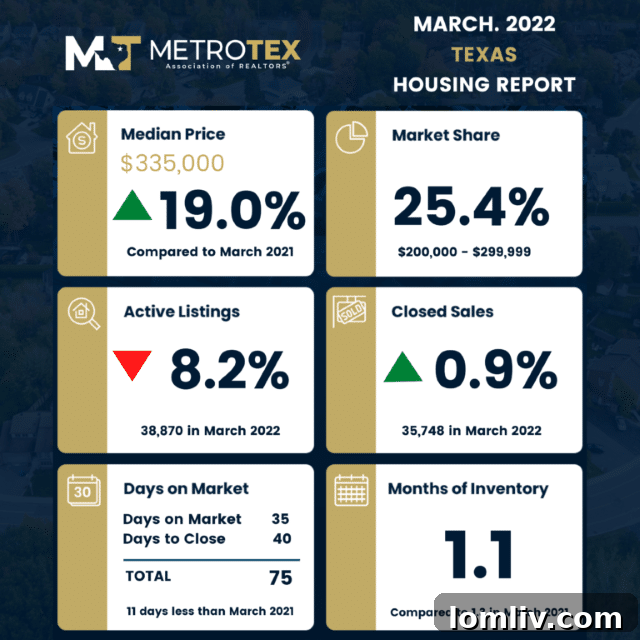
Zooming out to the state level, the Texas housing market has demonstrated remarkable resilience. According to the Texas Housing Insight report, released on June 9 by the Texas Real Estate Research Center, housing sales across the state continued their upward trajectory, increasing by 3.4 percent in the first quarter. Furthermore, the state’s median home price experienced its 15th consecutive month of growth, surging by 4.9 percent from the first quarter of 2021 to hit a new record-breaking $335,000 in March. This sustained growth underlines the enduring appeal and economic strength of the Lone Star State, driven by continued population migration and job creation.
However, this local and state-level strength is occurring against a backdrop of growing caution at the national level. Sentiment among the nation’s homebuilders has fallen for the sixth consecutive month, reaching its lowest point since June 2020. This decline, as reported by the influential National Association of Home Builders/Wells Fargo Housing Market Index (HMI), signals increasing headwinds for the construction industry.
NAHB Chairman Jerry Konter’s observations on the national scene resonate with the evolving dynamics in North Texas: “Six consecutive monthly declines for the [Housing Market Index] is a clear sign of a slowing housing market in a high-inflation, slow-growth economic environment.” This stark assessment points to broader economic challenges, including persistent inflation, rising material costs, and labor shortages, all of which constrain builders’ ability to deliver new homes efficiently and affordably. A sustained drop in builder confidence could eventually translate into a slower pace of new construction, impacting future housing supply.
Outlook for North Texas Real Estate: A Market in Transition
The May housing report for North Texas paints a picture of a market in flux. While prices continue to climb, albeit at a potentially moderating pace, the significant increase in inventory suggests a shift towards a more balanced market. Buyers, who have faced intense competition and limited choices for years, may find more opportunities and potentially greater negotiation power. Sellers, on the other hand, may need to adjust their expectations, focusing on competitive pricing and presentation to stand out in a market with more options.
The impact of rising mortgage rates will remain a dominant factor, influencing affordability and shaping demand. As the Federal Reserve continues its efforts to tame inflation, further rate adjustments are possible, which will continue to steer the real estate market. Both buyers and sellers in North Texas should remain acutely aware of these macroeconomic forces and their local manifestations, seeking expert guidance to navigate this evolving landscape successfully.
📎 North Texas Real Estate Information System Monthly MLS Summary Report | May 2022
What is MetroTex Association of Realtors? MetroTex is a leading real estate association that serves professionals across North Texas, providing invaluable market insights, educational resources, and advocacy. With the robust support of the Real Estate Center at Texas A&M University, MetroTex delivers current and relevant monthly and annual market reports. Their Texas A&M Housing statistics are meticulously compiled from listing data gathered from over 50 MLS (Multiple Listing Service) systems throughout Texas, offering an unparalleled view of the state’s real estate health.
Report Review: The MetroTex reports are celebrated for their clarity and accessibility. They present complex data in an easy-to-follow, graphics-rich style that simplifies understanding market trends. Crucially, MetroTex also provides a direct link to the North Texas Real Estate Information System’s (NTREIS) monthly MLS summary report. This report is an exceptionally detailed and comprehensive resource, offering a deep dive into the raw data for those seeking extensive granular analysis—a true treasure trove for market researchers. It’s a four-bunny rabbit hole for data enthusiasts! 🐇 🐇 🐇 🐇