

2016 Housing Market Forecast: Navigating Rising Rates and Shifting Dynamics
As December draws to a close, the real estate world braces itself for the annual deluge of year-end reviews and future forecasts. Every blog, website, and industry expert is busy analyzing data, polishing their predictions, and offering a glimpse into what the new year might hold for homebuyers, sellers, and investors. At daltxrealestate.com, we’re no exception. We’ve delved into the latest reports, observed emerging trends, and compiled a comprehensive outlook to help you navigate the evolving landscape of the 2016 housing market.
The final months of the previous year offered a distinct picture, especially December, which exhibited a noticeable slowdown. Following a period of consistent cooling that began around October, the housing market experienced a dip in activity, often likened to “molasses in January.” This trend signaled a moderation from the earlier frenetic pace, prompting many to question the direction of the market as we stepped into 2016.
Looking ahead, the consensus among economists points toward a crucial shift: a gradual increase in mortgage interest rates. This anticipated rise could introduce new challenges, potentially deterring some prospective buyers and leading to a deceleration in existing home sales. However, this isn’t necessarily a cause for alarm. Many experts believe that this adjustment, combined with a persistently optimistic outlook on job growth and a strengthening labor market, signals a healthy stabilization of the market. After years of recovery and significant price appreciation in many regions, especially those that have returned to or surpassed pre-economic downturn levels, a more balanced environment could foster sustainable growth rather than speculative bubbles.
December 2015 Performance: A Snapshot from Realtor.com
To fully understand the foundational shifts expected in 2016 real estate, it’s essential to first review the market’s recent performance. Realtor.com’s December 2015 data provided valuable insights into the closing dynamics of the year:
• Inventory Movement: Listing inventory continued to move faster compared to the same period last year. However, aligning with typical holiday season patterns, it was expected to trend down approximately 7 percent over November. This indicates a seasonal cool-down, where fewer new listings enter the market, and buyer activity temporarily subsides. Despite this monthly slowdown, the year-over-year improvement suggests a healthier overall market where homes are finding buyers more quickly than in the past. The median age of inventory reached 93 days, marking an 11 percent increase from November but a 7 percent decrease year-over-year. This metric highlights the dual effect of holiday sluggishness contrasted with a long-term trend of quicker sales.
• Median Listing Prices: Median listing prices showed a slight month-over-month decrease, falling 1 percent to $228,000. This minor adjustment is often a seasonal phenomenon, as sellers become more flexible with pricing during the slower holiday period to attract buyers. Crucially, despite this modest monthly dip, the figure still represented a robust 9 percent increase year-over-year. This strong annual growth underscores the underlying strength of the market throughout 2015 and provides a solid base as we transition into 2016 housing market trends.
Dallas and Midland Shine in the “Hotness Index”
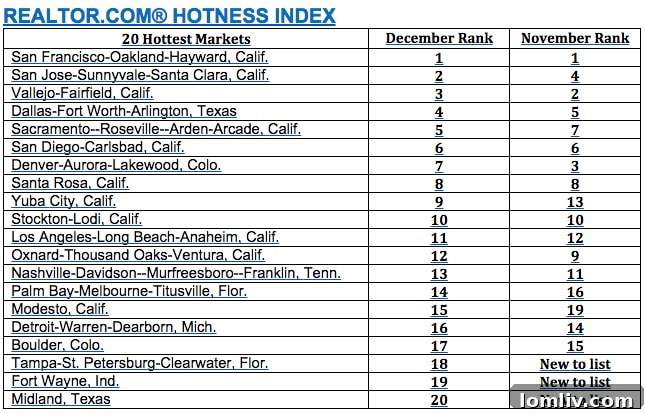
Realtor.com’s “Hotness Index,” which ranks metropolitan areas based on a combination of fast-moving inventory and high viewing demand, showcased remarkable performance from several Texas cities. Dallas, in particular, solidified its position as a highly desirable market, climbing to the No. 4 spot nationally, up from No. 5 the previous month. This consistent high ranking for the Dallas housing market reflects its strong economic fundamentals, robust job growth, and significant population influx. The area’s diverse economy, burgeoning tech sector, and relatively affordable cost of living compared to other major U.S. cities have made it a magnet for both residents and real estate investors.
Furthermore, Midland, Texas, made a noteworthy entry onto the list at the No. 20 spot. This inclusion is particularly impressive, given Midland’s reliance on the energy sector. Its appearance on the “Hotness Index” indicates resilience and strong local demand, possibly driven by specific industry growth or regional economic diversification efforts that continue to attract new residents and investment despite broader energy market fluctuations.
Freddie Mac’s Comprehensive Predictions for 2016
Beyond the immediate past, understanding the real estate forecast 2016 requires a look at the broader macroeconomic predictions. Freddie Mac, a key player in the secondary mortgage market, offered its detailed projections for the year, shedding light on critical factors like interest rates, home sales, and price appreciation. These forecasts provide a macroeconomic framework for analyzing the stability and growth prospects of the housing sector. Here are the key takeaways from HousingWire’s report on Freddie Mac’s predictions for 2016:
- Mortgage Interest Rates: The 30-year fixed-rate mortgage was expected to average below 4.5% for 2016 on an annualized basis. While this suggests a slight uptick from previous lows, rates remaining below 4.5% generally indicate a still-favorable borrowing environment. For homebuyers, this means that while monthly payments might be marginally higher than peak affordability periods, they are still historically attractive, especially when coupled with wage growth. This forecast sets a crucial benchmark for mortgage interest rates 2016 and their impact on buyer purchasing power.
- Affordability vs. Demand: Gradually higher mortgage interest rates will undoubtedly present an affordability challenge for some segments of buyers, particularly first-time homeowners or those in rapidly appreciating markets. However, this will likely be counterbalanced by a strengthening labor market and significant pent-up demand. The robust job market ensures more people are employed, earning steady incomes, and feeling confident about their financial future. Pent-up demand, accumulated from years of economic uncertainty where many delayed home purchases, is expected to continue driving 2015’s home sales momentum into 2016. This dynamic suggests that while some buyers may be priced out, a larger pool of qualified buyers will remain active.
- House Price Growth: Freddie Mac predicted that house price growth would moderate slightly to 4.4% in 2016. This moderation is driven partly by the reduction in homebuyer affordability due to rising rates and also by a reduced demand resulting from the Federal Reserve’s tightening monetary policy. A more moderate pace of appreciation is generally considered healthier and more sustainable than rapid double-digit growth, preventing market overheating and increasing the risk of bubbles. For investors, this suggests stable, albeit less explosive, returns.
- Overall Housing Activity: Despite the monetary tightening, housing activity was projected to grow in 2016. Total housing starts—a key indicator of new construction—were expected to increase by a significant 16% year-over-year. This surge in new builds is crucial for addressing the existing inventory shortages that plagued many markets. Concurrently, total home sales (including both new and existing homes) were forecast to increase by 3%. This dual growth in construction and sales activity highlights a robust underlying demand and a market that is adjusting to new economic realities while continuing its expansion.
- Mortgage Originations and Refinancing: While home purchases were anticipated to increase, higher interest rates were expected to reduce refinance volume. When rates rise, the incentive for homeowners to refinance their existing mortgages diminishes. This shift was predicted to push overall mortgage originations lower in 2016 compared to 2015. This is a natural consequence of a tightening rate environment and reflects a market transition from a refinance-driven to a purchase-driven mortgage landscape.
Navigating the New Real Estate Landscape
For those deeply entrenched in the real estate industry, these shifts might evoke a sense of déjà vu or even apprehension. Many might be thinking, “First TRID, now this?” The TILA-RESPA Integrated Disclosure (TRID) rule, implemented in late 2015, introduced significant changes to the mortgage closing process, causing initial disruptions and longer closing times. Now, layering higher interest rates and a moderating market onto these operational adjustments presents a new set of challenges for lenders and real estate professionals alike.
However, for those who have been paying close attention to market signals, these developments are not entirely unexpected. Back in August, CoreLogic had already projected an overall cooling in sales. Their analysis pointed to a scenario where demand was beginning to outstrip supply, particularly in the single-family home market, while new construction was heavily concentrated in multi-family rentals. This imbalance created pressure, making a market adjustment inevitable.
Despite these national trends and regulatory shifts, there remains a significant amount of room for interpretation and regional variation, especially in dynamic markets like North Texas. The economic engines driving Dallas, Fort Worth, and the surrounding areas — with their strong corporate relocations, job creation, and diverse industries — often create microclimates that behave differently from national averages. This resilience means that while the broader market may experience moderation, specific regions can continue to see robust activity, albeit with new considerations for affordability and inventory management.
For buyers, understanding the trajectory of mortgage interest rates 2016 is paramount. Acting sooner rather than later could secure a lower rate before further increases. For sellers, pricing strategically and focusing on market-ready homes will be crucial in a less frenzied environment. The emphasis shifts from simply listing a home to actively marketing it and understanding the local competitive landscape.
The 2016 housing market forecast paints a picture of transition – from rapid recovery to sustainable growth. It’s a market that rewards preparedness, informed decision-making, and a keen eye on local nuances. While challenges like affordability and adjusting to new regulations persist, the underlying economic strength, particularly in robust job markets, provides a strong foundation for continued activity.
What are your thoughts on these predictions? How did your local market perform in 2015, and where do you envision its position in 2016 amidst these anticipated changes? Share your insights and perspectives below!