Dallas City Council Greenlights I-345 Hybrid Trench with Critical Mandates for Urban Reimagination
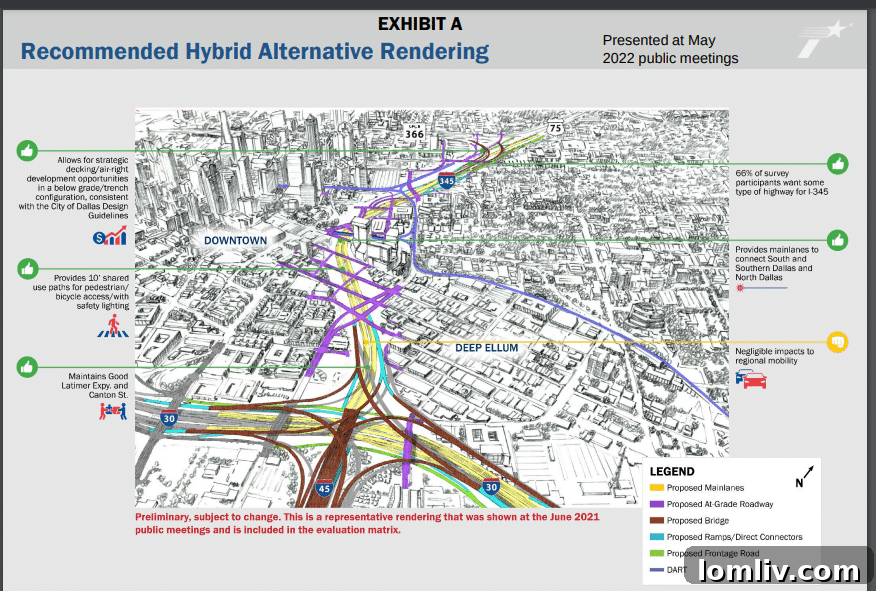
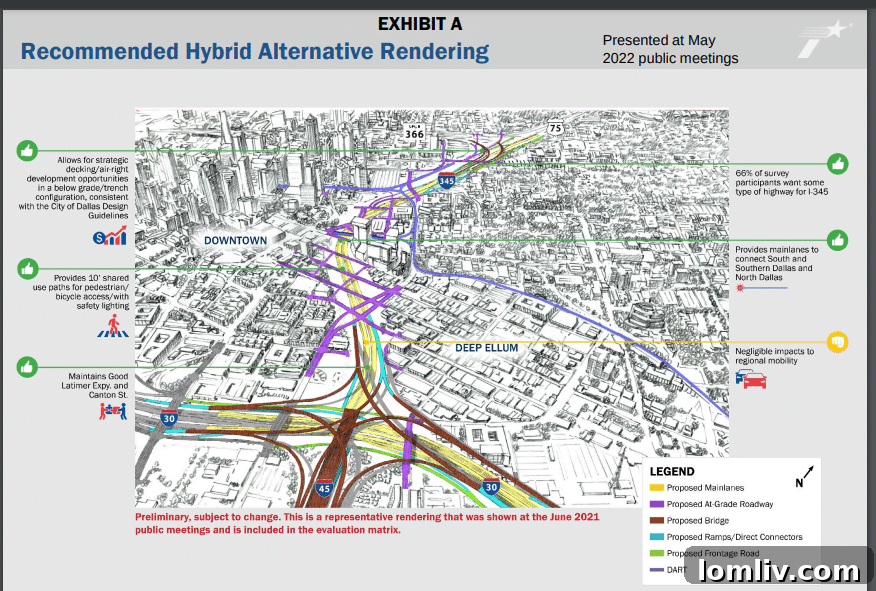
In a move poised to redefine the urban fabric of Dallas, the City Council has given its unanimous, albeit conditional, approval to the Texas Department of Transportation’s (TxDOT) ambitious $1 billion “refined hybrid trench” option for reconstructing Interstate 345. This pivotal decision, reached after extensive deliberation, includes crucial caveats: a non-negotiable demand for the comprehensive exploration of alternative designs and a commitment to integrating broader city planning objectives. This conditional endorsement signals a strategic effort by Dallas to balance the imperatives of state-level transportation infrastructure with its own vision for a more connected, equitable, and vibrant urban core.
Interstate 345, an aging freeway segment, has long been a contentious issue, serving as a physical barrier that has historically separated vital downtown areas from vibrant neighborhoods such as Deep Ellum. While TxDOT’s “refined hybrid trench” proposes a combination of depressed and at-grade highway sections, the long-term implications for urban connectivity and development have fueled intense debate among residents, urban planners, and community advocates. The council’s decision marks a significant step forward, initiating a complex, decade-long project that will profoundly impact Dallas’s future.
Historically, TxDOT has expressed firm resistance to considering alternatives beyond its preferred hybrid trench design. As the state agency controlling the significant funding for this monumental project, its influence is substantial. This dynamic has often placed Dallas in a challenging position, balancing the need for state funding with local desires for more transformative solutions. Critics argue that a swift adoption of TxDOT’s plan without rigorous independent scrutiny risks squandering a generational opportunity to re-stitch the city’s urban fabric and foster more sustainable development.
The pursuit of an independent study, which could run concurrently with TxDOT’s initial design phase, is estimated to cost Dallas up to $2 million. Furthermore, state officials have cautioned that if Dallas were to subsequently reverse its support for the hybrid trench after TxDOT has expended significant resources on its design, the city could be liable for reimbursement costs reaching up to $20 million. Despite these financial considerations, proponents of exploring alternative designs argue that the potential for long-term urban revitalization and the creation of a truly integrated city—one that prioritizes people over solely vehicles—justifies the additional time and expense. For them, this is not merely a highway project but a defining moment for Dallas’s urban identity, demanding the most thoughtful and comprehensive approach possible.
Dallas’s Conditional Approval: A Comprehensive Framework for Integrated Urban Development
The resolution, eloquently presented by Deputy Mayor Pro Tem Omar Narvaez, establishes a robust framework of conditions, signaling Dallas’s unwavering commitment to shaping the I-345 reconstruction in alignment with its strategic urban goals. These conditions are not passive suggestions but active requirements designed to ensure the project’s design and implementation phases are deeply informed by the city’s broader vision. Narvaez’s motion represents a sophisticated strategy to assert local control and influence over a state-managed infrastructure initiative, ensuring genuine collaboration rather than mere acquiescence.
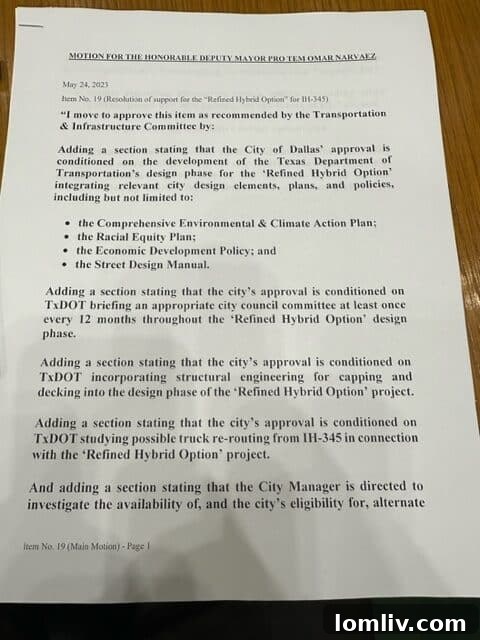
I move to approve this item as recommended by the Transportation and Infrastructure Committee by:
Mandating Integration of City Design Elements, Plans, and Policies: The City of Dallas’s approval is explicitly conditioned upon TxDOT’s design phase for the “Refined Hybrid Option” thoroughly integrating relevant city design elements, comprehensive plans, and established policies. This critical stipulation ensures that the I-345 project actively contributes to Dallas’s holistic urban development and sustainability objectives. Key city frameworks to be incorporated include, but are not limited to:
- The Comprehensive Environmental and Climate Action Plan (CECAP): To guarantee the project minimizes its environmental footprint, promotes sustainable practices, and enhances urban resilience against climate change impacts.
- The Racial Equity Plan: To proactively address historical injustices stemming from previous infrastructure decisions, fostering inclusive development and ensuring equitable distribution of project benefits across all Dallas communities.
- The Economic Development Policy: To maximize local economic opportunities, support small businesses, and stimulate job creation and growth in areas directly impacted by the I-345 corridor.
- The Street Design Manual: To ensure that all surface-level streets and urban interfaces connected to the highway are meticulously designed for enhanced pedestrian safety, robust bicycle infrastructure, and seamless overall urban connectivity, prioritizing multi-modal transportation.
Establishing Mandatory Bi-Annual Briefings for Enhanced Transparency: The city’s approval is conditioned on TxDOT providing comprehensive briefings to an appropriate city council committee at least once every six months throughout the entire “Refined Hybrid Option” design phase. This crucial amendment, initially proposed as 12 months and subsequently shortened to reinforce accountability, underscores the council’s strong desire for continuous oversight, transparent communication, and timely updates on design progress and critical decision-making processes.
Incorporating Structural Engineering for Capping and Decking: The city’s approval is conditioned on TxDOT integrating comprehensive structural engineering plans for capping and decking into the design phase of the “Refined Hybrid Option” project. Capping and decking are transformative elements that enable the creation of new urban land above depressed highway sections, unlocking unprecedented opportunities for parks, public spaces, mixed-use housing, and commercial developments, thereby physically and socially reconnecting historically divided neighborhoods.
Commissioning a Study on Truck Re-routing from IH-345: The city’s approval is conditioned on TxDOT conducting a thorough study on the feasibility of possible truck re-routing from IH-345 in conjunction with the “Refined Hybrid Option” project. This initiative aims to significantly mitigate the environmental burden, noise pollution, and traffic congestion associated with heavy freight traffic within urban areas, ultimately enhancing air quality and the quality of life for Dallas residents.
Directing Investigation into Alternative Funding and Design Options: The City Manager is explicitly directed to investigate the availability of, and the city’s eligibility for, alternate sources of funding. This includes, but is not limited to, programs such as the U.S. Department of Transportation’s Reconnecting Communities Pilot Program. These critical funds would be dedicated to:
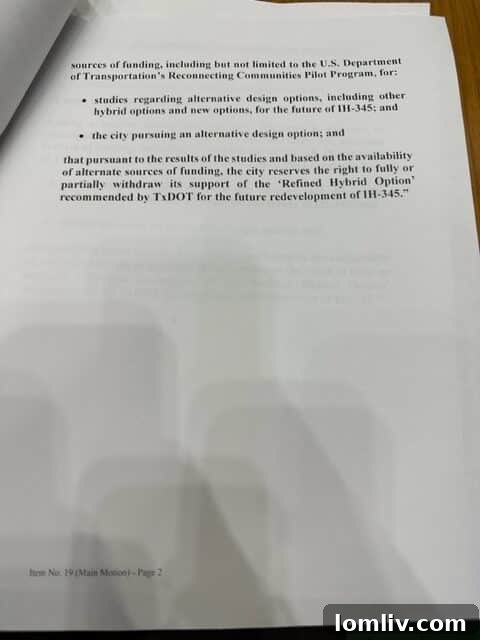
- Conducting comprehensive, independent studies regarding alternative design options for the long-term future of IH-345, encompassing various hybrid configurations and entirely new urban planning concepts.
- Supporting the city’s pursuit and implementation of an alternative design option, should these studies prove viable and adequate funding be secured through federal or other sources.
Reserving the Right to Withdraw Support: Pursuant to the outcomes of these mandated studies and contingent upon the availability of identified alternative sources of funding, the City of Dallas explicitly reserves the right to fully or partially withdraw its support of the “Refined Hybrid Option” as initially recommended by TxDOT for the future redevelopment of IH-345. This vital clause provides Dallas with substantial leverage, ensuring that the current approval is a conditional agreement, not a final and irreversible commitment, maintaining the flexibility to adapt to new information and opportunities.
Motion From Deputy Mayor Pro Tem Omar Narvaez
Navigating the Future: Diverse Perspectives on I-345’s Evolution
The City Council meeting on Wednesday was marked by a robust public dialogue, with thirteen speakers passionately addressing the chamber. Notably, all speakers either voiced strong opposition to TxDOT’s hybrid option or ardently advocated for the necessity of an independent study, reflecting a pervasive community desire for more innovative and integrated urban solutions. Deputy Mayor Pro Tem Narvaez acknowledged this public sentiment, explaining that his carefully crafted motion allows the city to collaboratively enter the design phase with TxDOT while strategically keeping critical discussions – such as the integration of pedestrian sidewalks, dedicated bike lanes, and expansive green spaces – firmly on the negotiation table for subsequent stages of the project.
“I feel like this council has heard the residents loud and clear, and I hope that you all heard that a lot of what you asked for is in this motion,” Narvaez affirmed, highlighting the significant compromises achieved through diligent negotiation. “We were able to come up with what I believe were some solid compromises. We as a council have passed a lot of impactful policy over the last two to four years. I appreciate that TxDOT has agreed to integrate relevant city design elements, policies, and plans. They did not have to do this.” This statement underscores the political maneuvering and strategic engagement required to secure such concessions from a powerful state agency, demonstrating the council’s commitment to its residents’ long-term interests.
While TxDOT traditionally bears the financial responsibility for such colossal infrastructure projects, its representatives have consistently emphasized that official city support is a prerequisite for securing essential federal funding. This intricate interdependency grants Dallas a crucial and influential voice in a project where TxDOT otherwise maintains significant control over the financial purse strings and initial project vision.
Whether the current Dallas City Council recognizes it or not, there’s genuine thirst among residents for implementing 21st Century ideas to deal with 20th-Century problems. pic.twitter.com/EqPovIVnya
— Downwinders at Risk (@cleanerair) May 24, 2023
District 1 Councilman Chad West, a prominent advocate for comprehensive independent studies and genuinely transformative alternatives, openly articulated his mixed feelings regarding the resolution of support. While acknowledging the value added by the amendments, West reiterated his foundational opposition to any infrastructure solution that perpetuates the physical and social division of vibrant urban districts like Deep Ellum and downtown Dallas. “I’m not in favor of a trench; I’m not in favor of an elevated freeway; I’m not in favor of a highway of any type continuing to divide the neighborhoods of Deep Ellum and downtown,” West passionately declared. He fervently championed the concept of a comprehensive “boulevard system,” rather than a singular boulevard, envisioning it as a powerful catalyst for significantly greater economic development, diverse housing opportunities, and the essential “re-stitching” of Dallas’s historically fractured urban fabric. For West, the project’s ultimate priority extends far beyond mere vehicular throughput to the creation of a more cohesive, livable, and prosperous city. His “grudging” support underscores a cautious optimism, contingent on the explicit assurance that “doors remain open” for future, more innovative alternative considerations.
In contrast, District 12 Councilwoman Cara Mendelsohn articulated a more pragmatic and fiscally conservative viewpoint, firmly backing the hybrid plan based on what she concisely summarized as the “federal freight highway network.” Mendelsohn underscored the undeniable reality that I-345 functions as a critical component of the national highway system, serving indispensable freight and commercial transportation needs. “This is never going to not be a highway,” she asserted, dismissing the feasibility of completely transforming it into a full boulevard system. She argued that prolonged and contentious debates over what she perceives as unrealistic alternatives merely lead to unnecessary delays in critical infrastructure upgrades. Instead, Mendelsohn urged passionate advocates to channel their energy into optimizing the hybrid plan through innovative capping and decking solutions. She believes these elements offer concrete, tangible opportunities for urban improvement, facilitating new developments and creating valuable green spaces above the highway without compromising its fundamental function as a vital transportation corridor.
Adam Lamont, a dedicated District 10 resident and founder of the influential activist group Dallas Neighbors for Housing, offered a thoughtful post-vote assessment that encapsulated the delicate balance achieved by the council. He acknowledged the inclusion of “a lot of good things” within the motion, particularly the rigorous conditions imposed on TxDOT, which represent significant victories for community advocacy. However, Lamont also critically noted that, at its core, the resolution still represents a formal statement of support for the state agency’s initially preferred option. “The good news is that council is telling TxDOT that they need to do better than the current hybrid,” Lamont concluded, reflecting a hopeful yet cautiously vigilant stance from community organizations dedicated to fostering genuine urban transformation.
The reconstruction of I-345 transcends a mere infrastructure upgrade; it represents a defining moment for the City of Dallas. This project will test the city’s resolve to meticulously balance essential regional transportation needs with its progressive urban development aspirations. The conditional approval by the City Council marks the inception of a complex, multi-year process where sustained negotiation, innovative design, and persistent community advocacy will be absolutely crucial. As TxDOT now progresses into the design phase, Dallas is committed to meticulously monitoring progress, holding firm to its explicitly reserved right to explore, and potentially pursue, truly transformative alternative visions for one of its most critical urban arteries. The ultimate outcome of the I-345 project will undoubtedly establish a significant precedent for how major American cities strategically navigate the challenges posed by legacy infrastructure while vigorously seizing opportunities for forward-thinking urban renewal and community reconnection.