Unpacking the Future of Fair Park: A Deep Dive into Dallas’s Historic Landmark Debate
Fair Park, a beacon of Dallas history and culture, finds itself at the epicenter of a passionate debate concerning its future. As one of the city’s most significant cultural assets, its preservation and potential development are subjects that ignite strong opinions from community leaders, preservationists, and urban planners alike. Following a recent panel discussion on Fair Park, a press release issued by Preservation Dallas surfaced, offering a perspective that, in our view, inaccurately represented the nuanced conversations that took place. This article aims to clarify those discussions, address the points raised in the press release, and provide a comprehensive overview of the complex issues at hand, ensuring readers have access to the full context.
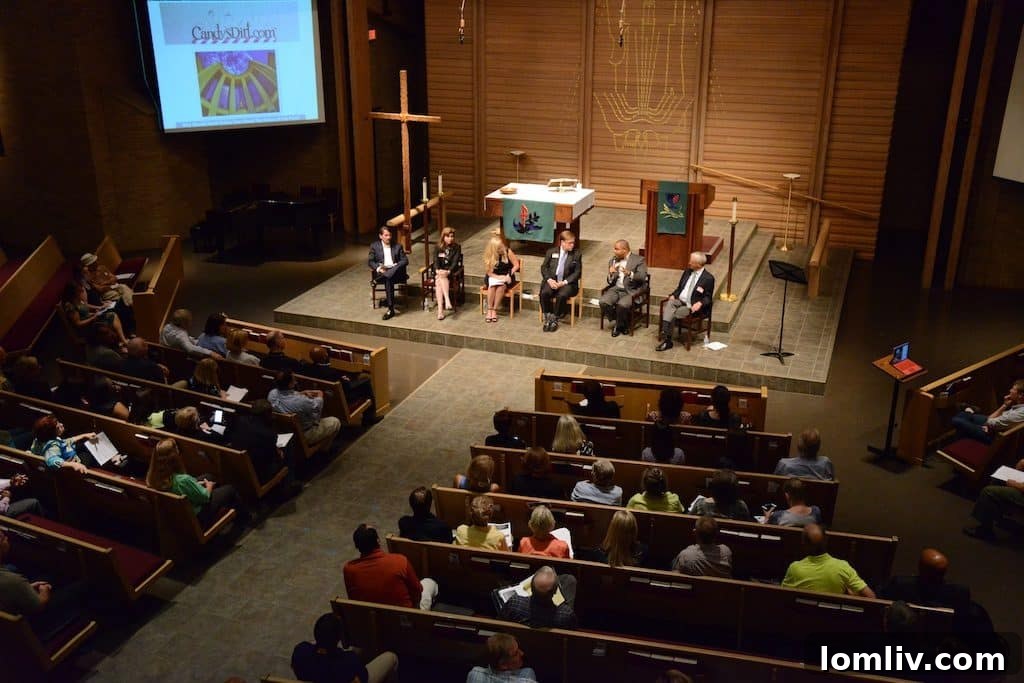
The panel discussion, which we deliberately video-taped and live-streamed for public transparency, was designed to disseminate information and explore various viewpoints on Fair Park’s revitalization. While some, including prominent figures like Jennifer Gates and members of Preservation Dallas, perceived the panel as one-sided due to the absence of “the other side,” it was never intended as a debate. Logistical challenges, such as conflicting city council budget meetings that night preventing participation from individuals like John Jenkins, meant that Thursday was the only viable evening. Furthermore, with limited space at the original venue, our primary goal was to capture and share valuable insights, with the intention of organizing a follow-up panel featuring alternative perspectives.
We firmly believe there is inherent value in openly sharing information and considering diverse perspectives, even if they initially appear to represent a single viewpoint. Unlike a debate, a panel discussion serves to educate and inform, offering different expert opinions on a complex subject. The Mayor, much like a President, commands a powerful platform, and the “other side” of this discussion has certainly garnered extensive media coverage. Our intention was simply to add more voices to the conversation.
Let it be known that we hold the dedicated individuals at Preservation Dallas in high regard, and our admiration for Virginia McAlester is profound. Her tireless efforts were instrumental in establishing our historic district, and Dallas owes her a tremendous debt of gratitude. However, with the utmost respect and affection, we must assert that the press release in question selectively extracts and miscontextualizes elements from our Thursday evening discussion.
The Evolving Landscape: Preservation vs. Development in Fair Park
The core of this complex issue often boils down to a fundamental tension: the aims of preservation versus the impulses of development. It’s a dynamic frequently observed in urban renewal projects, where preservationists, often for valid reasons, harbor skepticism towards developers. History provides ample evidence for this caution; one need only look at the impact developers had on areas like State Thomas to understand these concerns. A pervasive fear exists that prominent figures, such as Don Williams, a lawyer with a background in working for major developers, might pursue opportunistic land acquisition within Fair Park.
Indeed, a comment regarding “land grabbing” was voiced by an audience member after our panel, reflecting a broader anxiety. This deep-seated apprehension suggests that the entire Fair Park initiative could be a calculated maneuver to acquire land cheaply and subsequently flip it for significant profit once the area appreciates, much like State Thomas or Uptown. It’s crucial to note that, historically, the primary entity purchasing real estate around Fair Park has been the State Fair of Texas, raising questions about broader development patterns.
Beyond land speculation, there’s an equally potent concern: the potential impact on Fair Park’s irreplaceable architectural treasures. These aren’t merely old buildings; they are National Historic Landmarks, Art Deco goddesses that, as Mayor Rawlings rightly points out, constitute the largest collection of Art Deco buildings in the United States. The thought of altering these structures is anathema to many. As unequivocally stated during our discussion: “Touch those buildings over my dead body.”
Deconstructing the Preservation Dallas Press Release: A Point-by-Point Clarification
The Preservation Dallas press release raised several critical points, which we believe warrant direct and detailed clarification. Here, we address each assertion to ensure a clear understanding of the panel’s actual discourse and our perspective on these vital issues.
Addressing the “Danger of Losing Fair Park National Historic Landmark”
“We are in serious danger of losing our Fair Park National Historic Landmark.”
This statement, while impactful, is simply not true and was never a topic of discussion at our panel. The prevailing sentiment among the panelists and, we believe, a significant portion of the community, is that the historic landmarks of Fair Park are sacrosanct. The debate centers on how best to enhance and activate the park and its surroundings, not on any intention to dismantle or jeopardize its National Historic Landmark status. Our focus is on strategic revitalization that respects and elevates these invaluable assets.
The Promise of “Properly Done Development Around the Park”
“I have heard constant rumors that it had to do with real estate development, but properly done development around the park could be a wonderful thing. Why were the goals of the Fair Park Texas Foundation-adding tons of green space, active park spaces, great tenants in landmark buildings, and dynamic events activating the park year-round-be anything but positive for development around the park?”
We wholeheartedly agree that “properly done development AROUND the park” is precisely what was advocated last Thursday. Our panel showcased successful examples from other cities, demonstrating how thoughtful urban planning can uplift surrounding communities. As former developer Don Williams eloquently put it, elevating the park naturally elevates the surrounding area. Homes overlooking a beautifully landscaped, vibrant green park will inherently command greater value, making the land more desirable for investment and improving the quality of life for residents. This is the essence of a “rising tide lifts all boats” philosophy, where the park’s enhancement serves as an economic catalyst for the entire neighborhood.
Distinguishing Development “Around” vs. “In” Fair Park
“Those who lead the vehement opposition to the Fair Park Texas Foundation have real estate development in mind. AND, THE REAL ESTATE DEVELOPMENT IS NOT ADJACENT TO FAIR PARK, IT IS IN FAIR PARK!”
To suggest that our focus is solely on development *in* Fair Park in a destructive manner is a misrepresentation. Our discussions explored how to make the area around Fair Park self-sustaining, focusing on improving and preserving existing homes rather than displacing residents. For non-condemned properties, we envision a conservation district similar to Dallas’s successful M Streets, enhancing architectural character and community value. Just look at the inspiring transformation of areas like Parkdale as a testament to this potential.
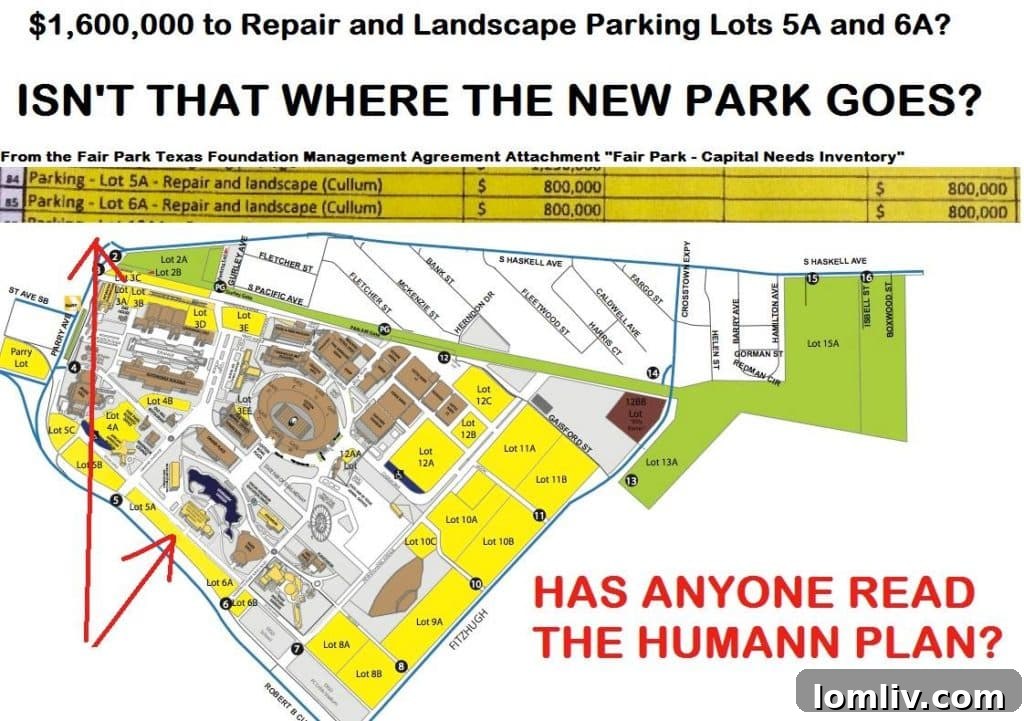
The overarching theme was that creating a substantial, genuine park at Fair Park (which Robert Wilonsky aptly calls “Fair Parking Lot”) would serve as the primary impetus for improving the entire surrounding area. However, a significant concern with the current agreement before the City Council is the lack of guarantee regarding the park’s size, with the Foundation given a full year to conceptualize it. Furthermore, the Walt Humann plan notably requests $1,600,000 to repair and landscape two parking lots where the Fair Park Texas Foundation had promised to replace them with a community park. This raises a crucial question: where is the promised park in this financial allocation?
What was consistently discussed was the desire for a significantly larger park than what is currently being proposed. The consensus was that if we truly establish a lush, green park, private development would naturally be drawn to the area, revitalizing surrounding neighborhoods much like what occurred in Bishop Arts. Any development *within* Fair Park proper, as envisioned, would primarily take the form of strategic leasing of existing structures, such as the Swine Building, or securing year-round tenants for buildings that are largely dormant outside of the State Fair. Attracting quality tenants on shortened leases, typical for State Fair usage, is a considerable challenge in real estate. For a model of successful public-private trust management of historic sites, one need only look to the Presidio in San Francisco. This former army post, dating back to 1776, spans three square miles on the northern coast, embodying a vision of adaptive reuse:
Hundreds of former military buildings are now animated by more than 3,000 residents and 200 companies—including high tech start-ups, innovative non-profits and others that offer a surprising mix of visitor experiences. The park is home to museums and food trucks, art and archaeological sites, San Francisco’s newest recreation facilities and its most historic building. On any given day at the Presidio, organizations are pursuing new ideas, scientists are conducting research, and people of all ages are learning, playing and exploring.
At the Presidio, no structures were demolished. Instead, the original military buildings were meticulously restored and preserved, and homes once occupied by generals were beautifully remodeled and are now leased at competitive monthly rates. Many would eagerly reside in such a place. A prime example of high-tech integration is the Letterman Digital Arts Center, George Lucas’s satellite campus to Skywalker Ranch, established at The Presidio twelve years ago. This idyllic campus, featuring pristine brick buildings—both historic and modern—white verandas, and lush green hills, serves as the headquarters for Lucas Films, housing Industrial Light & Magic, animation studios, consumer product divisions, and digital media operations. When our panelists discussed attracting “tenants” to Fair Park, this caliber of innovative, long-term operation in South Dallas was precisely the vision they had in mind.
Clarifying the Panel’s Composition and Intent
“Then Thursday night I attended a panel on Fair Park, featuring Don Williams and others. I was stunned by the misinformation being given to the audience and there was no one on the panel to refute any of it. There was no one to represent park interests or the foundation. There were no preservationists.”
As previously explained, the event was explicitly billed as a panel discussion, not a debate. Furthermore, to suggest that “there were no preservationists” or representatives of “park interests” is to fundamentally misunderstand the panelists’ perspectives and the broader goal of community enhancement. We all share a deep commitment to preserving Fair Park’s legacy while ensuring its vibrant future. The panel included:
- Texas State Representative Eric Johnson (full disclosure: Don Williams is a major campaign contributor, a fact transparently noted).
- Urban Land Institute leader and Price Waterhouse Coopers executive Byron Carlock, Jr.
- Former City Councilwoman Angela Hunt.
- Our editor, Jon Anderson.
Each panelist brought a unique and valuable perspective rooted in a commitment to Dallas’s urban fabric and historical assets. To imply a lack of preservationist interest among this group is an oversight of their established records and stated intentions.
Re-evaluating “Best Practices” and Fair Park’s Unique Context
“One panel member, a former executive with Post Properties who was active in Uptown, showed slides of “best practices” redevelopment projects around the country-examples of what might be good for Fair Park (hotels, housing, and many other uses). All would transform the park into something entirely inconsistent with its historic landmark status. Asked for the “best example,” he pointed to “The Gulch” development near the Nashville Country Music Hall of Fame, which was moved from its Music Row site and spurred redevelopment of a work-live-play environment. This is the “best” example for what is most appropriate for Fair Park itself?”
Byron Carlock, the panelist referenced, utilized “The Gulch” as an example not for its specific outcome of moving a landmark, but rather as a case study in an area with profound local emotional attachment—much like the State Fair of Texas within Fair Park. He specifically emphasized that his reference was NOT about touching the historic buildings, but about illustrating a successful “work/live/play” environment that emerged from strategic urban planning around a key cultural institution. He also cited The Presidio as a relevant model. Carlock’s point was to explore how reducing the State Fair’s permanent footprint on the Fair Park campus could liberate space for a more expansive park or a dynamic work/live/play environment. Such an approach would generate increased revenue, which could then be reinvested directly into the restoration, maintenance, and long-term preservation of Fair Park’s invaluable historical buildings.
Shared Vision: A Texas Music Hall of Fame and Surrounding Development
“Mind you it could be wonderful to have a Texas Music Hall of Fame in Fair Park (one of the uses suggested for the old Women’s Museum) and to see the land across the street (in three different directions even?) redevelop.”
On this point, there is clear alignment. Indeed, ideas like establishing a Texas Music Hall of Fame within existing structures, such as the former Women’s Museum, and encouraging thoughtful redevelopment of the land across the street—in all three directions—were precisely the kinds of forward-thinking concepts our panel enthusiastically discussed. This vision promotes a holistic revitalization that extends beyond the park’s immediate boundaries.
The Role of Economic Development vs. Park Management
“A panelist complained that this process had treated Fair Park as a park and been overseen by the Park Department, when it should have been handled by the Economic Development Department.”
This statement constitutes a complete misquote of State Representative Eric Johnson. At the outset of his remarks, Representative Johnson explicitly disclosed that he had no prior knowledge of, nor control over, the specific Humann plan/proposal, and that he was speaking purely from his personal opinions about what would best benefit the neighborhood. As the representative for District 100, which encompasses Fair Park, Eric Johnson spoke from the perspective of his constituents. His personal opinion was that Fair Park should be strategically treated as an economic development opportunity, one that could finally uplift the residents who have long suffered from historical injustices and neglect. He shared poignant stories of growing up in the neighborhood and hearing his grandparents recount the painful memory of “Negro day” at the fair. Our aim was to hear directly from someone representing the neighborhood and to explore proactive ways to minimize displacement. The last thing any thoughtful revitalization effort should do is improve an area only to inadvertently push out its long-standing residents.
A critical question we must ask is: does the Humann plan, anywhere, at any point, discuss measures to prevent displacement? Our panel explicitly addressed several methods; we urge you to watch the video for those details. Importantly, Eric Johnson, a seasoned lawyer, underscored a fundamental principle: any governmental contract MUST explicitly spell out all promises and guarantees. Even when meticulously detailed, these promises are challenging to enforce; when left vague or unstated, they become utterly impossible to uphold. This, in a nutshell, is our primary contention with the Humann plan: its lack of concrete, enforceable guarantees.
Revisiting the Hargreaves Plan: A Look Back at Past Visions
“No one mentioned the excellent Hargreaves Plan that “puts the park back into Fair Park,” and was developed with more than a year of public meetings, and was unanimously adopted by the city council. It was a true public planning process. And in addition to its fine treatment of Fair Park itself, included preliminary work on an entertainment district just outside the park, along with street sections that could transform Cullum’s walkability.”
While the Hargreaves Plan was indeed an extensive effort, it’s essential to remember its timestamp: 2003. That’s thirteen years ago. Furthermore, as our own Suzanne Felber rightly highlights, Fair Park is a bustling, vibrant place 364 days a year. Yet, the Hargreaves Plan itself, on page 9, offered a stark assessment:
Despite its myriad virtues, Fair Park is not reaching its potential visitor capacity. On any given weekday, the park remains largely vacant. Many of the museums report attendance figures that are far below their goal levels and are struggling to stay in operation. Misperceptions about safety and access keep some visitors away, and the lack of visitors adds to the perception that the park is closed. At this point, Fair Park lacks a cohesive identity. The absence of any significant green recreation space belies its very title as “park”. Managing the park in a manner such that the wealth of events supports daily attendance— rather than detracts from it—is crucial to the life of Fair Park. Past efforts have attempted to revitalize this gem, yet as of now, no one plan has succeeded in turning it into the vibrant place it has the potential to be.
Thirteen years later, despite unanimous adoption of a plan suggesting a park, where is it? This historical context underscores the persistent challenge of transforming plans into tangible realities for Fair Park.
Leveraging Space: Development Without Displacement
“Another panelist explained that Fair Park was the only 277 acres in southern Dallas that could be developed without displacing a single house or business. Apparently, it is not enough to create a fantastic park that will dramatically improve the area around it. One must redevelop the site itself as a real estate boomtown like Uptown, another one of the panelists “best practice” examples?”
The panelist’s point, primarily articulated by Byron Carlock, and a sentiment shared by all of us, was that Fair Park offers a truly unique opportunity precisely because of its vast existing space. The intention was to highlight the positive aspect of development *without* displacement—a critical concern where eminent domain often casts a shadow. Virginia McAlester, we are certain, would concur that building live/work/play environments on some of the expansive parking lots currently owned by the State Fair of Texas, or any other existing parking areas, would be a welcome and beneficial addition. The fundamental argument is that there is ample space within Fair Park’s current footprint to undertake substantial, impactful development without altering a single historical building or disturbing any of its beloved attractions, like the swan boats.
The visual evidence of this potential is compelling, and we extend our sincere gratitude to the team at RocketBrand for helping us present these possibilities.
The Preservation Dallas Press Release: Full Text
For complete transparency, we are reprinting the press release from Preservation Dallas in its entirety below, allowing readers to review the original communication that prompted this detailed response:
Special Letter from Virginia McAlester regarding Fair Park
IS FAIR PARK A NATIONAL HISTORIC LANDMARK AND PARK TO BE ENHANCED WITH GREEN SPACE, YEAR-ROUND USES, EVENTS AND ACTIVITIES?
OR, IS IT A 277 ACRE REDEVELOPMENT SITE?
All,
We are in serious danger of losing our Fair Park National Historic Landmark. Short of a natural disaster, I never thought I would write those words.
The huge amounts of negative social media about the non-profit Fair Park Texas Foundation, the many different plans solicited by an individual, and the one-sided panel discussions have taken me aback.
I have heard constant rumors that it had to do with real estate development, but properly done development around the park could be a wonderful thing. Why were the goals of the Fair Park Texas Foundation-adding tons of green space, active park spaces, great tenants in landmark buildings, and dynamic events activating the park year-round-be anything but positive for development around the park?
Then on Thursday morning I received the upcoming Op Ed piece (or so it was presented to me) that suddenly made it all clear. It simply confirms what many suspected. Those who lead the vehement opposition to the Fair Park Texas Foundation have real estate development in mind.
AND, THE REAL ESTATE DEVELOPMENT IS NOT ADJACENT TO FAIR PARK, IT IS IN FAIR PARK!
The Fair Park Texas Foundation is the equivalent of the Central Park Conservancy. What would have happened if forty years ago (when Central Park was in trouble) development interests had said “leave it to us, we will take care of all that unsafe, abandoned land. We will develop it and see that the park doesn’t cost the city anything! And of course we will leave a privately funded park or two.” This, versus the non-profit Conservancy dedicated to the preservation of the park and its assets. Where would Central Park be today? Or the Boston Common? Or San Diego’s Balboa Park?
Then Thursday night I attended a panel on Fair Park, featuring Don Williams and others. I was stunned by the misinformation being given to the audience and there was no one on the panel to refute any of it. There was no one to represent park interests or the foundation. There were no preservationists.
One panel member, a former executive with Post Properties who was active in Uptown, showed slides of “best practices” redevelopment projects around the country-examples of what might be good for Fair Park (hotels, housing, and many other uses). All would transform the park into something entirely inconsistent with its historic landmark status. Asked for the “best example,” he pointed to “The Gulch” development near the Nashville Country Music Hall of Fame, which was moved from its Music Row site and spurred redevelopment of a work-live-play environment. This is the “best” example for what is most appropriate for Fair Park itself?
Mind you it could be wonderful to have a Texas Music Hall of Fame in Fair Park (one of the uses suggested for the old Women’s Museum) and to see the land across the street (in three different directions even?) redevelop.
A panelist complained that this process had treated Fair Park as a park and been overseen by the Park Department, when it should have been handled by the Economic Development Department.
No one mentioned the excellent Hargreaves Plan that “puts the park back into Fair Park,” and was developed with more than a year of public meetings, and was unanimously adopted by the city council. It was a true public planning process. And in addition to its fine treatment of Fair Park itself, included preliminary work on an entertainment district just outside the park, along with street sections that could transform Cullum’s walkability.
Another panelist explained that Fair Park was the only 277 acres in southern Dallas that could be developed without displacing a single house or business.
Apparently, it is not enough to create a fantastic park that will dramatically improve the area around it. One must redevelop the site itself as a real estate boomtown like Uptown, another one of the panelists “best practice” examples?
If you want to save Fair Park as a Park and as a National Historic Landmark please attend the Council Briefing at City Hall this Monday at 1 PM.
And by all means, PLEASE send a letter or email to the Dallas City Council. (click for addresses below)
Virginia McAlester
District 1 – Scott Griggs
District 2 – Adam Medrano
District 3 – Casey Thomas c/o Richard Soto
District 4 – Carolyn Arnold c/o Franklin Meredith
District 5 – Rick Callahan
District 6 – Monica Alonzo c/o Yolanda Ramirez
District 7 – Tiffani Young
District 8 – Eric Wilson c/o Maria Salazar
District 9 – Mark Clayton
District 10 – Adam McGough
District 11 – Lee Kleinman c/o Sophia Figueroa
District 12 – Sandy Greyson
District 13 – Jennifer Staubach Gates c/o Carolyn Williamson
District 14 – Philip Kingston
Mayor Mike Rawlings c/o Scott Goldstein
You can also send a message to City Officials as a group by clicking here and filling out the form at the top or by phone 214-670-3301
Show your Support for the Fair Park Texas Foundation and the future of Fair Park!
Monday, August 29
1:00
City Hall – Council Chamber (6th floor, take red or green elevators)
Arrive early to get a seat and to pick up a support sticker!
Charting a Path Forward for Fair Park
The future of Fair Park is not a binary choice between preservation and development, but rather an intricate tapestry woven from both. Our panel discussions underscored a collective desire for a “bigger” and “leafy green” park that truly honors the site’s natural potential and historical significance. Such a foundational improvement would undoubtedly draw private development to the surrounding areas, echoing the successful revitalization seen in districts like Bishop Arts, creating a positive ripple effect throughout the community.
Furthermore, strategically integrating development *within* Fair Park through initiatives like leasing out dormant historic buildings to innovative, year-round tenants—envisioning a Lucasfilm-type operation in South Dallas—presents an unparalleled opportunity. This approach would activate the park beyond State Fair operating days, generate crucial revenue for maintenance and restoration, and introduce dynamic new uses that align with its historic character.
The key takeaway from our discussions, and a central critique of the Humann plan, remains the necessity of explicit, enforceable guarantees in any government contract. Vague promises for green space size, community parks, or measures against displacement leave too much to chance. Fair Park, with its unique architectural heritage and vast, untapped potential, deserves a future where its historic buildings are untouched and revered, its expansive spaces are thoughtfully developed without displacing a single resident, and its role as an economic engine for South Dallas is fully realized. We encourage all interested parties to delve deeper into the various proposals, engage with City Council, and advocate for a plan that truly serves the best interests of Fair Park and the entire Dallas community.